Biodiversity Net Gain is rapidly reshaping how land development and infrastructure projects are planned, assessed and delivered across the UK.
What was once treated primarily as an environmental planning consideration is increasingly influencing engineering design, procurement strategy and long term land management decisions throughout the construction sector. As Biodiversity Net Gain requirements become embedded within development frameworks, project teams are under growing pressure to demonstrate not only ecological intent, but measurable ecological outcomes.
For erosion control and geotechnical engineering, this shift is becoming increasingly significant.
Historically, slope stabilisation and erosion management were often approached as purely technical exercises focused on preventing soil loss, maintaining embankment integrity and protecting infrastructure assets. While these objectives remain critical, there is now a growing recognition that material selection itself can directly influence habitat establishment, vegetation success and long-term ecological recovery.
In many environments, the materials introduced into landscapes during construction play an important role in determining how effectively ecosystems regenerate following disturbance.
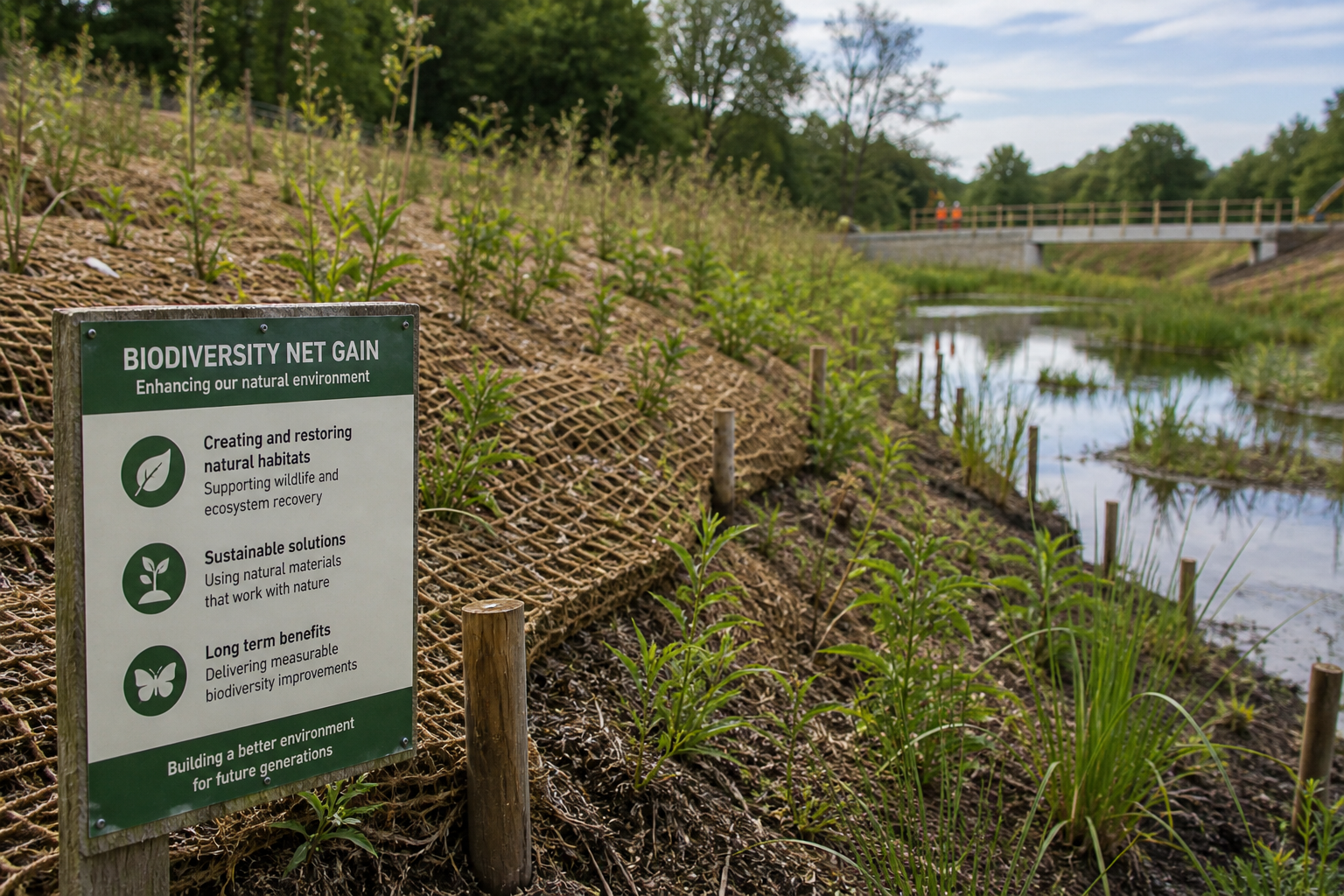
This is particularly relevant during the early stages of habitat establishment. Newly formed embankments, riverbanks, attenuation basins and restoration areas are highly vulnerable during the first months following installation. Without appropriate surface protection, rainfall impact and runoff can strip topsoil, displace seed mixes and undermine vegetation establishment before ecological recovery has had an opportunity to develop.
Effective erosion control is therefore closely linked to successful biodiversity outcomes.
However, the type of erosion control system specified can also influence the quality and resilience of habitat recovery itself.
Increasingly, questions are being raised around the long term ecological implications associated with permanent synthetic materials within sensitive environments. Concerns surrounding microplastic persistence, material fragmentation and ecological compatibility are contributing to wider discussions about how infrastructure projects interact with surrounding ecosystems over time.
At the same time, Biodiversity Net Gain is encouraging a broader shift towards landscape led and nature-based infrastructure approaches.
Natural fibre erosion control systems such as coir netting, coir blankets and coir logs are becoming increasingly relevant within this context. Their ability to stabilise exposed soils while supporting vegetation establishment and gradually integrating into the surrounding environment aligns closely with the wider objectives of habitat restoration and ecological resilience.
Importantly, successful Biodiversity Net Gain delivery is not achieved through planting schemes alone.
Long-term ecological performance depends heavily on whether vegetation can establish successfully, whether soils remain stable during vulnerable recovery phases and whether engineered interventions support natural ecological processes rather than constrain them. Material specification therefore becomes part of a much wider environmental strategy rather than an isolated procurement decision.
This is influencing infrastructure delivery across highways, flood management schemes, river restoration projects, rail corridors and large scale land development sites throughout the UK.
Infrastructure clients and local authorities are increasingly looking for solutions capable of balancing engineering performance with ecological sensitivity and long term environmental stewardship. In many cases, projects that integrate these objectives effectively are likely to become more attractive within future procurement and planning environments.
The wider implication for the geotechnical sector is becoming increasingly clear.
Biodiversity considerations are no longer operating separately from engineering decisions. They are becoming directly interconnected. As environmental accountability continues to evolve, material selection will increasingly influence not only how infrastructure performs technically, but also how successfully landscapes recover ecologically after construction has taken place.
In the years ahead, erosion control systems are unlikely to be judged solely on whether they stabilise ground. They will also be assessed on whether they contribute positively to the long term environmental condition of the landscapes they are designed to protect.