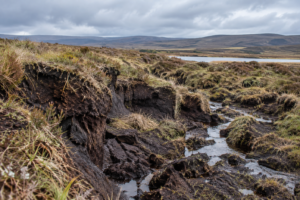
Land restoration projects often begin with ambitious environmental objectives.
Whether the goal is habitat creation, quarry restoration, brownfield regeneration, riverbank recovery or biodiversity enhancement, the end vision is usually similar: a stable, self-sustaining landscape capable of supporting healthy vegetation and ecological function.
In many cases, however, the path to achieving that outcome is less straightforward than expected.
Project teams frequently focus considerable attention on seed selection, planting strategies and habitat design. Whilst these elements are undoubtedly important, successful restoration depends upon something more fundamental.
Vegetation can only thrive when the landscape itself is capable of supporting establishment.
Without adequate surface stability and protection during the earliest stages of recovery, even the most carefully designed restoration schemes can struggle to achieve their intended outcomes.
The assumption That Nature Will Quickly Recover
A common misconception within land restoration is that vegetation alone will stabilise disturbed ground.
In theory, this appears reasonable. Plants develop root systems, reinforce soils, reduce runoff and contribute to long-term landscape resilience. Given sufficient time, healthy vegetation can indeed become one of the most effective forms of erosion control available.
The challenge lies within the phrase “given sufficient time”.
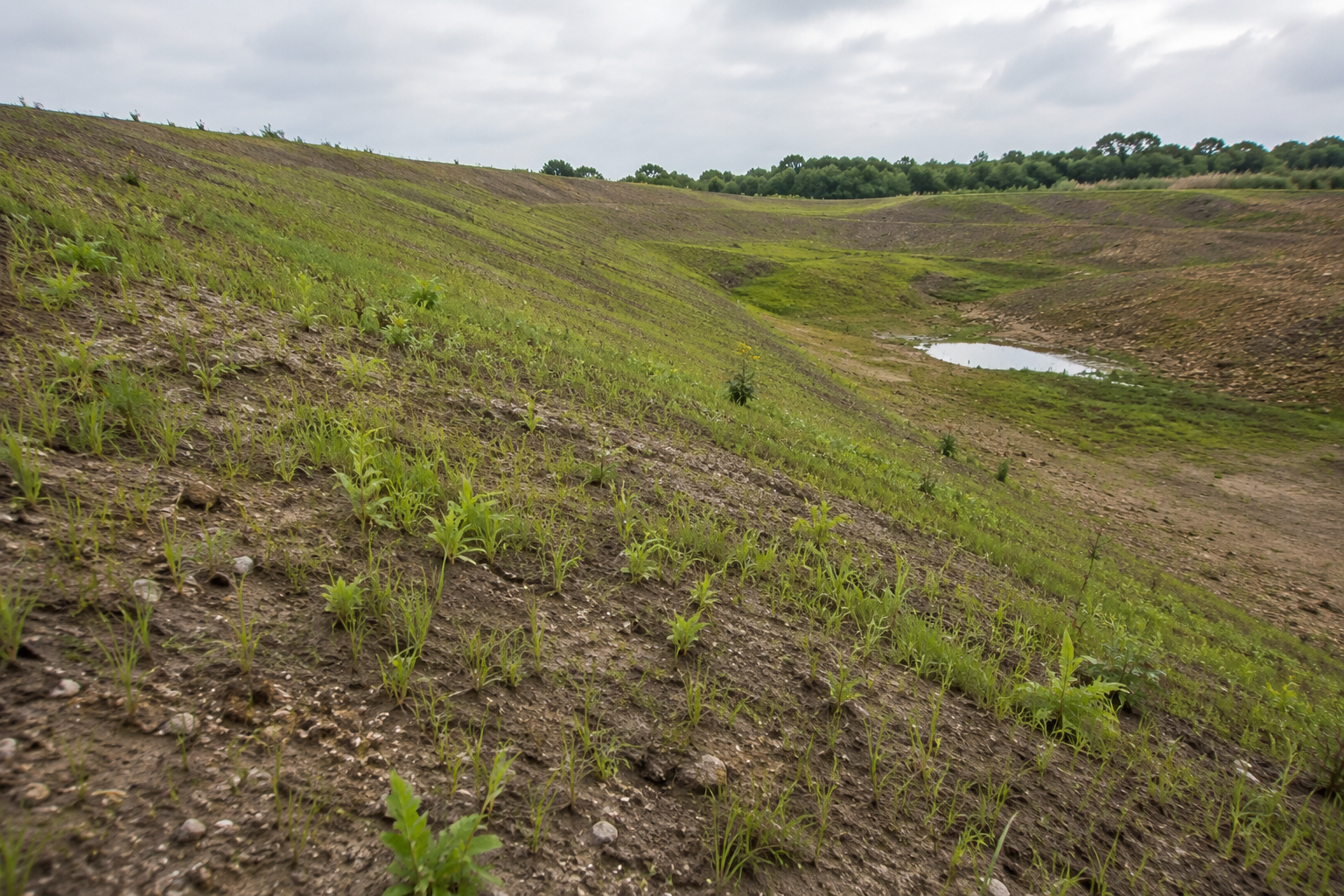
Newly seeded landscapes are often highly vulnerable.
Before root systems develop and vegetation matures, exposed soils remain susceptible to rainfall impact, surface runoff, wind erosion and moisture loss. During this period, the landscape has not yet developed the natural resilience required to protect itself.
The result is a critical gap between project completion and ecological establishment.
It is within this gap that many restoration failures occur.
Understanding common restoration failures
Across a wide range of restoration projects, the causes of failure are often remarkably similar.
Seeded areas may experience poor germination. Newly formed slopes can suffer surface erosion. Rainfall events may remove valuable growing media. Vegetation establishment becomes patchy, inconsistent or delayed.
Whilst these outcomes are often attributed to poor weather conditions, the underlying issue is frequently one of insufficient surface protection during the establishment phase.
Disturbed soils are inherently unstable.
Once exposed, they become vulnerable to erosive forces that can rapidly undo months of restoration effort. The consequences extend beyond aesthetics. Surface degradation can affect vegetation performance, increase maintenance requirements and delay the achievement of wider ecological objectives.
Successful restoration therefore requires more than planting alone.
It requires managing the physical environment during the period when recovery remains most vulnerable.
The problem of seed washout
One of the most common challenges within restoration projects is seed displacement.
Heavy rainfall can mobilise seeds before germination occurs, particularly on exposed slopes and recently graded surfaces. Surface runoff may transport seed mixtures away from intended planting zones, reducing establishment rates and creating uneven vegetation coverage.
This issue is particularly problematic during the first few months following installation when vegetation has not yet developed sufficient root mass to resist erosion.
Once seed loss occurs, recovery becomes increasingly difficult.
Areas with limited vegetation establishment often experience further erosion, creating a cycle of degradation that can require additional intervention and reseeding.
Protecting seed during this critical period is therefore essential to successful restoration.
Surface Erosion: The hidden threat to ecological recovery
Surface erosion is often viewed as a construction issue.
In reality, it remains one of the most significant threats to ecological restoration.
Even relatively minor soil loss can affect restoration performance by removing nutrients, reducing soil depth and disrupting seed establishment. Over time, small areas of erosion can develop into larger zones of instability, particularly on slopes and exposed landforms.
For restoration projects, the consequences are rarely confined to the affected area alone.
Sediment migration may impact drainage systems, nearby watercourses and adjacent habitats. Maintenance costs can increase significantly, whilst project timelines may be extended as remedial works become necessary.
Preventing erosion during the early stages of recovery is therefore considerably more effective than attempting to repair the damage later.
Why moisture retention matters
Successful vegetation establishment depends upon more than soil stability alone.
Moisture availability plays a critical role in germination, root development and plant survival.
Newly restored landscapes frequently experience challenging moisture conditions. Exposed soils can dry rapidly during warm periods, whilst surface runoff may reduce infiltration during rainfall events. Together, these factors can create an environment that is less favourable for vegetation establishment.
Maintaining moisture within the upper soil profile improves the likelihood of successful germination and supports healthier early-stage growth.
This becomes particularly important during the period when plants are developing the root systems that will ultimately provide long-term stability.
The importance of the establishment phase
The establishment phase is arguably the most important stage of any restoration project.
This period, typically covering the first twelve to twenty-four months following installation, determines whether vegetation becomes successfully integrated within the landscape or whether recovery remains vulnerable to ongoing degradation.
Once mature root systems develop, many restoration sites become increasingly self-sustaining. Vegetation begins to reinforce soils naturally, improve infiltration rates and resist erosion without continued intervention.
Before that point is reached, however, temporary protection is often required.
The objective is not to replace natural processes, but to support them until the landscape becomes capable of functioning independently.
This principle underpins many successful land restoration strategies.
Supporting recovery through tatural fibre erosion control systems
Natural fibre erosion control systems are designed specifically to assist during this critical establishment period.
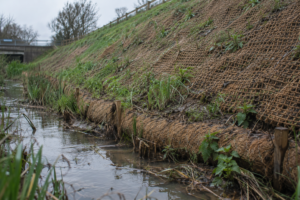
Products such as coir blankets and coir netting provide temporary surface protection whilst allowing vegetation to establish through and around the material. By reducing soil displacement, limiting seed washout and supporting moisture retention, these systems help create more favourable conditions for ecological recovery.
Importantly, they are intended to work alongside natural processes rather than compete with them.
As vegetation develops and root structures strengthen, the role of the erosion control system gradually diminishes. The landscape increasingly assumes responsibility for its own stability, creating a transition from engineered support to natural resilience.
For many restoration projects, this represents an effective balance between short-term performance and long-term environmental integration.
Looking beyond planting
Successful land restoration involves considerably more than selecting the correct seed mix.
The most effective projects recognise that ecological recovery depends upon both biological and physical processes working together. Vegetation establishment is essential, but it cannot succeed consistently where soils remain unstable, moisture is lost and erosion continues unchecked.
Before habitats can flourish, the landscape must first be given the opportunity to recover.
Engineering that supports this recovery during its earliest stages often determines whether restoration objectives are achieved efficiently or remain vulnerable to repeated intervention.
Vegetation is ultimately what transforms a landscape.
However, in many cases, it is the temporary measures implemented beforehand that make that transformation possible.