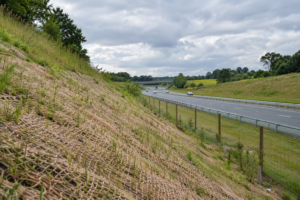
Erosion on an embankment is easy to see. The cause of it is not always quite so obvious.
After prolonged rainfall, attention naturally turns to what is happening at the surface: bare soil, rilling, displaced material or vegetation beginning to fail. Yet on some slopes, these are symptoms of a problem developing within the ground itself.
Water does more than run over a slope. It infiltrates it.
Understanding that distinction matters when deciding how an embankment or cutting should be protected.
When the ground becomes saturated
The behaviour of a slope can change considerably as its moisture content increases.
During prolonged or repeated rainfall, water infiltrating the soil may create saturated areas, emerge as seepage or accumulate where drainage is restricted. Ground close to the toe can soften, whilst isolated wet areas may begin to lose vegetation or show signs of surface movement.
These conditions should not automatically be treated as conventional surface erosion.
Installing erosion protection over visibly damaged ground may protect against further surface loss, but it will not address excessive groundwater, inadequate drainage or an underlying stability problem.
The first task is therefore diagnosis.
Where is the water coming from? Is it travelling across the surface, through the soil, or both? Is there evidence of persistent seepage? Has drainage become blocked? Is material being eroded by runoff, or is movement occurring because the ground itself has become excessively wet?
Those questions should come before material selection.
The toe deserves particular attention
The lower part of a slope can often provide useful clues.
Runoff naturally reaches the toe, but subsurface water may also emerge there. Localised erosion can then remove soil and vegetation, creating further routes for water and sediment movement.
This is also where different forms of natural-fibre erosion control can perform quite different functions.
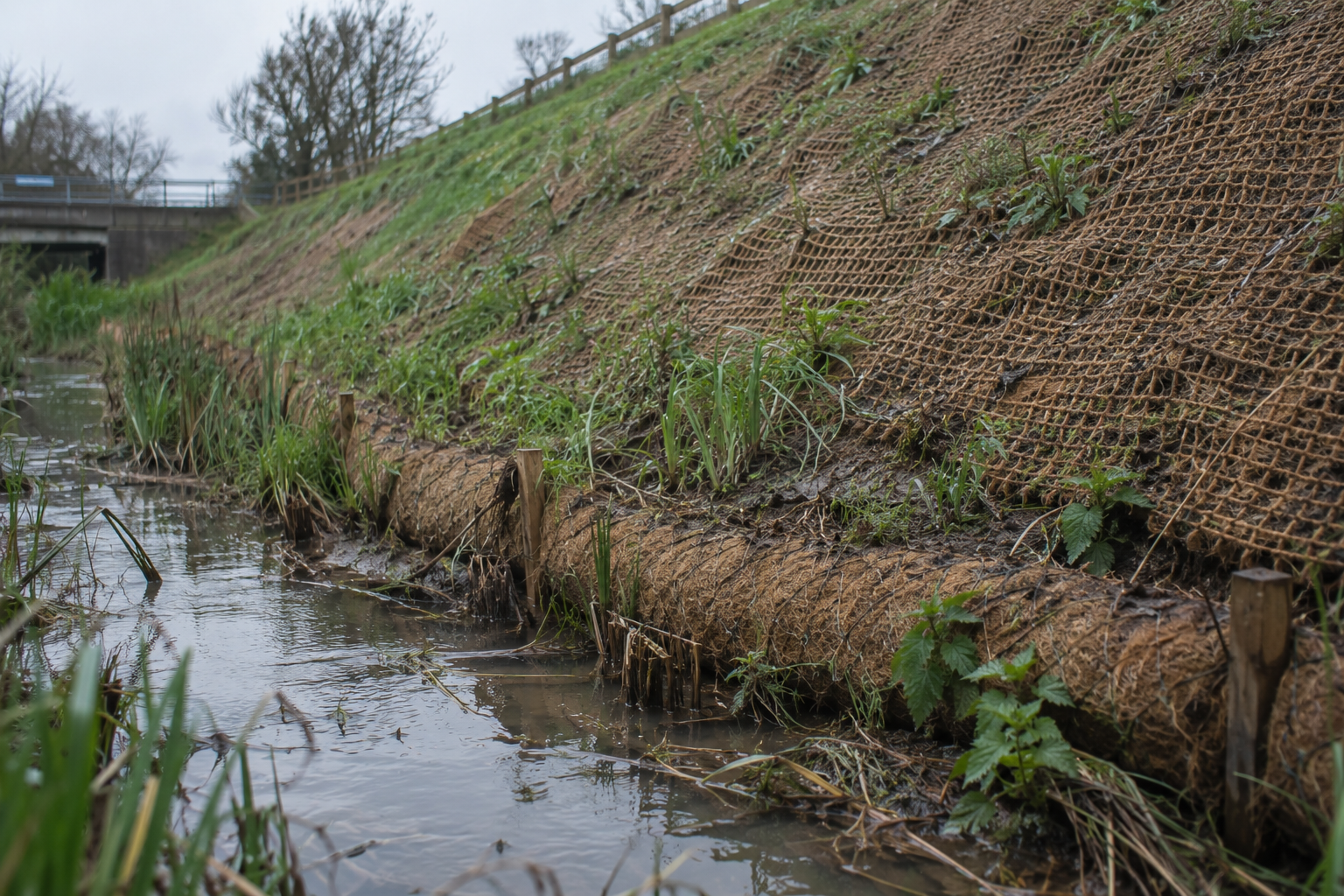
On suitable slopes, coir netting can protect exposed soil against surface erosion whilst allowing vegetation to establish through its open structure. Rather than creating a permanent artificial covering, the netting provides temporary reinforcement during the period when the soil is most vulnerable.
In appropriate water-management and restoration applications, coir logs can perform another role. Installed along vulnerable margins, toes or selected flow interfaces, they can help intercept sediment, reduce localised erosion and create conditions in which vegetation can establish.
Neither should be treated as a substitute for correctly designed drainage. Their value lies in being used as part of the wider solution.
Vegetation is part of the engineering response
Vegetation is more than the final landscaping treatment on an earthwork.
Uneven growth, persistent bare areas or vegetation repeatedly failing in the same location can indicate differences in moisture, runoff or soil conditions. Successfully established vegetation, meanwhile, provides increasingly effective natural surface protection as roots develop.
This establishment period is precisely where natural-fibre systems can add value.
At SALIKE®, our coir netting is available in different weights and configurations because erosion risk is not uniform from one site to another. Coir logs likewise need to be considered in relation to site geometry, water conditions, installation and the function they are expected to perform.
As Shiran Amunugama, Managing Director of SALIKE®, puts it: “The important question is not simply how we protect the soil, but why that soil is becoming vulnerable in the first place.”
Treat the cause, then protect the surface
Good erosion control begins by understanding the mechanism.
Where rainfall impact and surface runoff are responsible, coir netting may provide valuable surface protection. Where vulnerable toes, margins or particular water interfaces need protection, coir logs may form part of the response. Where saturation, seepage or ground instability is the underlying issue, however, the engineering solution must begin there.
This distinction is central to SALIKE®’s approach.
Natural materials have considerable potential within modern erosion control and geotechnical projects. Their strongest applications are not found by starting with the product.
They are found by understanding the ground, the water and what the site actually needs.