For a road earthworks package, practical completion is an important milestone. For the embankment itself, however, it is really only the beginning.
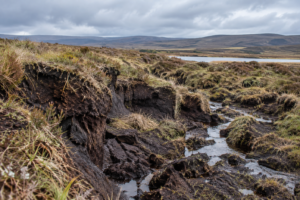
A newly formed slope continues to change long after the earthworks contractor has left site. Soil settles. Rainfall tests the surface. Runoff begins to find preferred routes. Vegetation establishes unevenly and, in some areas, may not establish at all.
This is why erosion protection should not simply be regarded as something required to get an embankment through construction. It needs to support the slope through the vulnerable period between completed earthworks and established vegetation.
The months after construction matter
A freshly constructed road embankment can look remarkably stable on the day it is handed over. The difficulty is that its appearance in dry weather tells us relatively little about how the surface will respond to several months of British weather.
Heavy rainfall can detach exposed soil particles and create rilling across a slope. More importantly, water rarely behaves uniformly. Small variations in levels, compaction or drainage can concentrate runoff into particular areas.
Once a flow path begins to develop, what starts as minor surface erosion can become progressively more difficult to manage.
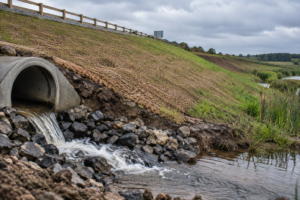
The consequences are not confined to the slope itself. Mobilised sediment can enter drainage channels, culverts and attenuation systems, creating additional maintenance requirements elsewhere within the highway asset.
Hydroseeding is not erosion protection on day one
Vegetation is one of the most effective long-term forms of surface protection available to an embankment, but it needs time to become effective.
Hydroseeding or conventional seeding does not immediately create a reinforced surface. Germination and root development depend upon moisture, temperature, soil conditions and the season in which the work is undertaken.
There is therefore an important establishment window when the soil remains vulnerable.
If significant rainfall occurs during this period, seed and fine soil can be displaced before roots have developed sufficiently to hold the surface together. Poor establishment can then leave isolated bare areas which remain susceptible to erosion long after the remainder of the slope has vegetated.
This is where temporary erosion control deserves greater consideration at the design stage.
Designing for establishment, not simply installation
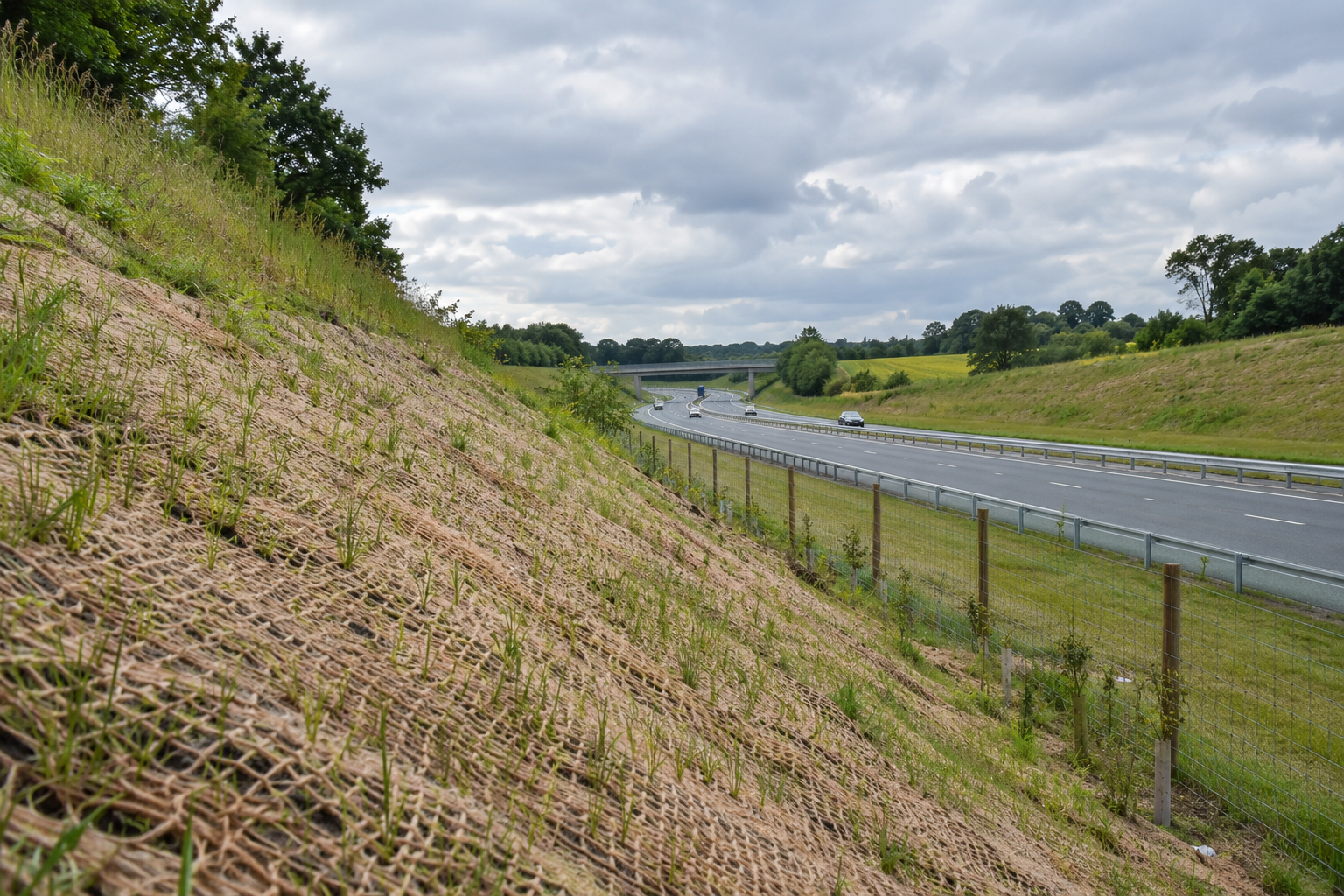
Natural-fibre erosion control systems can provide immediate surface protection whilst vegetation becomes established.
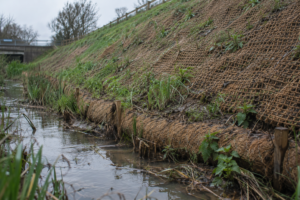
Depending upon the slope, soil and hydraulic conditions, this may include coir netting, erosion control blankets or jute geotextiles installed directly over prepared and seeded ground.
Rather than replacing vegetation, these systems work alongside it.
They help protect the soil surface from rainfall impact, reduce the movement of loose material and provide a more stable environment for vegetation to establish through the structure. Natural fibres can then progressively weather as the vegetation and root system assume the longer-term stabilising role.
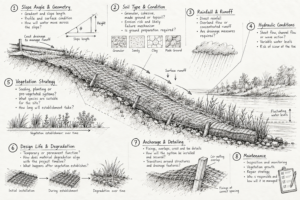
The appropriate solution, however, should always follow the site conditions. Gradient, soil characteristics, expected runoff, drainage arrangements, vegetation strategy and required design life all need consideration. Specifying a heavier product simply because it appears more robust is not necessarily good engineering.
Who owns the slope after handover?
There is also a practical question that is sometimes overlooked: responsibility.
When erosion appears several months after practical completion, is it an earthworks defect, a landscaping issue, a drainage problem or an asset maintenance matter?
By that stage, several parties may have moved on.
A better approach is to consider the establishment period from the outset. Designers, contractors and landscape teams should understand how the slope will be protected immediately after construction, how vegetation will establish and what inspection or remedial work may be required during the first seasons.
At SALIKE®, we believe road embankments should be treated as evolving assets rather than finished surfaces. Our work with natural-fibre erosion control systems is centred on that principle: combining engineering requirements with materials that can support vegetation and become part of the landscape rather than remaining separate from it.
Because successful erosion control is not simply about how a slope looks when the project is handed over.
It is about how it performs when the weather arrives.