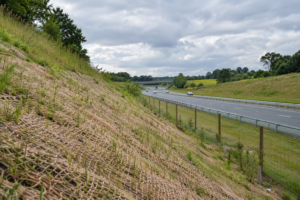
There is a tendency in erosion control to begin with the material.
Should it be coir netting? An erosion control blanket? A heavier geotextile? Something permanent?
For engineers and specifiers, there is a more useful place to start: what is the ground actually being protected from, and for how long?
An effective erosion control specification should follow the site conditions and anticipated failure mechanism. The product comes afterwards.
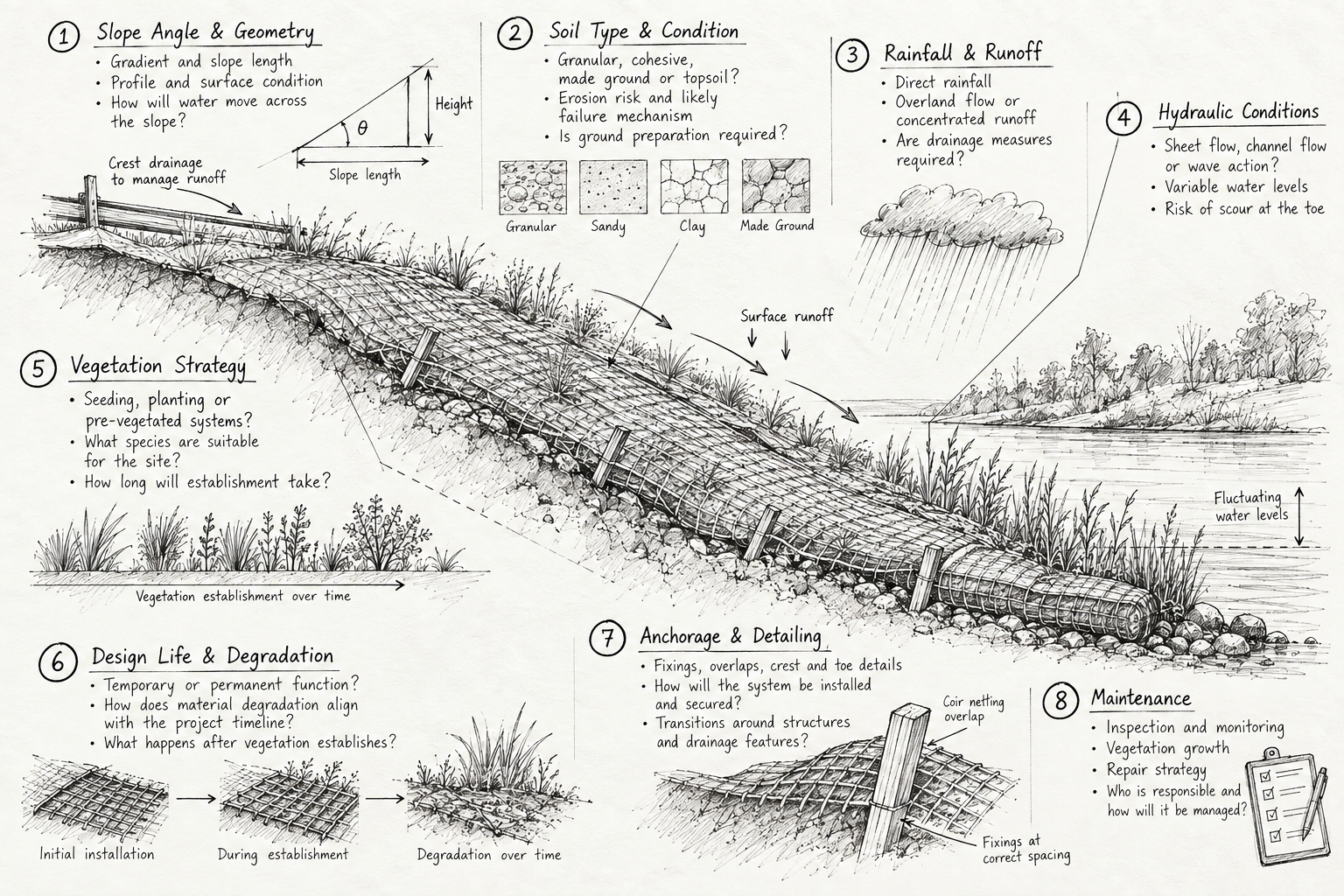
Start with the slope
Slope angle is an obvious consideration, but gradient alone tells us relatively little.
A moderate slope receiving concentrated runoff may present a greater erosion risk than a considerably steeper slope with well-managed drainage. Length, profile, surface preparation and changes in gradient can all influence how water behaves.
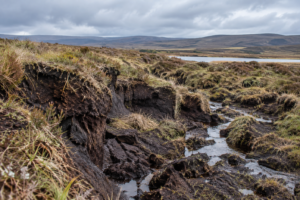
Soil matters just as much. A granular surface, cohesive clay, made ground and newly placed topsoil will respond differently to rainfall, runoff and drying.
Before developing a slope erosion design, the designer needs to understand what is actually exposed.
Where is the water coming from?
Rainfall is only part of the question.
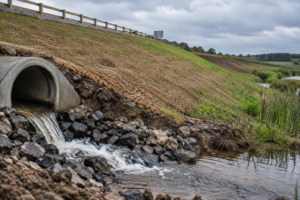
Is water falling directly onto the slope? Is runoff arriving from the crest? Are drainage outlets creating concentrated flows? Could seepage or saturation be involved? Is there flowing water at the toe?
These distinctions matter because erosion caused by rainfall impact and shallow surface runoff is very different from scour associated with concentrated or sustained flow.
No geotextile specification should be expected to compensate for an unresolved drainage problem.
What happens before the vegetation establishes?
This is one of the most important questions in natural-fibre erosion control.
A specification may show a fully vegetated slope as the finished condition, but the ground must first survive the weeks and months required to reach it.
That establishment period is often when the surface is most vulnerable.
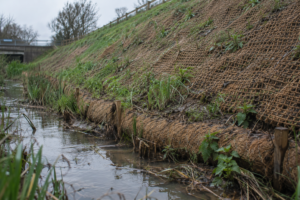
Where conditions are appropriate, coir netting can provide temporary surface protection whilst allowing seeded vegetation to develop through its open structure. The appropriate netting specification should then be considered against slope geometry, soil conditions, anticipated erosion forces and the required establishment period.
The objective is not simply to cover the soil. It is to create the conditions in which the intended vegetation strategy has a realistic opportunity to succeed.
Design life and degradation should be considered together
Natural-fibre systems introduce another important specification question: how long does the intervention actually need to perform?
Permanent synthetic reinforcement may be entirely appropriate where a permanent engineering function is required. Equally, leaving a persistent material in the ground can be unnecessary where its principal purpose is to protect the surface until vegetation becomes established.
With coir and other natural-fibre systems, degradation should therefore not be regarded simply as a material limitation. In the correct application, it can form part of the design philosophy.
The required functional period, anticipated vegetation establishment and eventual degradation of the material should be considered as one system.
Anchorage is part of the system
Even a correctly selected material can perform poorly if installation is treated as an afterthought.
Ground contact, crest detailing, overlaps, anchorage spacing, transitions and treatment around drainage features all influence performance.
This becomes particularly important when specifying coir netting on longer or steeper slopes. A drawing that simply states “install erosion control matting” leaves a considerable amount unresolved.
Maintenance should also be considered before installation rather than after failure. Who inspects the slope after significant rainfall? What happens if vegetation establishes unevenly? How are damaged areas repaired? Who retains responsibility during the establishment period?
These are specification questions, not merely maintenance questions.
Specification before product
At SALIKE®, we believe the strongest erosion control solutions begin before a particular product is selected.
Slope angle. Soil. Rainfall. Hydraulics. Vegetation. Establishment period. Design life. Anchorage. Degradation. Maintenance.
Taken together, these factors provide a much better basis for selecting an erosion control system than starting with a product category.
Coir netting, erosion control blankets and coir logs all have valuable applications. They also have limits. Understanding both is part of responsible specification.
For engineers, consultants and contractors, perhaps the most useful question is therefore not:
“Which erosion control product should we use?”
It is:
“What does this site need the erosion control system to do?”
Once that is understood, the product decision becomes considerably clearer.