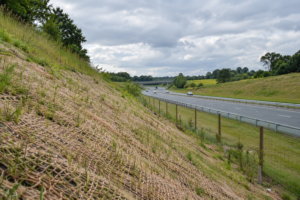
Drainage is designed to manage water. Yet on many earthworks, it is the journey towards the drainage system and what happens when water leaves it, that creates the erosion problem.
A highway embankment, railway cutting or development slope may have perfectly adequate drainage capacity on paper. But rainfall does not arrive conveniently at a channel or carrier drain. It falls across the entire surface, gathers momentum, follows small variations in level and eventually concentrates into preferred flow paths.
That transition from dispersed rainfall to concentrated runoff is where apparently minor surface erosion can become an engineering and maintenance issue.
Water will find its own route
Freshly formed earthworks are particularly susceptible.
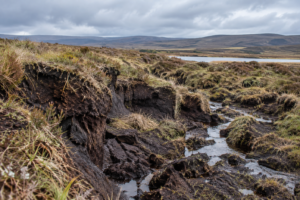
Before vegetation was established, exposed soil had relatively little protection against rainfall impact and surface runoff. Even shallow flows can begin moving fine particles down slope. Once a small depression develops, subsequent rainfall tends to follow it.
A faint line across a slope becomes a rill. The rill carries more water, which removes more soil, and the process continues.
The drainage infrastructure itself may be functioning exactly as intended. The problem is occurring before the water reaches it.
This is why erosion control and drainage design should not be considered entirely separate disciplines.
The difficult areas are often the transitions
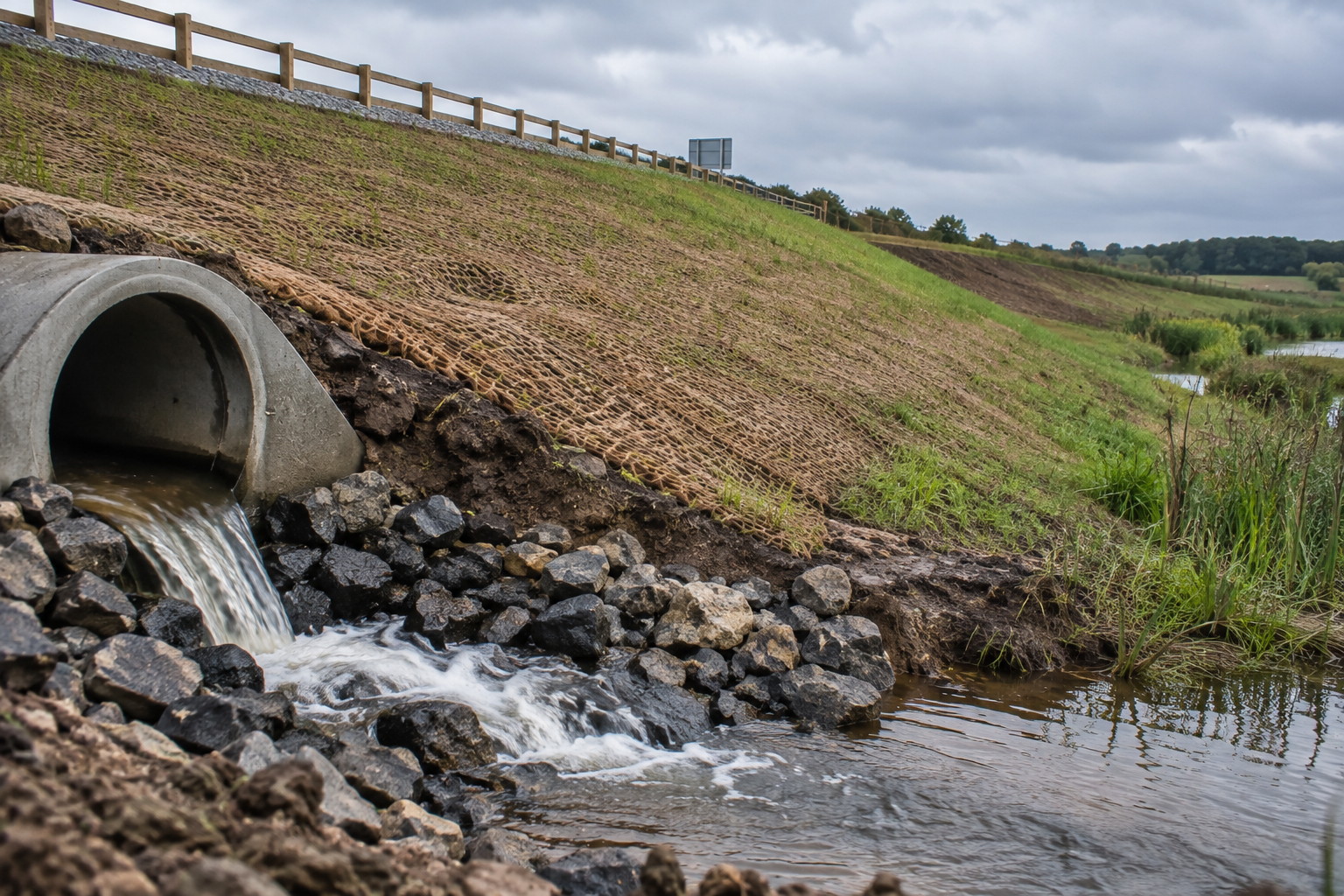
Drainage outlets provide another familiar example.
Water that has been collected safely across a site can become highly erosive when it is discharged onto an unprotected surface. The same can occur beside channels, around headwalls, at the toe of an embankment or where a hard drainage structure meets softer ground.
These relatively small interfaces can become disproportionately troublesome.
Localised scour may undermine surrounding soil. Sediment can subsequently enter channels, gullies, culverts and attenuation systems, creating maintenance requirements well beyond the original point of erosion.
Simply repairing the damaged soil rarely solves the problem if the flow mechanism remains unchanged.
Vegetation helps but not immediately
Established vegetation can provide excellent long-term surface protection. Root systems reinforce the upper soil profile whilst stems and foliage reduce the direct impact of rainfall.
The difficulty lies in getting there.
Hydroseeding a slope does not make it erosion-resistant overnight. There is an establishment period during which seed, topsoil and young vegetation remain vulnerable, particularly where runoff is already becoming concentrated.
Temporary surface protection can therefore have an important role.
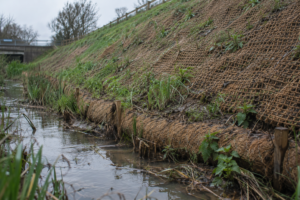
Depending upon gradient, soil conditions and anticipated flows, coir netting, natural-fibre erosion control blankets and coir logs can help protect vulnerable soil whilst vegetation develops. Rather than replacing planting, these systems can provide the transitional protection needed for it to succeed.
But there is an important distinction.
An erosion control blanket cannot correct inadequate drainage.
Where significant concentrated flows are present, the first question must be why the water is there and whether it should be intercepted, diverted or conveyed differently. Surface protection should form part of the engineering response, not disguise a hydraulic problem.
Look beyond the drain
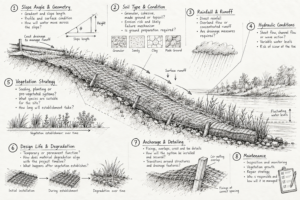
Good erosion control begins with understanding how water behaves across the whole earthwork.
Where does rainfall collect? Where does sheet flow become concentrated? What happens at changes in gradient? Where is water discharged? And what condition will the surface be in before vegetation has properly established?
At SALIKE®, our approach to natural-fibre erosion control starts with these questions. Coir and jute systems have an important place within sustainable earthworks, but their value comes from specifying them in response to the conditions on site rather than treating them as a universal solution.
Drainage design may determine where water should go.
Successful erosion control also considers how it gets there.