Peatland restoration is often discussed in terms of ecology, carbon and biodiversity. All are important. But anyone who has worked on badly degraded peat knows that there is another side to the problem: engineering.
Once peat becomes exposed and erosion becomes established, simply introducing vegetation is unlikely to address the underlying problem. Water movement, surface stability, erosion channels and the condition of the remaining peat all influence whether restoration succeeds.
In that respect, degraded peatland presents many of the same questions encountered elsewhere in geotechnical and erosion control work: how is water moving, where is material being lost, what is protecting the exposed surface, and how can vegetation become established without being washed away?
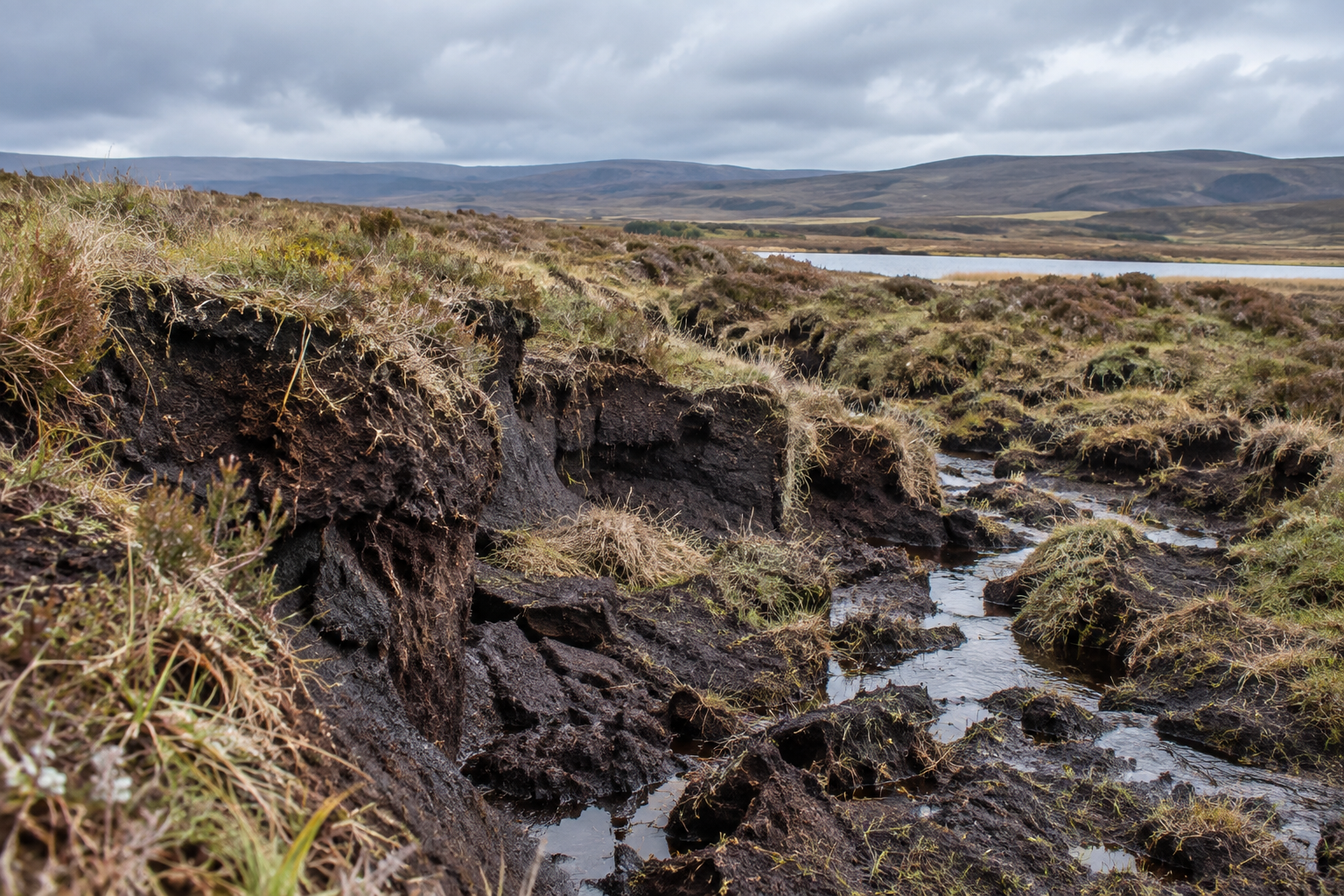
Exposed peat can deteriorate remarkably quickly
Healthy peatland relies upon wet conditions and vegetation cover. When that protective surface is damaged, exposed peat becomes vulnerable to weathering and erosion.
Rainfall can mobilise loose material, whilst concentrated flows begin to enlarge existing channels. Gullies deepen, peat haggs become increasingly exposed and bare surfaces can expand.
Wind can contribute further erosion during dry periods.
The difficulty is that these processes can reinforce one another. Loss of vegetation exposes more peat; erosion alters drainage; altered drainage can encourage further drying; and a drier, less stable surface becomes progressively more difficult to revegetate.
Restoration therefore needs to address the physical processes as well as the ecological outcome.
Hydrology comes first
Perhaps the most important consideration in peatland restoration is water.
Where historic drainage, erosion channels or artificial grips continue to remove water from the landscape, treating an isolated patch of exposed peat may achieve relatively little.
Restoration programmes increasingly seek to slow water movement and raise water levels through measures such as drain blocking, gully interventions, reprofiling and other forms of rewetting.
But slowing the water does not automatically stabilise every exposed surface.
Bare peat may still require protection whilst vegetation recovers. Steeper haggs and gully sides can remain vulnerable to rainfall impact and localised flows, particularly during the early stages of restoration.
Understanding where water is coming from, where it is travelling and what happens during significant rainfall should therefore influence the erosion control strategy.
Re-vegetation needs a stable surface
Vegetation ultimately provides one of the most valuable forms of long-term surface protection, but establishment takes time.
This creates a familiar engineering problem: protecting a vulnerable substrate during the period before vegetation can perform that role itself.
Depending upon site conditions, natural-fibre materials such as coir netting, coir logs, erosion control blankets and jute systems can form part of this transitional protection.
Their purpose is not to engineer peatland into a rigid landscape. Quite the opposite.
Used appropriately, natural-fibre systems can help retain loose surface material, reduce localised erosion and provide physical support during vegetation establishment. The fibres gradually weather whilst the recovering vegetation assumes a greater role in protecting the surface.
There is, however, no universal specification for degraded peat.
Flow conditions, peat depth, gradient, degree of erosion, anchoring conditions, restoration technique and vegetation strategy all matter. A solution suitable for a relatively sheltered exposed surface may be entirely inappropriate within an actively eroding gully.
Working with the landscape
The most effective peatland restoration schemes recognise that water, soil and vegetation cannot be treated separately.
A geotechnical approach does not mean imposing hard engineering upon a sensitive environment. It means understanding the physical behaviour of the site well enough to intervene intelligently and, where possible, using materials that support rather than compete with natural recovery.
At SALIKE®, this principle sits at the heart of our approach to natural-fibre erosion control. We work with coir and jute systems intended to provide practical surface protection whilst allowing vegetation and natural processes to become the longer term solution.
Peatland restoration ultimately succeeds when the landscape begins to function again.
Getting there requires more than putting plants back.
It requires understanding the ground beneath them, the water moving through it and the erosion taking place in between.