When vegetation is discussed on infrastructure projects, it is often viewed through an environmental lens. It contributes to biodiversity, improves visual appearance and supports habitat creation. All of these benefits are important, but they represent only part of the picture.
For engineers, vegetation has another, often overlooked, role.
It is an active component of infrastructure performance.
Healthy vegetation influences how water moves across a slope, how soil behaves during heavy rainfall and how exposed surfaces respond to weather over time. In many situations, it becomes one of the most effective natural forms of reinforcement available, working continuously throughout the life of an asset without mechanical intervention.
As infrastructure continues to face increasing pressure from more frequent rainfall and changing climatic conditions, understanding the engineering value of vegetation has never been more important.
More than a green surface
A well-vegetated embankment is far more than an area covered in grass or wildflowers.
Beneath the surface lies an extensive network of roots that binds soil particles together, increasing resistance to erosion and improving the stability of the upper soil layer. Whilst root systems are not a substitute for structural engineering, they provide valuable reinforcement where surface soils are most vulnerable to rainfall and runoff.
This natural strengthening effect develops gradually as vegetation becomes established, creating a living layer of protection that continues to evolve over time.
In many respects, vegetation should be viewed as part of the engineering solution rather than simply the finished appearance of a project.
The first line of defence against rainfall
Every rainfall event begins at the surface.
Before water reaches the soil, vegetation intercepts a proportion of that rainfall through leaves and stems, reducing the energy with which raindrops strike the ground. This seemingly simple process helps minimise the detachment of fine soil particles that often marks the beginning of surface erosion.
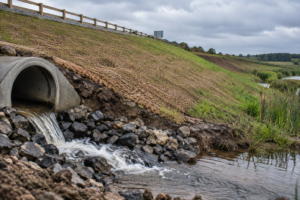
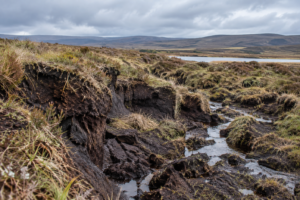
Where vegetation is sparse or absent, exposed soils receive the full impact of rainfall. Over time, repeated rainfall can loosen surface material, initiate shallow erosion channels and gradually remove valuable topsoil.
By reducing this initial impact, healthy vegetation provides an important layer of natural protection long before engineered drainage systems begin carrying water away.
Strengthening the soil naturally
Soil strength depends upon many factors, including moisture content, soil type and compaction. Vegetation contributes by reinforcing the upper soil profile through an interconnected network of roots that helps improve cohesion within the surface layer.
This reinforcement does not eliminate every risk associated with slope stability, but it significantly improves the soil’s ability to resist minor movement and surface erosion.
The result is a landscape that becomes increasingly resilient as vegetation matures.
It is one of the few engineering systems that continues improving long after installation.
Commenting on the role of vegetation within modern infrastructure, Shiran Amunugama, Managing Director of SALIKE®, said:
“Vegetation is often considered the finishing touch once construction is complete. In reality, it should be viewed as part of the engineering strategy from the outset. Healthy vegetation protects soil, manages water and contributes to the long-term resilience of infrastructure in ways that are easy to overlook, yet incredibly valuable.”
Managing water below the surface
The engineering benefits of vegetation extend beyond what can be seen.
Through the natural process of evapotranspiration, plants absorb moisture from the soil and release water vapour back into the atmosphere. This helps regulate soil moisture, reducing prolonged saturation that can weaken the upper soil profile and increase susceptibility to erosion.
Whilst vegetation alone cannot resolve every drainage challenge, it forms an important part of a wider approach to water management alongside well-designed drainage systems and appropriate earthworks.
Together, these elements help create slopes that perform more consistently throughout changing seasons.
Long-term resilience begins with establishment
Perhaps the greatest engineering value of vegetation is that it becomes stronger with time.
Unlike many construction materials that gradually deteriorate, healthy vegetation develops more extensive root systems, improves soil structure and enhances the natural resilience of the landscape as it matures.
This is why the period immediately following construction is so important. Protecting newly seeded slopes during their establishment phase allows vegetation to develop into the long-term stabilising system it is intended to become.
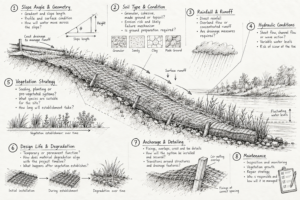
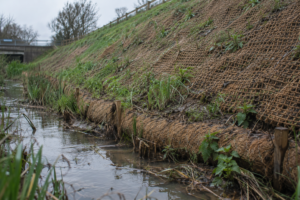
Temporary biodegradable erosion control systems, including coir netting, erosion control blankets and jute geotextiles, play an important role by protecting exposed soils whilst vegetation establishes naturally. Once healthy root systems have developed, the landscape increasingly relies on nature itself to provide ongoing reinforcement.
Looking at vegetation differently
As engineering continues to embrace more sustainable approaches to infrastructure delivery, vegetation deserves greater recognition as an engineering asset in its own right.
It reinforces soil, reduces the impact of rainfall, helps regulate moisture and contributes to the long-term stability of slopes and embankments. These are not simply environmental benefits; they are engineering functions that influence the performance of infrastructure throughout its life.
Perhaps it is time we stopped thinking of vegetation as the final stage of a project.
Instead, we should recognise it for what it truly is: one of the most effective and enduring engineering systems nature has to offer.