Riverbank engineering is undergoing a significant transformation.
For many years, river management strategies across the UK focused predominantly on hydraulic control and structural reinforcement. Concrete walls, steel sheet piling, riprap armouring and heavily engineered flood channels became standard responses to erosion, instability and flood risk in both urban and rural environments.
While these systems continue to play an important role in protecting critical infrastructure and high risk locations, the wider industry is increasingly recognising that long term river resilience cannot be achieved through structural intervention alone.
Rivers are dynamic natural systems.
Water levels fluctuate, sediment moves continuously and riverbanks evolve over time in response to hydrological pressure, vegetation growth and climatic conditions. Attempts to completely suppress these natural processes often create secondary challenges elsewhere within the river system, including downstream erosion transfer, habitat degradation and increased maintenance liabilities over the long term.
As climate pressures intensify and environmental expectations continue to evolve, riverbank engineering is moving towards more adaptive and ecologically integrated approaches.
This shift is being influenced by several factors simultaneously.
More extreme rainfall events and changing flood patterns are increasing pressure on river corridors across the country. At the same time, Biodiversity Net Gain requirements, habitat restoration initiatives and watercourse enhancement programmes are placing greater emphasis on ecological sensitivity within infrastructure and flood management projects.
Public expectations are evolving as well.
Communities increasingly expect rivers and waterways to function not only as engineered drainage assets, but also as ecological and recreational environments that contribute positively to landscape quality, biodiversity and local wellbeing. As a result, highly rigid and visually intrusive engineering interventions are often facing greater scrutiny during planning, consultation and project delivery stages.
This changing landscape is influencing how riverbank stabilisation solutions are being designed and specified.
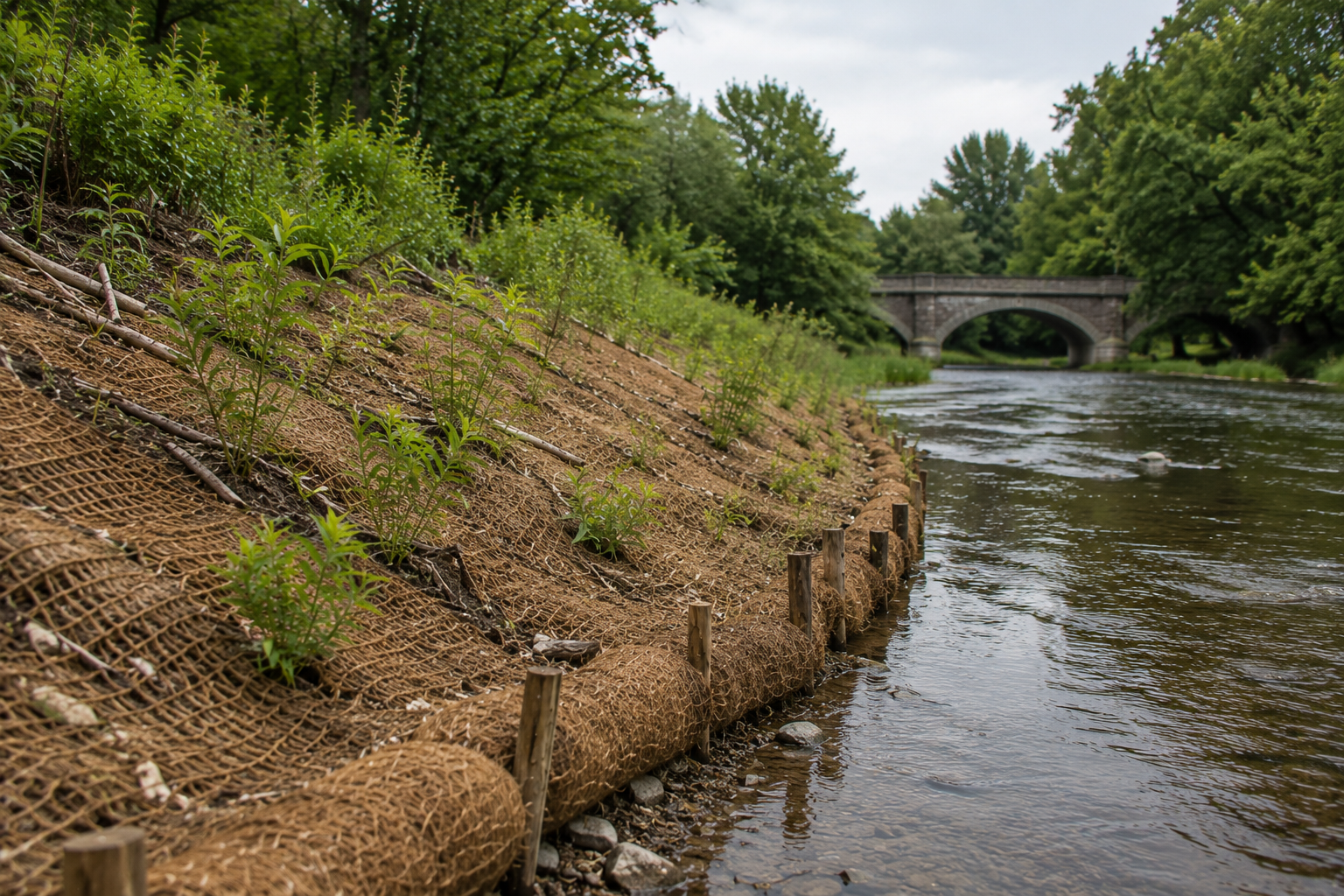
Natural fibre erosion control systems such as coir netting, coir blankets and coir logs are becoming increasingly common within river restoration and bank stabilisation projects. These systems help protect vulnerable soils during early establishment phases while supporting vegetation growth and allowing riverbanks to integrate more naturally into surrounding ecosystems over time.
Importantly, vegetation itself performs a substantial engineering role within riverbank environments.
Established root systems help reinforce soils, reduce surface erosion and improve resistance to hydraulic scour. Vegetated banks can also contribute to slower runoff velocities, sediment retention and wider ecological enhancement across river corridors. In many applications, combining engineered protection with long term vegetation establishment creates a more resilient and environmentally balanced outcome than rigid armouring solutions alone.
This does not mean hard engineering solutions are becoming obsolete.
Certain high energy hydraulic environments and critical infrastructure locations will continue to require robust structural interventions. However, the wider sector is increasingly recognising that engineering resilience and ecological sensitivity do not need to operate in opposition to one another.
The future of riverbank engineering is likely to involve a far more integrated balance between structural stability, environmental performance and long term landscape adaptability.
For infrastructure owners, local authorities and environmental planners, this represents a broader shift in how success itself is measured. Increasingly, projects are being evaluated not only on whether they prevent erosion, but also on how effectively they contribute to ecological recovery, visual integration and long term environmental stewardship.
River engineering is therefore no longer solely about controlling water movement. It is increasingly about understanding how infrastructure, ecology and public expectation can coexist within the same landscape.
As climate resilience and environmental accountability continue to shape the future of infrastructure delivery, riverbank engineering is becoming as much about working with natural systems as it is about protecting against them.