Sustainability has become one of the most widely used terms within the construction and infrastructure sectors. Across product literature, tender submissions and corporate reporting, environmental language now appears almost everywhere.
Yet within geotechnical engineering and erosion control particularly, an important distinction is beginning to emerge between sustainability as a marketing exercise and sustainability as an engineering principle.
The difference matters.
As infrastructure projects face growing scrutiny around carbon emissions, biodiversity impact and long-term environmental performance, superficial environmental claims are becoming increasingly difficult to justify. Clients, consultants and procurement teams are beginning to demand greater transparency around how products are manufactured, how they perform over their lifecycle and what environmental legacy they leave behind once their functional role is complete.
For the wider geotechnical sector, this represents a significant shift in accountability.
Historically, many erosion control and ground stabilisation systems were specified primarily around short term performance criteria such as tensile strength, installation speed and upfront cost efficiency. Environmental considerations, where included at all, often remained secondary to engineering functionality.
Today, that position is evolving rapidly.
Net Zero commitments, Biodiversity Net Gain requirements and ESG-driven procurement frameworks are placing increasing pressure on infrastructure stakeholders to demonstrate measurable environmental responsibility throughout project delivery. In this environment, sustainability claims unsupported by genuine lifecycle thinking are unlikely to withstand long term scrutiny.
This is particularly relevant in relation to material selection.
Many conventional synthetic erosion control systems are derived from petrochemical based polymers designed to remain within the environment indefinitely. While these systems may provide certain technical advantages in specific applications, questions are increasingly being raised around embodied carbon, disposal implications, microplastic persistence and long-term ecological compatibility.
At the same time, not every product marketed as “natural” or “eco-friendly” necessarily delivers meaningful sustainability benefits either.
Genuine sustainability within geotechnical engineering requires a more balanced and evidence led approach. It involves understanding not only how a material performs technically, but also how appropriately that performance aligns with the actual engineering requirement, environmental context and lifecycle duration of the project itself.
This is where natural fibre erosion control systems are increasingly attracting attention within infrastructure delivery.
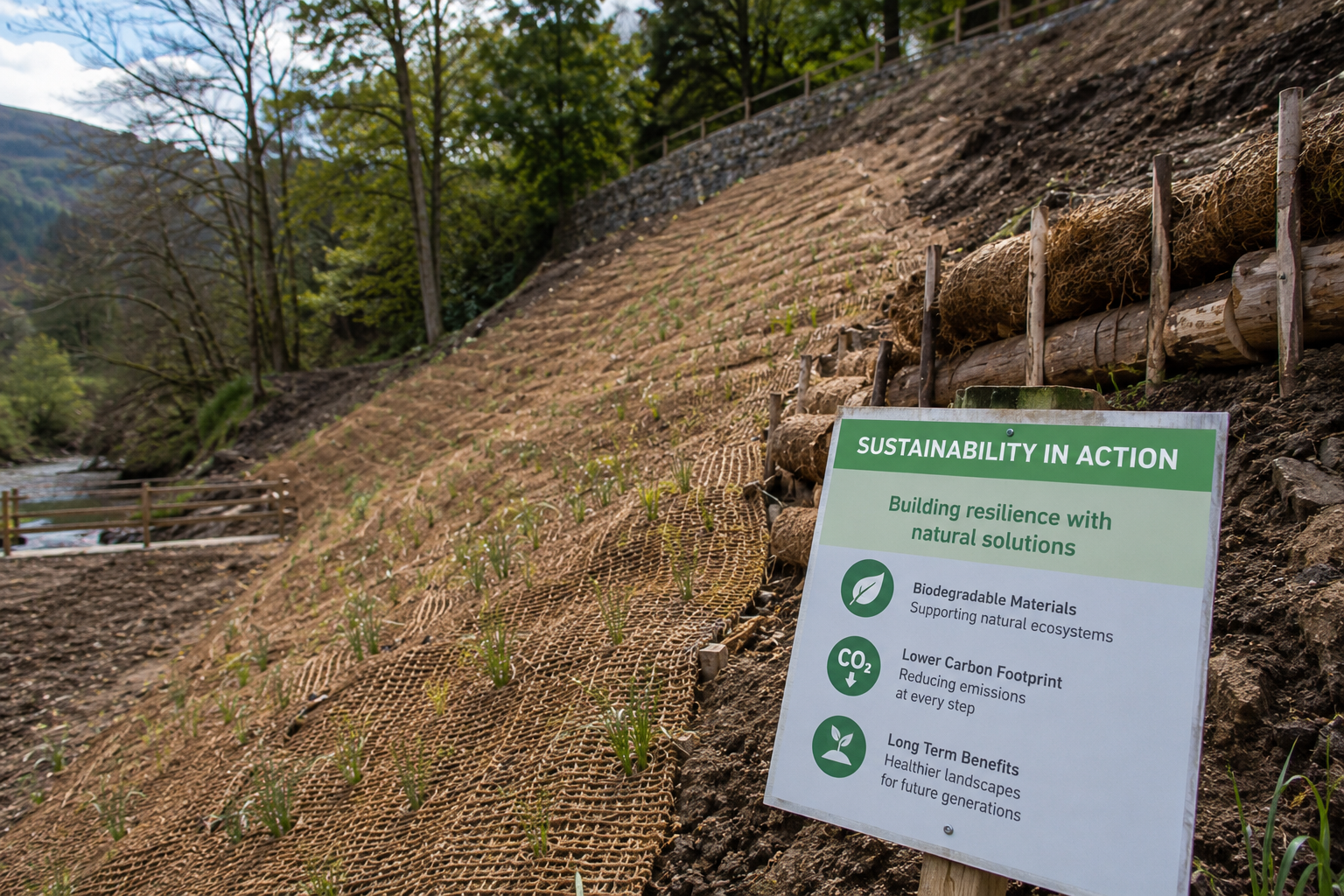
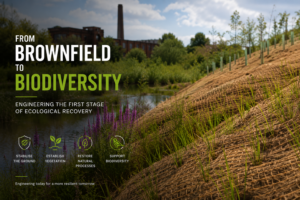
When appropriately specified, coir based erosion control solutions can provide effective temporary stabilisation during critical vegetation establishment phases while also supporting ecological integration and reducing long term synthetic dependency. Importantly, their value lies not simply in being biodegradable, but in the broader engineering logic behind their application.
Sustainability should not be treated as an aesthetic label attached to a product. It should reflect proportionate engineering, lifecycle accountability and long term environmental consideration.
The wider industry is gradually moving towards this understanding.
Infrastructure clients are becoming more informed. Procurement evaluations are becoming more sophisticated. Environmental reporting expectations are becoming more detailed. As a result, product claims increasingly require technical credibility, transparency and measurable evidence rather than broad environmental terminology alone.
For the geotechnical sector, this creates both a challenge and an opportunity.
The challenge is that outdated specification practices and superficial sustainability messaging are unlikely to remain sufficient in the years ahead. The opportunity is that organisations capable of combining engineering performance with genuine environmental responsibility will increasingly stand apart within a changing infrastructure landscape.
In the long term, genuine sustainability in geotechnical engineering will not be defined by marketing language. It will be defined by whether infrastructure solutions leave landscapes, ecosystems and future liabilities in a better condition than they found them.