Within modern infrastructure delivery, durability has long been treated as the defining benchmark of engineering quality. In erosion control and geotechnical applications particularly, materials capable of remaining intact for decades have traditionally been viewed as inherently superior.
However, as the industry moves towards lower carbon infrastructure, ecological restoration and whole-life environmental accountability, a more important question is beginning to emerge:
Should every engineering material remain in the environment indefinitely simply because it can?
Across slopes, embankments, riverbanks and temporary earthworks, many erosion control systems are only required to perform during a highly specific and relatively short window of vulnerability. The critical objective is often to stabilise exposed soil long enough for vegetation establishment, root development and natural ecological recovery to occur.
Once this transition takes place, the engineering function fundamentally changes.
In these scenarios, permanent synthetic materials can become environmentally disproportionate to the original engineering requirement. Long after vegetation has matured and soil systems have stabilised naturally, synthetic meshes and polymer based geotextiles frequently remain embedded within landscapes with no meaningful functional role. Over time, concerns surrounding microplastic persistence, environmental fragmentation and disposal liabilities are becoming increasingly difficult to overlook.
This is driving a broader shift in how engineers, consultants and infrastructure owners evaluate material suitability.
Rather than designing purely for maximum lifespan, many projects are now beginning to consider performance alignment matching material durability to the actual duration of engineering necessity.
This distinction is particularly important in erosion control applications.
The most vulnerable period for a newly formed slope or disturbed embankment is typically the first 12 to 24 months following installation. During this phase, exposed soils are susceptible to rainfall impact, surface runoff, sediment displacement and vegetation failure. Effective temporary erosion control systems help manage these risks while creating stable conditions for long term ecological establishment.
Once root structures develop and vegetation matures, the landscape increasingly becomes self-reinforcing.
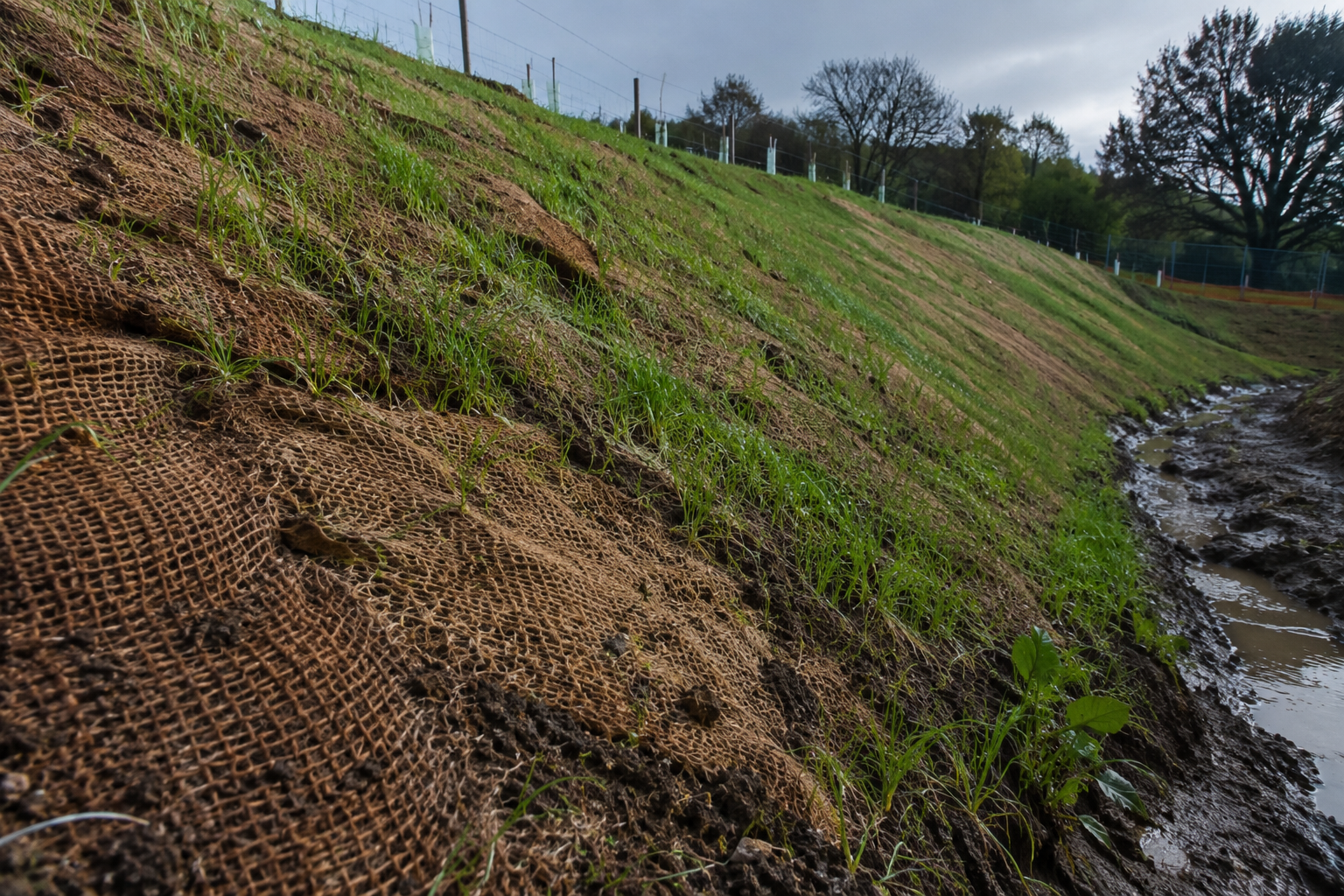
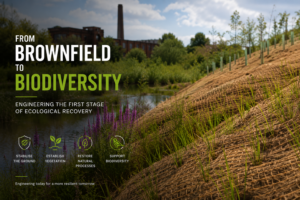
Natural fibre erosion control systems such as coir netting and coir blankets are designed around this principle. Rather than resisting ecological integration, they support it. Their functional lifespan aligns closely with the period during which surface protection is genuinely required, before gradually biodegrading into the surrounding environment.
Importantly, engineered biodegradability should not be confused with reduced engineering performance.
When appropriately specified, natural fibre systems can provide substantial tensile strength, surface stabilisation and moisture retention during critical establishment phases, while also supporting vegetation growth and improving ecological compatibility. In many cases, this creates a more balanced and environmentally proportionate engineering response than systems designed to remain permanently within the landscape.
The wider infrastructure sector is increasingly recognising that resilience is not always achieved through permanence alone. Adaptive design, ecological integration and lifecycle accountability are becoming equally important components of modern engineering decision making.
As climate pressures intensify and sustainability expectations continue to evolve, the future of geotechnical engineering is likely to favour solutions that work with natural recovery processes rather than against them.
In this context, designing for degradation is not a compromise in engineering integrity. It is a reflection of more intelligent, proportionate and forward-looking infrastructure design.