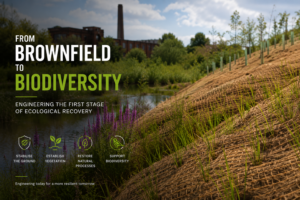
For decades, slope stability within civil engineering has been approached primarily through mechanical intervention. Retaining systems, rock armouring, concrete revetments and synthetic reinforcement products have traditionally formed the backbone of slope protection strategies across infrastructure and development projects.
While these systems continue to play an important role in many high load and high risk environments, the wider geotechnical sector is increasingly recognising that long term slope resilience cannot always be achieved through structural measures alone.
In many applications, vegetation itself performs a critical engineering function.
This shift in thinking is reshaping how engineers, consultants and asset owners approach erosion control, embankment management and landscape stabilisation particularly as climate pressures, carbon reduction targets and biodiversity expectations continue to intensify across the infrastructure sector.
Vegetation contributes to slope stability in several interconnected ways. Root systems help reinforce near surface soils by increasing shear resistance and reducing susceptibility to surface erosion. Dense vegetation cover limits direct rainfall impact, slows overland water flow and assists with moisture regulation within upper soil profiles. Collectively, these mechanisms help reduce sediment displacement and support longer term ground stability.
However, successful vegetation establishment on exposed or recently disturbed slopes is rarely straightforward.
Newly formed embankments, infrastructure cuttings and erosion prone gradients are often vulnerable during the early stages of recovery. Before root systems develop sufficiently, slopes remain exposed to rainfall impact, runoff concentration and surface instability. This establishment window is frequently where failures originate.
For this reason, temporary erosion control systems play an increasingly important role within modern bioengineered slope design.
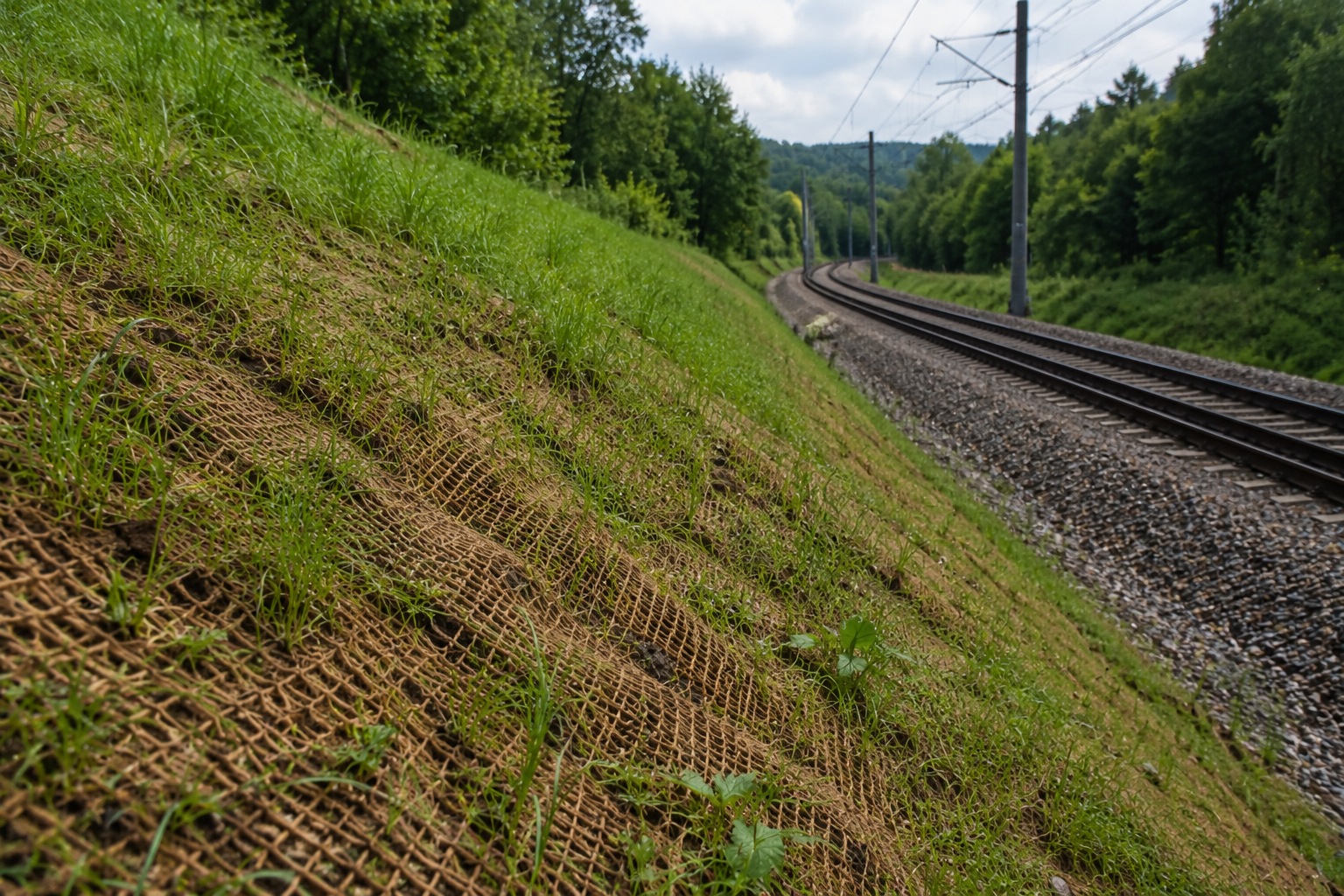
Natural fibre erosion control materials such as coir netting, coir blankets and coir logs are designed to support this transition period by stabilising exposed soils while simultaneously creating favourable conditions for vegetation growth. Unlike impermeable or highly rigid systems, natural fibre solutions allow ecological integration to occur progressively, supporting root penetration and long term landscape recovery.
Importantly, this does not represent a departure from engineering principles. Rather, it reflects a broader understanding of how natural systems can contribute to infrastructure performance when appropriately integrated into geotechnical design strategies.
This approach is becoming increasingly relevant across rail infrastructure, highways, riverbanks, flood management schemes and land restoration projects throughout the UK. Infrastructure owners are under growing pressure to deliver solutions that not only achieve technical performance requirements, but also align with wider environmental objectives surrounding carbon reduction, ecological enhancement and sustainable land management.
As a result, slope stabilisation is evolving from a purely structural discipline into a more integrated balance of engineering, hydrology and ecology.
The future of geotechnical engineering is unlikely to be defined solely by how effectively infrastructure resists natural processes. Increasingly, success will depend on how intelligently infrastructure works alongside them.
Vegetation is therefore no longer simply an environmental addition to engineering schemes. In many cases, it is becoming a fundamental component of long term slope stability itself.