Within civil engineering and infrastructure delivery, temporary works are frequently viewed through the lens of immediacy: necessary for construction sequencing, vegetation establishment or short term surface protection, but rarely treated as defining components of long term asset performance.
In erosion control and slope management, this assumption can be dangerously misleading.
The first weeks and months following installation often determine whether a slope, embankment or watercourse achieves long term ecological and structural stability. During this early establishment period, exposed soils remain highly vulnerable to rainfall impact, runoff concentration, surface scour and sediment displacement. Once erosion initiates, degradation accelerates quickly particularly on recently disturbed slopes where vegetation has yet to establish meaningful root reinforcement.
For infrastructure operators, this has direct implications for maintenance liabilities, environmental compliance and whole-life asset performance.
Across highways, rail corridors, utilities, riverbanks and development sites, many long term failures originate not from permanent engineering systems themselves, but from insufficient early stage erosion management. Surface instability during the vegetation establishment phase can compromise drainage pathways, reduce soil integrity, expose reinforcement systems and increase the likelihood of ongoing remedial intervention.
Temporary erosion control is therefore not temporary in consequence.
This is increasingly relevant as infrastructure projects face greater scrutiny around climate resilience, carbon reduction and environmental stewardship. More intense rainfall events, changing hydrological patterns and tighter regulatory expectations are forcing engineers and contractors to reconsider how temporary ground protection systems are specified.
Historically, synthetic erosion control materials dominated the sector due to perceptions of durability and uniformity. However, the industry is gradually recognising that material permanence does not always equate to engineering suitability.
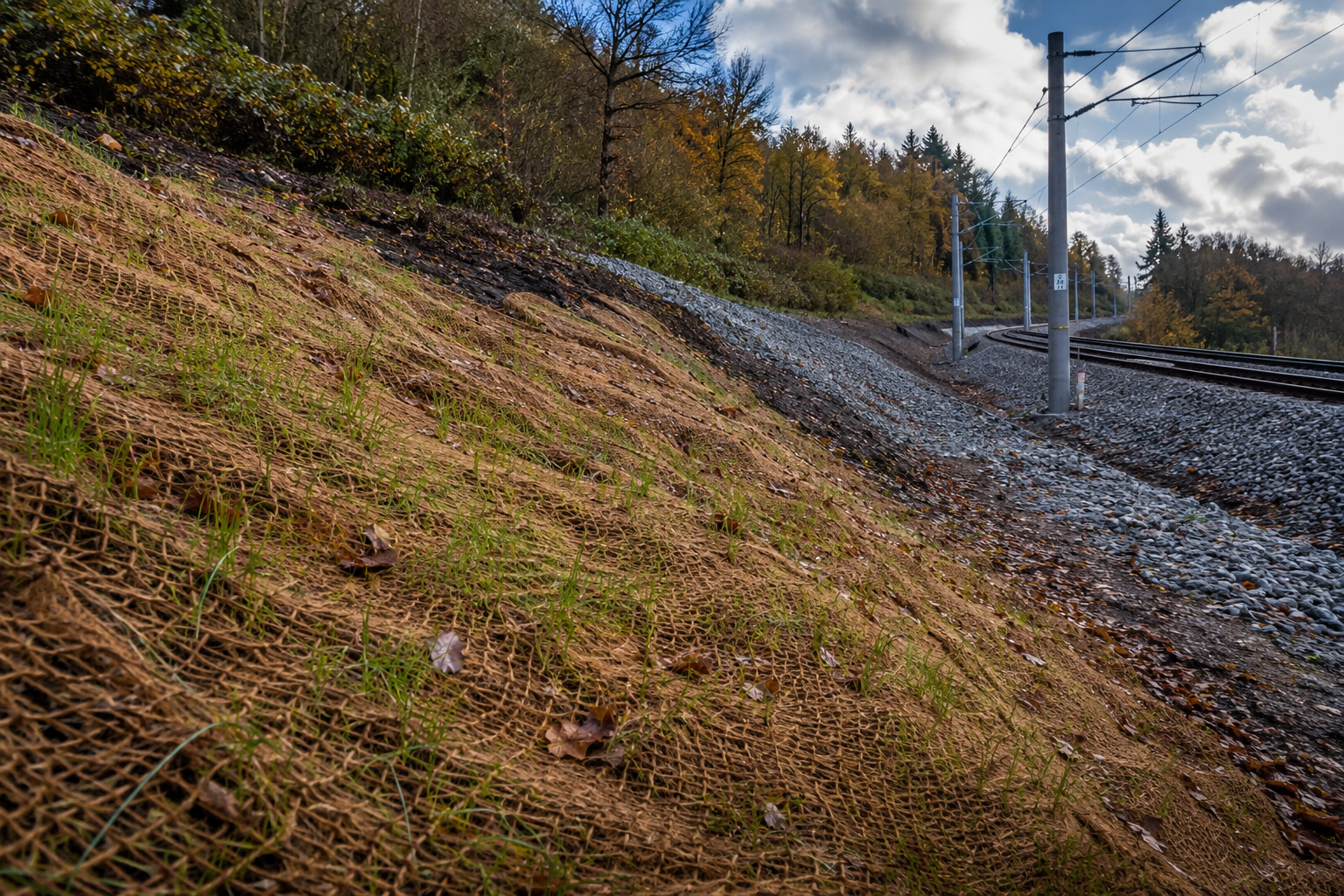
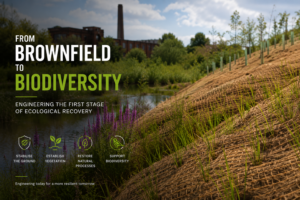
In many applications, biodegradable erosion control systems offer a more proportionate and environmentally aligned response. Natural fibre systems such as coir based erosion control blankets, coir netting and coir logs provide critical surface stabilisation during the most vulnerable establishment phase, while supporting vegetation growth and gradually integrating into the surrounding environment over time.
This distinction is important.
The objective of erosion control is not merely to resist natural processes indefinitely, but to facilitate stable ecological recovery and long term landscape resilience. Once vegetation matures and root structures develop, the role of the temporary erosion control layer diminishes naturally. In this context, engineered biodegradability becomes a performance characteristic rather than a limitation.
The conversation within geotechnical engineering is therefore evolving beyond short term installation requirements towards broader lifecycle thinking. Questions around embodied carbon, disposal impacts, microplastic legacy and long term ecological compatibility are becoming increasingly relevant within procurement frameworks and infrastructure design strategies.
As a result, temporary erosion control should no longer be treated as a secondary construction consideration or procurement afterthought. It is a foundational engineering decision that influences long term slope performance, vegetation success, environmental outcomes and future maintenance obligations.
For infrastructure projects seeking resilient, low carbon and environmentally integrated outcomes, the earliest intervention on site may ultimately prove to be the most important.