

The forgotten engineering value of vegetation
When vegetation is discussed on infrastructure projects, it is often viewed through an environmental lens. It contributes to biodiversity, improves visual appearance and supports habitat

Precision-engineered biodegradable natural fibres for consistent, reliable performance.
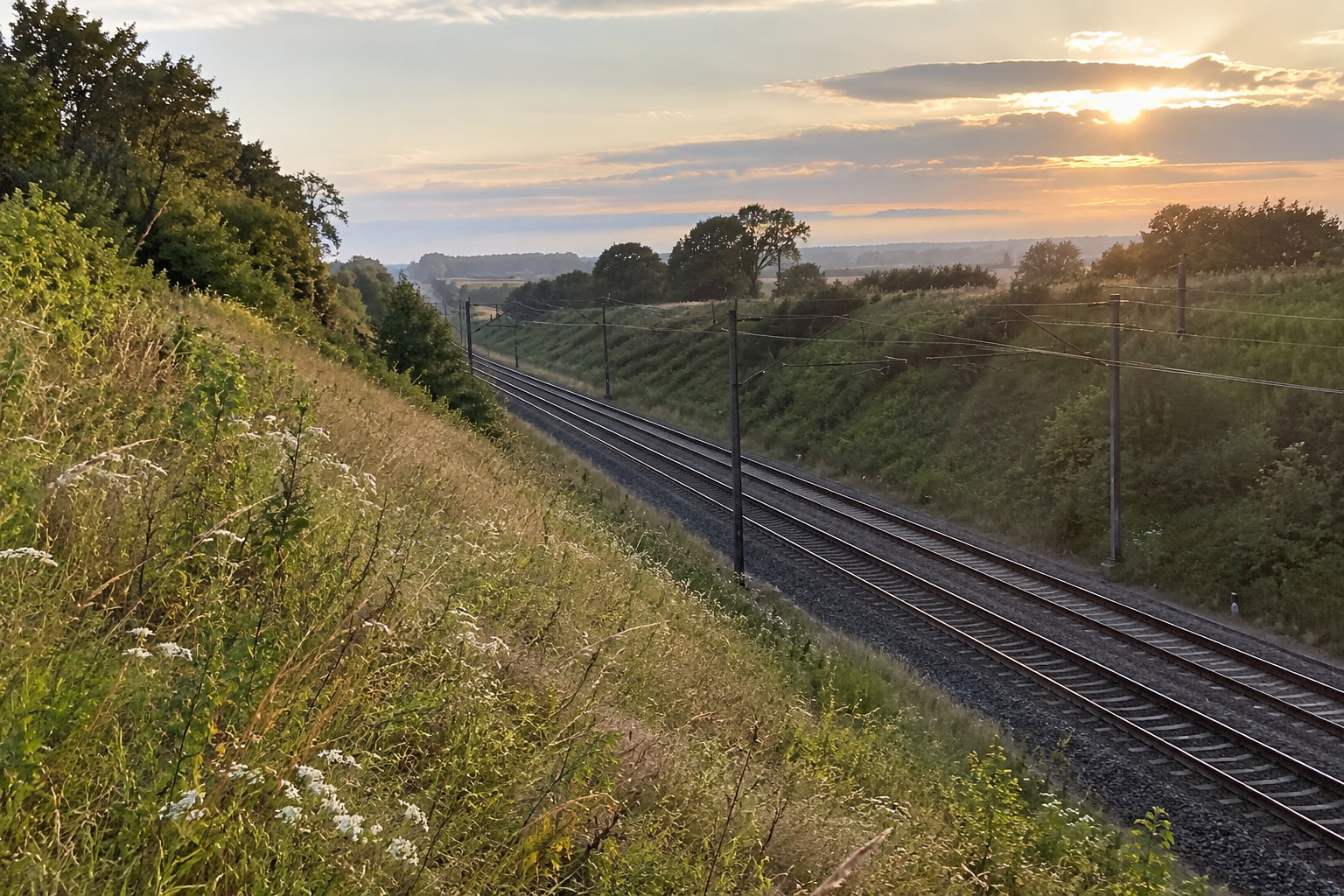
Britain’s railway earthworks were not built for the climate they are now being asked to withstand.
Across the network, cuttings and embankments that have performed for generations are increasingly being exposed to longer dry periods, intense rainfall events and more pronounced seasonal changes in ground moisture. These are not simply environmental considerations. For railway asset managers, they are engineering variables.
Network Rail manages more than 190,000 earthwork assets across approximately 20,000 miles of track. Many of its infrastructure slopes are more than 150 years old and, as Network Rail itself acknowledges, do not possess the capability and resilience of modern engineered slopes.
That makes the condition of the surface increasingly important.
A major railway earthwork failure is rarely the first indication that something is changing. Long before a landslip reaches the track, considerably smaller processes may already be taking place: vegetation becomes stressed, surface soils dry and crack, drainage pathways alter, bare areas develop, rainfall begins removing fine material and shallow erosion channels start to form.
Individually, these may appear minor.
Collectively, they can be the beginning of a much larger problem.
The summer of 2026 provides a particularly relevant example.
In August, Network Rail reported that soil moisture had reached its lowest level since its records began in 2009. Hot, dry weather can be particularly problematic for railway earthworks containing clay because moisture loss causes the soil to shrink. In some locations this can contribute to track movement and the introduction of speed restrictions.
But the engineering challenge does not necessarily end when the hot weather does.
The transition from a prolonged dry period into autumn and winter introduces a different set of conditions.
Desiccated ground may contain cracks and preferential pathways through which rainfall can initially penetrate. Vegetation weakened by drought may provide less effective surface protection. Areas of exposed soil may be more vulnerable to rainfall impact and runoff. Drainage systems then have to accommodate the return of sustained rainfall, sometimes after months of markedly different ground conditions.
Network Rail’s Earthworks Review describes how prolonged antecedent rainfall can reduce soil suction, increase saturation, create perched water tables and raise groundwater levels within cuttings and embankments. It also notes that shallow and deeper failures can respond differently as rainfall infiltrates through an earthwork.
This is why the change of season matters.
It is not simply a question of whether an embankment is wet or dry. It is the transition between conditions, and how the earthwork responds to that transition, that deserves attention.
When railway earthworks are discussed, attention understandably tends to focus on structural stability.
That is correct. A surface erosion control system is not a substitute for geotechnical stabilisation where an earthwork has an underlying structural instability.
But that distinction should not lead us to underestimate the engineering value of the surface.
The uppermost layer of a cutting or embankment is where rainfall first interacts with the earthwork. It is where runoff begins. It is where vegetation establishes. It is where fine soil particles can be detached and transported and where relatively small defects can begin to develop into rills and erosion channels.
Once runoff becomes concentrated, the process can accelerate.
A small bare area becomes a preferential flow path. A preferential flow path develops into a rill. The rill carries more water, removes more material and may eventually begin interacting with drainage infrastructure or other vulnerable parts of the earthwork.
This is not the same as saying that surface erosion causes every slope failure. It clearly does not.
It is saying that surface condition is one component of earthwork resilience, and it should be treated accordingly.
One of the difficulties with railway earthworks is that their behaviour does not fit neatly into individual disciplines.
Drainage is a geotechnical issue.
Vegetation can be an ecological issue, an operational issue and a geotechnical issue.
Surface erosion can be a maintenance issue until it develops into something considerably more serious.
The interaction between them is therefore important.
A drainage system can be perfectly adequate in principle but compromised by sediment. A slope can have been hydroseeded successfully but lose areas of young vegetation following drought. Vegetation management can expose previously protected soil. Localised runoff from the crest can create erosion in an otherwise stable cutting.
Network Rail itself identifies drainage and vegetation as important components of its risk-based earthworks maintenance strategy.
That joined-up view should extend to surface protection.
Rather than asking only whether a slope is structurally stable today, there is value in asking a second question:
What is protecting its surface while the landscape around it changes?
This is particularly relevant when considering vegetation.
Vegetation on infrastructure slopes is sometimes discussed primarily in terms of appearance, biodiversity or maintenance. From an earthworks perspective, however, appropriately established vegetation can perform another role.
At the surface, vegetation can reduce direct rainfall impact, interrupt overland flow and help protect exposed soil. Root systems can contribute to the reinforcement of near-surface soils, while established cover can reduce the opportunity for erosion channels to develop.
There is, of course, considerably more complexity to vegetation management on railway earthworks than simply encouraging maximum growth. Tree species, rooting behaviour, water demand, visibility, leaf fall, drainage, operational clearance and the condition of the underlying earthwork all have to be considered.
The effects can also vary according to soil type.
During the 2026 dry period, for example, Network Rail explained that trees and vegetation can exacerbate moisture loss from clay railway embankments, contributing to soil shrinkage. Targeted vegetation management is therefore part of its response at susceptible locations.
The engineering question is consequently not vegetation or no vegetation.
It is what vegetation, where, on what earthwork, and for what purpose?
That is a much more useful conversation.
There is another point that is sometimes overlooked.
An earthwork can become temporarily more vulnerable precisely because work has been carried out to improve it.
Drainage works, vegetation clearance, regrading, soil repairs and other interventions can leave areas of disturbed or newly exposed soil.
The permanent landscape may ultimately be considerably more resilient. But there is an establishment period between intervention and that final condition.
That period matters.
If the intended long term protection depends partly upon vegetation, the slope must remain protected while that vegetation establishes.
This is where temporary and biodegradable erosion-control systems can have a legitimate engineering role.
Not as permanent structural reinforcement.
Not as an alternative to drainage.
And certainly not as a universal solution to unstable railway earthworks.
Their role can be much more specific: protecting vulnerable surface soils during the period in which vegetation and the earthwork surface are establishing.
At Salike®, this distinction is central to how we view natural-fibre geotechnical systems.
Coir netting and erosion-control blankets can be used to provide temporary surface protection on suitable slopes, helping maintain soil contact, increase surface roughness and support vegetation establishment while the biological component of the system develops.
The open structure of coir netting allows vegetation to grow through the material rather than creating a permanent barrier between the soil and the developing vegetation.
Over time, the natural fibre material progressively degrades.
That characteristic can be particularly useful where the required engineering function is itself temporary: the material performs during the vulnerable establishment phase and then gradually relinquishes that role as vegetation becomes established.
The specification, however, has to begin with the site.
Slope geometry, soil characteristics, anticipated runoff, drainage, rainfall exposure, vegetation strategy, anchorage requirements and the expected establishment period all need to be understood before a material is selected.
A natural material is not automatically the correct material simply because it is natural.
Engineering suitability has to come first.
There is a broader asset-management principle behind this.
Infrastructure problems are generally easier to manage while they are still small.
An isolated patch of exposed soil is different from an established erosion channel.
A blocked drainage route is different from a saturated earthwork.
Poor vegetation establishment is different from widespread surface deterioration.
And surface deterioration is very different from an earthwork failure affecting an operational railway.
The purpose of inspection and monitoring is therefore not simply to identify failure. It is to identify change.
That change might be subtle: newly exposed soil, localised washout, displaced erosion protection, sediment accumulation, unusual water movement, loss of vegetation or the beginning of rilling.
These observations may not justify major intervention.
But they may justify action.
And in infrastructure asset management, relatively modest interventions undertaken at the right time can be considerably more effective than major remedial works undertaken too late.
Shiran Amunugama, Managing Director of Salike®, believes this intermediate stage deserves more attention as infrastructure adapts to increasingly variable weather conditions.
“We tend to talk about infrastructure in quite binary terms an asset is either performing or it has failed. In reality, there is a considerable period between those two conditions, and that is where good asset management can make an enormous difference.”
“With railway earthworks, you may begin with something relatively minor: vegetation loss, an exposed area of soil, a drainage issue or surface erosion following heavy rainfall. None of those things necessarily means that the earthwork is unstable. But equally, they should not simply be dismissed because the slope has not failed.”
“For us, the important point is understanding where natural-fibre systems genuinely have an engineering role. We are not suggesting that coir netting replaces structural slope stabilisation it doesn’t. But where the problem is protecting a vulnerable surface, controlling erosion and giving vegetation the opportunity to establish, there is a very credible role for properly specified natural-fibre systems.”
“As weather becomes less predictable, I think the industry will increasingly have to focus not only on repairing failed assets, but on recognising and managing vulnerability earlier.”
That is perhaps the most important point.
There will never be a single material, inspection regime or engineering intervention capable of eliminating weather-related risk from Britain’s railway earthworks.
The scale and age of the network make that impossible.
Network Rail’s portfolio includes more than 190,000 earthwork assets, with many slopes dating from the Victorian railway-building era. Managing those assets therefore requires prioritisation, monitoring and proportionate intervention rather than wholesale reconstruction.
Climate variability adds another layer to that challenge.
After an exceptionally dry summer, attention inevitably turns towards autumn and winter. For railway earthworks, however, the question should not simply be how much rain falls.
It should also be:
What condition is the earthwork in when that rain arrives?
Are drainage pathways functioning?
Has vegetation survived the preceding season?
Are areas of bare soil developing?
Is runoff beginning to concentrate?
Has previous protection become displaced?
And where intervention has recently taken place, is the new surface adequately protected while vegetation establishes?
These are relatively simple questions.
But they reflect a wider shift in infrastructure management: from responding to failure towards managing vulnerability.
For Britain’s ageing railway earthworks, that may become increasingly important.
Salike® is a British engineering-led supplier specialising in natural fibre erosion control and geotechnical systems for infrastructure and environmental applications. Established in 2015, Salike® works with contractors, consultants, distributors and project teams in the United Kingdom and internationally, with natural-fibre solutions supplied across more than 17 countries.
Its systems include coir netting and geotextiles, erosion-control blankets, coir logs, pre-planted coir logs, coir pallets and associated natural-fibre solutions for erosion management, slope protection, river restoration, habitat creation and environmental infrastructure.
Engineering performance. Environmental responsibility. Regenerative thinking.
When vegetation is discussed on infrastructure projects, it is often viewed through an environmental lens. It contributes to biodiversity, improves visual appearance and supports habitat

Infrastructure is often designed with an impressive lifespan in mind. Highways, railways, flood defences and earthworks are expected to perform reliably for many decades, with

When a slope fails, attention naturally turns to the moment the failure became visible. Images of collapsed embankments, exposed soil and disrupted infrastructure often dominate

Infrastructure is often judged by its ability to perform over decades. Roads, railways, flood defences and earthworks are all designed with longevity in mind, and