
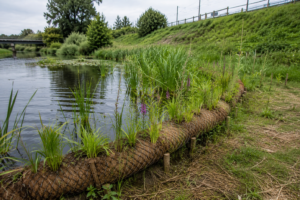
Creating Habitat While Protecting Infrastructure
For many years, infrastructure protection and habitat creation were often viewed as competing priorities. Engineers were tasked with delivering stability, resilience and asset protection, whilst

Precision-engineered biodegradable natural fibres for consistent, reliable performance.
Flood risk management is undergoing a period of significant change.
Across the UK, increasing rainfall intensity, urban expansion and changing climate patterns are placing growing pressure on drainage systems, watercourses and flood defence infrastructure. At the same time, expectations surrounding environmental performance, biodiversity enhancement and sustainable development continue to evolve.
As a result, flood management strategies are becoming broader in scope.
Traditional approaches focused heavily on controlling water through hard-engineered structures such as concrete channels, flood walls and reinforced embankments. Whilst these measures remain important in many situations, there is growing recognition that effective flood resilience often requires a more integrated approach.
Increasingly, engineers, environmental specialists and infrastructure clients are exploring how natural processes can contribute to long-term flood management objectives.
This shift has brought renewed attention to soft engineering solutions.
Soft engineering refers to techniques that work with natural processes rather than attempting to constrain them entirely.
The objective is not necessarily to prevent water from moving through the landscape. Instead, it is to influence how water behaves, how quickly it travels and how effectively the surrounding environment can respond to changing conditions.
Within flood risk management, soft engineering measures often seek to slow runoff, reduce erosion, improve infiltration and support natural storage capacity within catchments.
These interventions can complement traditional flood infrastructure whilst providing additional environmental benefits.
Importantly, they recognise that water is a natural component of the landscape rather than simply a problem to be controlled.
Historically, flood management often focused on resistance.
The primary objective was to prevent water from reaching vulnerable locations through physical barriers and engineered containment structures. Whilst this approach remains essential in many urban environments, it is increasingly being supplemented by strategies that improve resilience.
Flood resilience acknowledges that extreme weather events may occur despite protective measures.
The emphasis therefore shifts towards reducing impacts, managing risk and enabling landscapes to recover more effectively following flood events.
This broader perspective has encouraged greater consideration of natural systems within flood management planning.
Vegetation, floodplains, wetlands and restored watercourses all have important roles to play in improving resilience across catchments.
Surface water flooding is becoming an increasingly significant challenge throughout the UK.
Intense rainfall events can overwhelm drainage systems, generate rapid runoff and create localised flooding in both urban and rural environments. In many cases, the issue is not simply the volume of water, but the speed at which it moves across the landscape.
Managing runoff at source is therefore becoming an important component of modern flood risk strategies.
By slowing the movement of water and encouraging infiltration where appropriate, landscapes can help reduce downstream pressures and contribute to wider catchment resilience.
This approach often involves a combination of engineering, land management and ecological restoration measures working together.
The goal is to create systems capable of managing water more naturally whilst supporting broader environmental objectives.
Nature-based solutions are becoming increasingly prominent within flood risk management discussions.
Rather than relying exclusively on engineered infrastructure, these approaches seek to restore or enhance natural processes that help regulate water movement.
Examples may include wetland creation, floodplain reconnection, river restoration, riparian planting and erosion control measures that support vegetation establishment.
Whilst no single intervention can eliminate flood risk, collectively these measures can contribute to more resilient catchments and healthier watercourses.
Nature-based approaches are particularly valuable because they often deliver multiple benefits simultaneously.
Alongside flood management objectives, they can support biodiversity enhancement, improve water quality, reduce erosion and contribute to landscape recovery.
This ability to deliver multiple outcomes is becoming increasingly attractive to infrastructure clients and environmental regulators alike.
Flood management and erosion control are closely connected.
Periods of high flow can accelerate bank erosion, mobilise sediment and destabilise vulnerable areas along watercourses. These impacts may affect habitat quality, infrastructure performance and long-term channel stability.
Managing erosion therefore forms an important component of wider flood resilience strategies.
Protecting vulnerable banks whilst supporting vegetation establishment can help improve the long-term stability of watercourse environments. Over time, healthy vegetation and well-established root systems become increasingly effective at contributing to natural resilience.
The objective is not to eliminate natural river processes, but to prevent excessive degradation during periods of environmental stress.
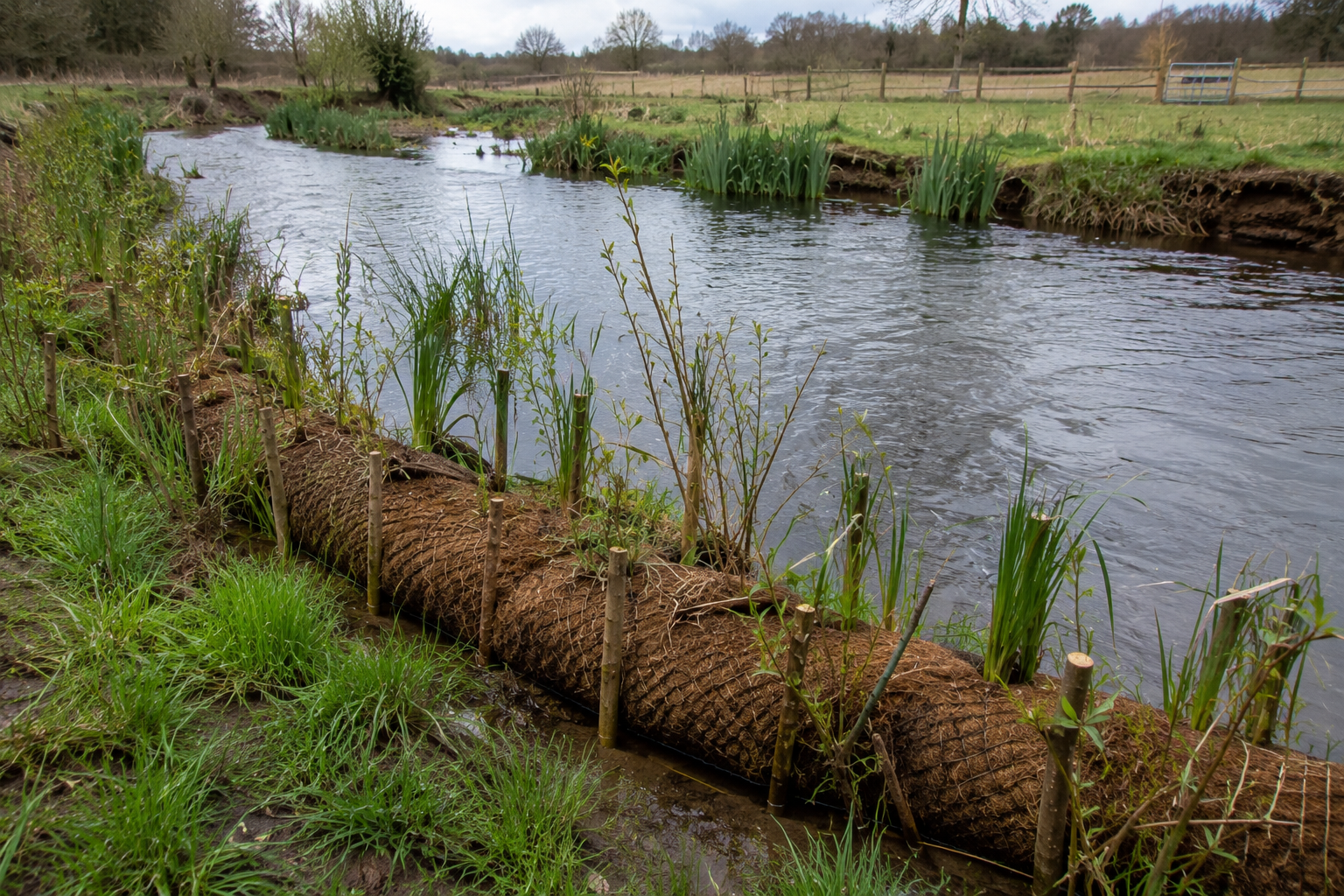
Natural fibre systems are increasingly being used within flood management and river restoration projects because they provide a practical bridge between engineering requirements and environmental objectives.
Products such as coir logs and coir rolls can assist with bank protection, sediment retention and vegetation establishment in areas vulnerable to erosion and fluctuating water levels. These systems help support recovering environments whilst integrating naturally within the landscape.
Importantly, they are often used as part of wider strategies focused on long-term resilience rather than short-term intervention alone.
By supporting vegetation development and helping stabilise vulnerable areas during critical periods, natural fibre systems contribute to the gradual creation of self-sustaining environments capable of performing effectively over time.
This reflects the broader philosophy underpinning many modern flood management projects.
The future of flood risk management is unlikely to rely upon a single approach.
Traditional infrastructure will continue to play a vital role in protecting communities and critical assets. However, there is growing recognition that resilient landscapes can contribute significantly to managing water more effectively.
Soft engineering, nature-based solutions and catchment-scale thinking are increasingly becoming part of mainstream infrastructure planning.
These approaches recognise that flood resilience depends not only upon structures and assets, but also upon the health and function of the wider landscape.
As climate pressures continue to evolve, successful flood management is likely to require a combination of engineering expertise, environmental understanding and long-term stewardship.
Increasingly, the most effective solutions may be those that work with natural systems rather than against them.
The growing role of soft engineering reflects this shift.
It is not about replacing traditional engineering. It is about expanding the range of tools available to create more resilient and sustainable flood management outcomes for the future.
For many years, infrastructure protection and habitat creation were often viewed as competing priorities. Engineers were tasked with delivering stability, resilience and asset protection, whilst
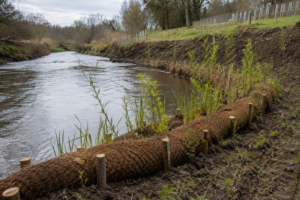
For much of the twentieth century, river engineering was often characterised by control. Watercourses were straightened, channels were reinforced and banks were protected using increasingly
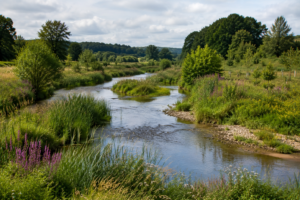
Across the UK, river restoration is becoming an increasingly important component of environmental management, flood resilience and habitat recovery. Decades of channel modification, hard engineering,
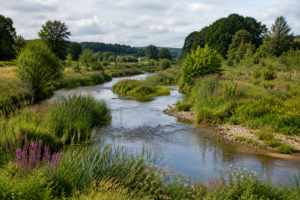
Across the UK, river restoration is becoming an increasingly important component of environmental management, flood resilience and habitat recovery. Decades of channel modification, hard engineering,