
Creating Habitat While Protecting Infrastructure
For many years, infrastructure protection and habitat creation were often viewed as competing priorities. Engineers were tasked with delivering stability, resilience and asset protection, whilst

Precision-engineered biodegradable natural fibres for consistent, reliable performance.
For much of the twentieth century, river engineering was often characterised by control.
Watercourses were straightened, channels were reinforced and banks were protected using increasingly robust engineered structures designed to resist erosion and contain water movement. Concrete revetments, rock armour, sheet piling and other hard-engineered systems became common features across rivers, drainage channels and flood management schemes.
Many of these interventions delivered important engineering benefits.
However, they also demonstrated that stability and environmental function do not always develop together.
As understanding of river processes has evolved, so too has the approach to watercourse management. Increasingly, engineers, environmental specialists and infrastructure clients are exploring how riverbanks can be stabilised whilst maintaining ecological value, supporting habitat creation and allowing natural processes to continue functioning.
This shift has contributed to the growing use of softer engineering approaches within river restoration and watercourse management projects.
Hard armouring typically refers to the use of rigid materials designed to prevent erosion through physical resistance.
Concrete structures, rock revetments, gabions and steel sheet piling all fall within this category. These systems can be highly effective in locations where infrastructure protection, asset stability or hydraulic performance are the overriding priorities.
In certain environments, hard engineering remains entirely appropriate.
Urban flood defences, bridge abutments, critical infrastructure crossings and heavily constrained channels often require robust engineered protection capable of resisting significant forces.
The challenge arises when these solutions are applied universally, regardless of site-specific objectives.
Not every watercourse requires complete separation from natural processes.
Unlike conventional infrastructure assets, rivers are naturally dynamic.
Channels migrate, vegetation develops, sediment moves and flow conditions change throughout the year. These processes contribute to the ecological diversity and resilience of healthy watercourse environments.
When river systems become overly constrained, some of these natural functions may be reduced.
Habitats can become simplified. Marginal vegetation may struggle to establish. Opportunities for ecological succession can diminish. Over time, this may affect the environmental value of the watercourse even where engineering performance remains satisfactory.
Modern river management increasingly seeks to balance stability with natural function.
The objective is not necessarily to eliminate movement altogether, but to manage it appropriately.
Historically, success within riverbank stabilisation projects was often measured primarily through erosion prevention.
Whilst stability remains an essential consideration, project teams are increasingly evaluating schemes against a broader range of outcomes.
Questions now frequently include:
Will the intervention support habitat creation?
Can vegetation establish successfully?
Will the scheme contribute to biodiversity objectives?
How will the riverbank evolve over time?
Does the solution integrate naturally within the surrounding environment?
These considerations are changing how performance itself is defined.
The most successful projects often deliver multiple benefits simultaneously rather than focusing solely on erosion resistance.
Riverbanks are among the most ecologically important environments within many landscapes.
Marginal vegetation provides shelter, food sources and breeding habitat for a wide range of species. Transitional zones between land and water often support significant biodiversity and contribute to wider ecological connectivity.
Engineering interventions can influence these habitats significantly.
Where solutions allow vegetation establishment and ecological integration, habitat value may increase over time. Conversely, heavily engineered structures can sometimes limit opportunities for natural colonisation and habitat development.
This does not mean that hard engineering is inherently unsuitable.
Rather, it highlights the importance of matching interventions to project objectives.
Where ecological enhancement forms part of the desired outcome, softer approaches may offer important advantages.
One of the defining characteristics of modern river restoration is ecological integration.
Rather than treating engineering and ecology as separate disciplines, projects increasingly seek to combine both objectives within a single design strategy.
This approach recognises that stable riverbanks and healthy ecosystems can often support one another.
Vegetation contributes to long-term bank resilience through root reinforcement and surface protection. Diverse habitats support ecological recovery. Natural processes help create adaptive and resilient environments capable of responding to changing conditions.
Engineering solutions that support these processes can therefore provide benefits beyond erosion control alone.
Many river restoration projects rely upon a period of transition.
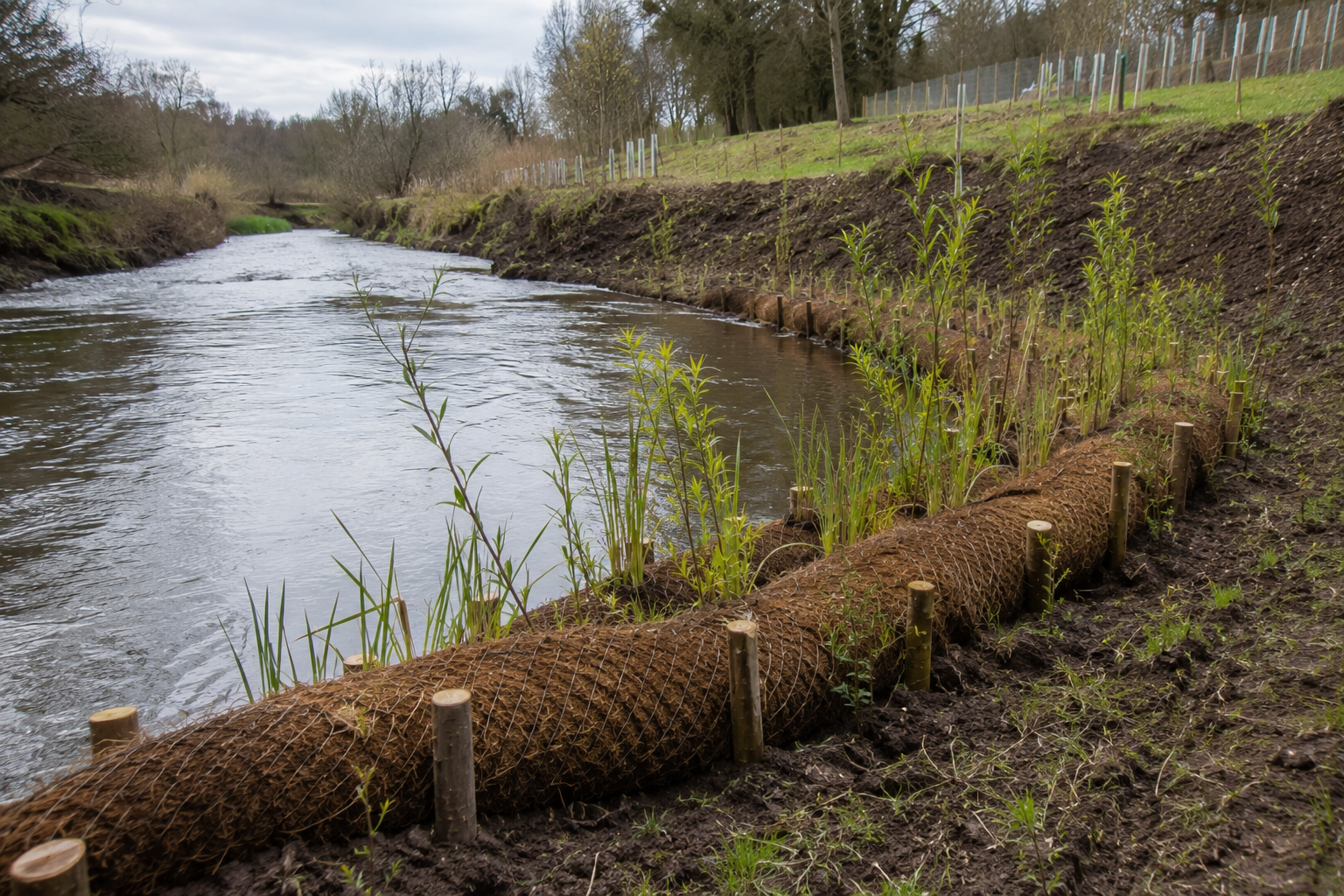
Immediately following installation, riverbanks may remain vulnerable whilst vegetation becomes established and ecological processes begin to develop. During this phase, temporary support measures can help create the conditions required for long-term recovery.
The objective is not necessarily to create permanent engineered structures.
Instead, it is to assist the riverbank until natural systems become capable of providing increasing levels of stability themselves.
This philosophy underpins many contemporary nature-based approaches to watercourse management.
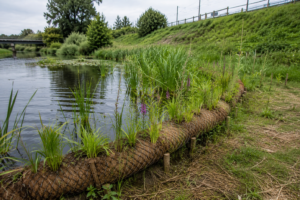
Natural fibre systems are increasingly used within river restoration and bank stabilisation projects because they support both engineering and environmental objectives.
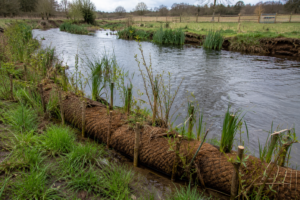
Products such as coir logs and coir pallets can provide temporary protection against erosion whilst creating opportunities for vegetation establishment and habitat development. Their structure helps retain soils, support marginal planting and encourage ecological integration during the most vulnerable stages of recovery.
Importantly, these systems are designed to work with natural processes rather than replace them.
As vegetation matures and root systems strengthen, the riverbank progressively becomes more self-sustaining. Stability increasingly derives from the recovering environment itself rather than the engineering intervention alone.
This creates a practical balance between immediate performance and long-term ecological function.
The future of river engineering is unlikely to be defined by a choice between hard and soft solutions.
Both approaches have important roles within modern watercourse management.
The key challenge is selecting the most appropriate intervention for the specific conditions, constraints and objectives of each project.
Where critical infrastructure requires protection, hard engineering may remain essential. Where habitat enhancement, ecological recovery and environmental integration are priorities, softer approaches may provide significant advantages.
Increasingly, successful projects combine elements of both.
This balanced perspective reflects a broader evolution within river management.
The objective is no longer simply to prevent erosion.
It is to create watercourses that are stable, resilient, environmentally valuable and capable of functioning effectively for future generations.
In many cases, achieving that outcome requires engineering solutions that work alongside natural systems rather than attempting to exclude them.
For many years, infrastructure protection and habitat creation were often viewed as competing priorities. Engineers were tasked with delivering stability, resilience and asset protection, whilst
Across the UK, river restoration is becoming an increasingly important component of environmental management, flood resilience and habitat recovery. Decades of channel modification, hard engineering,
Flood risk management is undergoing a period of significant change. Across the UK, increasing rainfall intensity, urban expansion and changing climate patterns are placing growing
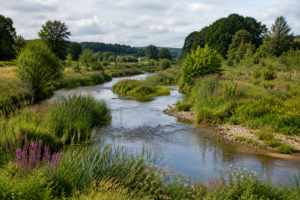
Across the UK, river restoration is becoming an increasingly important component of environmental management, flood resilience and habitat recovery. Decades of channel modification, hard engineering,