Across the UK, many aquatic and wetland habitats have experienced significant decline over the past century.
Urban development, river modification, agricultural intensification, drainage schemes and changing land use patterns have altered countless ponds, lakes, reservoirs and watercourses. Whilst these changes have often supported economic development and infrastructure growth, they have also contributed to the gradual loss of valuable habitat for wildlife.
The consequences extend beyond individual species.
Healthy aquatic ecosystems perform a wide range of functions. They support biodiversity, improve water quality, provide breeding and feeding opportunities, contribute to flood resilience and form part of wider ecological networks that connect landscapes together.
As pressure on natural habitats continues to increase, restoration and enhancement projects are becoming increasingly important.
One approach receiving growing attention is the use of floating habitat systems.
By creating new ecological space directly within water environments, floating islands can help restore habitat opportunities where conventional restoration approaches may be constrained.
The Challenge of Habitat Loss
Wetland and aquatic habitats are among the most productive ecosystems in the natural environment.
Margins of ponds, lakes and rivers support a diverse range of plants, insects, amphibians, birds and aquatic species. These transitional zones between land and water often provide shelter, food sources, breeding areas and ecological connectivity.
However, many waterbodies now possess limited habitat diversity.
Steep banks, engineered edges, fluctuating water levels and surrounding development can restrict opportunities for natural vegetation establishment. In urban and heavily managed environments, suitable habitat may be particularly scarce.
This creates a challenge for ecological recovery.
Even where water quality improves, wildlife may struggle to establish if suitable habitat remains unavailable.
What Are Floating Habitat Islands?
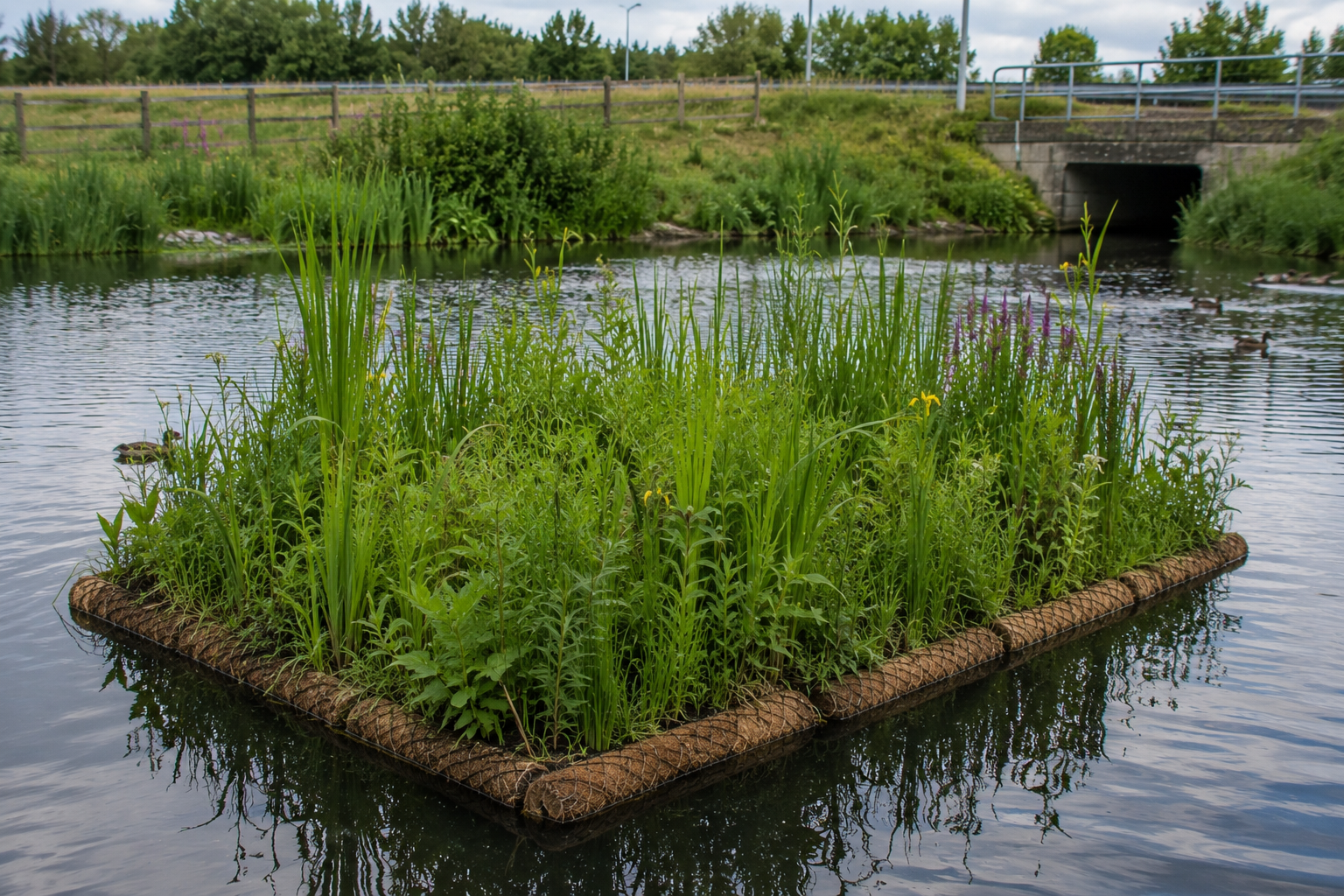
Floating habitat islands are engineered vegetated platforms designed to support plant growth directly on the surface of water.
Constructed using buoyant structures and natural fibre growing media, these systems create a floating ecosystem capable of supporting a wide range of wetland and marginal plant species.
Unlike traditional planting schemes that rely upon available shoreline space, floating islands introduce habitat directly into the waterbody itself.
This creates opportunities for ecological enhancement without requiring significant alteration to existing banks, infrastructure or surrounding land uses.
Importantly, floating islands do not simply provide planting space.
They create functioning ecological environments.
Creating Habitat Where Habitat Is Limited
One of the greatest advantages of floating islands is their ability to establish habitat in locations where natural opportunities may be restricted.
Reservoirs, balancing ponds, attenuation basins, urban lakes and heavily engineered waterbodies often possess relatively limited ecological value despite occupying significant areas of water.
Floating habitat systems can help address this challenge.
Vegetation established on floating islands creates shelter, feeding opportunities and breeding habitat for a variety of species. Birds may utilise the islands for nesting and refuge. Invertebrates benefit from increased vegetation diversity. Aquatic organisms gain access to shaded areas and submerged root structures.
Over time, the ecological value of the waterbody can increase significantly.
Supporting Biodiversity Through Ecological Complexity
Healthy ecosystems depend upon complexity.
The greater the diversity of habitats available, the greater the range of species that can potentially be supported.
Floating islands contribute to this complexity in several ways.
Above the water surface, vegetation provides habitat structure for insects, birds and pollinators. At the water interface, stems and plant material create valuable transition zones. Beneath the surface, extensive root networks develop within the water column, providing shelter and refuge for aquatic organisms.
These submerged root systems are particularly important.
They create habitat that may otherwise be absent within many engineered or simplified water environments.
In effect, floating islands increase ecological capacity both above and below the waterline.
Improving Water Quality Naturally
The environmental benefits of floating habitat systems extend beyond biodiversity alone.
Wetland plants absorb nutrients as part of their natural growth processes. Root systems provide surfaces upon which beneficial microbial communities can develop. Together, these processes can contribute to improved water quality over time.
Whilst floating islands should not be viewed as a substitute for wider catchment management or pollution control measures, they can form part of a broader strategy aimed at improving aquatic ecosystem health.
Their contribution is particularly valuable where ecological enhancement and water quality objectives overlap.
The Role of Natural Fibre Growing Systems
Natural fibre materials play an important role in many floating habitat systems.
Coir-based growing media provide a stable environment for vegetation establishment whilst supporting root development and moisture management. Their natural structure allows plants to establish effectively whilst integrating with ecological processes over time.
Within floating island applications, coir pallets offer an effective growing medium capable of supporting diverse wetland planting schemes. The combination of natural fibre materials and aquatic vegetation creates a system that functions both as habitat and as ecological infrastructure.
This relationship between engineering and ecology lies at the heart of successful habitat creation projects.
Supporting Nature Recovery in Managed Landscapes
Many modern landscapes contain waterbodies that were never originally intended as wildlife habitats.
Flood storage basins, attenuation ponds, reservoirs, ornamental lakes and urban drainage features are often designed primarily for engineering or operational purposes.
However, these environments can still contribute meaningfully to nature recovery.
Floating habitat systems allow ecological value to be introduced into locations where conventional habitat creation may be difficult or impractical.
This creates opportunities to support biodiversity without compromising the primary function of the asset.
For landowners, local authorities and environmental managers, this ability to achieve multiple objectives from the same space is increasingly attractive.
Engineering Habitat for the Future
The future of ecological restoration is unlikely to rely solely upon protecting existing habitats.
In many locations, new habitat opportunities will need to be created.
Floating islands demonstrate how engineering can contribute positively to this challenge. By providing space for vegetation, supporting biodiversity and enhancing aquatic environments, they create opportunities for nature to establish where it may otherwise struggle to do so.
Most importantly, they demonstrate that engineered solutions and ecological recovery do not need to exist in opposition.
When carefully designed, engineering can help rebuild habitats, strengthen ecosystems and contribute to long-term environmental resilience.
In a landscape where habitat loss remains one of the greatest challenges facing biodiversity, creating new ecological space may prove just as important as protecting what remains.