
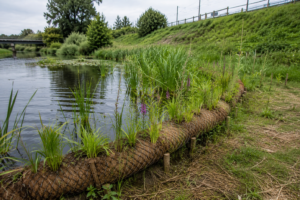
Creating Habitat While Protecting Infrastructure
For many years, infrastructure protection and habitat creation were often viewed as competing priorities. Engineers were tasked with delivering stability, resilience and asset protection, whilst

Precision-engineered biodegradable natural fibres for consistent, reliable performance.
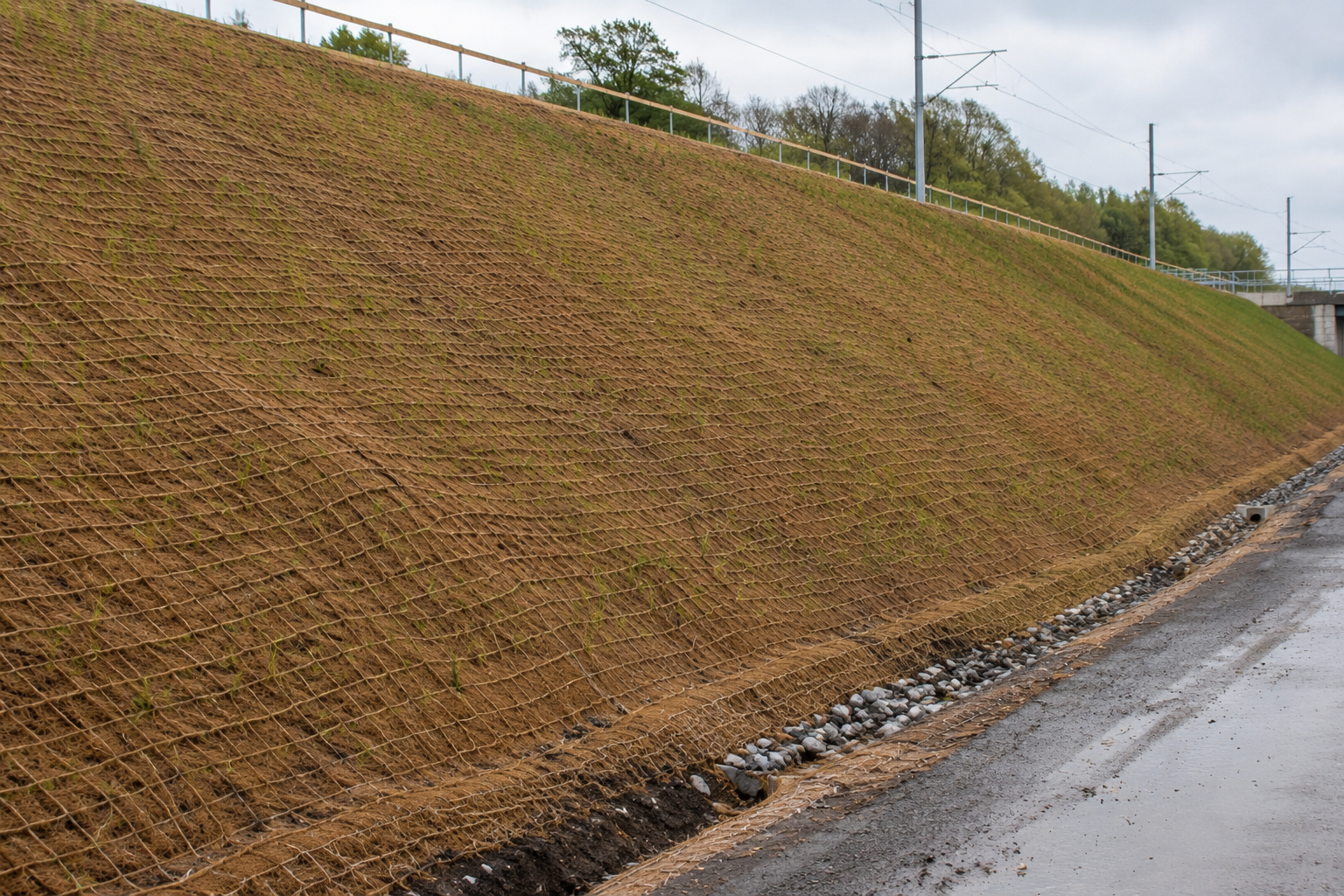
Selecting an erosion control solution is rarely a matter of choosing the strongest material available.
Successful specification depends upon understanding site conditions, project objectives, environmental constraints and the period during which protection is required. In many situations, the most appropriate solution is not necessarily the one with the longest lifespan or greatest mechanical strength, but the one whose performance characteristics align most closely with the engineering challenge being addressed.
This principle is particularly relevant when considering natural fibre erosion control systems.
Coir netting is increasingly specified across infrastructure, environmental restoration and landscape recovery projects throughout the UK. However, understanding where it is most effective — and where alternative solutions may be more appropriate — remains essential to achieving successful outcomes.
The question is not whether coir netting can perform.
The question is when it represents the most appropriate engineering response.
Coir netting is designed primarily as a temporary erosion control measure.
Its role is to protect vulnerable soil surfaces during the period when vegetation is becoming established. By reducing the effects of rainfall impact, surface runoff and localised soil displacement, coir netting helps create conditions that support long-term stabilisation through vegetation growth.
Importantly, the system is not intended to function as permanent structural reinforcement.
Instead, it forms part of a transitional process in which engineered protection gradually gives way to natural stability as root systems develop and mature.
This distinction is fundamental to appropriate specification.
Coir netting is particularly effective where erosion represents the primary concern and vegetation establishment forms part of the long-term design strategy.
Typical applications include:
In these environments, the objective is often to protect exposed soils during the critical establishment phase rather than provide permanent structural support.
Where vegetation is expected to become the primary stabilising mechanism, coir netting can provide an effective bridge between construction and ecological maturity.
Slope geometry plays an important role when specifying erosion control systems.
As gradients increase, the potential for soil movement, runoff concentration and erosion generally becomes greater. This places increased demands on both the erosion control system and the installation methodology.
Coir netting is commonly specified on a wide range of slopes, from gentle embankments through to relatively steep earthworks.
However, successful performance depends upon several factors including:
Steeper slopes may require additional anchoring, supplementary erosion control measures or alternative systems depending upon project-specific conditions.
For this reason, slope angle should never be considered in isolation.
The overall erosion risk profile remains the more important consideration.
One of the most misunderstood aspects of coir netting is lifespan.
Natural fibre systems are sometimes assessed against the assumption that longer durability automatically represents superior performance. In erosion control applications, this is not necessarily the case.
The key question is whether the material remains functional for as long as the site requires protection.
For many projects, the critical period extends through the first one to three growing seasons following installation. During this time, vegetation establishes, root systems develop and natural stabilisation processes begin to strengthen.
Coir netting is often well suited to this timeframe because its performance characteristics align closely with the establishment phase.
Once vegetation has matured, the landscape increasingly provides its own resistance to erosion.
In these circumstances, indefinite material persistence may offer limited additional benefit.
Coir netting performs a specific engineering function.
It helps reduce soil loss, supports vegetation establishment, improves surface stability and contributes to moisture retention within the upper soil profile. These benefits can significantly improve the likelihood of successful ecological recovery and long-term erosion resistance.
However, it is important to understand what coir netting is not designed to do.
It is not a substitute for structural slope stabilisation.
It is not intended to address deep-seated instability.
It is not a replacement for retaining structures, reinforced earth systems or geotechnical solutions designed to manage significant ground movement.
Where instability extends beyond surface erosion processes, additional engineering measures may be required.
Appropriate specification depends upon recognising these distinctions.
One of the reasons coir netting continues to gain acceptance across infrastructure and environmental projects is its ability to support both engineering and ecological objectives simultaneously.
The open structure of the material encourages vegetation growth through the netting whilst helping maintain soil stability during the establishment period. As ecological recovery progresses, the reliance on engineered intervention reduces.
This creates a practical relationship between short-term protection and long-term resilience.
For projects focused on landscape recovery, habitat creation, biodiversity enhancement and environmental integration, this characteristic can be particularly valuable.
In general terms, coir netting is most appropriate where:
Under these conditions, coir netting can provide an effective, proportionate and environmentally integrated solution.
The objective is not to create permanent engineered dominance over the landscape.
It is to support the landscape until it becomes capable of supporting itself.
Ultimately, successful specification is rarely about selecting a product in isolation.
It is about understanding how that product contributes to wider project objectives.
When used appropriately, coir netting can provide valuable protection during some of the most vulnerable stages of landscape development. It supports vegetation establishment, reduces erosion risks and helps create the conditions required for long-term stability.
Like any engineering solution, its effectiveness depends upon matching performance characteristics to project requirements.
The best specifications are not necessarily those that seek the strongest intervention.
They are those that seek the most appropriate one.
For many erosion control applications, that is precisely where coir netting performs best.
For many years, infrastructure protection and habitat creation were often viewed as competing priorities. Engineers were tasked with delivering stability, resilience and asset protection, whilst
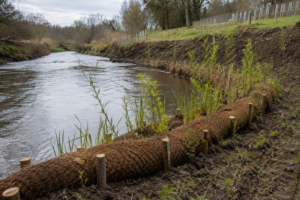
For much of the twentieth century, river engineering was often characterised by control. Watercourses were straightened, channels were reinforced and banks were protected using increasingly
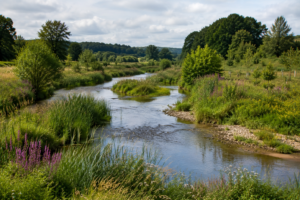
Across the UK, river restoration is becoming an increasingly important component of environmental management, flood resilience and habitat recovery. Decades of channel modification, hard engineering,
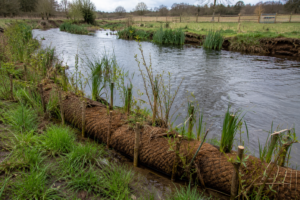
Flood risk management is undergoing a period of significant change. Across the UK, increasing rainfall intensity, urban expansion and changing climate patterns are placing growing