
Stabilising Watercourses Without Hard Armouring
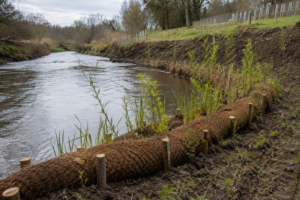
For much of the twentieth century, river engineering was often characterised by control. Watercourses were straightened, channels were reinforced and banks were protected using increasingly

Precision-engineered biodegradable natural fibres for consistent, reliable performance.
For many years, infrastructure protection and habitat creation were often viewed as competing priorities.
Engineers were tasked with delivering stability, resilience and asset protection, whilst environmental objectives were frequently considered separately through mitigation measures or post-construction enhancements. The result was often a clear distinction between engineered infrastructure and ecological environments.
That distinction is becoming increasingly blurred.
Across the UK, infrastructure projects are now expected to deliver a wider range of outcomes than ever before. Alongside traditional engineering requirements, projects are increasingly assessed against biodiversity objectives, environmental performance, climate resilience and long-term ecological value.
This shift is encouraging a new approach to project delivery.
Rather than treating engineering and ecology as separate disciplines, many schemes now seek to achieve both objectives simultaneously.
The challenge is no longer simply protecting infrastructure.
It is protecting infrastructure whilst creating environmental value.
Modern infrastructure projects operate within a more complex landscape than previous generations of development.
Planning requirements, environmental legislation, biodiversity policies and stakeholder expectations all place greater emphasis on the long-term relationship between infrastructure and the surrounding environment.
Projects are increasingly expected to contribute positively to landscape recovery, habitat enhancement and ecological resilience.
This does not reduce the importance of engineering performance.
If anything, the opposite is true.
Infrastructure must continue to perform reliably whilst also supporting broader environmental objectives.
The most successful projects recognise that these outcomes are often interconnected rather than conflicting.
Traditional engineering interventions were frequently designed around a single objective.
A riverbank protection scheme would focus on erosion control. A drainage project would prioritise hydraulic performance. A slope stabilisation measure would seek to reduce movement and improve safety.
Whilst these objectives remain important, modern project teams increasingly seek solutions capable of delivering multiple benefits.
This has given rise to the concept of dual-purpose engineering.
Dual-purpose engineering involves designing interventions that address technical requirements whilst simultaneously supporting environmental recovery, habitat creation or biodiversity enhancement.
The principle is straightforward.
If infrastructure investment is already taking place, can it also contribute to ecological improvement?
Increasingly, the answer is yes.
Biodiversity is no longer solely the responsibility of ecologists.
Across many infrastructure projects, biodiversity outcomes now influence planning approvals, project design and long-term asset management strategies.
This reflects a growing understanding that healthy ecosystems contribute to wider resilience.
Vegetation can support erosion control. Diverse habitats can improve ecological connectivity. Natural systems often provide services that complement engineered infrastructure.
The objective is not to replace engineering with ecology.
Rather, it is to recognise where ecological processes can contribute positively to engineering outcomes.
This integrated perspective is becoming increasingly important across river restoration, flood management, transport infrastructure and environmental improvement projects.
Many natural systems become more effective over time.
As vegetation establishes and root systems develop, soils become increasingly stable. Habitat complexity increases. Watercourse margins become more resilient. Ecological communities begin to contribute to the long-term function of the landscape.
Engineering interventions that support these processes can create lasting value.
Rather than relying solely on permanent structural solutions, projects may incorporate measures that assist ecological establishment during critical periods of recovery. Once natural systems become established, they contribute increasingly to the protection and resilience of the surrounding environment.
This relationship is particularly relevant in areas where infrastructure interacts closely with rivers, wetlands, floodplains and restored landscapes.
In these settings, ecological recovery and infrastructure protection often become mutually reinforcing objectives.
Habitat creation is increasingly integrated within infrastructure schemes rather than delivered as a separate activity.
River restoration projects may incorporate marginal planting and wetland habitats. Flood management schemes may create ecological corridors. Landscape recovery programmes may support biodiversity enhancement alongside erosion control and stabilisation measures.
The most successful projects recognise that habitat creation is not simply about planting vegetation.
Habitats require suitable conditions in which to establish and mature. Ground stability, moisture availability, water management and vegetation establishment all influence long-term success.
Engineering therefore plays an important role in creating the conditions required for ecological development.
Without these foundations, habitat objectives may remain difficult to achieve.
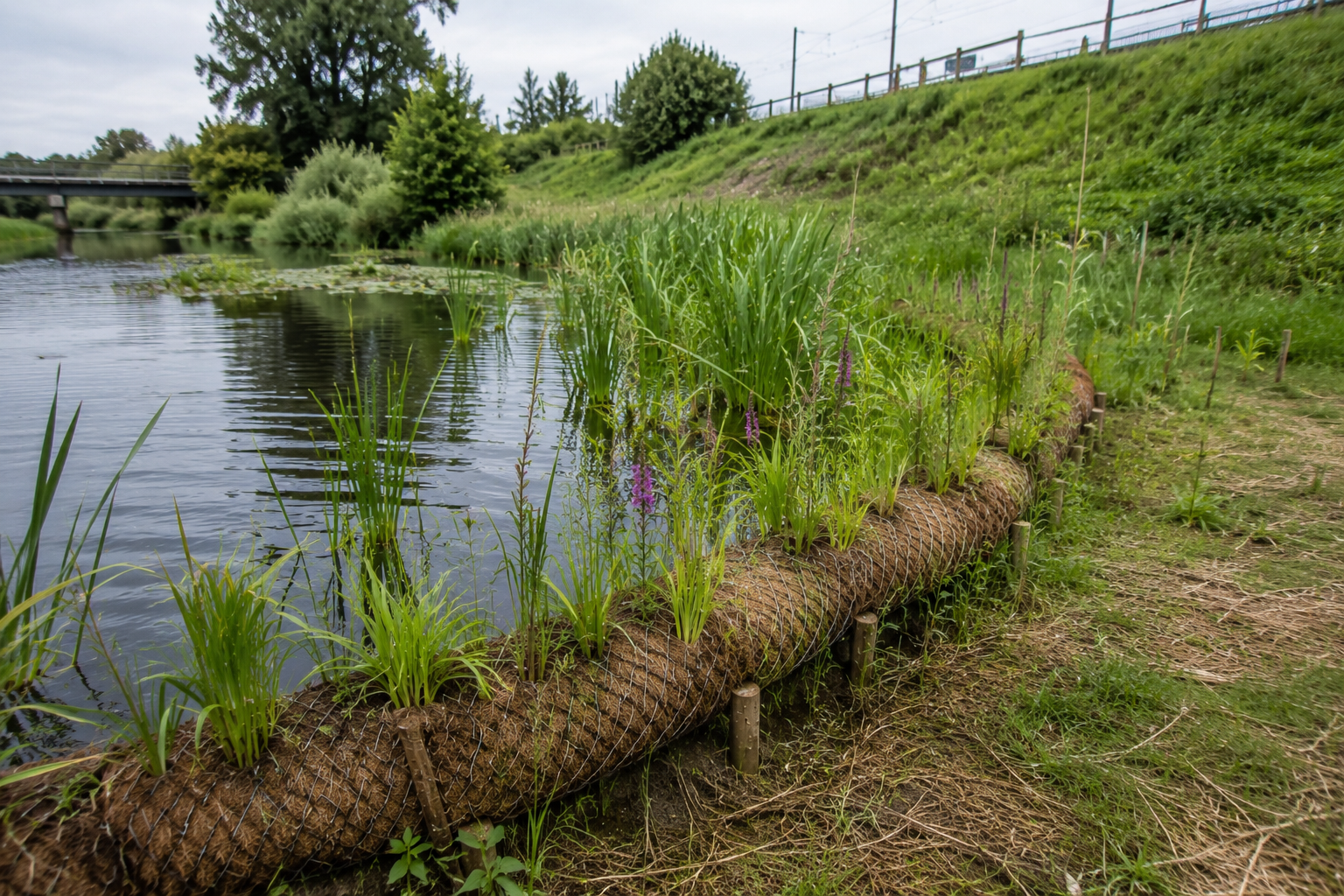
Pre-grown systems offer a practical example of how engineering and ecology can work together.
By incorporating established vegetation within engineered solutions, these systems provide immediate ecological value whilst contributing to stabilisation and environmental recovery objectives.
Unlike traditional approaches that rely entirely upon post-installation establishment, pre-grown systems can accelerate habitat development and reduce the period during which newly restored environments remain vulnerable.
This can be particularly beneficial within river restoration projects, wetland creation schemes, flood management initiatives and environmentally sensitive infrastructure works.
The result is an intervention that contributes to both engineering performance and biodiversity enhancement from the earliest stages of project delivery.
One of the defining characteristics of modern infrastructure delivery is the increasing emphasis on value.
Value is no longer measured solely through construction costs or engineering performance. Environmental outcomes, biodiversity enhancement, resilience and long-term stewardship all contribute to project success.
This is encouraging greater adoption of solutions capable of delivering multiple outcomes simultaneously.
Projects that stabilise riverbanks whilst creating habitat. Schemes that improve flood resilience whilst enhancing biodiversity. Restoration programmes that protect infrastructure whilst supporting ecological recovery.
These examples demonstrate how engineering interventions can contribute to a wider range of objectives than previously considered.
The future of infrastructure delivery is likely to involve increasing collaboration between engineering and environmental disciplines.
As climate pressures, biodiversity targets and environmental expectations continue to evolve, projects will require solutions that support both technical and ecological performance.
The most effective interventions are unlikely to be those that prioritise one objective at the expense of the other.
Instead, they will be solutions capable of protecting infrastructure whilst creating environmental value.
This represents more than a change in design philosophy.
It reflects a broader shift in how infrastructure itself is understood.
Increasingly, successful projects are not defined solely by the assets they protect.
They are defined by the landscapes they help create.
When engineering and ecology are considered together, infrastructure can become more resilient, more sustainable and more valuable for future generations.
Creating habitat whilst protecting infrastructure is no longer an aspiration.
It is becoming an expectation.
For much of the twentieth century, river engineering was often characterised by control. Watercourses were straightened, channels were reinforced and banks were protected using increasingly
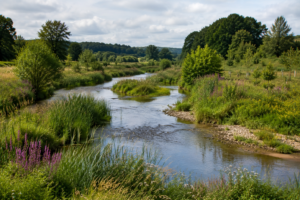
Across the UK, river restoration is becoming an increasingly important component of environmental management, flood resilience and habitat recovery. Decades of channel modification, hard engineering,
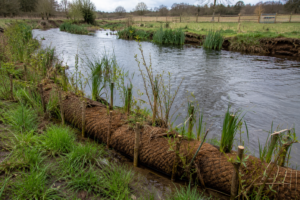
Flood risk management is undergoing a period of significant change. Across the UK, increasing rainfall intensity, urban expansion and changing climate patterns are placing growing
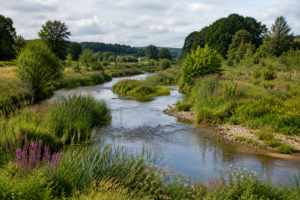
Across the UK, river restoration is becoming an increasingly important component of environmental management, flood resilience and habitat recovery. Decades of channel modification, hard engineering,