Within erosion control and geotechnical engineering, project success has traditionally been measured at the point of installation.
If a slope was stabilised, a riverbank secured or an embankment protected immediately following construction, the intervention was often considered complete from an engineering perspective. Yet across infrastructure networks throughout the UK, the long-term reality is often far more complex.
The performance of erosion control systems is rarely determined solely by what happens during installation. In many cases, the most important phase begins afterwards.
As infrastructure owners face growing pressure around climate resilience, environmental accountability and long term asset management, the industry is gradually moving towards a more holistic understanding of erosion control performance one that considers not only short-term stabilisation, but also how landscapes behave, recover and evolve over decades.
This shift towards whole life thinking is becoming increasingly important across highways, rail corridors, flood defence schemes, utilities infrastructure and environmental restoration projects.
Erosion is not a static engineering challenge.
Slopes, riverbanks and exposed soils are constantly influenced by rainfall intensity, vegetation establishment, hydrological movement and changing climatic conditions. Systems that appear effective during initial installation can deteriorate rapidly if long term ecological recovery, drainage behaviour or maintenance requirements have not been properly considered during the specification stage.
For infrastructure owners, this often results in recurring maintenance cycles, additional remedial works and increased operational costs over the lifespan of an asset.
As a result, engineers and procurement teams are increasingly evaluating erosion control solutions through a lifecycle lens rather than focusing solely on immediate construction outcomes.
This includes wider questions surrounding embodied carbon, material longevity, disposal implications, ecological compatibility and long term environmental resilience.
Material choice plays an important role within this discussion.
Historically, many erosion control systems were specified around maximum durability, with limited consideration given to whether material permanence genuinely aligned with the engineering function required. In temporary erosion control applications particularly, synthetic materials designed to remain indefinitely within the landscape may continue to persist long after vegetation has established and the original engineering objective has been achieved.
This is contributing to growing interest in more proportionate and environmentally integrated approaches.
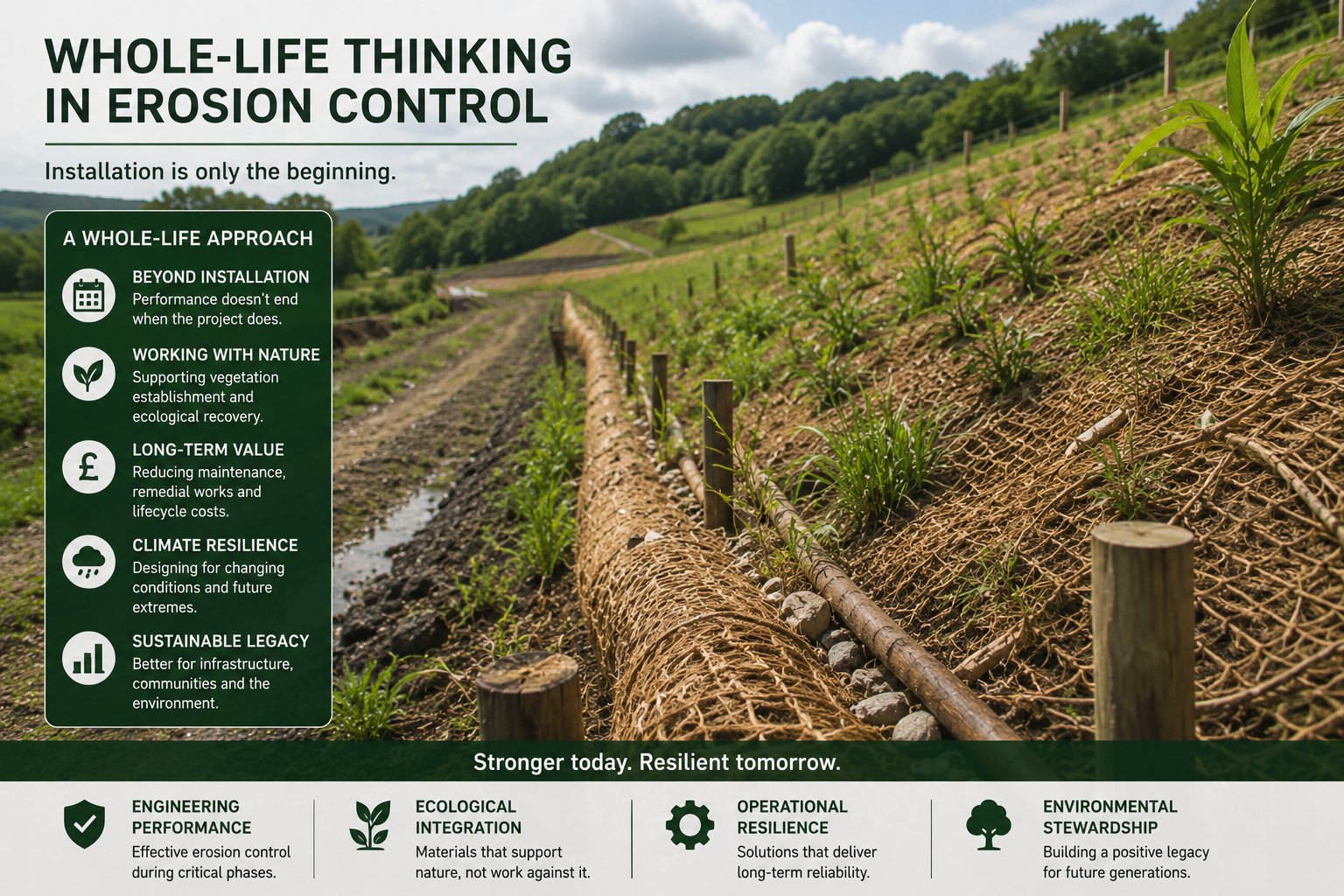
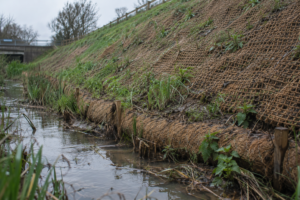
Natural fibre erosion control systems such as coir netting, coir blankets and coir logs are increasingly being used to stabilise vulnerable soils during critical establishment phases while supporting long term vegetation development and ecological recovery. Rather than acting independently from the surrounding environment, these systems are designed to work alongside natural landscape processes over time.
Importantly, whole life thinking is not simply about sustainability reporting or environmental compliance.
It is also about long term infrastructure resilience.
Vegetation establishment, surface water behaviour, maintenance accessibility and environmental integration all influence how effectively erosion control systems perform throughout the operational life of an asset. Projects that fail to account for these factors often face higher intervention costs and greater long-term instability than originally anticipated.
The wider infrastructure sector is gradually recognising that erosion control cannot be treated as an isolated construction activity disconnected from future landscape performance.
Instead, it is becoming part of a broader asset stewardship strategy one that balances engineering functionality, ecological recovery and long term operational resilience together.
For geotechnical engineering and infrastructure delivery alike, this represents a significant shift in perspective.
Installation may mark the beginning of erosion control works on site, but increasingly, it is the decades that follow which determine whether those interventions can truly be considered successful.