For many years, material selection within civil engineering and infrastructure projects was driven primarily by technical performance, programme efficiency and upfront cost. If a product satisfied specification requirements and met budget constraints, it was generally considered suitable for procurement.
That position is changing rapidly.
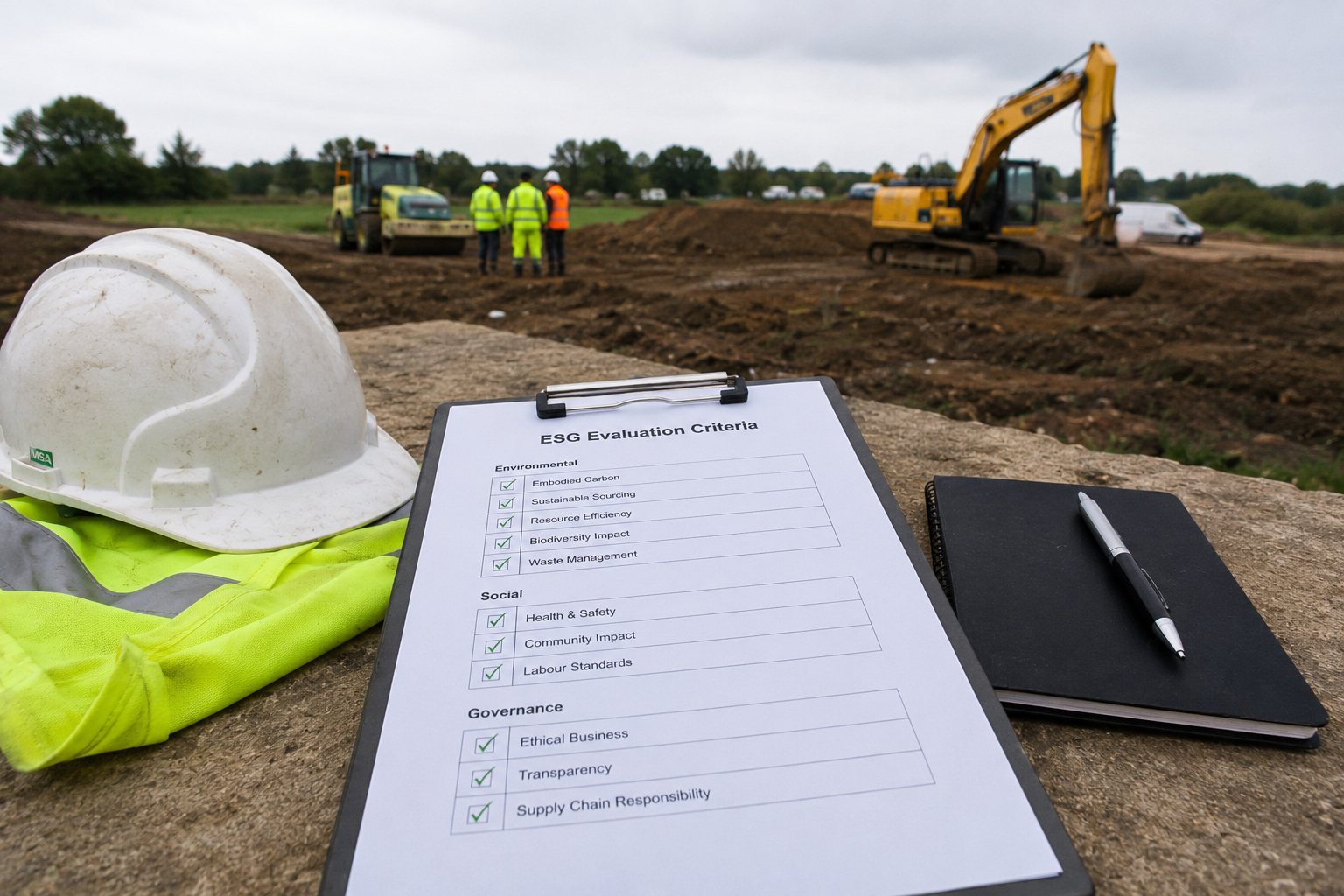
Across the UK infrastructure sector, Environmental, Social and Governance (ESG) criteria are beginning to influence procurement decisions at a scale not previously seen within engineering delivery. Increasingly, public authorities, infrastructure owners and major contractors are assessing projects not only on what is being built, but also on how it is being delivered, sourced and maintained over its entire lifecycle.
For the geotechnical and erosion control sectors, this shift carries significant implications.
Material selection is no longer viewed purely as a technical exercise. It is becoming part of a broader conversation around carbon accountability, biodiversity impact, environmental stewardship, responsible sourcing and long term sustainability performance.
This evolution is being driven by several converging pressures.
Net Zero commitments across public infrastructure bodies are accelerating demand for lower carbon construction solutions. Biodiversity Net Gain requirements are encouraging greater ecological sensitivity within land management and infrastructure delivery. At the same time, investors, regulators and local communities are placing increasing scrutiny on how infrastructure projects interact with the natural environment.
As a result, procurement frameworks are adapting accordingly.
Contractors bidding for major infrastructure schemes are increasingly expected to demonstrate measurable environmental value within tender submissions. This includes evidence surrounding embodied carbon reduction, sustainable sourcing, waste minimisation, lifecycle impacts and ecological compatibility. In many cases, these factors are now influencing competitive scoring during procurement evaluations.
Within erosion control and geotechnical engineering, this is prompting a reassessment of traditional specification approaches.
Historically, synthetic materials became deeply embedded within infrastructure supply chains due to familiarity, availability and standardisation. However, questions are increasingly being raised around the long term environmental implications associated with permanent polymer based systems particularly within applications where the engineering requirement itself may only be temporary.
This is creating growing interest in more environmentally integrated material strategies.
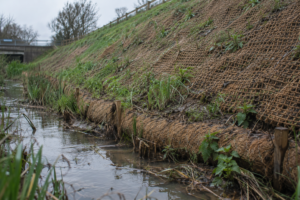
Natural fibre erosion control systems such as coir netting, coir blankets and coir logs are increasingly being considered not solely for their engineering functionality, but also for their contribution towards wider sustainability objectives. Their ability to support vegetation establishment, biodegrade naturally and reduce reliance on synthetic materials aligns closely with the direction many procurement frameworks are now moving towards.
Importantly, ESG driven procurement is not simply a passing environmental trend.
The wider infrastructure industry is undergoing a structural shift towards whole life accountability. Increasingly, clients are looking beyond short term installation costs and considering the broader environmental, operational and reputational implications of engineering decisions over decades rather than months.
This is changing how infrastructure value itself is defined.
Projects capable of balancing technical performance with carbon reduction, ecological sensitivity and responsible material selection are likely to become increasingly attractive within future procurement environments. Over time, sustainability credentials may carry similar weight to traditional engineering metrics within specification decisions.
For suppliers, consultants and contractors alike, the implication is clear: ESG considerations are no longer sitting at the edge of procurement strategy. They are steadily moving towards the centre of it.
The future of infrastructure delivery will not be shaped solely by engineering capability alone, but by how effectively projects integrate performance, resilience and environmental responsibility into every stage of decision making.