Within infrastructure delivery, temporary works are often viewed as short term necessities, important during construction phases perhaps, but secondary to the permanent engineering systems that ultimately define the finished asset.
In erosion control and geotechnical engineering, however, this assumption is increasingly being challenged.
Across highways, rail corridors, river restoration schemes and major earthworks projects, decisions made during the earliest stages of slope protection and ground stabilisation can significantly influence the long term resilience, environmental performance and maintenance profile of infrastructure assets for decades afterwards.
In many cases, temporary erosion control does not remain temporary in its consequences.
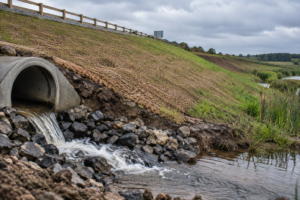
The first months following construction are frequently the most vulnerable period within any land disturbance project. Newly formed embankments, exposed soils and recently regraded slopes often lack mature vegetation and remain highly susceptible to rainfall impact, runoff concentration and sediment displacement. Without effective early stage stabilisation, small surface failures can gradually develop into larger maintenance liabilities over time.
This is particularly important as climate conditions become increasingly unpredictable.
More intense rainfall events, longer wet periods and changing hydrological behaviour are placing growing pressure on earthworks and drainage systems throughout the UK. Infrastructure assets that were once considered stable under historical weather patterns are increasingly experiencing accelerated erosion, vegetation failure and localised instability.
As a result, the role of temporary erosion control is evolving from a short term construction measure into a critical component of long-term infrastructure resilience.
The materials and systems specified during these early phases influence far more than immediate surface stability alone. They affect vegetation establishment, moisture retention, soil recovery and the ability of landscapes to develop natural long term resistance to erosion and hydraulic stress.
This is contributing to growing interest in bioengineered and environmentally integrated stabilisation approaches.
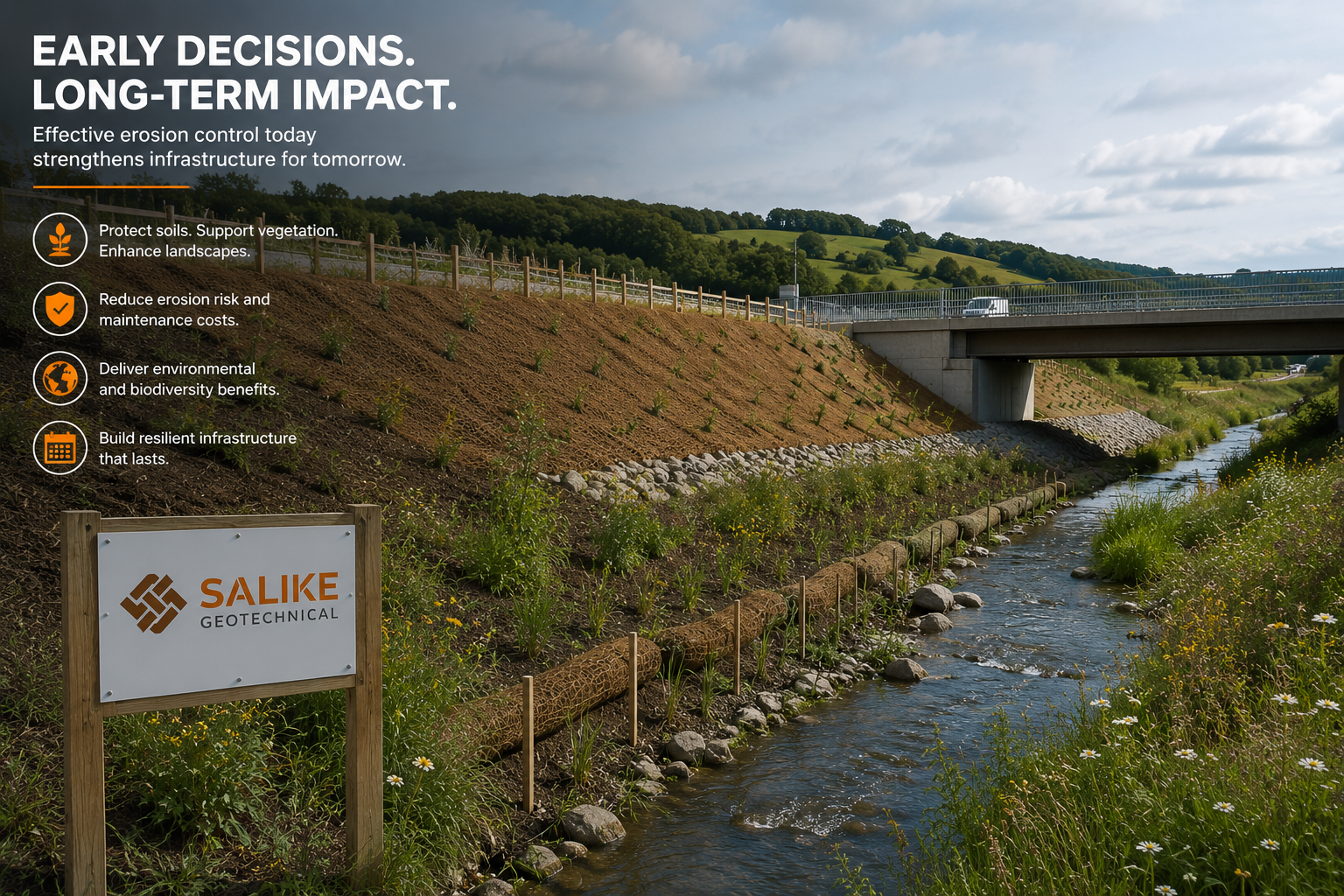
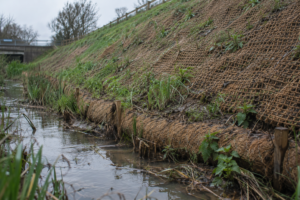
Natural fibre erosion control systems such as coir netting, coir blankets and coir logs are increasingly being used to protect vulnerable soils during establishment periods while simultaneously supporting vegetation growth and ecological recovery. Rather than functioning independently from the surrounding landscape, these systems are designed to work alongside natural stabilisation processes as vegetation matures over time.
Importantly, infrastructure resilience is no longer being assessed solely through structural performance metrics alone.
Public authorities, infrastructure owners and procurement frameworks are increasingly considering whole life asset management, embodied carbon, biodiversity outcomes and long-term environmental stewardship within engineering decision making. This is encouraging a broader understanding of what successful erosion control actually means within modern infrastructure delivery.
A slope that remains technically stable but requires repeated maintenance interventions over decades may not necessarily represent the most resilient outcome. Equally, systems that achieve short term stabilisation while undermining long-term ecological recovery can create wider environmental and operational challenges later in an asset’s lifecycle.
The wider geotechnical sector is therefore moving towards more integrated approaches that balance engineering performance with environmental adaptability and landscape recovery.
This represents an important cultural shift within infrastructure engineering.
Temporary works are no longer viewed simply as disposable construction stage interventions existing separately from long term asset performance. Increasingly, they are recognised as foundational decisions capable of influencing how infrastructure behaves, recovers and performs throughout its operational life.
For erosion control specialists and infrastructure designers alike, the implication is becoming increasingly clear.
The earliest engineering decisions made on site often leave the most permanent legacy.