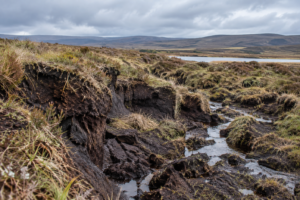
Across the UK, rainfall patterns are changing.
While flooding and extreme weather events have always formed part of the natural environment, the frequency and intensity of short duration rainfall events are becoming increasingly difficult for infrastructure owners and engineers to ignore. Surface water flooding, slope failures, drainage exceedance and erosion related asset damage are now affecting infrastructure networks with growing regularity.
For the erosion control and geotechnical sectors, this is forcing a wider reassessment of how landscapes and infrastructure are designed to cope with environmental pressure.
Traditional design assumptions based on historical weather patterns are no longer always sufficient.
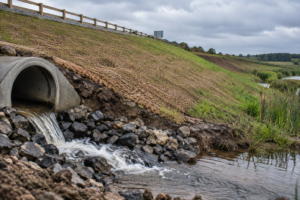
Many embankments, slopes and drainage systems across transport corridors, utilities infrastructure and development sites were originally designed around rainfall expectations that differ significantly from current climatic realities. As rainfall intensity increases, exposed soils are subjected to greater hydraulic stress, more aggressive runoff behaviour and accelerated surface degradation.
In practical terms, this means erosion can develop faster, travel further and cause more significant long-term instability than previously anticipated.
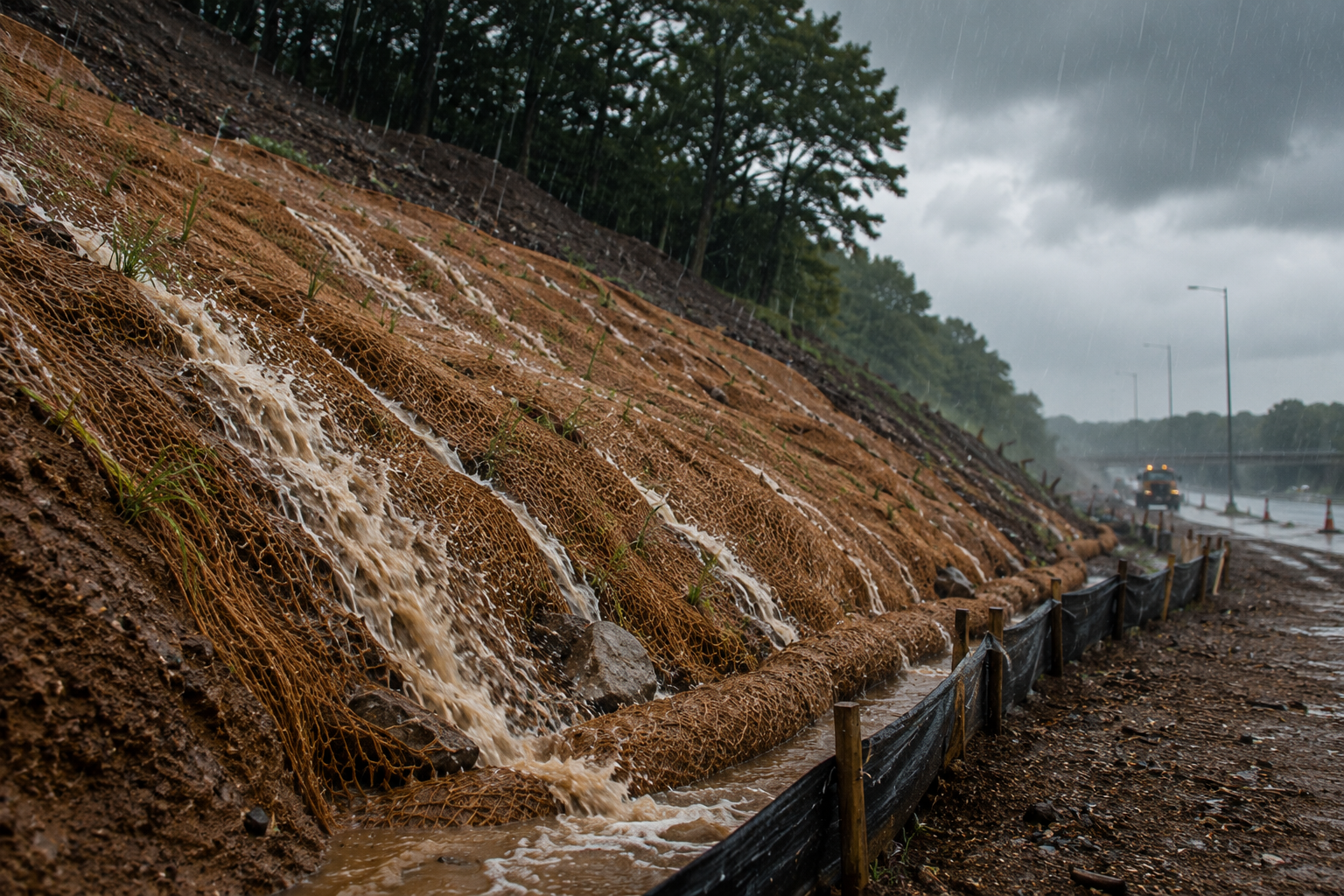
The earliest stages following construction or land disturbance are often the most vulnerable. Newly formed slopes, infrastructure cuttings and restoration areas frequently lack mature vegetation capable of resisting concentrated rainfall impact. During these periods, even relatively short duration storms can trigger surface scour, sediment displacement and localised instability if appropriate erosion control measures are not already in place.
This is becoming increasingly relevant across highways, rail infrastructure, flood defence schemes, peatland restoration projects and riverbank management works throughout the UK.
At the same time, climate resilience is no longer viewed solely as an operational issue. It is becoming a central design consideration.
Infrastructure clients and public authorities are placing greater emphasis on long-term adaptability, environmental resilience and lifecycle performance within procurement and specification strategies. Engineering systems are increasingly expected not only to perform under standard conditions, but also to remain resilient under more volatile and unpredictable weather patterns.
This is contributing to growing interest in adaptive and nature-based erosion control approaches.
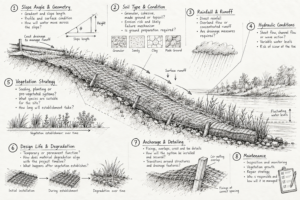
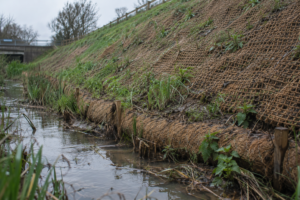
Natural fibre systems such as coir netting, coir blankets and coir logs are increasingly being used to stabilise vulnerable soils during critical establishment phases while supporting long-term vegetation development. Once established, vegetation itself becomes an important component of climate resilience by reinforcing soils, slowing runoff velocities and improving surface water management naturally over time.
Importantly, resilient erosion control is not simply about using stronger materials.
In many cases, resilience comes from designing systems capable of working alongside natural landscape processes rather than attempting to resist them entirely. Flexible, vegetated and ecologically integrated solutions often adapt more effectively to changing environmental conditions than highly rigid systems alone.
The wider infrastructure industry is gradually recognising this distinction.
Climate adaptation is no longer a theoretical discussion reserved for policy papers and sustainability reports. It is increasingly influencing practical engineering decisions on active construction sites and long term asset management programmes throughout the country.
For geotechnical engineering and erosion control specialists, this represents both a challenge and a responsibility.
The future resilience of infrastructure networks will depend heavily on how intelligently projects anticipate environmental pressure before failures occur. As climate conditions continue to evolve, erosion control can no longer be treated as a secondary landscape consideration. It is becoming a frontline component of climate-resilient infrastructure design.