Within parts of the civil engineering and geotechnical sectors, natural fibre erosion control systems are still occasionally viewed as secondary alternatives to conventional synthetic materials suitable for environmentally sensitive projects perhaps, but not always associated with high performance infrastructure delivery.
That perception is increasingly outdated.
As infrastructure design evolves towards lower carbon delivery models and more environmentally integrated engineering strategies, natural fibre systems are being reassessed not as niche ecological products, but as legitimate engineered solutions capable of performing effectively across a wide range of erosion control and slope stabilisation applications.
The key issue is often one of misunderstanding.
In many engineering discussions, biodegradability is incorrectly interpreted as weakness. Yet in erosion control, material permanence and engineering suitability are not always the same thing. The question is not simply how long a material can survive within the environment, but whether its functional lifespan aligns appropriately with the engineering objective it is intended to achieve.
This distinction is particularly important in temporary erosion control applications.
Across newly formed embankments, riverbanks, infrastructure cuttings and restoration projects, the most critical period for erosion management is often the first 12 to 24 months following installation. During this phase, exposed soils remain vulnerable to rainfall impact, runoff concentration and vegetation failure. Once mature vegetation establishes and root systems develop, the landscape increasingly begins to stabilise itself naturally.
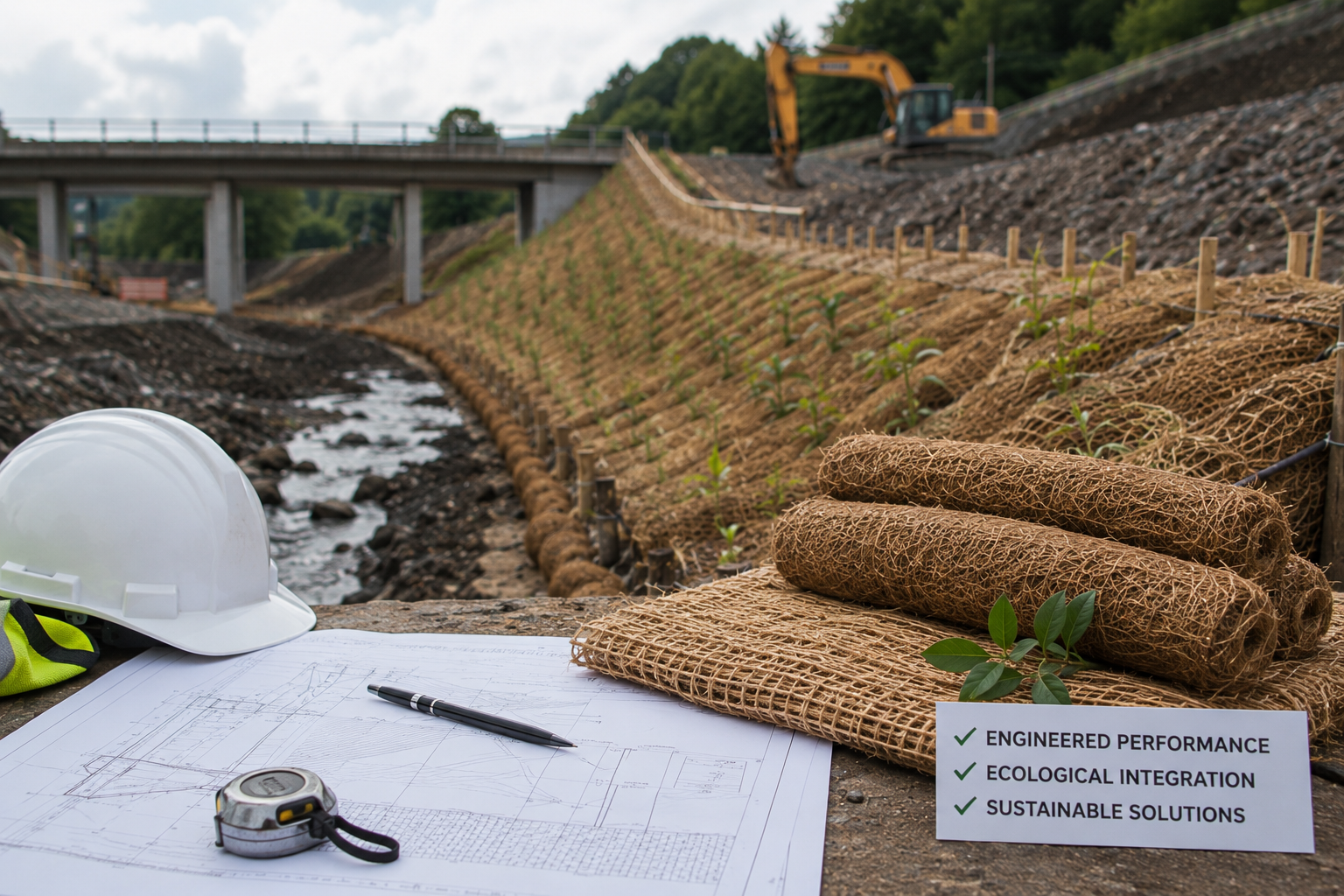
Natural fibre systems such as coir netting, coir blankets and coir logs are specifically designed around this transition period.
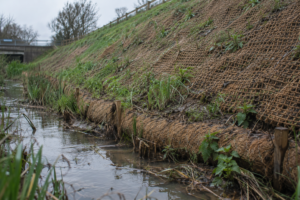
When appropriately specified and installed, coir based erosion control products can provide substantial tensile performance, surface stabilisation and hydraulic resistance while simultaneously supporting vegetation establishment and moisture retention. Their open mesh structures encourage root penetration and ecological integration, allowing the engineered system and the developing landscape to work together rather than independently.
Importantly, modern infrastructure performance is not assessed solely through short term mechanical strength alone.
Infrastructure clients and procurement frameworks are increasingly evaluating projects through broader criteria including embodied carbon, environmental compatibility, biodiversity outcomes and long term maintenance implications. As a result, engineering solutions capable of balancing technical functionality with ecological performance are becoming increasingly valuable within infrastructure delivery.
This is contributing to growing adoption of natural fibre systems across rail infrastructure, highways, river restoration schemes, flood management projects and coastal environments throughout the UK.
In many cases, the engineering challenge is no longer simply how to create the most rigid or permanent intervention possible. Instead, the focus is shifting towards proportionate engineering solutions designed to perform effectively during critical periods of vulnerability while supporting long term environmental resilience.
That shift is changing how performance itself is understood within the geotechnical sector.
Natural fibre systems are unlikely to replace every synthetic or hard engineered solution. Certain high load environments and permanent structural applications will continue to require more conventional reinforcement systems. However, the assumption that natural materials are inherently unsuitable for modern infrastructure applications is increasingly inconsistent with both current engineering practice and evolving procurement priorities.
The wider infrastructure industry is beginning to recognise that resilience, sustainability and technical performance do not need to operate in conflict with one another.
For erosion control and geotechnical engineering specialists, the future is likely to favour solutions capable of integrating all three.