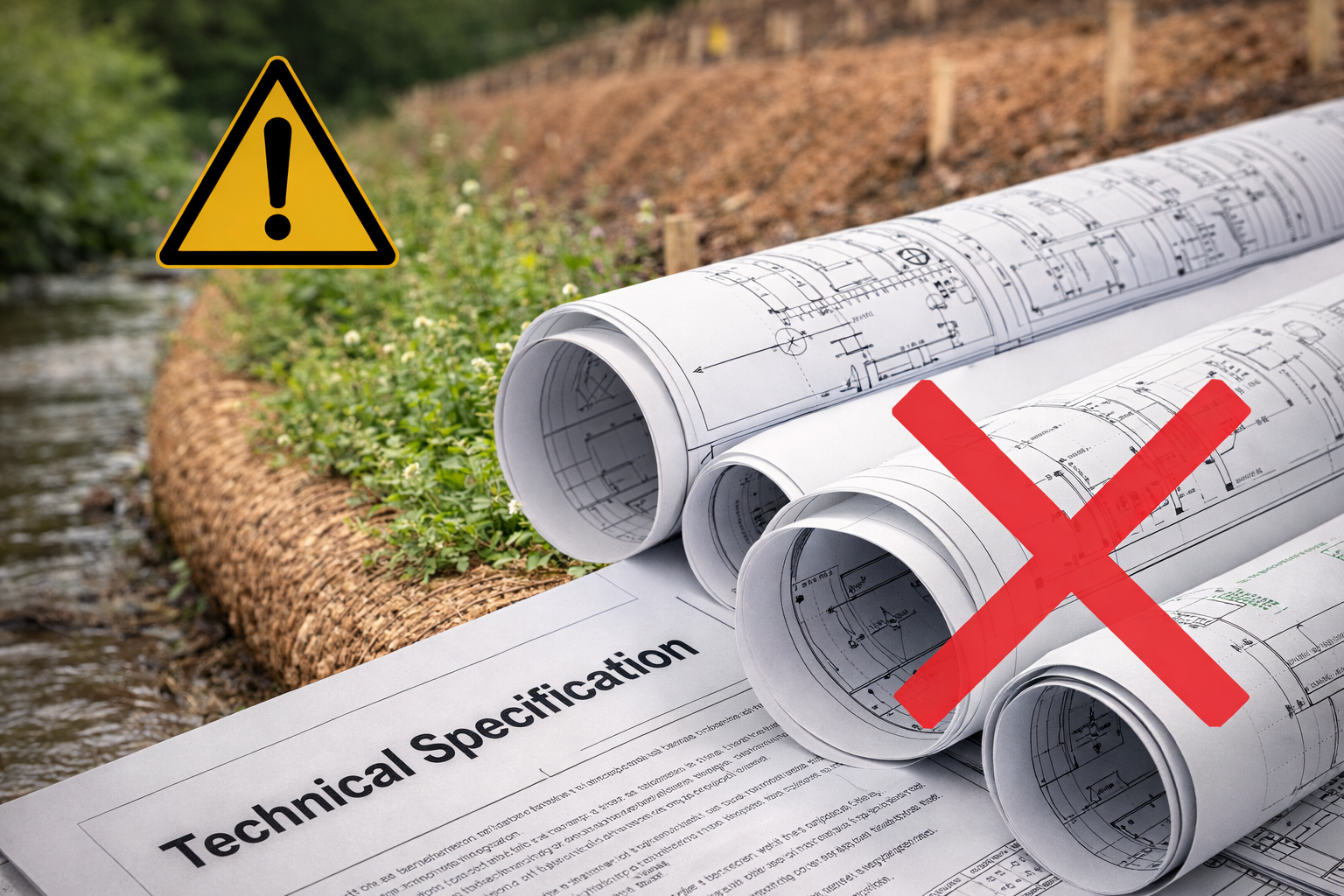
Policy has moved, specifications have not
The United Kingdom’s infrastructure landscape is undergoing a fundamental shift. Legislative and regulatory frameworks now place environmental performance, carbon reduction and biodiversity at the centre of design and procurement decisions.
The Climate Change Act 2008 establishes a legally binding commitment to achieve net zero greenhouse gas emissions by 2050. In parallel, the Environment Act 2021 introduces mandatory biodiversity net gain (BNG), requiring developments to deliver measurable ecological improvements.
Together, these frameworks signal a clear direction: infrastructure must not only perform technically, but also contribute positively to environmental outcomes.
However, despite this policy clarity, a disconnect remains within engineering practice, particularly at the level of material specification.
The Persistence of Conventional Materials
Across many geotechnical and erosion control applications, specifications continue to favour:
- synthetic geotextiles
- polymer based erosion control systems
- hard engineered solutions with extended design lives
These materials are often selected as a matter of convention, embedded within standard details, legacy specifications and risk averse design approaches. In many cases, their inclusion is not actively questioned, even where project objectives emphasise sustainability, carbon reduction and ecological integration.
The result is a contradiction:
projects designed to meet progressive environmental targets are frequently delivered using materials that do not align with those same objectives.
Understanding the Specification Gap
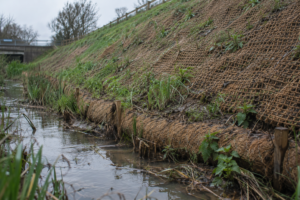
This misalignment, the specification gap, is not the result of a lack of viable alternatives. Natural fibre systems, including coir and jute based geotextiles, have been extensively proven in erosion control and bioengineering applications.
Instead, the gap arises from a combination of factors:
- Legacy design standards, where historical specifications persist despite evolving requirements
- Perceived risk, particularly around durability and performance consistency
- Limited awareness, where designers and specifiers are unfamiliar with the capabilities of natural fibre systems
- Specification inertia, where established solutions are replicated without reassessment
Critically, this gap is structural rather than technical.
Natural fibre systems in a policy aligned framework
When assessed against current policy objectives, natural fibre systems offer a compelling alignment.
In erosion control applications, coir based solutions provide:
- effective short term stabilisation
- support for vegetation establishment
- biodegradation aligned with natural processes
- minimal long term environmental impact
From a whole life perspective, these characteristics contribute to:
- reduced embodied carbon
- elimination of long term material persistence
- improved ecological integration
In the context of biodiversity net gain and carbon reporting, such outcomes are not peripheral they are central to project success.
From compliance to specification leadership
Bridging the specification gap requires more than incremental change. It demands a shift in how materials are evaluated, selected and justified within design processes.
For consultants and specifiers, this involves:
- actively aligning material choices with policy objectives
- reassessing standard details and legacy specifications
- considering whole life performance, not just initial function
- engaging with systems that support both engineering and ecological outcomes
This is not a move away from engineering rigour, but towards a more complete application of it.
Conclusion: closing the gap
The gap between policy ambition and specification practice represents both a challenge and an opportunity.
As regulatory expectations continue to evolve, the ability to integrate sustainable, nature-based solutions into engineering design will become a defining characteristic of leading organisations.
The question is no longer whether natural fibre systems can perform but whether specifications will evolve to reflect the realities of modern infrastructure delivery.
At Salike®, we see this transition as inevitable. More importantly, we see it as necessary enabling engineers to deliver solutions that are not only technically sound, but fully aligned with the environmental responsibilities shaping the future of the industry.