Engineering decisions in the age of carbon accountability
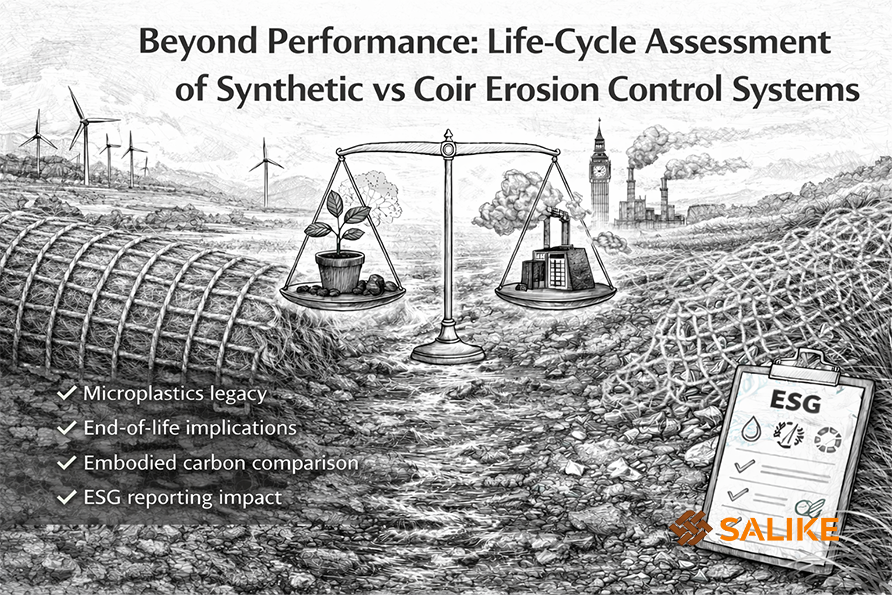
As infrastructure delivery in the United Kingdom becomes increasingly shaped by climate policy, biodiversity obligations and procurement scrutiny, material choice in erosion control can no longer be assessed solely on tensile strength or installation speed. Whole life impact carbon, persistence, environmental legacy and reporting implications now forms part of the engineering brief.
The Climate Change Act 2008 (as amended) commits the UK to achieving net zero greenhouse gas emissions by 2050. In parallel, public bodies are required to consider environmental impact under the Environment Act 2021, while biodiversity net gain requirements are reshaping land development and restoration practice. Within this evolving regulatory context, erosion control systems must be evaluated not merely for performance, but for their life cycle consequences.
At Salike®, we view material selection as a matter of engineering responsibility. The question is no longer whether a system performs but how it performs over its entire lifespan.
Life Cycle Assessment: from extraction to end of life
Life Cycle Assessment (LCA) considers the environmental impact of a product across its full journey: raw material extraction, manufacture, transport, installation, operational life and final disposition.
Synthetic erosion control systems typically manufactured from polypropylene, polyethylene or other polymer based geotextiles derive from fossil fuel feedstocks. Their production is energy intensive and results in embedded carbon within the material itself. Once installed, such products may remain in situ for decades, often beyond the functional life of the slope or bank stabilisation scheme.
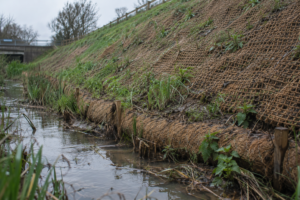
Natural fibre systems, by contrast, originate from renewable agricultural by products. Coir, derived from coconut husk fibre, is biodegradable and designed to perform during the critical establishment phase before gradually reintegrating into the soil profile. While all manufactured products carry some embodied carbon, the key distinction lies in persistence and end of life behaviour.
Microplastics and environmental legacy
One of the increasingly examined aspects of polymer based materials is their long term fragmentation. The UK Government’s Microbeads Regulations and wider research initiatives reflect a growing awareness of microplastic pollution in soils and waterways.
Although erosion control geotextiles are not equivalent to cosmetic microbeads, polymer materials exposed to ultraviolet degradation, mechanical abrasion and time can fragment. In sensitive environments river corridors, peatlands, wetlands the potential for long term polymer residues must be considered in design decisions.
Biodegradable natural fibre systems avoid this legacy. Once vegetation establishes and root reinforcement assumes structural responsibility, coir fibres break down through natural biological processes, contributing organic matter rather than persistent fragments.
For projects explicitly designed to restore ecosystems, the alignment between material behaviour and ecological intent is significant.
Embodied carbon and whole life logic
The UK Government’s Net Zero Strategy emphasises reducing emissions across infrastructure supply chains. Increasingly, contractors and consultants are required to quantify Scope 3 emissions those embedded within materials and procurement.
While precise embodied carbon figures vary depending on manufacturing source, transport distance and specification, the underlying distinction remains clear: polymer geosynthetics are fossil derived and carbon intensive at source; coir systems are plant based and renewable.
Moreover, the permanence of synthetic materials means that carbon embodied in them remains effectively “locked” within the landscape. Coir products, by contrast, support vegetation establishment which in turn contributes to carbon sequestration through biomass growth and soil stabilisation.
The carbon logic of temporary natural reinforcement in regenerative landscapes is therefore materially different from permanent polymer insertion.
End of life implications
End of life considerations are often overlooked in temporary erosion control. In many cases, synthetic materials are left in situ because removal is impractical or uneconomic. Over decades, these materials may remain buried within soils that were originally subject to ecological restoration.
Natural fibre systems are designed with transition in mind. Their structural function diminishes as vegetation roots strengthen the substrate. Degradation is not failure; it is part of the design philosophy.
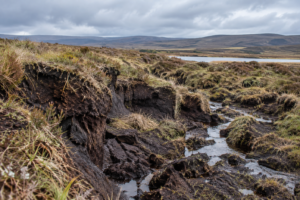
This distinction is critical in peatland restoration, riverbank stabilisation and biodiversity enhancement schemes, where material persistence can conflict with long term habitat objectives.
ESG reporting and procurement scrutiny
Environmental, Social and Governance (ESG) frameworks are now embedded within public procurement and corporate reporting. Organisations delivering infrastructure projects are increasingly required to demonstrate not only compliance, but environmental stewardship.
Material choice in erosion control may appear minor in isolation. Yet across linear infrastructure corridors and large scale restoration programmes, these choices aggregate into measurable environmental impact.
Specifying biodegradable, renewable systems can support:
- Carbon reduction narratives
- Biodiversity alignment
- Reduced long term material liability
- Demonstrable commitment to regenerative design
In this context, erosion control is no longer simply a geotechnical discipline. It becomes part of a wider environmental accountability framework.
Engineering integrity beyond tensile strength
At Salike®, we believe performance must remain paramount. Natural systems must meet practical engineering demands predictable tensile capacity, reliable installation characteristics and consistent manufacturing quality.
However, in landscapes where environmental restoration is the objective, the persistence of synthetic materials may conflict with long term ecological aims.
Beyond performance lies responsibility. Whole life assessment reveals that erosion control systems differ not only in how they stabilise soil, but in how they inhabit the landscape long after installation.
For UK organisations navigating net zero commitments, biodiversity obligations and ESG reporting frameworks, material selection in erosion control represents more than a technical detail. It is a strategic decision one that should align engineering reliability with environmental stewardship.
And in the evolving discipline of regenerative geotechnics, that alignment is fast becoming the new benchmark.