Precision-engineered biodegradable natural fibres for consistent, reliable performance.

Complete Guide to Coir Netting

What is Coir Netting?

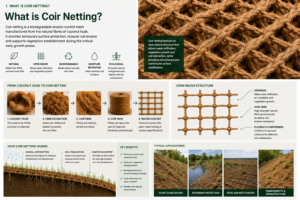
Coir netting is a biodegradable erosion control mesh manufactured from natural coconut fibres, designed to provide temporary surface stabilisation while supporting long-term vegetation establishment and environmental recovery.

Produced from the fibrous outer husk of coconuts, coir has been used for centuries due to its natural strength, durability and resistance to moisture degradation. In modern infrastructure and environmental engineering applications, these fibres are processed into woven netting systems that help protect exposed soil surfaces from erosion caused by rainfall, surface runoff, wind and environmental disturbance.

Unlike permanent synthetic erosion control materials, coir netting is intentionally designed to function as a temporary engineered system. Its role is to stabilise the landscape during the critical establishment phase of vegetation, before gradually biodegrading and reintegrating into the surrounding environment over time.

This transition-based performance philosophy is one of the defining characteristics of natural fibre erosion control systems.

At a material level, coir fibres are extracted from coconut husks, cleaned, sorted and spun into yarns or twines of varying thicknesses. These yarns are then woven into open mesh structures using different weave densities and configurations depending on the required engineering performance, durability and application.

The resulting netting combines:

  • structural surface reinforcement,
  • erosion resistance,
  • moisture retention,
  • vegetation support,
  • ecological compatibility.

The open weave structure is particularly important. Unlike impermeable surface coverings, coir netting allows water infiltration, vegetation penetration and natural interaction between the soil, atmosphere and developing root systems. This enables the landscape itself to progressively become the long-term stabilisation mechanism.

Today, coir netting is widely used across:

  • slope stabilisation projects,
  • riverbank protection works,
  • peatland restoration schemes,
  • renewable energy infrastructure,
  • highways and embankments,
  • ecological landscaping,
  • broader nature-based infrastructure applications.

Its increasing adoption reflects a wider shift within engineering and infrastructure sectors towards materials and systems that not only perform technically, but also align with modern sustainability, biodiversity and whole life environmental objectives.

From an engineering perspective, coir netting should not simply be viewed as a “natural alternative” to synthetic mesh systems. It represents a distinct category of erosion control material, one designed to work with ecological recovery processes rather than permanently override them.

Why Coir Netting is Used

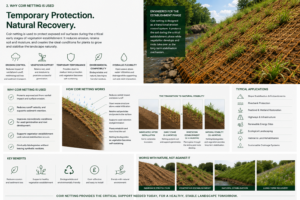
Coir netting is used within erosion control and land rehabilitation projects to provide temporary surface stabilisation while supporting the long-term establishment of vegetation and natural ground recovery.

In many environments, exposed soil surfaces are highly vulnerable during the early stages following disturbance. Construction activity, earthworks, vegetation clearance, infrastructure installation and land reprofiling can leave slopes and surfaces susceptible to:

  • rainfall erosion,
  • sediment loss,
  • runoff damage,
  • surface instability,
  • vegetation failure.

Without temporary protection, even moderate rainfall events can rapidly displace topsoil, create rilling and gullying, damage seedbeds and compromise restoration objectives.

Coir netting is therefore installed as a transitional erosion control system designed to protect the soil surface during this critical establishment phase.

Unlike impermeable coverings or permanent synthetic barriers, coir netting works by interacting with both the soil and the developing vegetation system.

The open mesh structure helps:

  • reduce the velocity of surface runoff,
  • minimise direct rainfall impact,
  • retain soil particles,
  • support seed retention,
  • create improved microclimatic conditions for germination and root development.

As vegetation establishes, plant roots progressively become the long-term stabilisation mechanism.

This is one of the most important engineering principles behind coir netting systems:
the netting itself is not intended to function as permanent structural reinforcement.

Instead, it acts as a temporary engineered support layer that enables the landscape to naturally recover and stabilise itself over time.

This philosophy aligns closely with modern approaches to:

  • nature-based infrastructure,
  • regenerative land management,
  • ecological engineering,
  • sustainable erosion control design.

Why Engineers and Environmental Specialists Specify Coir Netting

Coir netting is increasingly specified across infrastructure and environmental projects because it provides a balance between:

  • engineering functionality,
  • environmental compatibility,
  • installation practicality,
  • sustainable material performance.

Key reasons for its adoption include:

Surface Erosion Protection

Coir netting helps protect exposed soils against:

  • rainfall impact,
  • wind erosion,
  • surface washout,
  • sediment transport.

This is particularly important on:

  • embankments,
  • disturbed slopes,
  • riverbanks,
  • newly seeded areas.

Vegetation Establishment Support

The structure of coir netting supports vegetation growth by:

  • retaining moisture,
  • protecting seeds,
  • reducing soil displacement,
  • stabilising root zones during early growth stages.

This improves the likelihood of successful revegetation.

Temporary Engineered Performance

One of the defining characteristics of coir netting is that it is intentionally biodegradable.

In many erosion control applications, the objective is not permanent surface armouring, but temporary protection until vegetation becomes self-sustaining.

Coir netting therefore provides:

  • short-to-medium term stabilisation,
  • followed by gradual natural degradation,
  • without leaving synthetic residues within the environment.

Environmental Compatibility

Natural fibre systems are increasingly preferred within environmentally sensitive projects due to concerns surrounding:

  • plastic persistence,
  • microplastic pollution,
  • ecological disturbance,
  • long term environmental impact.

Coir netting integrates naturally into:

  • restoration schemes,
  • wetland environments,
  • peatland systems,
  • biodiversity-focused infrastructure projects.

Hydraulic Flexibility

The permeable open-weave structure allows:

  • water infiltration,
  • drainage,
  • vegetation penetration,
  • natural soil-atmosphere interaction.

This makes coir netting particularly suitable for ecological and hydrologically sensitive environments.

Sustainability & Nature Based Infrastructure

As infrastructure delivery increasingly prioritises:

  • Net Zero targets,
  • biodiversity enhancement,
  • whole-life carbon reduction,
  • sustainable procurement,

natural fibre erosion control systems are becoming increasingly relevant across modern engineering and environmental projects.

Coir netting forms part of a broader transition towards:

Infrastructure systems that work with natural recovery processes rather than against them.

Typical Situations Where Coir Netting is Used

Coir netting is commonly specified within:

  • Slope stabilisation works
  • Riverbank protection
  • Peatland restoration
  • Ecological landscaping
  • Habitat restoration
  • Highway embankments
  • Renewable energy infrastructure
  • Land rehabilitation schemes
  • Sustainable drainage systems
  • Vegetation establishment projects
 
How Coir Netting Works

Coir netting functions as a temporary surface stabilisation system designed to reduce erosion, protect exposed soils and support the establishment of vegetation during the critical early phases of landscape recovery.

Rather than acting as a rigid barrier, coir netting works through a combination of physical reinforcement, hydraulic interaction and ecological integration.

Its open weave structure allows the material to interact naturally with:

  • rainfall,
  • surface runoff,
  • soil particles,
  • vegetation,
  • developing root systems.

This creates a stabilising layer that protects the soil surface while enabling long-term natural recovery processes to take place.

The Core Engineering Functions of Coir Netting

Coir netting works through several simultaneous mechanisms.

Rainfall Impact Reduction

One of the primary causes of erosion is the direct impact of rainfall on exposed soil surfaces.

Raindrop impact can:

  • detach soil particles,
  • break apart surface structure,
  • initiate sediment movement.

Coir netting acts as a protective interception layer.

The woven fibre structure absorbs and disperses rainfall energy before it reaches the soil surface directly.

This helps:

  • minimise particle detachment,
  • reduce splash erosion,
  • protect vulnerable seedbeds.

Surface Runoff Control

During rainfall events, water flowing across exposed slopes can rapidly transport loose sediment downslope.

The open mesh structure of coir netting helps slow the velocity of surface runoff.

This reduces:

  • soil washout,
  • rill formation,
  • sediment transport,
  • localised surface instability.

By interrupting water flow pathways, the netting helps stabilise the upper soil layer during the establishment phase.

Soil Confinement & Surface Reinforcement

Coir netting provides temporary surface reinforcement by helping confine soil particles and stabilise loose topsoil.

The woven mesh structure:

  • holds surface material in place,
  • improves slope surface integrity,
  • assists with maintaining soil contact during rainfall and wind exposure.

This is particularly important on:

  • newly graded slopes,
  • embankments,
  • disturbed land,
  • erosion-prone surfaces.

Seed Retention & Germination Support

Without protection, seeds on exposed slopes can easily be displaced by:

  • wind,
  • rainfall,
  • runoff,
  • or sediment movement.

Coir netting helps retain seeds within the soil surface while also creating improved conditions for germination.

The fibre matrix:

  • traps organic material,
  • helps maintain soil moisture,
  • reduces temperature fluctuation,
  • creates a more stable microenvironment for vegetation establishment.

Root Development & Vegetation Integration

As vegetation begins to establish, plant roots progressively grow through and beneath the coir mesh structure.

Over time:

  • roots interlock with the soil,
  • vegetation density increases,
  • the landscape gradually develops natural structural stability.

The netting therefore transitions from being the primary stabilisation layer to a secondary support layer as vegetation becomes self-sustaining.

This transition is fundamental to how natural fibre erosion control systems are intended to perform.

Moisture Retention

Coir fibres naturally retain moisture due to their fibrous structure and organic composition.

This helps:

  • reduce surface drying,
  • maintain seedbed moisture,
  • support early-stage vegetation growth.

Moisture retention is especially valuable in:

  • exposed slopes,
  • dry climates,
  • newly seeded areas where vegetation establishment may otherwise be difficult.

Controlled Biodegradation

Unlike synthetic erosion control meshes, coir netting is designed to gradually biodegrade over time.

As vegetation establishes and root systems mature:

  • the dependence on the netting decreases,
  • the landscape progressively becomes naturally stabilised.

The coir fibres then slowly decompose and reintegrate into the surrounding environment without leaving permanent synthetic residue.

This creates a transition from:

engineered intervention to natural stabilisation.

The Temporary-to-Natural Stabilisation Process

One of the most important concepts in coir netting design is that the material supports a staged recovery process.

Stage 1 – Immediately After Installation

  • Soil surface is highly vulnerable
  • Coir netting provides immediate protection
  • Surface runoff is reduced
  • Soil particles are retained

Stage 2 – Early Vegetation Establishment

  • Seeds begin germination
  • Root systems develop
  • Moisture retention supports growth
  • Netting stabilises surface conditions

Stage 3 – Vegetation Integration

  • Root networks strengthen the soil
  • Vegetation density increases
  • Natural stabilisation mechanisms develop

Stage 4 – Long-Term Natural Stability

  • Vegetation becomes self-sustaining
  • Coir netting biodegrades gradually
  • The landscape itself becomes the long-term erosion control system

Why This Engineering Approach Matters

Traditional erosion control systems often rely on permanent synthetic reinforcement.

Modern nature-based infrastructure increasingly focuses on:

  • temporary intervention,
  • ecological recovery,
  • long-term environmental integration.

Coir netting represents this shift in engineering philosophy.

Rather than permanently armouring the landscape, it provides temporary engineered support that enables natural systems to recover and stabilise themselves over time.

This makes coir netting particularly relevant within:

  • sustainable infrastructure,
  • ecological engineering,
  • peatland restoration,
  • river restoration,
  • biodiversity-focused land management projects.
Types of Coir Netting

Coir netting is available in a range of weave configurations, fibre densities and performance grades designed to suit different erosion control, vegetation establishment and environmental engineering applications.

Not all coir netting performs in the same way.

The engineering characteristics of a coir netting system are influenced by several key variables, including:

  • fibre quality,
  • yarn thickness,
  • weave structure,
  • mesh aperture size,
  • mass per unit area (grams per square meter – gsm),
  • and manufacturing methods.

Selecting the appropriate coir netting specification is therefore critical to achieving suitable performance for the intended site conditions and project objectives.

In erosion control applications, lighter-grade systems may provide adequate short-term protection for low-risk environments, while heavier-grade systems are typically specified where:

  • slopes are steeper,
  • hydraulic exposure is greater,
  • vegetation establishment may take longer,
  • or extended functional lifespan is required.

Understanding GSM in Coir Netting

One of the most common methods of categorising coir netting is by:

GSM (grams per square metre).

GSM refers to the mass of material present across a square metre of netting and is generally associated with:

  • fibre density,
  • durability,
  • structural robustness,
  • and expected functional lifespan.

In general:

  • lower GSM systems are lighter and more flexible,
  • higher GSM systems provide greater reinforcement and longer-term erosion protection.

However, specification should never be based on GSM alone.

Performance also depends heavily on:

  • fibre quality,
  • yarn construction,
  • weave consistency,
  • installation quality,
  • and site conditions.

Common Types of Coir Netting

400gsm Coir Netting

Lightweight Surface Erosion Protection

400gsm coir netting is typically used for:

  • low-gradient slopes,
  • light erosion control,
  • landscaping,
  • and short-term vegetation establishment applications.

Characteristics:

  • lighter weave structure,
  • increased flexibility,
  • faster biodegradation profile,
  • easier handling and installation.

Typical applications:

  • garden slopes,
  • ecological landscaping,
  • temporary revegetation,
  • low-flow environments.

Typical lifespan:
approximately 2-3 years depending on environmental conditions.

700gsm Coir Netting

General-Purpose Erosion Control System

700gsm coir netting is one of the most widely specified grades for:

  • infrastructure projects,
  • embankments,
  • riverbanks,
  • and medium-risk erosion environments.

It provides a balance between:

  • flexibility,
  • durability,
  • vegetation integration,
  • and hydraulic performance.

Characteristics:

  • stronger yarn structure,
  • improved surface reinforcement,
  • moderate-to-long functional lifespan,
  • enhanced erosion resistance.

Typical applications:

  • roadside embankments,
  • riverbank stabilisation,
  • ecological restoration,
  • renewable energy sites,
  • sustainable drainage systems.

Typical lifespan:
approximately 3-5 years depending on exposure conditions.


900gsm Coir Netting

Enhanced Durability & Reinforcement

900gsm coir netting is designed for more demanding erosion control conditions where:

  • extended protection,
  • higher durability,
  • or increased surface stability is required.

Characteristics:

  • denser fibre structure,
  • increased tensile robustness,
  • improved resistance to hydraulic stress,
  • longer degradation profile.

Typical applications:

  • steeper slopes,
  • exposed environments,
  • infrastructure corridors,
  • high rainfall regions,
  • larger-scale restoration projects.

Typical lifespan:
approximately 4-6 years depending on environmental conditions.

1200gsm Coir Netting

Heavy-Duty Natural Fibre Erosion Control

1200gsm coir netting represents one of the heaviest natural fibre erosion control meshes commonly available.

It is typically specified where:

  • erosion exposure is significant,
  • vegetation establishment may be slower,
  • or extended temporary reinforcement is required.

Characteristics:

  • heavy yarn construction,
  • high fibre density,
  • enhanced durability,
  • increased surface reinforcement capacity.

Typical applications:

  • aggressive slope conditions,
  • large infrastructure embankments,
  • severe erosion environments,
  • long-term restoration works,
  • exposed coastal or upland applications.

Typical lifespan:
approximately 5-8 years depending on site conditions.

Open Weave vs Dense Weave Structures

Coir netting systems may also vary in weave openness and aperture configuration.

Open Weave Systems

Designed to:

  • maximise vegetation penetration,
  • improve water infiltration,
  • support rapid ecological integration.

Typically used where:

  • vegetation establishment is prioritised,
  • erosion exposure is moderate.

Dense Weave Systems

Provide:

  • greater immediate surface protection,
  • improved sediment retention,
  • enhanced resistance to runoff.

Typically specified where:

  • erosion forces are higher,
  • soil stability is more critical during establishment.

Machine-Woven vs Hand-Woven Coir Netting

Depending on manufacturing methods, coir netting may be:

  • machine woven,
  • semi-mechanically produced,
  • hand woven.

Machine-woven systems generally provide:

  • greater consistency,
  • dimensional uniformity,
  • repeatable engineering characteristics.

Hand-woven systems may vary more naturally in:

  • aperture size,
  • yarn tension,
  • overall appearance.

Choosing the Right Type of Coir Netting

Appropriate specification depends on:

  • slope gradient,
  • rainfall intensity,
  • hydraulic exposure,
  • soil conditions,
  • vegetation strategy,
  • project lifespan,
  • environmental sensitivity,
  • installation methodology.

Specification should therefore be considered within the wider context of:

site engineering requirements,

rather than simply selecting the “heaviest” product available.

In many situations, successful erosion control depends more on:

  • correct installation,
  • vegetation establishment,
  • environmental compatibility,
    than purely on mesh density alone.

Typical Comparison Table

Type

Typical Use

Relative Durability

Typical Lifespan

400gsm

Landscaping & light slopes

Moderate

2–3 years

700gsm

General erosion control

High

3–5 years

900gsm

Higher exposure slopes

Very High

4–6 years

1200gsm

Heavy-duty applications

Maximum

5–8 years

Engineering Characteristics

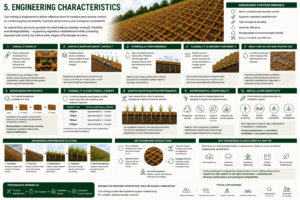
The engineering performance of coir netting is influenced by a combination of material properties, manufacturing quality, fibre structure and environmental interaction.

Although coir netting is derived from natural coconut fibre, it should not be viewed simply as an organic covering material. Properly manufactured coir netting functions as an engineered erosion control system designed to provide temporary surface reinforcement, hydraulic moderation and vegetation establishment support under a range of environmental conditions.

Its performance characteristics are determined not only by material weight or appearance, but by the interaction between:

  • fibre composition,
  • yarn construction,
  • weave geometry,
  • installation methodology,
  • and site-specific environmental factors.

Understanding these engineering characteristics is critical when specifying coir netting for infrastructure, restoration and erosion control projects.

Tensile Strength

Tensile strength refers to the resistance of the netting to pulling or stretching forces.

In erosion control applications, tensile performance influences the ability of the mesh to:

  • maintain structural integrity,
  • resist displacement,
  • and remain stable under hydraulic and environmental loading.

Coir fibres naturally possess relatively high lignin content, which contributes to:

  • fibre stiffness,
  • durability,
  • and tensile resistance.

The tensile performance of coir netting depends heavily on:

  • yarn thickness,
  • fibre quality,
  • weave density,
  • and manufacturing consistency.

Higher GSM systems typically provide:

  • increased tensile capacity,
  • improved durability,
  • and greater resistance to environmental stress.

Surface Reinforcement Capacity

Coir netting functions primarily as a surface reinforcement system rather than a deep structural stabilisation product.

Its role is to:

  • stabilise exposed topsoil,
  • protect seedbeds,
  • reduce shallow erosion,
  • and improve surface integrity during vegetation establishment.

The mesh structure helps distribute localised forces across the soil surface while reducing sediment displacement caused by:

  • rainfall impact,
  • runoff,
  • and wind exposure.

This temporary reinforcement is especially valuable on:

  • newly formed slopes,
  • embankments,
  • disturbed soils,
  • and restoration sites.

Hydraulic Performance

Hydraulic interaction is one of the defining engineering characteristics of coir netting.

Unlike impermeable surface coverings, coir netting is designed as an open permeable system.

This allows:

  • water infiltration,
  • surface drainage,
  • vegetation penetration,
  • and natural soil-atmosphere interaction.

The weave structure helps:

  • slow surface runoff velocity,
  • reduce erosion energy,
  • and minimise sediment transport.

At the same time, the open mesh design avoids trapping excessive surface water, which could otherwise increase hydrostatic pressure or destabilise slopes.

Hydraulic performance is influenced by:

  • aperture size,
  • slope gradient,
  • flow velocity,
  • soil type,
  • and installation quality.

Flexibility & Ground Conformity

One of the practical advantages of coir netting is its ability to conform naturally to uneven terrain.

The flexible woven structure allows the mesh to:

  • follow slope contours,
  • maintain soil contact,
  • and adapt to irregular ground conditions.
  • Good ground conformity is essential because:
  • gaps beneath the mesh can allow concentrated runoff,
  • increase erosion risk,
  • and reduce stabilisation effectiveness.

The natural flexibility of coir netting therefore contributes significantly to:

  • installation performance,
  • soil interaction,
  • and overall erosion control efficiency.

Moisture Retention Properties

Coir fibres naturally possess strong moisture retention characteristics.

The fibre structure can absorb and retain water while still allowing airflow and drainage.

This contributes to:

  • improved seed germination conditions,
  • reduced surface drying,
  • and enhanced vegetation establishment.

Moisture retention is particularly valuable in:

  • exposed environments,
  • dry climates,
  • newly seeded slopes,
  • and ecological restoration works where early vegetation establishment is critical.

Biodegradation Profile

Unlike synthetic erosion control meshes designed for permanent reinforcement, coir netting is engineered to biodegrade gradually over time.

The degradation profile depends on:

  • fibre quality,
  • environmental exposure,
  • UV radiation,
  • moisture levels,
  • microbial activity,
  • and climatic conditions.

Higher-density systems generally provide:

  • slower degradation,
  • longer functional lifespan,
  • and extended erosion protection.

Importantly, biodegradation should not be viewed as material failure.

Within many erosion control systems, biodegradation is an intentional engineering characteristic designed to allow:

temporary intervention followed by natural stabilisation.


Durability & Functional Lifespan

The functional lifespan of coir netting varies depending on:

  • GSM,
  • weave structure,
  • site conditions,
  • hydraulic exposure,
  • climate,
  • and installation quality.

Typical service life ranges may include:

Product Type

Typical Functional Lifespan

400gsm

Approximately 2-3 years

700gsm

Approximately 3-5 years

900gsm

Approximately 4-6 years

1200gsm

Approximately 5-8 years

These values are indicative only and may vary substantially depending on environmental conditions.

Vegetation Integration Performance

A key engineering characteristic of coir netting is its compatibility with natural vegetation establishment.

The open weave structure allows:

  • roots to penetrate through the mesh,
  • vegetation to interlock with the soil,
  • and natural stabilisation mechanisms to progressively develop.

As vegetation matures:

  • the dependence on the netting decreases,
  • and the root structure becomes the primary long-term stabilisation system.

This interaction between: engineered reinforcement and ecological recovery

is fundamental to natural fibre erosion control systems.

Environmental Compatibility

Coir netting is increasingly specified due to its compatibility with environmentally sensitive environments.

Unlike permanent synthetic systems, coir netting:

  • biodegrades naturally,
  • leaves no long-term plastic residue,
  • supports ecological recovery,
  • and integrates with natural vegetation systems.

This makes it particularly suitable for:

  • river restoration,
  • peatland rehabilitation,
  • biodiversity-focused projects,
  • ecological landscaping,
  • and nature-based infrastructure schemes.

Installation Sensitivity

The performance of coir netting is heavily influenced by installation quality.

Even high-specification products may underperform if:

  • anchoring is inadequate,
  • overlaps are incorrect,
  • slopes are poorly prepared,
  • or runoff pathways are not properly managed.

Engineering performance therefore depends on both:

  • product specification,
    and
  • competent installation methodology.
  •  

Why Engineering Characteristics Matter

Selecting coir netting based solely on:

  • appearance,
  • weight,
  • or price

can lead to inappropriate specification.

Proper system selection should consider:

  • site conditions,
  • hydraulic exposure,
  • vegetation objectives,
  • project lifespan,
  • and long-term environmental performance.

Understanding the engineering characteristics of coir netting allows designers, contractors and environmental specialists to specify systems that achieve both:

technical performance and ecological compatibility.

Applications of Coir Netting

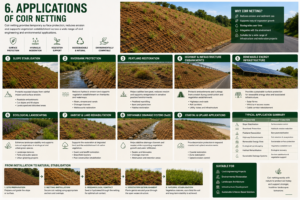
Coir netting is used across a wide range of erosion control, land rehabilitation and environmental engineering applications where temporary surface stabilisation and vegetation establishment are required.

Its combination of:

  • surface reinforcement,
  • hydraulic moderation,
  • vegetation support,
  • biodegradability,
  • and environmental compatibility

makes it suitable for both civil engineering and ecological restoration projects.

Unlike permanent hard-armouring systems, coir netting is designed to support the transition from:

Exposed disturbed ground to naturally stabilised vegetated landscapes.

As a result, coir netting is increasingly specified within:

  • sustainable infrastructure,
  • nature-based solutions,
  • biodiversity-focused schemes,
  • and environmentally sensitive land management projects.

Slope Stabilisation

One of the most common applications of coir netting is surface erosion protection on slopes and embankments.

Exposed slopes are particularly vulnerable to:

  • rainfall erosion,
  • runoff scour,
  • shallow sediment movement,
  • and vegetation failure during establishment.

Coir netting helps stabilise the surface layer by:

  • reducing runoff velocity,
  • protecting topsoil,
  • retaining seed,
  • and supporting root development.

Typical slope applications include:

  • roadside embankments,
  • cuttings,
  • landscaped slopes,
  • infrastructure corridors,
  • and disturbed construction areas.

It is important to note that coir netting is generally used for:

Surface erosion control, rather than deep structural slope reinforcement.

Riverbank Protection

Coir netting is widely used along:

  • riverbanks,
  • drainage channels,
  • streams,
  • and watercourse restoration projects.

Riverbanks are often exposed to:

  • fluctuating water levels,
  • hydraulic scour,
  • sediment loss,
  • and vegetation instability.

The open weave structure of coir netting allows:

  • vegetation penetration,
  • natural drainage,
  • and ecological integration,
    while helping reduce surface erosion during establishment.

Its biodegradable nature makes it especially suitable for:

  • environmentally sensitive aquatic environments,
  • habitat restoration,
  • and nature-based flood management schemes.

Peatland Restoration

Peatland restoration is becoming an increasingly important application for natural fibre erosion control systems.

Disturbed peatland surfaces are highly vulnerable to:

  • erosion,
  • desiccation,
  • sediment movement,
  • and vegetation loss.

Coir netting may be used to:

  • stabilise reprofiling works,
  • protect bare peat,
  • retain vegetation fragments,
  • and support revegetation.

In many peatland projects, avoiding long-term synthetic material introduction is a major environmental objective.

Natural fibre systems such as coir netting align closely with:

  • habitat restoration,
  • carbon-sensitive land management,
  • and ecological recovery strategies.

Highway & Infrastructure Embankments

Infrastructure projects frequently require temporary erosion control following:

  • earthworks,
  • grading,
  • vegetation clearance,
  • and slope formation.

Coir netting may be specified along:

  • highways,
  • rail corridors,
  • utility routes,
  • and infrastructure embankments.

Typical functions include:

  • protecting exposed soils,
  • reducing sediment runoff,
  • supporting hydroseeding,
  • and assisting vegetation establishment.

Its flexible structure allows installation across:

  • irregular terrain,
  • curved embankments,
  • and variable slope geometries.

Renewable Energy Infrastructure

The growth of renewable energy infrastructure has created increasing demand for sustainable erosion control systems.

Coir netting is commonly used around:

  • solar farms,
  • battery storage facilities,
  • wind farm access routes,
  • and cable corridor reinstatement works.

These sites often require:

  • temporary surface stabilisation,
  • rapid revegetation,
  • and low-environmental-impact solutions.

Natural fibre systems help align erosion control strategies with broader sustainability objectives associated with renewable infrastructure projects.

Ecological Landscaping

Coir netting is frequently used within:

  • ecological landscaping,
  • habitat creation,
  • urban greening,
  • and environmentally integrated public realm projects.

The material supports:

  • natural vegetation establishment,
  • improved soil retention,
  • and long-term ecological integration.

Unlike visually intrusive synthetic systems, coir netting gradually blends into the landscape as vegetation develops.

Habitat & Land Rehabilitation

Land rehabilitation projects often involve restoring:

  • degraded landscapes,
  • former industrial land,
  • disturbed ground,
  • and environmentally damaged sites.

Coir netting may be used to:

  • stabilise bare soils,
  • reduce erosion risk,
  • support ecological recovery,
  • and improve vegetation establishment success.

Typical rehabilitation environments may include:

  • quarry restoration,
  • landfill restoration,
  • brownfield recovery,
  • and post-construction environmental reinstatement.

Sustainable Drainage Systems (SuDS)

Coir netting may also be incorporated into:

  • swales,
  • drainage channels,
  • attenuation landscapes,
  • and sustainable drainage infrastructure.

In these systems, coir netting helps:

  • protect exposed surfaces,
  • reduce sediment transport,
  • support vegetation growth within drainage corridors.

Its permeable structure allows water movement while maintaining surface stability during establishment.

Coastal & Upland Applications

In certain environments, heavier-grade coir netting systems may be used within:

  • coastal restoration,
  • dune stabilisation,
  • upland erosion control,
  • and exposed environmental conditions.

These applications typically require:

  • higher durability,
  • denser weave structures,
  • and longer functional lifespan.

Environmental exposure in these settings may include:

  • high rainfall,
  • wind exposure,
  • unstable soils,
  • slow vegetation establishment.

Why Coir Netting is Suitable Across Multiple Sectors

The adaptability of coir netting comes from its ability to balance:

  • engineering functionality,
  • installation practicality,
  • ecological compatibility.

It can function effectively within:

  • civil engineering,
  • environmental restoration,
  • landscape architecture,
  • infrastructure delivery,
  • sustainability-led land management projects.

This versatility is one of the reasons coir netting is increasingly viewed not simply as a landscaping material, but as part of a broader category of:

nature-based erosion control and sustainable infrastructure systems.

Typical Application Summary

Application

Primary Function

Slope Stabilisation

Surface erosion control

Riverbank Protection

Hydraulic erosion reduction

Peatland Restoration

Bare peat stabilisation

Highway Embankments

Soil retention & revegetation

Renewable Energy Sites

Sustainable surface protection

Ecological Landscaping

Vegetation establishment

Habitat Rehabilitation

Ecological recovery

Sustainable Drainage Systems

Surface stabilisation & vegetation support

Coir Netting Installation Guide

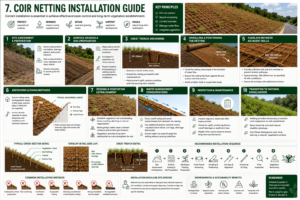
Correct installation is critical to the performance of any coir netting system.

Even high-quality erosion control materials may underperform if:

  • ground preparation is inadequate,
  • runoff pathways are not properly managed,
  • anchoring is insufficient,
  • or vegetation establishment is poorly planned.

Successful erosion control depends not only on the specification of the netting itself, but on how effectively the system integrates with:

  • the slope geometry,
  • soil conditions,
  • hydraulic exposure,
  • and long-term vegetation establishment strategy.

Coir netting should therefore be installed as part of a coordinated erosion control approach rather than simply laid onto exposed ground surfaces.

Installation Objectives

The primary objectives of coir netting installation are to:

  • protect exposed soil surfaces,
  • minimise erosion during establishment,
  • retain seed and growing media,
  • support vegetation development,
  • and create stable conditions for long-term natural recovery.

The netting must remain:

  • in close contact with the soil surface,
  • securely anchored,
  • and hydraulically stable during rainfall and runoff events.

Site Assessment & Preparation

Before installation begins, the site should be assessed to determine:

  • slope gradient,
  • soil stability,
  • drainage patterns,
  • runoff concentration areas,
  • vegetation requirements,
  • and erosion exposure conditions.

Proper site preparation is essential.

The surface should typically be:

  • graded,
  • smoothed,
  • and cleared of debris,
  • loose rocks,
  • large vegetation,
  • and sharp protrusions.

Uneven surfaces or voids beneath the netting may:

  • reduce soil contact,
  • allow concentrated runoff,
  • and compromise stabilisation performance.

Surface Grading & Soil Preparation

The slope or surface should be shaped to provide:

  • smooth transitions,
  • stable contours,
  • and controlled water movement.

Where required:

  • topsoil may be added,
  • soil amelioration undertaken,
  • or erosion-prone areas reinforced before installation.

In many projects:

  • seeding,
  • hydroseeding,
  • or planting preparation

is completed before the netting is installed.

Trench Anchoring at Crest

At the top of the slope, the coir netting should normally be secured within an anchor trench.

Typical crest anchoring may involve:

  • excavating a trench,
  • embedding the netting,
  • and backfilling compacted soil over the leading edge.

This helps:

  • prevent uplift,
  • reduce underflow,
  • and improve long-term stability.

Typical trench dimensions vary depending on:

  • slope conditions,
  • hydraulic exposure,
  • and project requirements.

Unrolling & Positioning the Netting

The netting should generally be unrolled downslope, following the natural direction of water flow.

The material should lie:

  • flush against the soil surface,
  • without significant gaps,
  • folds,
  • or suspended sections.

Maintaining full soil contact is critical for:

  • runoff control,
  • sediment retention,
  • and vegetation establishment.

Overlaps Between Adjacent Rolls

Adjacent rolls of coir netting should overlap sufficiently to prevent:

  • erosion pathways,
  • material separation,
  • and runoff concentration between panels.

Overlap requirements depend on:

  • slope gradient,
  • hydraulic conditions,
  • and product specification.

Typical overlap practices may include:

  • side overlaps,
  • end overlaps,
  • and staggered joint layouts.

All overlaps should be securely anchored.

Anchoring & Fixing Methods

Coir netting is commonly secured using:

  • biodegradable stakes,
  • timber pegs,
  • hardwood stakes,
  • bamboo pegs,
  • or steel fixing pins depending on project requirements.

Anchor density depends on:

  • slope steepness,
  • wind exposure,
  • hydraulic loading,
  • and soil conditions.

Additional anchoring may be required:

  • around overlaps,
  • drainage channels,
  • crest areas,
  • and high-flow zones.

Poor anchoring is one of the most common causes of installation failure.

Seeding & Vegetation Establishment

Coir netting performs most effectively when integrated with an appropriate vegetation strategy.

Vegetation may be established through:

  • hydroseeding,
  • direct seeding,
  • plug planting,
  • or natural regeneration approaches.

The netting helps:

  • retain seed,
  • protect germination zones,
  • maintain moisture,
  • and reduce surface disturbance during establishment.

Long-term erosion control performance ultimately depends on successful vegetation integration.

Water Management Considerations

Surface water management is essential during installation.

Concentrated runoff should not be allowed to flow:

  • beneath the netting,
  • through overlaps,
  • or across unprotected areas.

Additional measures may be required where:

  • flow velocities are high,
  • drainage pathways concentrate runoff,
  • or slopes are particularly exposed.

In some situations, coir netting may be integrated with:

  • check dams,
  • coir logs,
  • drainage controls,
  • or other erosion management systems.

Inspection & Maintenance

Following installation, the system should be inspected periodically to identify:

  • uplift,
  • anchoring failure,
  • runoff damage,
  • sediment displacement,
  • or vegetation establishment issues.

Inspection is particularly important after:

  • major rainfall events,
  • storm conditions,
  • or early-stage installation periods.

Minor repairs undertaken early can significantly improve long-term performance.

Transition to Natural Stabilisation

The objective of coir netting installation is not permanent surface armouring.

Instead, the system is intended to:

  • provide temporary engineered protection,
  • support vegetation establishment,
  • and facilitate natural long-term stabilisation.

As vegetation matures:

  • root systems strengthen the soil,
  • surface stability improves,
  • and dependence on the netting gradually decreases.

The coir fibres then biodegrade naturally over time.

Common Installation Mistakes

Common causes of underperformance include:

  • inadequate surface preparation,
  • poor anchoring,
  • insufficient overlaps,
  • suspended netting,
  • concentrated runoff beneath the mesh,
  • incorrect slope orientation,
  • and lack of vegetation establishment planning.

Installation quality is often just as important as product specification.

Installation Should Be Considered Site-Specific

Installation methods may vary significantly depending on:

  • slope geometry,
  • hydraulic exposure,
  • soil conditions,
  • environmental sensitivity,
  • climate,
  • and project objectives.

Complex or high-risk environments may require:

  • engineering assessment,
  • project-specific detailing,
  • or specialist installation methodologies.

Typical Installation Sequence

Stage

Installation Activity

1

Site assessment & preparation

2

Surface grading & soil preparation

3

Seeding or planting preparation

4

Crest trench anchoring

5

Unrolling & positioning

6

Overlaps & panel alignment

7

Anchoring & fixing

8

Final inspection

9

Vegetation establishment monitoring

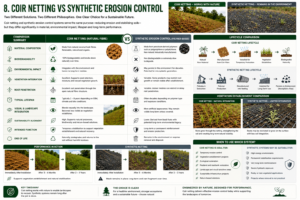
Coir Netting vs Synthetic Erosion Control

Coir netting and synthetic erosion control systems are both used to reduce surface erosion and support slope stabilisation, but they differ significantly in:

  • material composition,
  • environmental behaviour,
  • long-term performance philosophy,
  • and interaction with natural landscapes.

Understanding these differences is essential when selecting the most appropriate erosion control strategy for a project.

Historically, many erosion control systems relied heavily on synthetic polymer meshes designed to provide long-term or permanent reinforcement. While these materials may offer extended durability, growing attention is now being given to:

  • environmental impact,
  • microplastic pollution,
  • ecological integration,
  • whole-life sustainability,
  • and end-of-life material legacy.

As infrastructure and environmental sectors increasingly move towards nature-based solutions and sustainable land management approaches, natural fibre systems such as coir netting are becoming increasingly relevant within modern erosion control design.

Understanding the Difference in Engineering Philosophy

One of the most important distinctions between coir netting and synthetic erosion control systems lies in:

how long the material is intended to remain within the environment.

Synthetic Erosion Control Systems

Synthetic systems are generally designed to:

  • remain in place for extended periods,
  • provide long-term reinforcement,
  • and resist biological degradation.

These systems are often manufactured from:

  • polypropylene,
  • polyethylene,
  • polyester,
  • or other polymer-based materials.

They may provide:

  • high tensile durability,
  • extended lifespan,
  • and long-term reinforcement capability.

However, synthetic systems may also introduce:

  • long-term material persistence,
  • plastic residue,
  • ecological disruption,
  • and potential microplastic generation over time.

Coir Netting Systems

Coir netting follows a different engineering approach.

Rather than acting as permanent armouring, coir netting is designed to:

  • provide temporary stabilisation,
  • support vegetation establishment,
  • and gradually biodegrade as natural stabilisation mechanisms develop.

The objective is not to permanently override natural systems —
but to help landscapes recover and stabilise themselves over time.

This philosophy aligns closely with:

  • ecological restoration,
  • regenerative infrastructure,
  • sustainable land management,
  • and biodiversity-focused engineering approaches.

Material Composition

Coir Netting

  • Manufactured from natural coconut husk fibres
  • Biodegradable organic material
  • Natural fibre yarn construction
  • Renewable raw material source

Synthetic Systems

  • Manufactured from petroleum-derived polymers
  • Non-biodegradable or slow-degrading plastics
  • Artificial filament structures
  • Industrial polymer production processes

Environmental Interaction

Coir Netting

Coir netting:

  • integrates naturally with vegetation,
  • supports ecological recovery,
  • and gradually decomposes into the surrounding environment.

It leaves:

  • no permanent synthetic residue,
  • no long-term plastic mesh,
  • and no artificial reinforcement layer once biodegradation is complete.

Synthetic Systems

Synthetic meshes may:

  • remain within soils for extended periods,
  • persist after vegetation establishment,
  • and require removal in some applications.

Over time, environmental exposure may contribute to:

  • fragmentation,
  • material degradation,
  • and microplastic release.

Vegetation Establishment

Coir Netting

The open weave natural fibre structure:

  • supports root penetration,
  • improves seed retention,
  • maintains moisture,
  • and promotes vegetation integration.

As vegetation matures:

  • the landscape progressively becomes self-stabilising.

Synthetic Systems

Synthetic systems may also support vegetation establishment, but some denser polymer systems may:

  • restrict root penetration,
  • remain visible after establishment,
  • or interfere with natural ecological integration depending on system design.

Hydraulic Performance

Both coir and synthetic systems may provide:

  • runoff reduction,
  • surface protection,
  • and sediment control.

However, performance depends heavily on:

  • aperture size,
  • installation quality,
  • slope conditions,
  • and hydraulic exposure.

Coir netting generally performs most effectively where:

  • vegetation establishment is achievable,
  • ecological integration is important,
  • and temporary protection is appropriate.

Synthetic systems may be selected where:

  • extended reinforcement duration,
  • high hydraulic exposure,
  • or permanent stabilisation is required.

Durability & Lifespan

Coir Netting

Typical lifespan:

  • approximately 2-8 years depending on GSM and environmental conditions.

Designed for:

  • temporary engineered intervention,
  • followed by natural recovery.

Synthetic Systems

Typical lifespan:

  • often significantly longer,
  • potentially decades depending on polymer type and exposure conditions.

Designed for:

  • extended or permanent reinforcement applications.

Visual & Landscape Integration

Coir Netting

Coir netting:

  • blends naturally into landscapes,
  • supports ecological aesthetics,
  • and becomes progressively less visible as vegetation establishes.

This is particularly valuable within:

  • conservation areas,
  • ecological restoration,
  • landscape-sensitive projects,
  • and nature-based infrastructure.

Synthetic Systems

Synthetic meshes may:

  • remain visually apparent,
  • create artificial surface appearance,
  • or require covering treatments to reduce visibility.

Sustainability Considerations

As infrastructure procurement increasingly considers:

  • ESG,
  • Net Zero,
  • biodiversity,
  • and whole-life environmental impact,

natural fibre systems are receiving greater attention.

Coir netting contributes to:

  • reduced synthetic material use,
  • natural biodegradation,
  • ecological recovery,
  • and nature-based erosion control strategies.

However, material selection should always remain site-specific and performance-led.

Not all projects require the same erosion control approach.


Typical Comparison Summary

Characteristic

Coir Netting

Synthetic Erosion Control

Material Type

Natural coconut fibre

Polymer-based plastic

Biodegradable

Yes

Generally No

Environmental Residue

Minimal

Potential long-term persistence

Vegetation Integration

Excellent

Variable

Typical Lifespan

2–8 years

Often decades

Ecological Compatibility

High

Variable

Root Penetration

Excellent

Variable

Landscape Integration

Natural

More artificial appearance

Sustainability Alignment

Strong

Lower depending on material

Intended Function

Temporary stabilisation

Long-term/permanent reinforcement

There Is No Universal “Best” System

One of the most important engineering principles is that: erosion control systems should be selected according to project requirements, not ideology alone.

Coir netting is highly effective where:

  • temporary stabilisation,
  • vegetation establishment,
  • and ecological recovery are primary objectives.

Synthetic systems may remain appropriate where:

  • permanent reinforcement,
  • severe hydraulic loading,
  • or long-term structural stability is required.

The correct approach depends on:

  • environmental conditions,
  • engineering objectives,
  • project lifespan,
  • ecological sensitivity,
  • and long-term land management strategy.

The Growing Shift Towards Nature-Based Solutions

Across infrastructure and environmental sectors, there is increasing recognition that:

  • not all landscapes require permanent synthetic reinforcement,
  • and many erosion problems can be addressed through temporary stabilisation combined with successful vegetation establishment.

This shift is contributing to growing adoption of natural fibre erosion control systems, particularly within:

  • ecological restoration,
  • sustainable infrastructure,
  • peatland recovery,
  • river restoration,
  • and biodiversity-focused engineering projects.

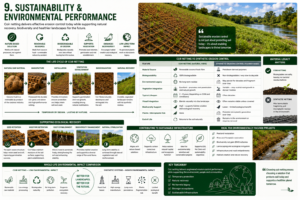
Sustainability & Environmental Performance

The sustainability performance of erosion control systems is becoming an increasingly important consideration within modern infrastructure, environmental engineering and land management projects.

Historically, erosion control specification was often driven primarily by:

  • immediate engineering performance,
  • material durability,
  • and installation practicality.

Today, however, projects are increasingly assessed through a wider lens that includes:

  • whole-life environmental impact,
  • biodiversity,
  • carbon considerations,
  • ecological recovery,
  • material legacy,
  • and long-term land stewardship.

Within this evolving landscape, natural fibre systems such as coir netting are receiving growing attention due to their ability to combine temporary engineering functionality with ecological compatibility and environmental integration.

A Nature-Based Erosion Control Approach

One of the defining sustainability characteristics of coir netting is that it works with natural recovery processes rather than against them.

Instead of permanently overriding landscape systems through artificial reinforcement, coir netting is designed to:

  • provide temporary stabilisation,
  • support vegetation establishment,
  • and gradually biodegrade as natural stabilisation develops.

This reflects a broader shift within infrastructure and environmental sectors towards:

  • nature-based solutions,
  • regenerative land management,
  • and ecological engineering principles.

Renewable Natural Fibre Material

Coir netting is manufactured using fibres extracted from the outer husk of coconuts.

The coconut husk is a naturally occurring by-product of the coconut industry, making coir:

  • renewable,
  • plant-derived,
  • and organically sourced.

Unlike petroleum-derived synthetic erosion control systems, coir fibres originate from biological rather than fossil-fuel-based material systems.

This contributes to the growing relevance of coir within:

  • sustainable infrastructure procurement,
  • environmentally sensitive projects,
  • and low-impact land restoration strategies.

Biodegradability & Environmental Integration

A key environmental characteristic of coir netting is its ability to biodegrade naturally over time.

As vegetation establishes and natural stabilisation mechanisms develop:

  • the coir fibres gradually decompose,
  • reintegrate into the surrounding environment,
  • and leave no permanent synthetic reinforcement layer behind.

This differs significantly from many synthetic erosion control systems which may:

  • persist within soils,
  • fragment over time,
  • or contribute to long-term plastic residue.

Within many projects, biodegradation is not viewed as a weakness, but as an intentional design feature aligned with temporary intervention and long-term ecological recovery.

Vegetation & Ecological Recovery

Coir netting supports ecological recovery by helping create conditions favourable for:

  • seed retention,
  • germination,
  • moisture retention,
  • root establishment,
  • and vegetation integration.

As vegetation develops:

  • root systems strengthen the soil,
  • biodiversity potential increases,
  • and the landscape progressively becomes self-stabilising.

This vegetation-led stabilisation philosophy is central to:

  • ecological restoration,
  • peatland rehabilitation,
  • river restoration,
  • and biodiversity-focused land management.

Microplastic & Material Legacy Considerations

There is increasing global concern surrounding:

  • long-term plastic persistence,
  • polymer fragmentation,
  • and microplastic accumulation within natural environments.

Because coir netting is manufactured from natural plant fibre:

  • it does not create long-term plastic mesh residue,
  • and does not introduce persistent polymer-based reinforcement into recovering landscapes.

This is particularly important within:

  • peatlands,
  • waterways,
  • conservation environments,
  • ecological restoration schemes,
  • and environmentally sensitive infrastructure projects.


Landscape Integration

Coir netting integrates naturally into landscapes during vegetation establishment.

Unlike some synthetic systems that may remain visually apparent long after installation, coir netting:

  • progressively blends into the surrounding environment,
  • becomes less visible as vegetation establishes,
  • and eventually biodegrades naturally.

This visual integration is particularly valuable within:

  • landscape-sensitive developments,
  • conservation projects,
  • and nature-based infrastructure schemes.

Carbon & Whole-Life Environmental Considerations

As infrastructure sectors increasingly focus on:

  • Net Zero,
  • embodied carbon,
  • and whole-life environmental assessment,

material selection is evolving beyond purely short-term performance criteria.

Natural fibre systems may contribute positively to:

  • reduced synthetic material dependency,
  • ecological recovery,
  • and lower long-term environmental impact compared with permanent polymer-based alternatives.

However, sustainability assessment should always remain evidence-led and project-specific.

Environmental performance depends on:

  • manufacturing,
  • transport,
  • installation,
  • project lifespan,
  • and long-term site outcomes.

Supporting Biodiversity Objectives

Coir netting is increasingly aligned with:

  • biodiversity enhancement,
  • habitat recovery,
  • ecological landscaping,
  • and environmentally integrated infrastructure design.

By supporting vegetation establishment and natural recovery processes, coir netting can contribute to:

  • habitat formation,
  • ecological connectivity,
  • and landscape resilience.

This is particularly relevant as many infrastructure and land management projects increasingly incorporate:

  • Biodiversity Net Gain (BNG),
  • habitat restoration,
  • and ecological enhancement objectives.

Sustainable Infrastructure & Nature-Based Solutions

Across the infrastructure sector, there is growing recognition that:

  • healthy landscapes provide functional infrastructure value,
  • vegetation can contribute to slope stability,
  • and ecological systems can form part of long-term erosion management strategies.

Coir netting aligns closely with this evolving:

nature-based infrastructure philosophy.

Rather than viewing landscapes purely as engineered surfaces requiring permanent armouring, natural fibre systems support:

  • temporary intervention,
  • ecological transition,
  • and long-term natural resilience.

Sustainability Does Not Remove the Need for Engineering Assessment

While coir netting offers significant environmental advantages, material selection should never be based solely on sustainability claims.

The suitability of any erosion control system depends on:

  • hydraulic conditions,
  • slope geometry,
  • environmental exposure,
  • project lifespan,
  • vegetation strategy,
  • and engineering objectives.

In some situations:

  • permanent reinforcement systems,
  • hybrid solutions,
  • or additional engineering measures

may still be required.

Good sustainable design balances environmental responsibility with appropriate engineering  performance.

Typical Sustainability Performance Summary

Sustainability Factor

Coir Netting Characteristics

Material Source

Renewable coconut husk fibre

Biodegradability

Naturally decomposes over time

Plastic Residue

No long-term synthetic mesh residue

Ecological Integration

High

Vegetation Compatibility

Excellent

Root Penetration

Excellent

Visual Integration

Natural landscape blending

Biodiversity Support

Supports habitat establishment

Nature-Based Alignment

Strong

Long-Term Material Persistence

Minimal

Why Sustainability Performance Matters

The role of erosion control systems is no longer viewed solely through the lens of:

  • immediate soil protection,
  • or installation efficiency.

Increasingly, infrastructure and environmental sectors are considering:

  • how landscapes recover,
  • what materials remain behind,
  • how ecosystems respond,
  • and whether stabilisation systems contribute positively to long-term environmental resilience.

Coir netting represents a shift towards erosion control systems that support both engineering performance and ecological recovery.

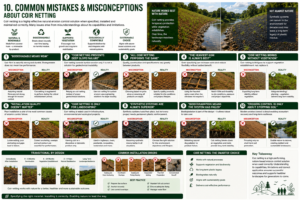
Common Mistakes & Misconceptions

Despite the increasing adoption of coir netting within erosion control and environmental engineering projects, there are still several common misconceptions surrounding:

  • natural fibre systems,
  • biodegradability,
  • erosion control performance,
  • and long-term landscape stabilisation.

In many cases, these misunderstandings arise because coir netting is incorrectly viewed as:

  • a landscaping material only,
  • a low-performance alternative to synthetic systems,
  • or a decorative surface covering rather than an engineered erosion control solution.

Understanding the limitations, capabilities and correct application of coir netting is essential to ensuring successful specification and realistic project expectations.

Misconception 1

“Biodegradable Means Weak”

One of the most common misconceptions is that biodegradable materials automatically provide poor engineering performance.

In reality, coir fibre possesses naturally high lignin content, which contributes to:

  • durability,
  • tensile resistance,
  • moisture tolerance,
  • and relatively slow biodegradation compared with many other natural fibres.

Coir netting is specifically engineered to provide:

  • temporary erosion protection,
  • surface reinforcement,
  • and vegetation establishment support during critical recovery phases.

Importantly temporary does not mean ineffective. The system is intentionally designed to function during the period in which the landscape is most vulnerable.

Misconception 2

“Coir Netting Prevents Deep Slope Failure”

Coir netting is primarily a:

Surface erosion control system.

It is not generally intended to replace:

  • deep geotechnical reinforcement,
  • retaining structures,
  • soil nailing,
  • or structural slope stabilisation systems.

While coir netting can:

  • reduce shallow erosion,
  • protect exposed soils,
  • and improve surface stability,

it should not be incorrectly specified as a solution for:

  • major geotechnical instability,
  • rotational failure,
  • or deep-seated slope movement.

Correct system selection always depends on:

  • engineering assessment,
  • site conditions,
  • and failure mechanisms.

Misconception 3

“All Coir Netting Performs the Same”

Coir netting performance can vary significantly depending on:

  • fibre quality,
  • yarn construction,
  • weave density,
  • aperture size,
  • manufacturing consistency,
  • and installation methodology.

Not all coir netting products provide the same:

  • durability,
  • tensile performance,
  • degradation profile,
  • or hydraulic behaviour.

Specification should therefore consider:

  • site exposure,
  • slope conditions,
  • project lifespan,
  • and vegetation strategy,
    rather than simply selecting the lowest-cost product.

Misconception 4

“The Heaviest GSM is Always Best”

Higher GSM systems generally provide:

  • increased durability,
  • denser weave structures,
  • and longer functional lifespan.

However, selecting the heaviest system available is not always the most appropriate engineering solution.

Over-specification may:

  • increase unnecessary material use,
  • reduce flexibility,
  • complicate installation,
  • or exceed the actual performance requirements of the site.

Appropriate specification should be performance-led and site-specific.

Misconception 5

“Coir Netting Works Without Vegetation”

Coir netting is designed to support: vegetation-led stabilisation. While the netting itself provides temporary erosion control, long-term performance depends heavily on successful vegetation establishment.

Without adequate:

  • seeding,
  • planting,
  • moisture conditions,
  • or ecological recovery,

the stabilisation system may not achieve its intended long-term function.

Vegetation is not simply an aesthetic addition, it forms part of the engineering mechanism.

Misconception 6

“Installation Quality Doesn’t Matter”

Even high-quality coir netting systems may fail if:

  • poorly anchored,
  • incorrectly overlapped,
  • installed over unstable surfaces,
  • or exposed to unmanaged concentrated runoff.

Common installation issues include:

  • suspended mesh,
  • inadequate crest anchoring,
  • poor soil contact,
  • and insufficient fixing density.

Successful performance depends on both correct specification and competent installation.


Misconception 7

“Coir Netting is Only for Landscaping”

Although widely used within landscaping projects, coir netting is increasingly specified across:

  • infrastructure projects,
  • river restoration,
  • peatland recovery,
  • renewable energy developments,
  • highways,
  • ecological engineering,
  • and sustainable drainage systems.

Modern erosion control increasingly recognises the importance of:

  • temporary intervention,
  • ecological recovery,
  • and nature-based stabilisation systems.

Coir netting therefore extends far beyond decorative or domestic applications.

Misconception 8

“Synthetic Systems Are Always Superior”

Synthetic systems may provide advantages in certain:

  • high-load,
  • permanent,
  • or extreme hydraulic environments.

However, many erosion control situations do not necessarily require:

  • permanent synthetic reinforcement,
  • long-term plastic persistence,
  • or artificial surface armouring.

Natural fibre systems can provide highly effective performance where:

  • vegetation establishment is achievable,
  • ecological integration is important,
  • and temporary stabilisation is appropriate.

The correct solution depends on:

  • engineering requirements,
  • environmental conditions,
  • and project objectives.

Misconception 9

“Biodegradation Means the System Has Failed”

Biodegradation is often misunderstood as deterioration or loss of performance.

In reality, coir netting is intentionally designed to:

  • biodegrade gradually,
  • while vegetation becomes established,
  • and natural root systems progressively assume the stabilisation role.

The transition from engineered support to natural stability is fundamental to how coir netting systems are intended to function.

Misconception 10

“Erosion Control is Only About Stopping Soil Movement”

Modern erosion control increasingly considers:

  • ecological recovery,
  • biodiversity,
  • vegetation establishment,
  • water interaction,
  • landscape resilience,
  • and long-term environmental outcomes.

Effective erosion control is not simply about covering soil. It is about creating stable conditions that allow landscapes to recover, regenerate and remain resilient over time.


Why These Misconceptions Matter

Many erosion control failures occur not because coir netting is ineffective —
but because:

  • expectations were unrealistic,
  • specification was inappropriate,
  • or the system was misunderstood.

Proper understanding helps ensure:

  • better project outcomes,
  • more effective system selection,
  • improved installation quality,
  • and realistic performance expectations.

Coir Netting Should Be Viewed as an Engineered Transitional System

Perhaps the most important concept is that coir netting is designed to:

  • provide temporary engineered support,
  • enable ecological recovery,
  • and facilitate natural long-term stabilisation.

It is not intended to permanently dominate the landscape, but to assist the landscape in recovering and stabilising itself.

This philosophy is central to:

  • sustainable erosion control,
  • nature-based infrastructure,
  • and regenerative land management approaches.

Typical Mistake vs Best Practice Summary

Common Mistake

Better Approach

Assuming biodegradable means weak

Understand temporary engineered performance

Using coir for deep slope failure

Use appropriate geotechnical assessment

Selecting products by GSM alone

Specify according to site conditions

Ignoring vegetation establishment

Integrate revegetation strategy

Poor anchoring & overlaps

Follow correct installation methodology

Expecting permanent reinforcement

Understand transitional stabilisation philosophy

Treating coir as landscaping only

Recognise infrastructure and engineering applications

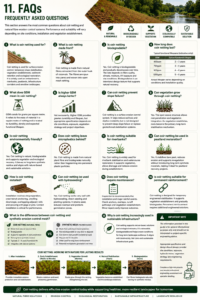
Frequently Asked Questions (FAQs)

This section addresses some of the most common technical, practical and environmental questions surrounding coir netting and natural fibre erosion control systems.

The answers below are intended as general guidance only. Actual performance, suitability and specification requirements will vary depending on:

  • site conditions,
  • slope geometry,
  • hydraulic exposure,
  • climate,
  • installation quality,
  • and vegetation establishment success.

What is coir netting used for?

Coir netting is primarily used for:

  • surface erosion control,
  • temporary slope stabilisation,
  • vegetation establishment,
  • sediment retention,
  • and ecological restoration.

It is commonly installed on:

  • embankments,
  • riverbanks,
  • peatland restoration projects,
  • infrastructure corridors,
  • and environmentally sensitive landscapes.

The netting provides temporary surface protection while vegetation establishes and natural stabilisation develops.

What is coir netting made from?

Coir netting is manufactured from natural fibres extracted from the outer husk of coconuts. The fibres are processed into coir yarns, which are then woven into open mesh netting structures of varying densities and specifications.

Is coir netting biodegradable?

Yes. Coir netting is a biodegradable erosion control system designed to gradually decompose over time.

The rate of biodegradation depends on:

  • fibre quality,
  • environmental exposure,
  • climate,
  • moisture,
  • UV exposure,
  • and site conditions.

Importantly, biodegradation is an intentional engineering characteristic designed to support temporary stabilisation followed by natural recovery.

How long does coir netting last?

The functional lifespan of coir netting varies depending on:

  • GSM,
  • weave structure,
  • environmental exposure,
  • hydraulic conditions,
  • and installation quality.

Typical indicative lifespans may include:

Product Type

Typical Functional Lifespan

400gsm

Approximately 2-3 years

700gsm

Approximately 3-5 years

900gsm

Approximately 4-6 years

1200gsm

Approximately 5-8 years

Actual lifespan may vary significantly depending on project conditions.

What does GSM mean in coir netting?

GSM stands for: grams per square metre.

It refers to the mass of material within a square metre of netting and is commonly associated with:

  • fibre density,
  • durability,
  • weave robustness,
  • and expected functional lifespan.

Higher GSM products generally provide:

  • increased durability,
  • denser weave structures,
  • and longer degradation profiles.

Is higher GSM always better?

Not necessarily.

While heavier GSM systems may provide:

  • greater durability,
  • increased reinforcement,
  • and longer service life,

Appropriate specification should always depend on:

  • site conditions,
  • slope gradient,
  • hydraulic exposure,
  • vegetation strategy,
  • and project objectives.

Over-specification may increase:

  • unnecessary material use,
  • installation complexity,
  • and project cost without improving outcomes.

Can coir netting prevent slope failure?

Coir netting is primarily designed for:

Surface erosion control.

It helps reduce:

  • soil loss,
  • runoff erosion,
  • and shallow surface instability.

However, it is not generally intended to replace:

  • deep geotechnical reinforcement systems,
  • retaining structures,
  • soil nails,
  • or structural slope stabilisation measures.

Major slope instability should always be assessed by appropriately qualified engineering professionals.

Can vegetation grow through coir netting?

Yes.

The open weave structure allows:

  • root penetration,
  • vegetation integration,
  • and natural soil interaction.

This is one of the key advantages of coir netting within:

  • ecological restoration,
  • revegetation,
  • and nature-based erosion control systems.

As vegetation establishes, root systems progressively become the primary long-term stabilisation mechanism.

Is coir netting environmentally friendly?

Coir netting is generally considered environmentally compatible because it is:

  • manufactured from natural coconut husk fibre,
  • biodegradable,
  • supportive of vegetation establishment,
  • and free from long-term synthetic mesh residue.

It is increasingly used within:

  • habitat restoration,
  • peatland recovery,
  • river restoration,
  • and environmentally sensitive infrastructure projects.

However, environmental performance should always be considered within the wider context of:

  • manufacturing,
  • transport,
  • installation,
  • and long-term project outcomes.

Does coir netting leave microplastics behind?

No. Coir netting is manufactured from natural plant fibre rather than synthetic polymer materials. As the fibres biodegrade, they decompose naturally rather than fragmenting into persistent plastic particles.

Is coir netting suitable for riverbanks?

Yes.

Coir netting is widely used for:

  • riverbank stabilisation,
  • channel protection,
  • and watercourse restoration.

The open weave structure supports:

  • vegetation establishment,
  • drainage,
  • and ecological integration while reducing erosion during establishment.

Project suitability depends on:

  • hydraulic exposure,
  • flow velocity,
  • bank geometry,
  • and environmental conditions.

Can coir netting be used in peatland restoration?

Yes.

Natural fibre systems are increasingly used within peatland restoration because they:

  • avoid introducing long-term synthetic materials,
  • support vegetation recovery,
  • and align with ecological restoration objectives.

Coir netting may help:

  • stabilise bare peat,
  • reduce erosion,
  • and support revegetation during recovery.

How is coir netting installed?

Typical installation involves:

  • site preparation,
  • surface grading,
  • crest trench anchoring,
  • downslope unrolling,
  • overlapping adjacent rolls,
  • and secure anchoring using pegs or fixing pins.

Correct installation is critical to achieving:

  • soil contact,
  • runoff control,
  • and long-term vegetation establishment.

Can coir netting be used with hydroseeding?

Yes.

Coir netting is commonly used alongside:

  • hydroseeding,
  • direct seeding,
  • and planting systems.

The mesh helps:

  • retain seed,
  • reduce washout,
  • maintain moisture,
  • and protect germination zones.

Does coir netting require maintenance?

Inspection is recommended following:

  • installation,
  • major rainfall events,
  • and early vegetation establishment periods.

Typical maintenance may involve:

  • checking anchors,
  • repairing uplift areas,
  • monitoring runoff pathways,
  • and assessing vegetation establishment progress.

Is coir netting suitable for permanent reinforcement?

Coir netting is generally designed for temporary engineered stabilisation. Its primary function is to:

  • protect the surface,
  • support vegetation establishment,
  • and facilitate natural long-term recovery.

Where permanent structural reinforcement is required, additional:

  • geotechnical,
  • hydraulic,
  • or engineered stabilisation measures

may also be necessary.

What is the difference between coir netting and synthetic erosion control mesh?

The primary differences relate to:

  • material composition,
  • biodegradability,
  • environmental legacy,
  • lifespan,
  • and long-term landscape integration.

Coir netting:

  • biodegrades naturally,
  • supports ecological recovery,
  • and leaves no long-term synthetic residue.

Synthetic systems:

  • may provide longer-term reinforcement,
  • but can remain within the environment for extended periods.

The appropriate solution depends on:

  • site conditions,
  • engineering requirements,
  • and project objectives.

Why is coir netting increasingly used in sustainable infrastructure?

Modern infrastructure projects increasingly consider:

  • sustainability,
  • biodiversity,
  • ecological recovery,
  • and whole-life environmental impact.

Coir netting aligns with:

  • nature-based solutions,
  • regenerative land management,
  • and vegetation-led stabilisation approaches.

This makes it increasingly relevant within:

  • sustainable infrastructure,
  • ecological engineering,
  • peatland restoration,
  • river restoration,
  • and environmentally integrated land management projects.

Important Technical Note

The information provided within this guide is intended for:

  • general informational purposes,
  • and should not be interpreted as project-specific engineering advice.

Appropriate specification and design should always consider:

  • site conditions,
  • environmental exposure,
  • hydraulic forces,
  • vegetation strategy,
  • and project-specific engineering requirements.

Complex or high-risk projects may require:

  • professional engineering assessment,
  • specialist detailing,
  • and project-specific stabilisation design.
Technical Resources

Technical documentation forms an important part of responsible erosion control specification and project delivery.

While product imagery and general guidance can help explain the principles of coir netting systems, infrastructure and environmental projects often require more detailed technical information to support:

  • specification development,
  • design coordination,
  • procurement,
  • installation planning,
  • and project documentation.

A well-structured technical resource library helps ensure that erosion control systems are understood not simply as products, but as part of a wider engineered and environmentally integrated solution.

For consultants, contractors, landscape architects and environmental specialists, access to clear technical resources can significantly improve:

  • specification accuracy,
  • installation consistency,
  • and long-term project outcomes.

Why Technical Resources Matter

Erosion control performance depends on much more than material selection alone.

Project success is influenced by:

  • site conditions,
  • hydraulic exposure,
  • vegetation establishment,
  • installation methodology,
  • and correct system integration.

Technical documentation helps bridge the gap between product information and practical project implementation.

It provides:

  • engineering clarity,
  • specification support,
  • installation guidance,
  • and technical consistency across project stakeholders.

Typical Technical Resources for Coir Netting Systems

A comprehensive technical resource section may include the following categories.

Product Technical Datasheets

Technical datasheets provide detailed product information relating to:

  • material composition,
  • weave structure,
  • GSM,
  • aperture size,
  • tensile characteristics,
  • roll dimensions,
  • durability,
  • and indicative applications.

Datasheets help support:

  • specification comparison,
  • procurement,
  • and project coordination.

Typical documents may include:

  • 400gsm Coir Netting Datasheet
  • 700gsm Coir Netting Datasheet
  • 900gsm Coir Netting Datasheet
  • 1200gsm Coir Netting Datasheet

Installation Guides

Installation guidance documents help ensure:

  • correct placement,
  • proper anchoring,
  • overlap consistency,
  • and appropriate surface preparation.

Typical installation resources may include:

  • slope installation guidance,
  • anchor trench details,
  • overlap layouts,
  • peg spacing diagrams,
  • and vegetation establishment recommendations.

Installation guidance is particularly important because system performance depends heavily on the correct implementation on site.

CAD Details & Technical Drawings

Technical drawings help support:

  • engineering coordination,
  • project detailing,
  • tender preparation,
  • and installation interpretation.

Typical drawing resources may include:

  • slope cross-sections,
  • overlap details,
  • crest anchoring details,
  • channel protection layouts,
  • and installation sequencing diagrams.

Depending on project complexity, drawings may be provided in:

  • PDF,
  • CAD,
  • or technical illustration formats.

Material Specification Clauses

Specification-ready text can assist consultants and contractors during:

  • tender preparation,
  • specification writing,
  • and procurement documentation.

These clauses may include:

  • material requirements,
  • installation standards,
  • performance considerations,
  • and environmental characteristics.

Well-structured specification clauses help improve:

  • project consistency,
  • technical clarity,
  • and procurement alignment.

Testing & Performance Information

Technical resource libraries may also include:

  • indicative testing information,
  • engineering performance data,
  • and material property guidance.

Typical performance data may reference:

  • tensile behaviour,
  • material density,
  • degradation characteristics,
  • hydraulic interaction,
  • and vegetation integration performance.

Testing information should always be interpreted within the context of:

  • site-specific conditions,
  • installation quality,
  • and project objectives.

Application Guidance Documents

Application-specific resources help explain how coir netting systems may be used within different environments.

Typical guidance areas may include:

  • slope stabilisation,
  • riverbank protection,
  • peatland restoration,
  • ecological landscaping,
  • and infrastructure embankments.

These documents help translate engineering principles into real-world project implementation.

Sustainability & Environmental Guidance

As sustainability becomes increasingly important within infrastructure procurement, technical resources may also include:

  • environmental information,
  • sustainability statements,
  • biodegradability guidance,
  • and nature-based infrastructure documentation.

These resources may assist projects considering:

  • Biodiversity Net Gain (BNG),
  • ecological restoration,
  • sustainable procurement,
  • and environmental management objectives.

Typical Technical Resource Categories

Resource Type

Purpose

Technical Datasheets

Product specification information

Installation Guides

Site implementation guidance

CAD Details

Engineering coordination & detailing

Specification Clauses

Tender & procurement support

Performance Information

Engineering characteristic guidance

Application Notes

Environment-specific guidance

Sustainability Documents

Environmental & ecological information

Technical Resources Support Better Project Outcomes

Providing access to structured technical resources helps improve:

  • communication between stakeholders,
  • installation consistency,
  • specification accuracy,
  • and long-term erosion control performance.

It also demonstrates that erosion control systems are being approached through informed engineering and environmental practice, rather than purely product-led supply.


Technical Information Should Always Be Interpreted Appropriately

While technical documentation provides important guidance, erosion control performance remains highly dependent on:

  • project-specific conditions,
  • hydraulic exposure,
  • soil characteristics,
  • vegetation establishment,
  • and installation quality.

Technical documents should therefore support, not replace, appropriate engineering judgement and project-specific assessment.

Complex or high-risk projects may require:

  • specialist engineering review,
  • hydraulic assessment,
  • or project-specific stabilisation design.

Complete Guide to Coir Netting

Coir netting is a biodegradable erosion control mesh manufactured from natural coconut fibres, designed to provide temporary surface stabilisation while supporting long-term vegetation establishment and environmental recovery.

Produced from the fibrous outer husk of coconuts, coir has been used for centuries due to its natural strength, durability and resistance to moisture degradation. In modern infrastructure and environmental engineering applications, these fibres are processed into woven netting systems that help protect exposed soil surfaces from erosion caused by rainfall, surface runoff, wind and environmental disturbance.

Unlike permanent synthetic erosion control materials, coir netting is intentionally designed to function as a temporary engineered system. Its role is to stabilise the landscape during the critical establishment phase of vegetation, before gradually biodegrading and reintegrating into the surrounding environment over time.

This transition-based performance philosophy is one of the defining characteristics of natural fibre erosion control systems.

At a material level, coir fibres are extracted from coconut husks, cleaned, sorted and spun into yarns or twines of varying thicknesses. These yarns are then woven into open mesh structures using different weave densities and configurations depending on the required engineering performance, durability and application.

The resulting netting combines:

  • structural surface reinforcement,
  • erosion resistance,
  • moisture retention,
  • vegetation support,
  • ecological compatibility.

The open weave structure is particularly important. Unlike impermeable surface coverings, coir netting allows water infiltration, vegetation penetration and natural interaction between the soil, atmosphere and developing root systems. This enables the landscape itself to progressively become the long-term stabilisation mechanism.

Today, coir netting is widely used across:

  • slope stabilisation projects,
  • riverbank protection works,
  • peatland restoration schemes,
  • renewable energy infrastructure,
  • highways and embankments,
  • ecological landscaping,
  • broader nature-based infrastructure applications.

Its increasing adoption reflects a wider shift within engineering and infrastructure sectors towards materials and systems that not only perform technically, but also align with modern sustainability, biodiversity and whole life environmental objectives.

From an engineering perspective, coir netting should not simply be viewed as a “natural alternative” to synthetic mesh systems. It represents a distinct category of erosion control material, one designed to work with ecological recovery processes rather than permanently override them.

Coir netting is used within erosion control and land rehabilitation projects to provide temporary surface stabilisation while supporting the long-term establishment of vegetation and natural ground recovery.

In many environments, exposed soil surfaces are highly vulnerable during the early stages following disturbance. Construction activity, earthworks, vegetation clearance, infrastructure installation and land reprofiling can leave slopes and surfaces susceptible to:

  • rainfall erosion,
  • sediment loss,
  • runoff damage,
  • surface instability,
  • vegetation failure.

Without temporary protection, even moderate rainfall events can rapidly displace topsoil, create rilling and gullying, damage seedbeds and compromise restoration objectives.

Coir netting is therefore installed as a transitional erosion control system designed to protect the soil surface during this critical establishment phase.

Unlike impermeable coverings or permanent synthetic barriers, coir netting works by interacting with both the soil and the developing vegetation system.

The open mesh structure helps:

  • reduce the velocity of surface runoff,
  • minimise direct rainfall impact,
  • retain soil particles,
  • support seed retention,
  • create improved microclimatic conditions for germination and root development.

As vegetation establishes, plant roots progressively become the long-term stabilisation mechanism.

This is one of the most important engineering principles behind coir netting systems:
the netting itself is not intended to function as permanent structural reinforcement.

Instead, it acts as a temporary engineered support layer that enables the landscape to naturally recover and stabilise itself over time.

This philosophy aligns closely with modern approaches to:

  • nature-based infrastructure,
  • regenerative land management,
  • ecological engineering,
  • sustainable erosion control design.

Why Engineers and Environmental Specialists Specify Coir Netting

Coir netting is increasingly specified across infrastructure and environmental projects because it provides a balance between:

  • engineering functionality,
  • environmental compatibility,
  • installation practicality,
  • sustainable material performance.

Key reasons for its adoption include:

Surface Erosion Protection

Coir netting helps protect exposed soils against:

  • rainfall impact,
  • wind erosion,
  • surface washout,
  • sediment transport.

This is particularly important on:

  • embankments,
  • disturbed slopes,
  • riverbanks,
  • newly seeded areas.

Vegetation Establishment Support

The structure of coir netting supports vegetation growth by:

  • retaining moisture,
  • protecting seeds,
  • reducing soil displacement,
  • stabilising root zones during early growth stages.

This improves the likelihood of successful revegetation.

Temporary Engineered Performance

One of the defining characteristics of coir netting is that it is intentionally biodegradable.

In many erosion control applications, the objective is not permanent surface armouring, but temporary protection until vegetation becomes self-sustaining.

Coir netting therefore provides:

  • short-to-medium term stabilisation,
  • followed by gradual natural degradation,
  • without leaving synthetic residues within the environment.

Environmental Compatibility

Natural fibre systems are increasingly preferred within environmentally sensitive projects due to concerns surrounding:

  • plastic persistence,
  • microplastic pollution,
  • ecological disturbance,
  • long term environmental impact.

Coir netting integrates naturally into:

  • restoration schemes,
  • wetland environments,
  • peatland systems,
  • biodiversity-focused infrastructure projects.

Hydraulic Flexibility

The permeable open-weave structure allows:

  • water infiltration,
  • drainage,
  • vegetation penetration,
  • natural soil-atmosphere interaction.

This makes coir netting particularly suitable for ecological and hydrologically sensitive environments.

Sustainability & Nature Based Infrastructure

As infrastructure delivery increasingly prioritises:

  • Net Zero targets,
  • biodiversity enhancement,
  • whole-life carbon reduction,
  • sustainable procurement,

natural fibre erosion control systems are becoming increasingly relevant across modern engineering and environmental projects.

Coir netting forms part of a broader transition towards:

Infrastructure systems that work with natural recovery processes rather than against them.

Typical Situations Where Coir Netting is Used

Coir netting is commonly specified within:

  • Slope stabilisation works
  • Riverbank protection
  • Peatland restoration
  • Ecological landscaping
  • Habitat restoration
  • Highway embankments
  • Renewable energy infrastructure
  • Land rehabilitation schemes
  • Sustainable drainage systems
  • Vegetation establishment projects

Coir netting functions as a temporary surface stabilisation system designed to reduce erosion, protect exposed soils and support the establishment of vegetation during the critical early phases of landscape recovery.

Rather than acting as a rigid barrier, coir netting works through a combination of physical reinforcement, hydraulic interaction and ecological integration.

Its open weave structure allows the material to interact naturally with:

  • rainfall,
  • surface runoff,
  • soil particles,
  • vegetation,
  • developing root systems.

This creates a stabilising layer that protects the soil surface while enabling long-term natural recovery processes to take place.

The Core Engineering Functions of Coir Netting

Coir netting works through several simultaneous mechanisms.

Rainfall Impact Reduction

One of the primary causes of erosion is the direct impact of rainfall on exposed soil surfaces.

Raindrop impact can:

  • detach soil particles,
  • break apart surface structure,
  • initiate sediment movement.

Coir netting acts as a protective interception layer.

The woven fibre structure absorbs and disperses rainfall energy before it reaches the soil surface directly.

This helps:

  • minimise particle detachment,
  • reduce splash erosion,
  • protect vulnerable seedbeds.

Surface Runoff Control

During rainfall events, water flowing across exposed slopes can rapidly transport loose sediment downslope.

The open mesh structure of coir netting helps slow the velocity of surface runoff.

This reduces:

  • soil washout,
  • rill formation,
  • sediment transport,
  • localised surface instability.

By interrupting water flow pathways, the netting helps stabilise the upper soil layer during the establishment phase.

Soil Confinement & Surface Reinforcement

Coir netting provides temporary surface reinforcement by helping confine soil particles and stabilise loose topsoil.

The woven mesh structure:

  • holds surface material in place,
  • improves slope surface integrity,
  • assists with maintaining soil contact during rainfall and wind exposure.

This is particularly important on:

  • newly graded slopes,
  • embankments,
  • disturbed land,
  • erosion-prone surfaces.

Seed Retention & Germination Support

Without protection, seeds on exposed slopes can easily be displaced by:

  • wind,
  • rainfall,
  • runoff,
  • or sediment movement.

Coir netting helps retain seeds within the soil surface while also creating improved conditions for germination.

The fibre matrix:

  • traps organic material,
  • helps maintain soil moisture,
  • reduces temperature fluctuation,
  • creates a more stable microenvironment for vegetation establishment.

Root Development & Vegetation Integration

As vegetation begins to establish, plant roots progressively grow through and beneath the coir mesh structure.

Over time:

  • roots interlock with the soil,
  • vegetation density increases,
  • the landscape gradually develops natural structural stability.

The netting therefore transitions from being the primary stabilisation layer to a secondary support layer as vegetation becomes self-sustaining.

This transition is fundamental to how natural fibre erosion control systems are intended to perform.

Moisture Retention

Coir fibres naturally retain moisture due to their fibrous structure and organic composition.

This helps:

  • reduce surface drying,
  • maintain seedbed moisture,
  • support early-stage vegetation growth.

Moisture retention is especially valuable in:

  • exposed slopes,
  • dry climates,
  • newly seeded areas where vegetation establishment may otherwise be difficult.

Controlled Biodegradation

Unlike synthetic erosion control meshes, coir netting is designed to gradually biodegrade over time.

As vegetation establishes and root systems mature:

  • the dependence on the netting decreases,
  • the landscape progressively becomes naturally stabilised.

The coir fibres then slowly decompose and reintegrate into the surrounding environment without leaving permanent synthetic residue.

This creates a transition from:

engineered intervention to natural stabilisation.

The Temporary-to-Natural Stabilisation Process

One of the most important concepts in coir netting design is that the material supports a staged recovery process.

Stage 1 – Immediately After Installation

  • Soil surface is highly vulnerable
  • Coir netting provides immediate protection
  • Surface runoff is reduced
  • Soil particles are retained

Stage 2 – Early Vegetation Establishment

  • Seeds begin germination
  • Root systems develop
  • Moisture retention supports growth
  • Netting stabilises surface conditions

Stage 3 – Vegetation Integration

  • Root networks strengthen the soil
  • Vegetation density increases
  • Natural stabilisation mechanisms develop

Stage 4 – Long-Term Natural Stability

  • Vegetation becomes self-sustaining
  • Coir netting biodegrades gradually
  • The landscape itself becomes the long-term erosion control system

Why This Engineering Approach Matters

Traditional erosion control systems often rely on permanent synthetic reinforcement.

Modern nature-based infrastructure increasingly focuses on:

  • temporary intervention,
  • ecological recovery,
  • long-term environmental integration.

Coir netting represents this shift in engineering philosophy.

Rather than permanently armouring the landscape, it provides temporary engineered support that enables natural systems to recover and stabilise themselves over time.

This makes coir netting particularly relevant within:

  • sustainable infrastructure,
  • ecological engineering,
  • peatland restoration,
  • river restoration,
  • biodiversity-focused land management projects.

Coir netting is available in a range of weave configurations, fibre densities and performance grades designed to suit different erosion control, vegetation establishment and environmental engineering applications.

Not all coir netting performs in the same way.

The engineering characteristics of a coir netting system are influenced by several key variables, including:

  • fibre quality,
  • yarn thickness,
  • weave structure,
  • mesh aperture size,
  • mass per unit area (grams per square meter – gsm),
  • and manufacturing methods.

Selecting the appropriate coir netting specification is therefore critical to achieving suitable performance for the intended site conditions and project objectives.

In erosion control applications, lighter-grade systems may provide adequate short-term protection for low-risk environments, while heavier-grade systems are typically specified where:

  • slopes are steeper,
  • hydraulic exposure is greater,
  • vegetation establishment may take longer,
  • or extended functional lifespan is required.

Understanding GSM in Coir Netting

One of the most common methods of categorising coir netting is by:

GSM (grams per square metre).

GSM refers to the mass of material present across a square metre of netting and is generally associated with:

  • fibre density,
  • durability,
  • structural robustness,
  • and expected functional lifespan.

In general:

  • lower GSM systems are lighter and more flexible,
  • higher GSM systems provide greater reinforcement and longer-term erosion protection.

However, specification should never be based on GSM alone.

Performance also depends heavily on:

  • fibre quality,
  • yarn construction,
  • weave consistency,
  • installation quality,
  • and site conditions.

Common Types of Coir Netting

400gsm Coir Netting

Lightweight Surface Erosion Protection

400gsm coir netting is typically used for:

  • low-gradient slopes,
  • light erosion control,
  • landscaping,
  • and short-term vegetation establishment applications.

Characteristics:

  • lighter weave structure,
  • increased flexibility,
  • faster biodegradation profile,
  • easier handling and installation.

Typical applications:

  • garden slopes,
  • ecological landscaping,
  • temporary revegetation,
  • low-flow environments.

Typical lifespan:
approximately 2-3 years depending on environmental conditions.

700gsm Coir Netting

General-Purpose Erosion Control System

700gsm coir netting is one of the most widely specified grades for:

  • infrastructure projects,
  • embankments,
  • riverbanks,
  • and medium-risk erosion environments.

It provides a balance between:

  • flexibility,
  • durability,
  • vegetation integration,
  • and hydraulic performance.

Characteristics:

  • stronger yarn structure,
  • improved surface reinforcement,
  • moderate-to-long functional lifespan,
  • enhanced erosion resistance.

Typical applications:

  • roadside embankments,
  • riverbank stabilisation,
  • ecological restoration,
  • renewable energy sites,
  • sustainable drainage systems.

Typical lifespan:
approximately 3-5 years depending on exposure conditions.

900gsm Coir Netting

Enhanced Durability & Reinforcement

900gsm coir netting is designed for more demanding erosion control conditions where:

  • extended protection,
  • higher durability,
  • or increased surface stability is required.

Characteristics:

  • denser fibre structure,
  • increased tensile robustness,
  • improved resistance to hydraulic stress,
  • longer degradation profile.

Typical applications:

  • steeper slopes,
  • exposed environments,
  • infrastructure corridors,
  • high rainfall regions,
  • larger-scale restoration projects.

Typical lifespan:
approximately 4-6 years depending on environmental conditions.

1200gsm Coir Netting

Heavy-Duty Natural Fibre Erosion Control

1200gsm coir netting represents one of the heaviest natural fibre erosion control meshes commonly available.

It is typically specified where:

  • erosion exposure is significant,
  • vegetation establishment may be slower,
  • or extended temporary reinforcement is required.

Characteristics:

  • heavy yarn construction,
  • high fibre density,
  • enhanced durability,
  • increased surface reinforcement capacity.

Typical applications:

  • aggressive slope conditions,
  • large infrastructure embankments,
  • severe erosion environments,
  • long-term restoration works,
  • exposed coastal or upland applications.

Typical lifespan:
approximately 5-8 years depending on site conditions.

Open Weave vs Dense Weave Structures

Coir netting systems may also vary in weave openness and aperture configuration.

Open Weave Systems

Designed to:

  • maximise vegetation penetration,
  • improve water infiltration,
  • support rapid ecological integration.

Typically used where:

  • vegetation establishment is prioritised,
  • erosion exposure is moderate.

Dense Weave Systems

Provide:

  • greater immediate surface protection,
  • improved sediment retention,
  • enhanced resistance to runoff.

Typically specified where:

  • erosion forces are higher,
  • soil stability is more critical during establishment.

Machine-Woven vs Hand-Woven Coir Netting

Depending on manufacturing methods, coir netting may be:

  • machine woven,
  • semi-mechanically produced,
  • hand woven.

Machine-woven systems generally provide:

  • greater consistency,
  • dimensional uniformity,
  • repeatable engineering characteristics.

Hand-woven systems may vary more naturally in:

  • aperture size,
  • yarn tension,
  • overall appearance.

Choosing the Right Type of Coir Netting

Appropriate specification depends on:

  • slope gradient,
  • rainfall intensity,
  • hydraulic exposure,
  • soil conditions,
  • vegetation strategy,
  • project lifespan,
  • environmental sensitivity,
  • installation methodology.

Specification should therefore be considered within the wider context of:

site engineering requirements,

rather than simply selecting the “heaviest” product available.

In many situations, successful erosion control depends more on:

  • correct installation,
  • vegetation establishment,
  • environmental compatibility,
    than purely on mesh density alone.

Typical Comparison Table

Type

Typical Use

Relative Durability

Typical Lifespan

400gsm

Landscaping & light slopes

Moderate

2–3 years

700gsm

General erosion control

High

3–5 years

900gsm

Higher exposure slopes

Very High

4–6 years

1200gsm

Heavy-duty applications

Maximum

5–8 years

The engineering performance of coir netting is influenced by a combination of material properties, manufacturing quality, fibre structure and environmental interaction.

Although coir netting is derived from natural coconut fibre, it should not be viewed simply as an organic covering material. Properly manufactured coir netting functions as an engineered erosion control system designed to provide temporary surface reinforcement, hydraulic moderation and vegetation establishment support under a range of environmental conditions.

Its performance characteristics are determined not only by material weight or appearance, but by the interaction between:

  • fibre composition,
  • yarn construction,
  • weave geometry,
  • installation methodology,
  • and site-specific environmental factors.

Understanding these engineering characteristics is critical when specifying coir netting for infrastructure, restoration and erosion control projects.

Tensile Strength

Tensile strength refers to the resistance of the netting to pulling or stretching forces.

In erosion control applications, tensile performance influences the ability of the mesh to:

  • maintain structural integrity,
  • resist displacement,
  • and remain stable under hydraulic and environmental loading.

Coir fibres naturally possess relatively high lignin content, which contributes to:

  • fibre stiffness,
  • durability,
  • and tensile resistance.

The tensile performance of coir netting depends heavily on:

  • yarn thickness,
  • fibre quality,
  • weave density,
  • and manufacturing consistency.

Higher GSM systems typically provide:

  • increased tensile capacity,
  • improved durability,
  • and greater resistance to environmental stress.

Surface Reinforcement Capacity

Coir netting functions primarily as a surface reinforcement system rather than a deep structural stabilisation product.

Its role is to:

  • stabilise exposed topsoil,
  • protect seedbeds,
  • reduce shallow erosion,
  • and improve surface integrity during vegetation establishment.

The mesh structure helps distribute localised forces across the soil surface while reducing sediment displacement caused by:

  • rainfall impact,
  • runoff,
  • and wind exposure.

This temporary reinforcement is especially valuable on:

  • newly formed slopes,
  • embankments,
  • disturbed soils,
  • and restoration sites.

Hydraulic Performance

Hydraulic interaction is one of the defining engineering characteristics of coir netting.

Unlike impermeable surface coverings, coir netting is designed as an open permeable system.

This allows:

  • water infiltration,
  • surface drainage,
  • vegetation penetration,
  • and natural soil-atmosphere interaction.

The weave structure helps:

  • slow surface runoff velocity,
  • reduce erosion energy,
  • and minimise sediment transport.

At the same time, the open mesh design avoids trapping excessive surface water, which could otherwise increase hydrostatic pressure or destabilise slopes.

Hydraulic performance is influenced by:

  • aperture size,
  • slope gradient,
  • flow velocity,
  • soil type,
  • and installation quality.

Flexibility & Ground Conformity

One of the practical advantages of coir netting is its ability to conform naturally to uneven terrain.

The flexible woven structure allows the mesh to:

  • follow slope contours,
  • maintain soil contact,
  • and adapt to irregular ground conditions.
  • Good ground conformity is essential because:
  • gaps beneath the mesh can allow concentrated runoff,
  • increase erosion risk,
  • and reduce stabilisation effectiveness.

The natural flexibility of coir netting therefore contributes significantly to:

  • installation performance,
  • soil interaction,
  • and overall erosion control efficiency.

Moisture Retention Properties

Coir fibres naturally possess strong moisture retention characteristics.

The fibre structure can absorb and retain water while still allowing airflow and drainage.

This contributes to:

  • improved seed germination conditions,
  • reduced surface drying,
  • and enhanced vegetation establishment.

Moisture retention is particularly valuable in:

  • exposed environments,
  • dry climates,
  • newly seeded slopes,
  • and ecological restoration works where early vegetation establishment is critical.

Biodegradation Profile

Unlike synthetic erosion control meshes designed for permanent reinforcement, coir netting is engineered to biodegrade gradually over time.

The degradation profile depends on:

  • fibre quality,
  • environmental exposure,
  • UV radiation,
  • moisture levels,
  • microbial activity,
  • and climatic conditions.

Higher-density systems generally provide:

  • slower degradation,
  • longer functional lifespan,
  • and extended erosion protection.

Importantly, biodegradation should not be viewed as material failure.

Within many erosion control systems, biodegradation is an intentional engineering characteristic designed to allow:

temporary intervention followed by natural stabilisation.

Durability & Functional Lifespan

The functional lifespan of coir netting varies depending on:

  • GSM,
  • weave structure,
  • site conditions,
  • hydraulic exposure,
  • climate,
  • and installation quality.

Typical service life ranges may include:

Product Type

Typical Functional Lifespan

400gsm

Approximately 2-3 years

700gsm

Approximately 3-5 years

900gsm

Approximately 4-6 years

1200gsm

Approximately 5-8 years

These values are indicative only and may vary substantially depending on environmental conditions.

Vegetation Integration Performance

A key engineering characteristic of coir netting is its compatibility with natural vegetation establishment.

The open weave structure allows:

  • roots to penetrate through the mesh,
  • vegetation to interlock with the soil,
  • and natural stabilisation mechanisms to progressively develop.

As vegetation matures:

  • the dependence on the netting decreases,
  • and the root structure becomes the primary long-term stabilisation system.

This interaction between: engineered reinforcement and ecological recovery

is fundamental to natural fibre erosion control systems.

Environmental Compatibility

Coir netting is increasingly specified due to its compatibility with environmentally sensitive environments.

Unlike permanent synthetic systems, coir netting:

  • biodegrades naturally,
  • leaves no long-term plastic residue,
  • supports ecological recovery,
  • and integrates with natural vegetation systems.

This makes it particularly suitable for:

  • river restoration,
  • peatland rehabilitation,
  • biodiversity-focused projects,
  • ecological landscaping,
  • and nature-based infrastructure schemes.

Installation Sensitivity

The performance of coir netting is heavily influenced by installation quality.

Even high-specification products may underperform if:

  • anchoring is inadequate,
  • overlaps are incorrect,
  • slopes are poorly prepared,
  • or runoff pathways are not properly managed.

Engineering performance therefore depends on both:

  • product specification,
    and
  • competent installation methodology.
  •  

Why Engineering Characteristics Matter

Selecting coir netting based solely on:

  • appearance,
  • weight,
  • or price

can lead to inappropriate specification.

Proper system selection should consider:

  • site conditions,
  • hydraulic exposure,
  • vegetation objectives,
  • project lifespan,
  • and long-term environmental performance.

Understanding the engineering characteristics of coir netting allows designers, contractors and environmental specialists to specify systems that achieve both:

technical performance and ecological compatibility.

Coir netting is used across a wide range of erosion control, land rehabilitation and environmental engineering applications where temporary surface stabilisation and vegetation establishment are required.

Its combination of:

  • surface reinforcement,
  • hydraulic moderation,
  • vegetation support,
  • biodegradability,
  • and environmental compatibility

makes it suitable for both civil engineering and ecological restoration projects.

Unlike permanent hard-armouring systems, coir netting is designed to support the transition from:

Exposed disturbed ground to naturally stabilised vegetated landscapes.

As a result, coir netting is increasingly specified within:

  • sustainable infrastructure,
  • nature-based solutions,
  • biodiversity-focused schemes,
  • and environmentally sensitive land management projects.

Slope Stabilisation

One of the most common applications of coir netting is surface erosion protection on slopes and embankments.

Exposed slopes are particularly vulnerable to:

  • rainfall erosion,
  • runoff scour,
  • shallow sediment movement,
  • and vegetation failure during establishment.

Coir netting helps stabilise the surface layer by:

  • reducing runoff velocity,
  • protecting topsoil,
  • retaining seed,
  • and supporting root development.

Typical slope applications include:

  • roadside embankments,
  • cuttings,
  • landscaped slopes,
  • infrastructure corridors,
  • and disturbed construction areas.

It is important to note that coir netting is generally used for:

Surface erosion control, rather than deep structural slope reinforcement.

Riverbank Protection

Coir netting is widely used along:

  • riverbanks,
  • drainage channels,
  • streams,
  • and watercourse restoration projects.

Riverbanks are often exposed to:

  • fluctuating water levels,
  • hydraulic scour,
  • sediment loss,
  • and vegetation instability.

The open weave structure of coir netting allows:

  • vegetation penetration,
  • natural drainage,
  • and ecological integration,
    while helping reduce surface erosion during establishment.

Its biodegradable nature makes it especially suitable for:

  • environmentally sensitive aquatic environments,
  • habitat restoration,
  • and nature-based flood management schemes.

Peatland Restoration

Peatland restoration is becoming an increasingly important application for natural fibre erosion control systems.

Disturbed peatland surfaces are highly vulnerable to:

  • erosion,
  • desiccation,
  • sediment movement,
  • and vegetation loss.

Coir netting may be used to:

  • stabilise reprofiling works,
  • protect bare peat,
  • retain vegetation fragments,
  • and support revegetation.

In many peatland projects, avoiding long-term synthetic material introduction is a major environmental objective.

Natural fibre systems such as coir netting align closely with:

  • habitat restoration,
  • carbon-sensitive land management,
  • and ecological recovery strategies.

Highway & Infrastructure Embankments

Infrastructure projects frequently require temporary erosion control following:

  • earthworks,
  • grading,
  • vegetation clearance,
  • and slope formation.

Coir netting may be specified along:

  • highways,
  • rail corridors,
  • utility routes,
  • and infrastructure embankments.

Typical functions include:

  • protecting exposed soils,
  • reducing sediment runoff,
  • supporting hydroseeding,
  • and assisting vegetation establishment.

Its flexible structure allows installation across:

  • irregular terrain,
  • curved embankments,
  • and variable slope geometries.

Renewable Energy Infrastructure

The growth of renewable energy infrastructure has created increasing demand for sustainable erosion control systems.

Coir netting is commonly used around:

  • solar farms,
  • battery storage facilities,
  • wind farm access routes,
  • and cable corridor reinstatement works.

These sites often require:

  • temporary surface stabilisation,
  • rapid revegetation,
  • and low-environmental-impact solutions.

Natural fibre systems help align erosion control strategies with broader sustainability objectives associated with renewable infrastructure projects.

Ecological Landscaping

Coir netting is frequently used within:

  • ecological landscaping,
  • habitat creation,
  • urban greening,
  • and environmentally integrated public realm projects.

The material supports:

  • natural vegetation establishment,
  • improved soil retention,
  • and long-term ecological integration.

Unlike visually intrusive synthetic systems, coir netting gradually blends into the landscape as vegetation develops.

Habitat & Land Rehabilitation

Land rehabilitation projects often involve restoring:

  • degraded landscapes,
  • former industrial land,
  • disturbed ground,
  • and environmentally damaged sites.

Coir netting may be used to:

  • stabilise bare soils,
  • reduce erosion risk,
  • support ecological recovery,
  • and improve vegetation establishment success.

Typical rehabilitation environments may include:

  • quarry restoration,
  • landfill restoration,
  • brownfield recovery,
  • and post-construction environmental reinstatement.

Sustainable Drainage Systems (SuDS)

Coir netting may also be incorporated into:

  • swales,
  • drainage channels,
  • attenuation landscapes,
  • and sustainable drainage infrastructure.

In these systems, coir netting helps:

  • protect exposed surfaces,
  • reduce sediment transport,
  • support vegetation growth within drainage corridors.

Its permeable structure allows water movement while maintaining surface stability during establishment.

Coastal & Upland Applications

In certain environments, heavier-grade coir netting systems may be used within:

  • coastal restoration,
  • dune stabilisation,
  • upland erosion control,
  • and exposed environmental conditions.

These applications typically require:

  • higher durability,
  • denser weave structures,
  • and longer functional lifespan.

Environmental exposure in these settings may include:

  • high rainfall,
  • wind exposure,
  • unstable soils,
  • slow vegetation establishment.

Why Coir Netting is Suitable Across Multiple Sectors

The adaptability of coir netting comes from its ability to balance:

  • engineering functionality,
  • installation practicality,
  • ecological compatibility.

It can function effectively within:

  • civil engineering,
  • environmental restoration,
  • landscape architecture,
  • infrastructure delivery,
  • sustainability-led land management projects.

This versatility is one of the reasons coir netting is increasingly viewed not simply as a landscaping material, but as part of a broader category of:

nature-based erosion control and sustainable infrastructure systems.

Typical Application Summary

Application

Primary Function

Slope Stabilisation

Surface erosion control

Riverbank Protection

Hydraulic erosion reduction

Peatland Restoration

Bare peat stabilisation

Highway Embankments

Soil retention & revegetation

Renewable Energy Sites

Sustainable surface protection

Ecological Landscaping

Vegetation establishment

Habitat Rehabilitation

Ecological recovery

Sustainable Drainage Systems

Surface stabilisation & vegetation support

Correct installation is critical to the performance of any coir netting system.

Even high-quality erosion control materials may underperform if:

  • ground preparation is inadequate,
  • runoff pathways are not properly managed,
  • anchoring is insufficient,
  • or vegetation establishment is poorly planned.

Successful erosion control depends not only on the specification of the netting itself, but on how effectively the system integrates with:

  • the slope geometry,
  • soil conditions,
  • hydraulic exposure,
  • and long-term vegetation establishment strategy.

Coir netting should therefore be installed as part of a coordinated erosion control approach rather than simply laid onto exposed ground surfaces.

Installation Objectives

The primary objectives of coir netting installation are to:

  • protect exposed soil surfaces,
  • minimise erosion during establishment,
  • retain seed and growing media,
  • support vegetation development,
  • and create stable conditions for long-term natural recovery.

The netting must remain:

  • in close contact with the soil surface,
  • securely anchored,
  • and hydraulically stable during rainfall and runoff events.

Site Assessment & Preparation

Before installation begins, the site should be assessed to determine:

  • slope gradient,
  • soil stability,
  • drainage patterns,
  • runoff concentration areas,
  • vegetation requirements,
  • and erosion exposure conditions.

Proper site preparation is essential.

The surface should typically be:

  • graded,
  • smoothed,
  • and cleared of debris,
  • loose rocks,
  • large vegetation,
  • and sharp protrusions.

Uneven surfaces or voids beneath the netting may:

  • reduce soil contact,
  • allow concentrated runoff,
  • and compromise stabilisation performance.

Surface Grading & Soil Preparation

The slope or surface should be shaped to provide:

  • smooth transitions,
  • stable contours,
  • and controlled water movement.

Where required:

  • topsoil may be added,
  • soil amelioration undertaken,
  • or erosion-prone areas reinforced before installation.

In many projects:

  • seeding,
  • hydroseeding,
  • or planting preparation

is completed before the netting is installed.

Trench Anchoring at Crest

At the top of the slope, the coir netting should normally be secured within an anchor trench.

Typical crest anchoring may involve:

  • excavating a trench,
  • embedding the netting,
  • and backfilling compacted soil over the leading edge.

This helps:

  • prevent uplift,
  • reduce underflow,
  • and improve long-term stability.

Typical trench dimensions vary depending on:

  • slope conditions,
  • hydraulic exposure,
  • and project requirements.

Unrolling & Positioning the Netting

The netting should generally be unrolled downslope, following the natural direction of water flow.

The material should lie:

  • flush against the soil surface,
  • without significant gaps,
  • folds,
  • or suspended sections.

Maintaining full soil contact is critical for:

  • runoff control,
  • sediment retention,
  • and vegetation establishment.

Overlaps Between Adjacent Rolls

Adjacent rolls of coir netting should overlap sufficiently to prevent:

  • erosion pathways,
  • material separation,
  • and runoff concentration between panels.

Overlap requirements depend on:

  • slope gradient,
  • hydraulic conditions,
  • and product specification.

Typical overlap practices may include:

  • side overlaps,
  • end overlaps,
  • and staggered joint layouts.

All overlaps should be securely anchored.

Anchoring & Fixing Methods

Coir netting is commonly secured using:

  • biodegradable stakes,
  • timber pegs,
  • hardwood stakes,
  • bamboo pegs,
  • or steel fixing pins depending on project requirements.

Anchor density depends on:

  • slope steepness,
  • wind exposure,
  • hydraulic loading,
  • and soil conditions.

Additional anchoring may be required:

  • around overlaps,
  • drainage channels,
  • crest areas,
  • and high-flow zones.

Poor anchoring is one of the most common causes of installation failure.

Seeding & Vegetation Establishment

Coir netting performs most effectively when integrated with an appropriate vegetation strategy.

Vegetation may be established through:

  • hydroseeding,
  • direct seeding,
  • plug planting,
  • or natural regeneration approaches.

The netting helps:

  • retain seed,
  • protect germination zones,
  • maintain moisture,
  • and reduce surface disturbance during establishment.

Long-term erosion control performance ultimately depends on successful vegetation integration.

Water Management Considerations

Surface water management is essential during installation.

Concentrated runoff should not be allowed to flow:

  • beneath the netting,
  • through overlaps,
  • or across unprotected areas.

Additional measures may be required where:

  • flow velocities are high,
  • drainage pathways concentrate runoff,
  • or slopes are particularly exposed.

In some situations, coir netting may be integrated with:

  • check dams,
  • coir logs,
  • drainage controls,
  • or other erosion management systems.

Inspection & Maintenance

Following installation, the system should be inspected periodically to identify:

  • uplift,
  • anchoring failure,
  • runoff damage,
  • sediment displacement,
  • or vegetation establishment issues.

Inspection is particularly important after:

  • major rainfall events,
  • storm conditions,
  • or early-stage installation periods.

Minor repairs undertaken early can significantly improve long-term performance.

Transition to Natural Stabilisation

The objective of coir netting installation is not permanent surface armouring.

Instead, the system is intended to:

  • provide temporary engineered protection,
  • support vegetation establishment,
  • and facilitate natural long-term stabilisation.

As vegetation matures:

  • root systems strengthen the soil,
  • surface stability improves,
  • and dependence on the netting gradually decreases.

The coir fibres then biodegrade naturally over time.

Common Installation Mistakes

Common causes of underperformance include:

  • inadequate surface preparation,
  • poor anchoring,
  • insufficient overlaps,
  • suspended netting,
  • concentrated runoff beneath the mesh,
  • incorrect slope orientation,
  • and lack of vegetation establishment planning.

Installation quality is often just as important as product specification.

Installation Should Be Considered Site-Specific

Installation methods may vary significantly depending on:

  • slope geometry,
  • hydraulic exposure,
  • soil conditions,
  • environmental sensitivity,
  • climate,
  • and project objectives.

Complex or high-risk environments may require:

  • engineering assessment,
  • project-specific detailing,
  • or specialist installation methodologies.

Typical Installation Sequence

Stage

Installation Activity

1

Site assessment & preparation

2

Surface grading & soil preparation

3

Seeding or planting preparation

4

Crest trench anchoring

5

Unrolling & positioning

6

Overlaps & panel alignment

7

Anchoring & fixing

8

Final inspection

9

Vegetation establishment monitoring

Coir netting and synthetic erosion control systems are both used to reduce surface erosion and support slope stabilisation, but they differ significantly in:

  • material composition,
  • environmental behaviour,
  • long-term performance philosophy,
  • and interaction with natural landscapes.

Understanding these differences is essential when selecting the most appropriate erosion control strategy for a project.

Historically, many erosion control systems relied heavily on synthetic polymer meshes designed to provide long-term or permanent reinforcement. While these materials may offer extended durability, growing attention is now being given to:

  • environmental impact,
  • microplastic pollution,
  • ecological integration,
  • whole-life sustainability,
  • and end-of-life material legacy.

As infrastructure and environmental sectors increasingly move towards nature-based solutions and sustainable land management approaches, natural fibre systems such as coir netting are becoming increasingly relevant within modern erosion control design.

Understanding the Difference in Engineering Philosophy

One of the most important distinctions between coir netting and synthetic erosion control systems lies in:

how long the material is intended to remain within the environment.

Synthetic Erosion Control Systems

Synthetic systems are generally designed to:

  • remain in place for extended periods,
  • provide long-term reinforcement,
  • and resist biological degradation.

These systems are often manufactured from:

  • polypropylene,
  • polyethylene,
  • polyester,
  • or other polymer-based materials.

They may provide:

  • high tensile durability,
  • extended lifespan,
  • and long-term reinforcement capability.

However, synthetic systems may also introduce:

  • long-term material persistence,
  • plastic residue,
  • ecological disruption,
  • and potential microplastic generation over time.

Coir Netting Systems

Coir netting follows a different engineering approach.

Rather than acting as permanent armouring, coir netting is designed to:

  • provide temporary stabilisation,
  • support vegetation establishment,
  • and gradually biodegrade as natural stabilisation mechanisms develop.

The objective is not to permanently override natural systems —
but to help landscapes recover and stabilise themselves over time.

This philosophy aligns closely with:

  • ecological restoration,
  • regenerative infrastructure,
  • sustainable land management,
  • and biodiversity-focused engineering approaches.

Material Composition

Coir Netting

  • Manufactured from natural coconut husk fibres
  • Biodegradable organic material
  • Natural fibre yarn construction
  • Renewable raw material source

Synthetic Systems

  • Manufactured from petroleum-derived polymers
  • Non-biodegradable or slow-degrading plastics
  • Artificial filament structures
  • Industrial polymer production processes

Environmental Interaction

Coir Netting

Coir netting:

  • integrates naturally with vegetation,
  • supports ecological recovery,
  • and gradually decomposes into the surrounding environment.

It leaves:

  • no permanent synthetic residue,
  • no long-term plastic mesh,
  • and no artificial reinforcement layer once biodegradation is complete.

Synthetic Systems

Synthetic meshes may:

  • remain within soils for extended periods,
  • persist after vegetation establishment,
  • and require removal in some applications.

Over time, environmental exposure may contribute to:

  • fragmentation,
  • material degradation,
  • and microplastic release.

Vegetation Establishment

Coir Netting

The open weave natural fibre structure:

  • supports root penetration,
  • improves seed retention,
  • maintains moisture,
  • and promotes vegetation integration.

As vegetation matures:

  • the landscape progressively becomes self-stabilising.

Synthetic Systems

Synthetic systems may also support vegetation establishment, but some denser polymer systems may:

  • restrict root penetration,
  • remain visible after establishment,
  • or interfere with natural ecological integration depending on system design.

Hydraulic Performance

Both coir and synthetic systems may provide:

  • runoff reduction,
  • surface protection,
  • and sediment control.

However, performance depends heavily on:

  • aperture size,
  • installation quality,
  • slope conditions,
  • and hydraulic exposure.

Coir netting generally performs most effectively where:

  • vegetation establishment is achievable,
  • ecological integration is important,
  • and temporary protection is appropriate.

Synthetic systems may be selected where:

  • extended reinforcement duration,
  • high hydraulic exposure,
  • or permanent stabilisation is required.

Durability & Lifespan

Coir Netting

Typical lifespan:

  • approximately 2-8 years depending on GSM and environmental conditions.

Designed for:

  • temporary engineered intervention,
  • followed by natural recovery.

Synthetic Systems

Typical lifespan:

  • often significantly longer,
  • potentially decades depending on polymer type and exposure conditions.

Designed for:

  • extended or permanent reinforcement applications.

Visual & Landscape Integration

Coir Netting

Coir netting:

  • blends naturally into landscapes,
  • supports ecological aesthetics,
  • and becomes progressively less visible as vegetation establishes.

This is particularly valuable within:

  • conservation areas,
  • ecological restoration,
  • landscape-sensitive projects,
  • and nature-based infrastructure.

Synthetic Systems

Synthetic meshes may:

  • remain visually apparent,
  • create artificial surface appearance,
  • or require covering treatments to reduce visibility.

Sustainability Considerations

As infrastructure procurement increasingly considers:

  • ESG,
  • Net Zero,
  • biodiversity,
  • and whole-life environmental impact,

natural fibre systems are receiving greater attention.

Coir netting contributes to:

  • reduced synthetic material use,
  • natural biodegradation,
  • ecological recovery,
  • and nature-based erosion control strategies.

However, material selection should always remain site-specific and performance-led.

Not all projects require the same erosion control approach.

Typical Comparison Summary

Characteristic

Coir Netting

Synthetic Erosion Control

Material Type

Natural coconut fibre

Polymer-based plastic

Biodegradable

Yes

Generally No

Environmental Residue

Minimal

Potential long-term persistence

Vegetation Integration

Excellent

Variable

Typical Lifespan

2–8 years

Often decades

Ecological Compatibility

High

Variable

Root Penetration

Excellent

Variable

Landscape Integration

Natural

More artificial appearance

Sustainability Alignment

Strong

Lower depending on material

Intended Function

Temporary stabilisation

Long-term/permanent reinforcement

There Is No Universal “Best” System

One of the most important engineering principles is that: erosion control systems should be selected according to project requirements, not ideology alone.

Coir netting is highly effective where:

  • temporary stabilisation,
  • vegetation establishment,
  • and ecological recovery are primary objectives.

Synthetic systems may remain appropriate where:

  • permanent reinforcement,
  • severe hydraulic loading,
  • or long-term structural stability is required.

The correct approach depends on:

  • environmental conditions,
  • engineering objectives,
  • project lifespan,
  • ecological sensitivity,
  • and long-term land management strategy.

The Growing Shift Towards Nature-Based Solutions

Across infrastructure and environmental sectors, there is increasing recognition that:

  • not all landscapes require permanent synthetic reinforcement,
  • and many erosion problems can be addressed through temporary stabilisation combined with successful vegetation establishment.

This shift is contributing to growing adoption of natural fibre erosion control systems, particularly within:

  • ecological restoration,
  • sustainable infrastructure,
  • peatland recovery,
  • river restoration,
  • and biodiversity-focused engineering projects.

The sustainability performance of erosion control systems is becoming an increasingly important consideration within modern infrastructure, environmental engineering and land management projects.

Historically, erosion control specification was often driven primarily by:

  • immediate engineering performance,
  • material durability,
  • and installation practicality.

Today, however, projects are increasingly assessed through a wider lens that includes:

  • whole-life environmental impact,
  • biodiversity,
  • carbon considerations,
  • ecological recovery,
  • material legacy,
  • and long-term land stewardship.

Within this evolving landscape, natural fibre systems such as coir netting are receiving growing attention due to their ability to combine temporary engineering functionality with ecological compatibility and environmental integration.

A Nature-Based Erosion Control Approach

One of the defining sustainability characteristics of coir netting is that it works with natural recovery processes rather than against them.

Instead of permanently overriding landscape systems through artificial reinforcement, coir netting is designed to:

  • provide temporary stabilisation,
  • support vegetation establishment,
  • and gradually biodegrade as natural stabilisation develops.

This reflects a broader shift within infrastructure and environmental sectors towards:

  • nature-based solutions,
  • regenerative land management,
  • and ecological engineering principles.

Renewable Natural Fibre Material

Coir netting is manufactured using fibres extracted from the outer husk of coconuts.

The coconut husk is a naturally occurring by-product of the coconut industry, making coir:

  • renewable,
  • plant-derived,
  • and organically sourced.

Unlike petroleum-derived synthetic erosion control systems, coir fibres originate from biological rather than fossil-fuel-based material systems.

This contributes to the growing relevance of coir within:

  • sustainable infrastructure procurement,
  • environmentally sensitive projects,
  • and low-impact land restoration strategies.

Biodegradability & Environmental Integration

A key environmental characteristic of coir netting is its ability to biodegrade naturally over time.

As vegetation establishes and natural stabilisation mechanisms develop:

  • the coir fibres gradually decompose,
  • reintegrate into the surrounding environment,
  • and leave no permanent synthetic reinforcement layer behind.

This differs significantly from many synthetic erosion control systems which may:

  • persist within soils,
  • fragment over time,
  • or contribute to long-term plastic residue.

Within many projects, biodegradation is not viewed as a weakness, but as an intentional design feature aligned with temporary intervention and long-term ecological recovery.

Vegetation & Ecological Recovery

Coir netting supports ecological recovery by helping create conditions favourable for:

  • seed retention,
  • germination,
  • moisture retention,
  • root establishment,
  • and vegetation integration.

As vegetation develops:

  • root systems strengthen the soil,
  • biodiversity potential increases,
  • and the landscape progressively becomes self-stabilising.

This vegetation-led stabilisation philosophy is central to:

  • ecological restoration,
  • peatland rehabilitation,
  • river restoration,
  • and biodiversity-focused land management.

Microplastic & Material Legacy Considerations

There is increasing global concern surrounding:

  • long-term plastic persistence,
  • polymer fragmentation,
  • and microplastic accumulation within natural environments.

Because coir netting is manufactured from natural plant fibre:

  • it does not create long-term plastic mesh residue,
  • and does not introduce persistent polymer-based reinforcement into recovering landscapes.

This is particularly important within:

  • peatlands,
  • waterways,
  • conservation environments,
  • ecological restoration schemes,
  • and environmentally sensitive infrastructure projects.

Landscape Integration

Coir netting integrates naturally into landscapes during vegetation establishment.

Unlike some synthetic systems that may remain visually apparent long after installation, coir netting:

  • progressively blends into the surrounding environment,
  • becomes less visible as vegetation establishes,
  • and eventually biodegrades naturally.

This visual integration is particularly valuable within:

  • landscape-sensitive developments,
  • conservation projects,
  • and nature-based infrastructure schemes.

Carbon & Whole-Life Environmental Considerations

As infrastructure sectors increasingly focus on:

  • Net Zero,
  • embodied carbon,
  • and whole-life environmental assessment,

material selection is evolving beyond purely short-term performance criteria.

Natural fibre systems may contribute positively to:

  • reduced synthetic material dependency,
  • ecological recovery,
  • and lower long-term environmental impact compared with permanent polymer-based alternatives.

However, sustainability assessment should always remain evidence-led and project-specific.

Environmental performance depends on:

  • manufacturing,
  • transport,
  • installation,
  • project lifespan,
  • and long-term site outcomes.

Supporting Biodiversity Objectives

Coir netting is increasingly aligned with:

  • biodiversity enhancement,
  • habitat recovery,
  • ecological landscaping,
  • and environmentally integrated infrastructure design.

By supporting vegetation establishment and natural recovery processes, coir netting can contribute to:

  • habitat formation,
  • ecological connectivity,
  • and landscape resilience.

This is particularly relevant as many infrastructure and land management projects increasingly incorporate:

  • Biodiversity Net Gain (BNG),
  • habitat restoration,
  • and ecological enhancement objectives.

Sustainable Infrastructure & Nature-Based Solutions

Across the infrastructure sector, there is growing recognition that:

  • healthy landscapes provide functional infrastructure value,
  • vegetation can contribute to slope stability,
  • and ecological systems can form part of long-term erosion management strategies.

Coir netting aligns closely with this evolving:

nature-based infrastructure philosophy.

Rather than viewing landscapes purely as engineered surfaces requiring permanent armouring, natural fibre systems support:

  • temporary intervention,
  • ecological transition,
  • and long-term natural resilience.

Sustainability Does Not Remove the Need for Engineering Assessment

While coir netting offers significant environmental advantages, material selection should never be based solely on sustainability claims.

The suitability of any erosion control system depends on:

  • hydraulic conditions,
  • slope geometry,
  • environmental exposure,
  • project lifespan,
  • vegetation strategy,
  • and engineering objectives.

In some situations:

  • permanent reinforcement systems,
  • hybrid solutions,
  • or additional engineering measures

may still be required.

Good sustainable design balances environmental responsibility with appropriate engineering  performance.

Typical Sustainability Performance Summary

Sustainability Factor

Coir Netting Characteristics

Material Source

Renewable coconut husk fibre

Biodegradability

Naturally decomposes over time

Plastic Residue

No long-term synthetic mesh residue

Ecological Integration

High

Vegetation Compatibility

Excellent

Root Penetration

Excellent

Visual Integration

Natural landscape blending

Biodiversity Support

Supports habitat establishment

Nature-Based Alignment

Strong

Long-Term Material Persistence

Minimal

Why Sustainability Performance Matters

The role of erosion control systems is no longer viewed solely through the lens of:

  • immediate soil protection,
  • or installation efficiency.

Increasingly, infrastructure and environmental sectors are considering:

  • how landscapes recover,
  • what materials remain behind,
  • how ecosystems respond,
  • and whether stabilisation systems contribute positively to long-term environmental resilience.

Coir netting represents a shift towards erosion control systems that support both engineering performance and ecological recovery.

Despite the increasing adoption of coir netting within erosion control and environmental engineering projects, there are still several common misconceptions surrounding:

  • natural fibre systems,
  • biodegradability,
  • erosion control performance,
  • and long-term landscape stabilisation.

In many cases, these misunderstandings arise because coir netting is incorrectly viewed as:

  • a landscaping material only,
  • a low-performance alternative to synthetic systems,
  • or a decorative surface covering rather than an engineered erosion control solution.

Understanding the limitations, capabilities and correct application of coir netting is essential to ensuring successful specification and realistic project expectations.

Misconception 1

“Biodegradable Means Weak”

One of the most common misconceptions is that biodegradable materials automatically provide poor engineering performance.

In reality, coir fibre possesses naturally high lignin content, which contributes to:

  • durability,
  • tensile resistance,
  • moisture tolerance,
  • and relatively slow biodegradation compared with many other natural fibres.

Coir netting is specifically engineered to provide:

  • temporary erosion protection,
  • surface reinforcement,
  • and vegetation establishment support during critical recovery phases.

Importantly temporary does not mean ineffective. The system is intentionally designed to function during the period in which the landscape is most vulnerable.

Misconception 2

“Coir Netting Prevents Deep Slope Failure”

Coir netting is primarily a:

Surface erosion control system.

It is not generally intended to replace:

  • deep geotechnical reinforcement,
  • retaining structures,
  • soil nailing,
  • or structural slope stabilisation systems.

While coir netting can:

  • reduce shallow erosion,
  • protect exposed soils,
  • and improve surface stability,

it should not be incorrectly specified as a solution for:

  • major geotechnical instability,
  • rotational failure,
  • or deep-seated slope movement.

Correct system selection always depends on:

  • engineering assessment,
  • site conditions,
  • and failure mechanisms.

Misconception 3

“All Coir Netting Performs the Same”

Coir netting performance can vary significantly depending on:

  • fibre quality,
  • yarn construction,
  • weave density,
  • aperture size,
  • manufacturing consistency,
  • and installation methodology.

Not all coir netting products provide the same:

  • durability,
  • tensile performance,
  • degradation profile,
  • or hydraulic behaviour.

Specification should therefore consider:

  • site exposure,
  • slope conditions,
  • project lifespan,
  • and vegetation strategy,
    rather than simply selecting the lowest-cost product.

Misconception 4

“The Heaviest GSM is Always Best”

Higher GSM systems generally provide:

  • increased durability,
  • denser weave structures,
  • and longer functional lifespan.

However, selecting the heaviest system available is not always the most appropriate engineering solution.

Over-specification may:

  • increase unnecessary material use,
  • reduce flexibility,
  • complicate installation,
  • or exceed the actual performance requirements of the site.

Appropriate specification should be performance-led and site-specific.

Misconception 5

“Coir Netting Works Without Vegetation”

Coir netting is designed to support: vegetation-led stabilisation. While the netting itself provides temporary erosion control, long-term performance depends heavily on successful vegetation establishment.

Without adequate:

  • seeding,
  • planting,
  • moisture conditions,
  • or ecological recovery,

the stabilisation system may not achieve its intended long-term function.

Vegetation is not simply an aesthetic addition, it forms part of the engineering mechanism.

Misconception 6

“Installation Quality Doesn’t Matter”

Even high-quality coir netting systems may fail if:

  • poorly anchored,
  • incorrectly overlapped,
  • installed over unstable surfaces,
  • or exposed to unmanaged concentrated runoff.

Common installation issues include:

  • suspended mesh,
  • inadequate crest anchoring,
  • poor soil contact,
  • and insufficient fixing density.

Successful performance depends on both correct specification and competent installation.

Misconception 7

“Coir Netting is Only for Landscaping”

Although widely used within landscaping projects, coir netting is increasingly specified across:

  • infrastructure projects,
  • river restoration,
  • peatland recovery,
  • renewable energy developments,
  • highways,
  • ecological engineering,
  • and sustainable drainage systems.

Modern erosion control increasingly recognises the importance of:

  • temporary intervention,
  • ecological recovery,
  • and nature-based stabilisation systems.

Coir netting therefore extends far beyond decorative or domestic applications.

Misconception 8

“Synthetic Systems Are Always Superior”

Synthetic systems may provide advantages in certain:

  • high-load,
  • permanent,
  • or extreme hydraulic environments.

However, many erosion control situations do not necessarily require:

  • permanent synthetic reinforcement,
  • long-term plastic persistence,
  • or artificial surface armouring.

Natural fibre systems can provide highly effective performance where:

  • vegetation establishment is achievable,
  • ecological integration is important,
  • and temporary stabilisation is appropriate.

The correct solution depends on:

  • engineering requirements,
  • environmental conditions,
  • and project objectives.

Misconception 9

“Biodegradation Means the System Has Failed”

Biodegradation is often misunderstood as deterioration or loss of performance.

In reality, coir netting is intentionally designed to:

  • biodegrade gradually,
  • while vegetation becomes established,
  • and natural root systems progressively assume the stabilisation role.

The transition from engineered support to natural stability is fundamental to how coir netting systems are intended to function.

Misconception 10

“Erosion Control is Only About Stopping Soil Movement”

Modern erosion control increasingly considers:

  • ecological recovery,
  • biodiversity,
  • vegetation establishment,
  • water interaction,
  • landscape resilience,
  • and long-term environmental outcomes.

Effective erosion control is not simply about covering soil. It is about creating stable conditions that allow landscapes to recover, regenerate and remain resilient over time.

Why These Misconceptions Matter

Many erosion control failures occur not because coir netting is ineffective —
but because:

  • expectations were unrealistic,
  • specification was inappropriate,
  • or the system was misunderstood.

Proper understanding helps ensure:

  • better project outcomes,
  • more effective system selection,
  • improved installation quality,
  • and realistic performance expectations.

Coir Netting Should Be Viewed as an Engineered Transitional System

Perhaps the most important concept is that coir netting is designed to:

  • provide temporary engineered support,
  • enable ecological recovery,
  • and facilitate natural long-term stabilisation.

It is not intended to permanently dominate the landscape, but to assist the landscape in recovering and stabilising itself.

This philosophy is central to:

  • sustainable erosion control,
  • nature-based infrastructure,
  • and regenerative land management approaches.

Typical Mistake vs Best Practice Summary

Common Mistake

Better Approach

Assuming biodegradable means weak

Understand temporary engineered performance

Using coir for deep slope failure

Use appropriate geotechnical assessment

Selecting products by GSM alone

Specify according to site conditions

Ignoring vegetation establishment

Integrate revegetation strategy

Poor anchoring & overlaps

Follow correct installation methodology

Expecting permanent reinforcement

Understand transitional stabilisation philosophy

Treating coir as landscaping only

Recognise infrastructure and engineering applications

This section addresses some of the most common technical, practical and environmental questions surrounding coir netting and natural fibre erosion control systems.

The answers below are intended as general guidance only. Actual performance, suitability and specification requirements will vary depending on:

  • site conditions,
  • slope geometry,
  • hydraulic exposure,
  • climate,
  • installation quality,
  • and vegetation establishment success.

What is coir netting used for?

Coir netting is primarily used for:

  • surface erosion control,
  • temporary slope stabilisation,
  • vegetation establishment,
  • sediment retention,
  • and ecological restoration.

It is commonly installed on:

  • embankments,
  • riverbanks,
  • peatland restoration projects,
  • infrastructure corridors,
  • and environmentally sensitive landscapes.

The netting provides temporary surface protection while vegetation establishes and natural stabilisation develops.

What is coir netting made from?

Coir netting is manufactured from natural fibres extracted from the outer husk of coconuts. The fibres are processed into coir yarns, which are then woven into open mesh netting structures of varying densities and specifications.

Is coir netting biodegradable?

Yes. Coir netting is a biodegradable erosion control system designed to gradually decompose over time.

The rate of biodegradation depends on:

  • fibre quality,
  • environmental exposure,
  • climate,
  • moisture,
  • UV exposure,
  • and site conditions.

Importantly, biodegradation is an intentional engineering characteristic designed to support temporary stabilisation followed by natural recovery.

How long does coir netting last?

The functional lifespan of coir netting varies depending on:

  • GSM,
  • weave structure,
  • environmental exposure,
  • hydraulic conditions,
  • and installation quality.

Typical indicative lifespans may include:

Product Type

Typical Functional Lifespan

400gsm

Approximately 2-3 years

700gsm

Approximately 3-5 years

900gsm

Approximately 4-6 years

1200gsm

Approximately 5-8 years

Actual lifespan may vary significantly depending on project conditions.

What does GSM mean in coir netting?

GSM stands for: grams per square metre.

It refers to the mass of material within a square metre of netting and is commonly associated with:

  • fibre density,
  • durability,
  • weave robustness,
  • and expected functional lifespan.

Higher GSM products generally provide:

  • increased durability,
  • denser weave structures,
  • and longer degradation profiles.

Is higher GSM always better?

Not necessarily.

While heavier GSM systems may provide:

  • greater durability,
  • increased reinforcement,
  • and longer service life,

Appropriate specification should always depend on:

  • site conditions,
  • slope gradient,
  • hydraulic exposure,
  • vegetation strategy,
  • and project objectives.

Over-specification may increase:

  • unnecessary material use,
  • installation complexity,
  • and project cost without improving outcomes.

Can coir netting prevent slope failure?

Coir netting is primarily designed for:

Surface erosion control.

It helps reduce:

  • soil loss,
  • runoff erosion,
  • and shallow surface instability.

However, it is not generally intended to replace:

  • deep geotechnical reinforcement systems,
  • retaining structures,
  • soil nails,
  • or structural slope stabilisation measures.

Major slope instability should always be assessed by appropriately qualified engineering professionals.

Can vegetation grow through coir netting?

Yes.

The open weave structure allows:

  • root penetration,
  • vegetation integration,
  • and natural soil interaction.

This is one of the key advantages of coir netting within:

  • ecological restoration,
  • revegetation,
  • and nature-based erosion control systems.

As vegetation establishes, root systems progressively become the primary long-term stabilisation mechanism.

Is coir netting environmentally friendly?

Coir netting is generally considered environmentally compatible because it is:

  • manufactured from natural coconut husk fibre,
  • biodegradable,
  • supportive of vegetation establishment,
  • and free from long-term synthetic mesh residue.

It is increasingly used within:

  • habitat restoration,
  • peatland recovery,
  • river restoration,
  • and environmentally sensitive infrastructure projects.

However, environmental performance should always be considered within the wider context of:

  • manufacturing,
  • transport,
  • installation,
  • and long-term project outcomes.

Does coir netting leave microplastics behind?

No. Coir netting is manufactured from natural plant fibre rather than synthetic polymer materials. As the fibres biodegrade, they decompose naturally rather than fragmenting into persistent plastic particles.

Is coir netting suitable for riverbanks?

Yes.

Coir netting is widely used for:

  • riverbank stabilisation,
  • channel protection,
  • and watercourse restoration.

The open weave structure supports:

  • vegetation establishment,
  • drainage,
  • and ecological integration while reducing erosion during establishment.

Project suitability depends on:

  • hydraulic exposure,
  • flow velocity,
  • bank geometry,
  • and environmental conditions.

Can coir netting be used in peatland restoration?

Yes.

Natural fibre systems are increasingly used within peatland restoration because they:

  • avoid introducing long-term synthetic materials,
  • support vegetation recovery,
  • and align with ecological restoration objectives.

Coir netting may help:

  • stabilise bare peat,
  • reduce erosion,
  • and support revegetation during recovery.

How is coir netting installed?

Typical installation involves:

  • site preparation,
  • surface grading,
  • crest trench anchoring,
  • downslope unrolling,
  • overlapping adjacent rolls,
  • and secure anchoring using pegs or fixing pins.

Correct installation is critical to achieving:

  • soil contact,
  • runoff control,
  • and long-term vegetation establishment.

Can coir netting be used with hydroseeding?

Yes.

Coir netting is commonly used alongside:

  • hydroseeding,
  • direct seeding,
  • and planting systems.

The mesh helps:

  • retain seed,
  • reduce washout,
  • maintain moisture,
  • and protect germination zones.

Does coir netting require maintenance?

Inspection is recommended following:

  • installation,
  • major rainfall events,
  • and early vegetation establishment periods.

Typical maintenance may involve:

  • checking anchors,
  • repairing uplift areas,
  • monitoring runoff pathways,
  • and assessing vegetation establishment progress.

Is coir netting suitable for permanent reinforcement?

Coir netting is generally designed for temporary engineered stabilisation. Its primary function is to:

  • protect the surface,
  • support vegetation establishment,
  • and facilitate natural long-term recovery.

Where permanent structural reinforcement is required, additional:

  • geotechnical,
  • hydraulic,
  • or engineered stabilisation measures

may also be necessary.

What is the difference between coir netting and synthetic erosion control mesh?

The primary differences relate to:

  • material composition,
  • biodegradability,
  • environmental legacy,
  • lifespan,
  • and long-term landscape integration.

Coir netting:

  • biodegrades naturally,
  • supports ecological recovery,
  • and leaves no long-term synthetic residue.

Synthetic systems:

  • may provide longer-term reinforcement,
  • but can remain within the environment for extended periods.

The appropriate solution depends on:

  • site conditions,
  • engineering requirements,
  • and project objectives.

Why is coir netting increasingly used in sustainable infrastructure?

Modern infrastructure projects increasingly consider:

  • sustainability,
  • biodiversity,
  • ecological recovery,
  • and whole-life environmental impact.

Coir netting aligns with:

  • nature-based solutions,
  • regenerative land management,
  • and vegetation-led stabilisation approaches.

This makes it increasingly relevant within:

  • sustainable infrastructure,
  • ecological engineering,
  • peatland restoration,
  • river restoration,
  • and environmentally integrated land management projects.

Important Technical Note

The information provided within this guide is intended for:

  • general informational purposes,
  • and should not be interpreted as project-specific engineering advice.

Appropriate specification and design should always consider:

  • site conditions,
  • environmental exposure,
  • hydraulic forces,
  • vegetation strategy,
  • and project-specific engineering requirements.

Complex or high-risk projects may require:

  • professional engineering assessment,
  • specialist detailing,
  • and project-specific stabilisation design.

Technical documentation forms an important part of responsible erosion control specification and project delivery.

While product imagery and general guidance can help explain the principles of coir netting systems, infrastructure and environmental projects often require more detailed technical information to support:

  • specification development,
  • design coordination,
  • procurement,
  • installation planning,
  • and project documentation.

A well-structured technical resource library helps ensure that erosion control systems are understood not simply as products, but as part of a wider engineered and environmentally integrated solution.

For consultants, contractors, landscape architects and environmental specialists, access to clear technical resources can significantly improve:

  • specification accuracy,
  • installation consistency,
  • and long-term project outcomes.

Why Technical Resources Matter

Erosion control performance depends on much more than material selection alone.

Project success is influenced by:

  • site conditions,
  • hydraulic exposure,
  • vegetation establishment,
  • installation methodology,
  • and correct system integration.

Technical documentation helps bridge the gap between product information and practical project implementation.

It provides:

  • engineering clarity,
  • specification support,
  • installation guidance,
  • and technical consistency across project stakeholders.

Typical Technical Resources for Coir Netting Systems

A comprehensive technical resource section may include the following categories.

Product Technical Datasheets

Technical datasheets provide detailed product information relating to:

  • material composition,
  • weave structure,
  • GSM,
  • aperture size,
  • tensile characteristics,
  • roll dimensions,
  • durability,
  • and indicative applications.

Datasheets help support:

  • specification comparison,
  • procurement,
  • and project coordination.

Typical documents may include:

  • 400gsm Coir Netting Datasheet
  • 700gsm Coir Netting Datasheet
  • 900gsm Coir Netting Datasheet
  • 1200gsm Coir Netting Datasheet

Installation Guides

Installation guidance documents help ensure:

  • correct placement,
  • proper anchoring,
  • overlap consistency,
  • and appropriate surface preparation.

Typical installation resources may include:

  • slope installation guidance,
  • anchor trench details,
  • overlap layouts,
  • peg spacing diagrams,
  • and vegetation establishment recommendations.

Installation guidance is particularly important because system performance depends heavily on the correct implementation on site.

CAD Details & Technical Drawings

Technical drawings help support:

  • engineering coordination,
  • project detailing,
  • tender preparation,
  • and installation interpretation.

Typical drawing resources may include:

  • slope cross-sections,
  • overlap details,
  • crest anchoring details,
  • channel protection layouts,
  • and installation sequencing diagrams.

Depending on project complexity, drawings may be provided in:

  • PDF,
  • CAD,
  • or technical illustration formats.

Material Specification Clauses

Specification-ready text can assist consultants and contractors during:

  • tender preparation,
  • specification writing,
  • and procurement documentation.

These clauses may include:

  • material requirements,
  • installation standards,
  • performance considerations,
  • and environmental characteristics.

Well-structured specification clauses help improve:

  • project consistency,
  • technical clarity,
  • and procurement alignment.

Testing & Performance Information

Technical resource libraries may also include:

  • indicative testing information,
  • engineering performance data,
  • and material property guidance.

Typical performance data may reference:

  • tensile behaviour,
  • material density,
  • degradation characteristics,
  • hydraulic interaction,
  • and vegetation integration performance.

Testing information should always be interpreted within the context of:

  • site-specific conditions,
  • installation quality,
  • and project objectives.

Application Guidance Documents

Application-specific resources help explain how coir netting systems may be used within different environments.

Typical guidance areas may include:

  • slope stabilisation,
  • riverbank protection,
  • peatland restoration,
  • ecological landscaping,
  • and infrastructure embankments.

These documents help translate engineering principles into real-world project implementation.

Sustainability & Environmental Guidance

As sustainability becomes increasingly important within infrastructure procurement, technical resources may also include:

  • environmental information,
  • sustainability statements,
  • biodegradability guidance,
  • and nature-based infrastructure documentation.

These resources may assist projects considering:

  • Biodiversity Net Gain (BNG),
  • ecological restoration,
  • sustainable procurement,
  • and environmental management objectives.

Typical Technical Resource Categories

Resource Type

Purpose

Technical Datasheets

Product specification information

Installation Guides

Site implementation guidance

CAD Details

Engineering coordination & detailing

Specification Clauses

Tender & procurement support

Performance Information

Engineering characteristic guidance

Application Notes

Environment-specific guidance

Sustainability Documents

Environmental & ecological information

Technical Resources Support Better Project Outcomes

Providing access to structured technical resources helps improve:

  • communication between stakeholders,
  • installation consistency,
  • specification accuracy,
  • and long-term erosion control performance.

It also demonstrates that erosion control systems are being approached through informed engineering and environmental practice, rather than purely product-led supply.

Technical Information Should Always Be Interpreted Appropriately

While technical documentation provides important guidance, erosion control performance remains highly dependent on:

  • project-specific conditions,
  • hydraulic exposure,
  • soil characteristics,
  • vegetation establishment,
  • and installation quality.

Technical documents should therefore support, not replace, appropriate engineering judgement and project-specific assessment.

Complex or high-risk projects may require:

  • specialist engineering review,
  • hydraulic assessment,
  • or project-specific stabilisation design.