

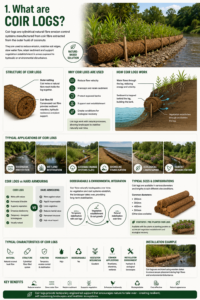
Coir logs are cylindrical natural fibre erosion control systems manufactured primarily from coir fibre extracted from the outer husk of coconuts.
Designed to provide temporary yet durable stabilisation within environmentally sensitive landscapes, coir logs are widely used in:
Their primary function is to:
Unlike rigid hard armouring solutions such as concrete, steel or rock revetments, coir logs are intended to work with natural ecological processes rather than against them. As vegetation establishes around and through the system, the landscape progressively becomes self stabilising while the coir fibres gradually biodegrade over time.
Understanding the Structure of Coir Logs
A coir log is typically formed by compressing coir fibre into a cylindrical shape and enclosing it within a surrounding netting structure.
The outer netting may be manufactured from:
The internal coir fibre fill acts as:
This creates a flexible, permeable and biologically compatible stabilisation system capable of integrating naturally into landscapes and aquatic environments.
Why Coir Logs are Used
Coir logs are commonly used where landscapes are exposed to:
Typical engineering functions include:
Their permeability allows water movement while still helping stabilise soils and protect vulnerable edges during vegetation establishment.
A Nature Based Stabilisation System
One of the defining characteristics of coir logs is that they form part of a nature based erosion control approach. Rather than permanently replacing natural systems with artificial structures, coir logs are designed to:
As plants establish:
This transition from engineered intervention to natural resilience is central to how coir log systems are intended to function.
Typical Applications of Coir Logs
Coir logs are commonly specified within:
They are particularly valuable within:
Coir Logs vs Hard Armouring Systems
Traditional erosion control often relied heavily on:
While these systems may remain appropriate in certain high energy environments, they can also:
Coir logs provide an alternative approach by:
This makes them particularly suited to sustainable infrastructure and ecological engineering projects.
Biodegradability & Environmental Integration
Coir fibre naturally biodegrades over time through biological and environmental processes.
Importantly, biodegradation within coir log systems is not viewed as failure.
Instead, it reflects the intended engineering philosophy:
As vegetation and root systems mature, the landscape progressively assumes the stabilisation role originally supported by the coir log.
This approach aligns closely with:
Typical Sizes & Configurations
Coir logs are available in a range of:
Common diameters may include:
Larger systems may provide:
Vegetated & Pre Planted Coir Logs
Some coir log systems may also be:
These systems are commonly used within:
Vegetated systems can accelerate:
Coir Logs as Living Infrastructure
Modern environmental engineering increasingly recognises that:
Coir logs contribute to this philosophy by supporting:
Rather than functioning purely as inert barriers, coir logs can become part of living stabilisation systems.
This represents a significant shift away from purely hard-engineered erosion control approaches towards more:
Typical Characteristics of Coir Logs
| Characteristic | Description |
| Material | Natural coconut husk fibre |
| Structure | Cylindrical fibre-filled system |
| Function | Temporary erosion control & stabilisation |
| Permeability | High |
| Biodegradable | Yes |
| Vegetation Integration | Excellent |
| Common Applications | Riverbanks, shorelines, wetlands |
| Installation Environment | Hydraulic & ecological landscapes |
Disclaimer: This article is provided for general information only and does not constitute engineering, environmental, design, legal, or professional advice. Project-specific advice should always be obtained from suitably qualified professionals.
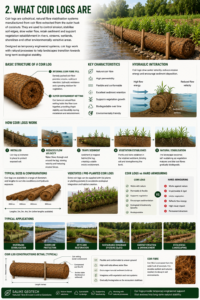
Coir logs are engineered natural fibre stabilisation systems designed to provide temporary erosion control and ecological support within environmentally sensitive landscapes.
Manufactured primarily from compressed coir fibre derived from the outer husk of coconuts, coir logs are formed into cylindrical units that can be installed along:
Their function extends beyond simple physical protection.
Coir logs are designed to:
Understanding Coir Fibre
The core material used within coir logs is coir fibre. Coir fibre is extracted from the fibrous outer husk surrounding coconuts.
This fibre possesses several natural characteristics that make it suitable for erosion control applications, including:
Once processed, the coir fibre is cleaned, separated and compressed to form the internal stabilisation core of the coir log system.
Basic Structure of a Coir Log
A coir log typically consists of two main components:
Internal Coir Fibre Fill
The internal core is formed from densely packed coir fibre.
This fibre fill provides:
The fibre matrix also creates:
Outer Containment Netting
The fibre core is held together within an external netting structure.
Depending on specification requirements, this netting may be manufactured from:
The outer netting provides:
A Flexible Stabilisation System
Unlike rigid erosion control systems such as:
coir logs are:
This allows them to:
Their flexibility also makes them suitable for:
Hydraulic Interaction
One of the defining characteristics of coir logs is their ability to interact with water flow in a controlled way.
Rather than acting as impermeable barriers, coir logs:
This hydraulic moderation helps create more stable conditions for:
Sediment Retention & Bank Formation
As water velocity reduces around the coir log:
Over time, this process contributes to:
This gradual transition from engineered support to natural landform stability is fundamental to the design philosophy of coir log systems.
Coir Logs as Temporary Engineered Systems
Coir logs are not intended to function as permanent hard-engineering barriers.
Instead, they are designed as temporary engineered stabilisation systems.
Their role is to:
As vegetation matures:
Typical Sizes & Configurations
Coir logs are manufactured in a variety of:
Typical diameters may include:
Different sizes are selected depending on:
Longer and larger diameter systems generally provide:
Vegetated & Pre-Planted Systems
Some coir log systems may include:
These vegetated configurations can accelerate:
Such systems are increasingly used within:
A Living Erosion Control System
Unlike conventional hard armouring systems which remain static and inert, coir logs evolve over time.
As vegetation establishes:
For this reason, coir logs are increasingly viewed not simply as erosion control products, but as components of living infrastructure systems.
Typical Characteristics of Coir Logs
| Characteristic | Description |
| Material | Natural coir fibre |
| Structure | Cylindrical fibre-filled unit |
| Permeability | High |
| Flexibility | Excellent |
| Biodegradable | Yes |
| Ecological Integration | High |
| Typical Use | Bank & shoreline stabilisation |
| Vegetation Support | Excellent |
Disclaimer: This article is provided for general information only and does not constitute engineering, environmental, design, legal, or professional advice. Project-specific advice should always be obtained from suitably qualified professionals.
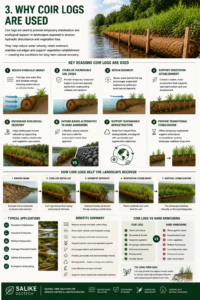
Coir logs are used to provide temporary stabilisation and ecological support in landscapes exposed to:
They are widely specified where there is a need to:
Unlike rigid hard engineering systems that permanently alter natural environments, coir logs are designed to function as transitional stabilisation systems, supporting the landscape while ecological processes progressively take over.
This approach makes coir logs particularly valuable within:
Understanding the Problem: Why Erosion Occurs
Water movement naturally exerts force on exposed soils and shorelines.
Over time, this can lead to:
Common causes of erosion include:
Once erosion begins, landscapes often become increasingly vulnerable because:
Coir logs help interrupt this cycle.
1. To Reduce Hydraulic Energy
One of the primary reasons coir logs are used is to reduce the erosive energy of moving water.
As water encounters the coir log:
This hydraulic moderation is especially important along:
Reducing water energy helps create more stable conditions for:
2. To Stabilise Vulnerable Soil Edges
Exposed soil edges are highly susceptible to:
Coir logs provide temporary structural support that helps:
Their flexible structure allows them to:
This makes them particularly suitable for:
3. To Retain Sediment
Sediment retention is a critical function of coir logs.
As water flow slows around the log:
This sediment accumulation:
Over time, sediment deposition behind and around the coir log contributes to natural landform recovery.
4. To Support Vegetation Establishment
Vegetation is one of the most important long-term stabilisation mechanisms in natural erosion control systems.
Coir logs help support vegetation by:
The coir fibre matrix itself also provides:
As plants establish:
5. To Encourage Ecological Recovery
Modern environmental engineering increasingly recognises that healthy ecosystems contribute to infrastructure resilience.
Coir logs are used not simply to stop erosion, but to help landscapes:
This ecological approach supports:
For this reason, coir logs are commonly used within:
6. To Provide a Nature Based Alternative to Hard Armouring
Traditional erosion control often relied heavily on:
While such systems remain necessary in some high energy environments, they can also:
Coir logs offer a more adaptive and ecologically integrated alternative by:
This aligns closely with nature-based infrastructure and regenerative engineering principles.
7. To Support Sustainable Infrastructure Objectives
Infrastructure sectors increasingly consider:
Coir logs help support these objectives because they:
This makes them particularly relevant within:
8. To Create Transitional Stabilisation
Perhaps the most important reason coir logs are used is that they provide temporary engineered support while nature re-establishes itself.
Unlike permanent armouring systems designed to remain indefinitely, coir logs are intended to:
This transition from engineered protection to ecological self stabilisation is central to how coir log systems function.
Typical Applications Where Coir Logs Are Used
Environment | Primary Purpose |
Riverbanks | Reduce bank erosion |
Wetlands | Support ecological recovery |
Shorelines | Reduce wave & flow erosion |
Drainage Channels | Moderate runoff velocity |
SuDS Systems | Stabilise vegetated drainage |
Habitat Restoration | Support biodiversity recovery |
Ecological Landscaping | Natural edge stabilisation |
Why Coir Logs Are Increasingly Important
As infrastructure and environmental sectors increasingly move towards:
Coir logs are becoming more widely recognised as multifunctional living infrastructure systems, rather than simple erosion control products.
Their ability to combine:
Disclaimer: This article is provided for general information only and does not constitute engineering, environmental, design, legal, or professional advice. Project-specific advice should always be obtained from suitably qualified professionals.
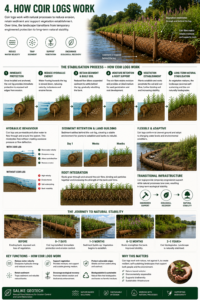
Coir logs work by combining:
Rather than functioning as rigid barriers that completely block water movement, coir logs are designed to interact with natural environmental processes in a controlled and stabilising way.
Their effectiveness comes not from resisting nature entirely, but from:
This approach is fundamental to nature based erosion control systems.
Understanding the Stabilisation Process
The operation of a coir log can be understood as a sequence of interconnected environmental and engineering functions.
Stage 1 – Initial Installation & Immediate Protection
Once installed and securely anchored:
At this stage, the system immediately begins to:
This temporary protection is particularly important during:
Stage 2 – Hydraulic Energy Dissipation
One of the primary functions of coir logs is to reduce water velocity and dissipate hydraulic energy.
As flowing water encounters the coir log:
Rather than reflecting flow aggressively like rigid hard armouring systems, coir logs:
This reduction in hydraulic stress helps:
Stage 3 – Sediment Retention & Deposition
As water flow slows around the coir log:
This sediment retention is extremely important because it:
Over time, sediment accumulation behind and around the coir log contributes to natural bank rebuilding and landform recovery.
Stage 4 – Moisture Retention & Root Support
The coir fibre matrix naturally retains moisture while still allowing:
This creates favourable conditions for:
The fibre structure also acts as:
As vegetation develops:
Stage 5 – Vegetation Establishment & Ecological Integration
Vegetation is central to how coir log systems achieve long term stability.
Once plants establish:
The coir log helps create a transition from vulnerable exposed bank to vegetated self-stabilising ecosystem. This transition is one of the defining principles of: regenerative erosion control systems.
Stage 6 – Long Term Natural Stabilisation
As ecological recovery progresses:
Importantly biodegradation is part of the design philosophy, not system failure.
The intended outcome is:
Hydraulic Behaviour of Coir Logs
Unlike impermeable structures, coir logs are:
Water is able to:
This permeability:
This makes coir logs particularly suitable for:
Sediment Dynamics & Natural Recovery
One of the key engineering advantages of coir logs is their ability to support controlled sediment deposition.
As sediment accumulates:
This gradual recovery process helps convert:
Interaction with Vegetation
Coir logs are highly compatible with vegetation establishment because:
Vegetation may establish through:
As roots mature:
Flexible Environmental Adaptation
Another reason coir logs work effectively is their flexibility.
Unlike rigid systems:
This reduces:
Coir Logs as Transitional Infrastructure
Perhaps the most important concept is that coir logs function as transnational stabilisation infrastructure. They are not designed to permanently dominate the landscape.
Instead, they:
This reflects a major shift in modern environmental engineering towards:
Typical Functional Sequence
Stage | Primary Function |
Installation | Immediate erosion protection |
Hydraulic Interaction | Flow velocity reduction |
Sediment Retention | Soil accumulation |
Moisture Retention | Vegetation support |
Vegetation Establishment | Root reinforcement |
Biodegradation | Transition to natural stability |
Why Understanding the Process Matters
Coir logs are sometimes misunderstood as:
In reality, they are dynamic ecological engineering systems designed to interact with:
Understanding how coir logs work is essential for:
Disclaimer: This article is provided for general information only and does not constitute engineering, environmental, design, legal, or professional advice. Project-specific advice should always be obtained from suitably qualified professionals.
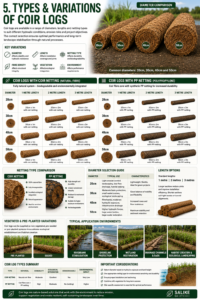
Coir logs are manufactured in a range of:
Selecting the correct coir log configuration is important because performance can vary depending on:
While the fundamental stabilisation principles remain similar across all systems, larger or more heavily reinforced configurations may provide:
Understanding Coir Log Variations
The primary variations between coir log systems typically relate to:
Variation Type | Influences |
Diameter | Stability & hydraulic resistance |
Length | Installation coverage |
Fibre Density | Structural integrity |
Netting Type | Durability & containment |
Vegetated / Non-Vegetated | Ecological integration |
Installation Environment | Performance requirements |
Common Coir Log Diameters
Coir logs are commonly manufactured in the following diameters:
Diameter | Typical Application |
20cm | Light erosion control & landscaping |
30cm | Moderate bank protection |
40cm | Riverbanks & hydraulic environments |
50cm | Higher exposure & large-scale restoration |
Larger diameter systems generally provide:
Standard Coir Log Lengths
Typical standard lengths include:
Longer sections may:
Shorter sections may be advantageous where:
Coir Netting vs PP Netting Systems
One of the most important variations in coir log construction is the: outer containment netting system.
Coir logs are commonly supplied using either:
Each system offers different performance characteristics and environmental considerations.
Coir Logs with Coir Netting
These systems utilise natural coir fibre netting as the external containment structure. This configuration creates a fully natural fibre erosion control system.
Typical Configurations
20cm Diameter
30cm Diameter
40cm Diameter
50cm Diameter
Characteristics of Coir Netting Systems
Coir netted logs typically provide:
These systems are often preferred within:
Because both the fibre fill and outer mesh are natural materials, the system progressively biodegrades as vegetation establishes and natural stability develops.
Coir Logs with PP Netting
These systems utilise polypropylene (PP) containment netting around the coir fibre core.
The internal fibre remains natural coir, but the outer mesh provides additional:
Typical Configurations
20cm Diameter
30cm Diameter
40cm Diameter
50cm Diameter
Characteristics of PP Netting Systems
PP netted systems may provide:
These systems may be selected where:
However, unlike fully natural fibre systems, PP netting introduces:
Choosing Between Coir Netting & PP Netting
The most suitable system depends on:
Typical Comparison
Characteristic | Coir Netting | PP Netting |
Material Type | Natural fibre | Synthetic polymer |
Biodegradable | Yes | No |
Ecological Integration | Excellent | Moderate |
Structural Durability | Moderate | Higher |
Environmental Persistence | Minimal | Long-term |
Typical Use | Ecological restoration | Higher exposure environments |
Diameter Selection Considerations
Selecting the appropriate diameter depends on:
20cm Logs
Typically used for:
30cm Logs
Often used for:
40cm Logs
Commonly specified for:
50cm Logs
Generally used where:
Vegetated & Pre Planted Variations
Some coir log systems may also be supplied as:
These configurations support:
Typical species may include:
Understanding Variation is Critical
Not all coir log systems perform identically.
Performance depends heavily on:
Correct specification should therefore be site specific and performance led, rather than based solely on product size alone.
Disclaimer: This article is provided for general information only and does not constitute engineering, environmental, design, legal, or professional advice. Project-specific advice should always be obtained from suitably qualified professionals.
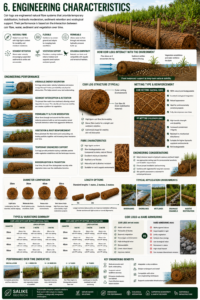
The engineering performance of coir logs is influenced by a combination of:
Although coir logs are manufactured from natural fibre materials, they should not be misunderstood as simple landscaping products.
When correctly specified and installed, coir log systems can provide highly effective:
Understanding their engineering characteristics is essential for:
Natural Fibre Composition
The primary engineering material within coir logs is coir fibre, extracted from the outer husk of coconuts. Coir fibre contains naturally high levels of lignin, which contributes to:
Compared with many other natural fibres, coir generally provides:
This makes coir particularly suitable for:
Structural Flexibility
One of the defining engineering characteristics of coir logs is their flexibility.
Unlike rigid armouring systems:
This flexibility helps:
Flexible systems are particularly advantageous where:
Permeability & Hydraulic Interaction
Coir logs are highly permeable systems.
Water is able to:
This permeability:
Rather than aggressively reflecting water flow, coir logs:
This characteristic is fundamental to nature-based hydraulic stabilisation.
Sediment Retention Capacity
The porous fibre matrix within coir logs creates effective conditions for sediment interception and retention.
As water flow slows around the system:
This sediment accumulation:
Over time, sediment retention helps transform:
Vegetation Integration
Coir logs are engineered to work with vegetation systems rather than independently from them.
The fibre matrix supports:
As vegetation establishes:
This interaction between:
Temporary Engineered Performance
Coir logs are designed as temporary stabilisation systems.
Their engineering role is to:
Unlike permanent hard engineering structures, coir logs are intended to:
This transition from engineered support to natural stability is central to the design philosophy of coir-based systems.
Biodegradation Characteristics
Biodegradation is one of the most important engineering considerations of coir systems.
The rate of degradation depends on:
Importantly biodegradation is not system failure. Instead, it reflects the intended temporary nature of the stabilisation process.
Typical functional performance may extend for:
Diameter & Mass Influence
Larger diameter coir logs generally provide:
Smaller systems may offer:
Selecting the correct diameter depends on:
Fibre Density & Structural Integrity
The density of the internal coir fibre influences:
Higher density systems may provide:
However, excessively dense systems may:
Appropriate specification therefore requires balance between stability and ecological integration.
Netting Type & Reinforcement
The outer containment netting also influences engineering behaviour.
Coir Netting Systems
Typically provide:
PP Netting Systems
Typically provide:
The appropriate system depends on:
Hydraulic Energy Dissipation
Coir logs reduce:
This energy dissipation helps:
Unlike rigid structures that may deflect energy downstream, coir logs encourage distributed hydraulic moderation.
Ecological Engineering Characteristics
Modern infrastructure increasingly values systems that provide:
Coir logs contribute to:
This multifunctional behaviour is one reason why coir logs are increasingly recognised as living infrastructure systems.
Typical Engineering Characteristics Summary
Characteristic | Engineering Behaviour |
Material Type | Natural coir fibre |
Flexibility | High |
Permeability | High |
Sediment Retention | Excellent |
Vegetation Integration | Excellent |
Hydraulic Energy Reduction | Effective |
Biodegradable | Yes |
Ecological Compatibility | High |
Temporary Stabilisation | Primary design function |
Engineering Performance Depends on Correct Specification
The effectiveness of coir logs depends heavily on:
No single configuration is appropriate for every environment.
Good engineering practice requires site-specific assessment and performance-led specification.
Disclaimer: This article is provided for general information only and does not constitute engineering, environmental, design, legal, or professional advice. Project-specific advice should always be obtained from suitably qualified professionals.
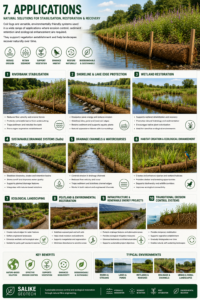
Coir logs are used across a wide range of:
Their flexibility, permeability and ecological compatibility make them suitable for environments where both erosion control and environmental integration are important.
Unlike rigid hard-armouring systems that permanently alter landscapes, coir logs are commonly applied where the objective is to:
As a result, coir logs are increasingly specified within:
Riverbank Stabilisation
One of the most common applications of coir logs is riverbank protection and stabilisation.
Riverbanks are highly vulnerable to:
Coir logs help stabilise riverbanks by:
Over time:
This makes coir logs highly suitable for:
Shoreline & Lake Edge Protection
Coir logs are widely used along:
These landscapes are often exposed to:
Coir logs help:
Because they integrate naturally into the environment, coir logs are often preferred within:
3. Wetland Restoration
Wetlands are highly dynamic ecological environments that require:
Coir logs are frequently used within wetland rehabilitation and habitat restoration projects because they:
Their biodegradable nature also helps avoid introducing:
Typical wetland applications include:
4. Sustainable Drainage Systems (SuDS)
Modern sustainable drainage systems increasingly incorporate:
Coir logs are commonly used within SuDS environments to:
Their permeability allows:
This aligns closely with sustainable urban water management approaches.
5. Drainage Channels & Watercourses
Artificial and natural drainage channels may experience:
Coir logs help moderate these hydraulic conditions by:
They are particularly useful where:
6. Habitat Creation & Ecological Enhancement
Coir logs are increasingly used as part of biodiversity enhancement and habitat creation strategies.
Because they support:
they can help create:
Vegetated coir log systems may also provide:
7. Ecological Landscaping
Within landscape architecture and environmental design, coir logs are often used to:
They are commonly incorporated into:
Their natural appearance and biodegradable composition help support visually integrated landscape design.
8. Peatland & Environmental Restoration
Coir logs may also be used within:
In these applications, they help:
Because they are manufactured from natural fibre materials, coir logs align well with:
9. Infrastructure & Renewable Energy Projects
Coir logs are increasingly specified within:
Typical uses include:
As infrastructure sectors increasingly adopt:
Coir logs are becoming more widely integrated into environmentally conscious infrastructure design.
10. Transitional Erosion Control Systems
Perhaps one of the most important applications of coir logs is their role within transitional stabilisation systems.
Rather than permanently replacing natural landscapes with rigid structures, coir logs help:
This transition from engineered intervention to natural resilience is central to:
Typical Application Summary
Application | Primary Function |
Riverbanks | Erosion reduction & bank stabilisation |
Shorelines | Wave & edge protection |
Wetlands | Ecological restoration |
SuDS | Drainage edge stabilisation |
Drainage Channels | Flow moderation |
Habitat Creation | Biodiversity support |
Ecological Landscaping | Natural landscape integration |
Infrastructure Projects | Sustainable environmental protection |
Why Application Understanding Matters
Not all environments require the same stabilisation approach.
Successful use of coir logs depends on understanding:
The most effective applications are those where:
Disclaimer: This article is provided for general information only and does not constitute engineering, environmental, design, legal, or professional advice. Project-specific advice should always be obtained from suitably qualified professionals.
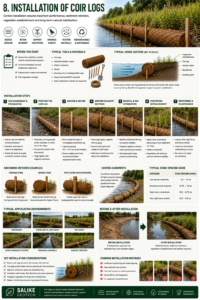
Correct installation is one of the most important factors influencing the long-term performance of coir log systems.
Even high quality coir logs may underperform if:
Successful installation should ensure that the coir log:
Because coir logs are designed as transitional stabilisation systems, installation should always be approached as part of a wider:
Understanding the Purpose of Installation
The objective of installation is not simply to place a cylindrical fibre unit along a bank edge.
The installation process is intended to:
Correct positioning and anchoring are essential to ensure that the system:
Typical Installation Environments
Coir logs are commonly installed within:
Each environment presents different:
Installation methodology should therefore always be site-specific.
Stage 1 – Site Assessment & Preparation
Before installation begins, the site should be assessed for:
Typical preparation may include:
Good preparation helps:
Stage 2 – Positioning the Coir Logs
Coir logs are typically installed:
The log should sit firmly against the soil surface without excessive gaps or unsupported sections.
Correct positioning helps:
Where multiple logs are used:
Stage 3 – Anchoring & Securing
Anchoring is one of the most critical stages of installation.
Without sufficient anchoring:
Coir logs are commonly secured using:
Anchors are typically driven:
Correct anchoring spacing depends on:
Higher energy environments generally require:
Stage 4 – Jointing Adjacent Sections
Where multiple logs are connected:
Poorly connected joints may create:
In curved alignments:
Good continuity helps maintain uniform hydraulic moderation and sediment retention.
Stage 5 – Backfilling & Soil Integration
In many installations, soil may be:
This helps:
Proper soil integration also encourages:
Stage 6 – Vegetation Establishment
Vegetation is central to the long-term success of coir log systems.
Installation is often combined with:
As vegetation establishes:
The transition from engineered support to vegetation-led stability is a fundamental design principle of coir log systems.
Stage 7 – Monitoring & Early Maintenance
Following installation, early inspection is important to identify:
Inspections are particularly important after:
Early maintenance may include:
Hydraulic Considerations During Installation
Installation should always consider:
Improper placement may:
Correct installation helps ensure that the coir log:
Because coir logs are commonly used within:
installation should minimise:
Careful installation helps support:
Common Installation Mistakes
Common installation problems may include:
These issues may reduce:
Successful performance depends on correct specification and competent installation.
Typical Installation Sequence
Stage | Primary Objective |
Site Preparation | Create stable installation surface |
Positioning | Maintain continuous soil contact |
Anchoring | Prevent movement & displacement |
Jointing | Ensure hydraulic continuity |
Backfilling | Improve integration & stability |
Vegetation Establishment | Support long-term stabilisation |
Monitoring | Maintain system performance |
Installation as Part of a Wider Stabilisation Strategy
Coir logs should not be viewed as isolated products.
Their effectiveness depends on integration with:
The best outcomes occur where installation forms part of a holistic nature based stabilisation approach.
Disclaimer: This article is provided for general information only and does not constitute engineering, environmental, design, legal, or professional advice. Project-specific advice should always be obtained from suitably qualified professionals.
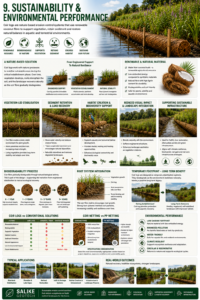
Sustainability is one of the defining characteristics of coir log systems.
Unlike many conventional erosion control materials that rely heavily on:
Coir logs are manufactured primarily from natural coconut husk fibre, a renewable material capable of supporting both:
This makes coir logs particularly relevant within modern infrastructure and environmental sectors increasingly focused on:
A Nature Based Stabilisation System
Coir logs are fundamentally different from conventional hard armouring systems because they are designed to work with ecological processes rather than replace them. Their purpose is not simply to resist erosion indefinitely through rigid containment.
Instead, coir logs:
This transition from engineered intervention to ecological self stabilisation is central to the sustainability philosophy behind coir-based erosion control systems.
Renewable Natural Fibre Material
The primary material used within coir logs is coir fibre, which is extracted from the outer husk of coconuts. Coconut husk is a naturally renewable agricultural resource.
Using coir fibre within erosion control systems helps utilise:
Compared with heavily processed synthetic materials, coir fibre offers:
Biodegradability & Environmental Integration
One of the most important environmental characteristics of coir logs is biodegradability.
Over time, coir fibre gradually breaks down through:
Importantly biodegradation is not viewed as product failure. Instead, it reflects the intended engineering and ecological function of the system.
The coir log provides stabilisation during the vulnerable establishment phase while:
As the landscape stabilises naturally, the need for engineered support progressively reduces.
This approach helps avoid leaving:
Vegetation Led Stabilisation
Coir logs support vegetation establishment and ecological succession.
The coir fibre matrix:
As plants establish:
Vegetation led recovery is one of the most sustainable forms of erosion control because:
Sediment Retention & Land Recovery
Coir logs help reduce sediment loss by:
This sediment retention contributes to:
Rather than simply preventing erosion through rigid barriers, coir logs help landscapes regenerate naturally.
Habitat Creation & Biodiversity Support
Because coir logs integrate naturally with vegetation systems, they can support:
Typical environmental benefits may include:
Vegetated coir log systems are increasingly used within:
Reduced Visual Impact
Traditional erosion control systems such as:
Coir logs generally provide:
As vegetation establishes, coir logs often become:
This is particularly important within:
Supporting Sustainable Infrastructure
Modern infrastructure increasingly incorporates:
Coir logs align closely with these approaches because they:
Typical applications include:
Nature Based Infrastructure Principles
Coir logs are increasingly recognised as part of nature-based infrastructure systems.
Nature based infrastructure uses:
Rather than attempting to dominate natural systems through rigid engineering alone, nature based approaches seek to:
Coir logs contribute to this philosophy by:
Temporary vs Permanent Environmental Footprint
One of the key sustainability advantages of coir logs is that they are designed as temporary stabilisation systems.
Unlike permanent synthetic infrastructure that may remain within landscapes indefinitely, coir systems progressively integrate into the environment over time.
This helps reduce:
The intended outcome is:
Environmental Considerations of PP Netting Systems
Some coir logs may incorporate polypropylene (PP) netting for increased structural containment.
While PP systems may improve:
Specification decisions should therefore consider:
Sustainability as a Functional Engineering Principle
Importantly, sustainability within coir log systems is not merely aesthetic or promotional.
The environmental performance of coir logs is directly linked to:
The engineering philosophy is fundamentally based on temporary support enabling long term natural resilience.
Typical Sustainability Characteristics
Sustainability Characteristic | Performance |
Renewable Material | Yes |
Biodegradable | Yes |
Vegetation Support | Excellent |
Ecological Integration | High |
Habitat Enhancement Potential | High |
Sediment Retention | Effective |
Nature-Based Function | Yes |
Long-Term Synthetic Persistence | Minimal (coir netting systems) |
Sustainability Depends on Correct Application
While coir logs offer significant environmental benefits, successful sustainable performance still depends on:
Nature based systems are most effective when:
Disclaimer: This article is provided for general information only and does not constitute engineering, environmental, design, legal, or professional advice. Project-specific advice should always be obtained from suitably qualified professionals.
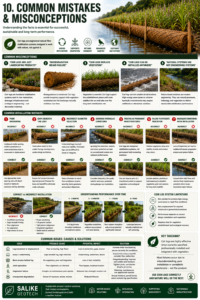
Coir logs are often misunderstood as:
In reality, coir logs are engineered natural fibre stabilisation systems designed to interact with:
Like all erosion control systems, their effectiveness depends heavily on:
Many performance issues associated with coir logs are not caused by the material itself, but by:
Understanding the most common mistakes and misconceptions is essential for:
Misconception 1 – “Coir Logs Are Just Landscaping Products”
One of the most common misconceptions is that coir logs are merely:
In reality, coir logs are widely used within:
Their performance relies on:
While visually natural, coir logs are functional stabilisation systems, not simply decorative materials.
Misconception 2 – “Biodegradation Means Failure”
Many people incorrectly assume that because coir logs biodegrade they are weak or ineffective. In reality biodegradation is a fundamental part of the design philosophy.
Coir logs are intended to:
As vegetation matures:
The intended long term outcome is natural self sustaining stability, not permanent artificial containment.
Misconception 3 – “Coir Logs Replace Vegetation”
Coir logs are not designed to function independently from vegetation systems.
In fact, vegetation establishment is critical to long-term success.
The coir log provides:
Without vegetation integration:
Successful projects typically combine coir logs with:
Misconception 4 – “Coir Logs Can Be Installed Anywhere”
Not all environments are suitable for coir log systems.
While coir logs perform well within many:
they may not be appropriate as standalone systems within:
Correct specification requires site specific engineering assessment.
Mistake 1 – Poor Anchoring
One of the most common installation failures is inadequate anchoring.
If coir logs are not properly secured:
Common anchoring mistakes include:
Proper anchoring is essential for:
Mistake 2 – Leaving Gaps Beneath the Logs
Coir logs must maintain continuous contact with the ground surface.
If voids exist beneath the system:
Poor ground preparation can significantly reduce:
Proper installation should ensure:
Mistake 3 – Incorrect Diameter Selection
Selecting the wrong coir log diameter may reduce performance.
Undersized systems may:
Oversized systems may:
Diameter selection should consider:
Mistake 4 – Ignoring Hydraulic Conditions
Coir logs function through hydraulic interaction. If water velocity,
flow direction, or scour potential are ignored during design or installation:
Hydraulic assessment is particularly important within:
Mistake 5 – Treating Coir Logs as Permanent Hard Structures
Coir logs should not be specified with the expectation that they will behave like:
They are designed as temporary stabilisation systems that support:
Successful specification depends on understanding this transitional engineering role.
Mistake 6 – Failure to Integrate Vegetation
Vegetation establishment is one of the most important factors influencing long-term performance.
Projects that fail to:
Root systems provide:
The coir log functions most effectively when integrated into vegetation led stabilisation systems.
Mistake 7 – Inadequate Monitoring After Installation
Even well installed systems benefit from:
Common post installation risks include:
Monitoring is particularly important after:
Early intervention can help prevent:
Misconception 5 – “Natural Systems Are Not Engineering Systems”
Perhaps the biggest misconception is the assumption that natural fibre systems are somehow not engineered solutions.
Modern erosion control increasingly recognises that:
Coir logs represent:
Understanding the Limits of Coir Logs-
Like all stabilisation systems, coir logs have:
Successful use depends on:
Nature based systems are most effective when:
Typical Mistakes Summary
Common Issue | Potential Impact |
Poor Anchoring | Movement or displacement |
Ground Voids | Undermining & scour |
Incorrect Diameter | Reduced performance |
No Vegetation Integration | Weak long-term stability |
Ignoring Hydraulics | Concentrated erosion |
Poor Monitoring | Progressive instability |
Unrealistic Expectations | Incorrect specification |
Why Understanding These Issues Matters
Many coir log failures occur not because:
Understanding the strengths,
limitations,
and intended engineering role of coir logs is essential for:
Disclaimer: This article is provided for general information only and does not constitute engineering, environmental, design, legal, or professional advice. Project-specific advice should always be obtained from suitably qualified professionals.
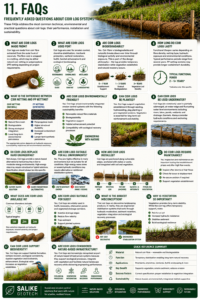
Understanding how coir logs function, where they are suitable, and how they should be specified is important for achieving successful long-term erosion control and ecological recovery outcomes.
The following FAQs address some of the most common technical, environmental and practical questions relating to coir log systems.
What are coir logs made from?
Coir logs are primarily manufactured from coir fibre, which is extracted from the outer husk of coconuts.
The internal fibre core is typically compressed into a cylindrical form and contained within an outer netting structure, which may be manufactured from:
What are coir logs used for?
Coir logs are used for:
Their primary role is to:
Are coir logs biodegradable?
Yes.
Coir fibre is a biodegradable natural material.
Over time, the fibre gradually breaks down through:
Importantly biodegradation is part of the intended design philosophy, not system failure. The coir log provides temporary stabilisation while vegetation establishes and natural stabilisation processes develop.
How long do coir logs last?
The functional lifespan of coir logs depends on factors such as:
Typical performance periods may range from:
PP netting systems may provide longer containment durability than fully natural fibre systems.
What is the difference between coir netting and PP netting?
The difference relates to the outer containment mesh.
Coir Netting
PP Netting
The appropriate option depends on:
Are coir logs environmentally friendly?
Coir logs are widely considered environmentally integrated erosion control systems.
Their sustainability characteristics include:
However, environmental performance depends on:
Can coir logs be planted?
Yes.
Many coir log systems are designed to support:
Some coir logs may also be supplied as:
Vegetation is extremely important because:
Can coir logs be used underwater?
Coir logs are commonly installed:
Typical applications include:
However, specification should always consider:
Do coir logs replace hard engineering?
Not necessarily.
Coir logs are nature-based stabilisation systems, and may provide an alternative to hard armouring in many:
However, extremely high-energy environments may still require:
Correct specification should always be site specific.
Are coir logs suitable for all environments?
No.
While coir logs are highly effective within many:
they are not suitable for every condition.
Performance depends on:
High energy wave zones or severe hydraulic conditions may require:
How are coir logs installed?
Coir logs are typically:
Correct installation generally includes:
Installation quality is one of the most important factors influencing long term performance.
Do coir logs require maintenance?
Like most erosion control systems, coir logs benefit from:
Monitoring is especially important after:
Maintenance may include:
What sizes are coir logs available in?
Coir logs are commonly manufactured in diameters such as:
Typical lengths may include:
Different sizes are selected depending on:
Are coir logs suitable for sustainable drainage systems (SuDS)?
Yes.
Coir logs are widely used within:
They help:
Their permeability and ecological compatibility make them well suited to nature-based water management systems.
What is the biggest misconception about coir logs?
One of the most common misconceptions is that coir logs are decorative landscaping products.
In reality, they are:
Their performance depends on:
Why is vegetation so important?
Vegetation provides long-term stabilisation.
While the coir log offers temporary support:
Without vegetation integration:
Can coir logs support biodiversity?
Yes.
Coir logs may help support:
As vegetation establishes and sediment accumulates:
Are coir logs considered nature-based infrastructure?
Increasingly, yes.
Coir logs are commonly viewed as part of nature-based infrastructure systems because they:
Disclaimer: This article is provided for general information only and does not constitute engineering, environmental, design, legal, or professional advice. Project-specific advice should always be obtained from suitably qualified professionals.
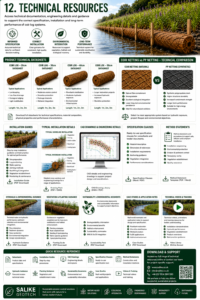
Technical documentation plays an important role in the successful specification, installation and long-term performance of coir log systems.
While general guidance and visual information can help explain the principles of erosion control and ecological stabilisation, infrastructure and environmental projects often require:
A well developed technical resource library helps bridge the gap between product understanding and practical project implementation.
For consultants, contractors, landscape architects and environmental specialists, access to organised technical resources can significantly improve:
Why Technical Resources Matter
Coir log performance depends on much more than:
Successful outcomes are heavily influenced by:
Technical resources help ensure that coir logs are understood as engineered ecological stabilisation systems, rather than simple landscape products.
They support:
Product Technical Datasheets
Technical datasheets provide structured product information relating to:
Typical datasheets may include:
Coir Log Datasheet – 20cm Diameter
Typical applications:
Coir Log Datasheet – 30cm Diameter
Typical applications:
Coir Log Datasheet – 40cm Diameter
Typical applications:
Coir Log Datasheet – 50cm Diameter
Typical applications:
Coir Netting vs PP Netting Technical Information
Because outer netting systems significantly influence:
Technical resources should clearly explain the differences between:
Coir Netting Systems
PP Netting Systems
Technical comparison documents help consultants and specifiers select the most appropriate system for site-specific conditions.
Installation Guides
Installation guidance is one of the most important technical resource categories.
Correct installation strongly influences:
Typical installation resources may include:
Typical Installation Guidance Topics
Installation Topic | Purpose |
Site Preparation | Improve ground contact |
Log Positioning | Maintain hydraulic continuity |
Stake Spacing | Ensure structural stability |
Jointing Methods | Reduce erosion gaps |
Backfilling | Improve integration |
Vegetation Establishment | Support long-term stability |
Monitoring | Maintain performance |
CAD Drawings & Engineering Details
Technical drawing resources may support:
Typical drawings may include:
Depending on project requirements, drawings may be provided in:
Specification Clauses
Specification ready documentation can assist consultants during:
Typical specification resources may include:
Structured specification clauses help improve:
Method Statements
Method statements provide practical guidance relating to:
Typical method statement topics may include:
Hydraulic & Environmental Guidance
Because coir logs interact directly with:
technical resources may also include:
These resources help support more informed environmental engineering decisions.
Vegetation & Planting Guidance
Long term stabilisation performance depends heavily on vegetation establishment.
Technical planting guidance may therefore include:
Planting resources may also help support:
Sustainability & Environmental Documentation
As infrastructure sectors increasingly prioritise:
technical resources may also include:
These resources may support projects considering:
Typical Technical Resource Categories
Resource Type | Purpose |
Datasheets | Product information |
Installation Guides | Practical implementation |
CAD Drawings | Engineering coordination |
Method Statements | Construction procedures |
Specification Clauses | Tender & procurement support |
Hydraulic Guidance | Flow & erosion understanding |
Planting Guidance | Vegetation integration |
Sustainability Documents | Environmental support |
Technical Resources Improve Project Outcomes
Structured technical documentation helps improve:
It also reinforces the understanding that coir logs are engineered environmental systems, not simply landscape materials.
This distinction is increasingly important within:
Disclaimer: This article is provided for general information only and does not constitute engineering, environmental, design, legal, or professional advice. Project-specific advice should always be obtained from suitably qualified professionals.
Coir logs are cylindrical natural fibre erosion control systems manufactured primarily from coir fibre extracted from the outer husk of coconuts.
Designed to provide temporary yet durable stabilisation within environmentally sensitive landscapes, coir logs are widely used in:
Their primary function is to:
Unlike rigid hard armouring solutions such as concrete, steel or rock revetments, coir logs are intended to work with natural ecological processes rather than against them. As vegetation establishes around and through the system, the landscape progressively becomes self stabilising while the coir fibres gradually biodegrade over time.
Understanding the Structure of Coir Logs
A coir log is typically formed by compressing coir fibre into a cylindrical shape and enclosing it within a surrounding netting structure.
The outer netting may be manufactured from:
The internal coir fibre fill acts as:
This creates a flexible, permeable and biologically compatible stabilisation system capable of integrating naturally into landscapes and aquatic environments.
Why Coir Logs are Used
Coir logs are commonly used where landscapes are exposed to:
Typical engineering functions include:
Their permeability allows water movement while still helping stabilise soils and protect vulnerable edges during vegetation establishment.
A Nature Based Stabilisation System
One of the defining characteristics of coir logs is that they form part of a nature based erosion control approach. Rather than permanently replacing natural systems with artificial structures, coir logs are designed to:
As plants establish:
This transition from engineered intervention to natural resilience is central to how coir log systems are intended to function.
Typical Applications of Coir Logs
Coir logs are commonly specified within:
They are particularly valuable within:
Coir Logs vs Hard Armouring Systems
Traditional erosion control often relied heavily on:
While these systems may remain appropriate in certain high energy environments, they can also:
Coir logs provide an alternative approach by:
This makes them particularly suited to sustainable infrastructure and ecological engineering projects.
Biodegradability & Environmental Integration
Coir fibre naturally biodegrades over time through biological and environmental processes.
Importantly, biodegradation within coir log systems is not viewed as failure.
Instead, it reflects the intended engineering philosophy:
As vegetation and root systems mature, the landscape progressively assumes the stabilisation role originally supported by the coir log.
This approach aligns closely with:
Typical Sizes & Configurations
Coir logs are available in a range of:
Common diameters may include:
Larger systems may provide:
Vegetated & Pre Planted Coir Logs
Some coir log systems may also be:
These systems are commonly used within:
Vegetated systems can accelerate:
Coir Logs as Living Infrastructure
Modern environmental engineering increasingly recognises that:
Coir logs contribute to this philosophy by supporting:
Rather than functioning purely as inert barriers, coir logs can become part of living stabilisation systems.
This represents a significant shift away from purely hard-engineered erosion control approaches towards more:
Typical Characteristics of Coir Logs
| Characteristic | Description |
| Material | Natural coconut husk fibre |
| Structure | Cylindrical fibre-filled system |
| Function | Temporary erosion control & stabilisation |
| Permeability | High |
| Biodegradable | Yes |
| Vegetation Integration | Excellent |
| Common Applications | Riverbanks, shorelines, wetlands |
| Installation Environment | Hydraulic & ecological landscapes |
Disclaimer: This article is provided for general information only and does not constitute engineering, environmental, design, legal, or professional advice. Project-specific advice should always be obtained from suitably qualified professionals.
Coir logs are engineered natural fibre stabilisation systems designed to provide temporary erosion control and ecological support within environmentally sensitive landscapes.
Manufactured primarily from compressed coir fibre derived from the outer husk of coconuts, coir logs are formed into cylindrical units that can be installed along:
Their function extends beyond simple physical protection.
Coir logs are designed to:
Understanding Coir Fibre
The core material used within coir logs is coir fibre. Coir fibre is extracted from the fibrous outer husk surrounding coconuts.
This fibre possesses several natural characteristics that make it suitable for erosion control applications, including:
Once processed, the coir fibre is cleaned, separated and compressed to form the internal stabilisation core of the coir log system.
Basic Structure of a Coir Log
A coir log typically consists of two main components:
Internal Coir Fibre Fill
The internal core is formed from densely packed coir fibre.
This fibre fill provides:
The fibre matrix also creates:
Outer Containment Netting
The fibre core is held together within an external netting structure.
Depending on specification requirements, this netting may be manufactured from:
The outer netting provides:
A Flexible Stabilisation System
Unlike rigid erosion control systems such as:
coir logs are:
This allows them to:
Their flexibility also makes them suitable for:
Hydraulic Interaction
One of the defining characteristics of coir logs is their ability to interact with water flow in a controlled way.
Rather than acting as impermeable barriers, coir logs:
This hydraulic moderation helps create more stable conditions for:
Sediment Retention & Bank Formation
As water velocity reduces around the coir log:
Over time, this process contributes to:
This gradual transition from engineered support to natural landform stability is fundamental to the design philosophy of coir log systems.
Coir Logs as Temporary Engineered Systems
Coir logs are not intended to function as permanent hard-engineering barriers.
Instead, they are designed as temporary engineered stabilisation systems.
Their role is to:
As vegetation matures:
Typical Sizes & Configurations
Coir logs are manufactured in a variety of:
Typical diameters may include:
Different sizes are selected depending on:
Longer and larger diameter systems generally provide:
Vegetated & Pre-Planted Systems
Some coir log systems may include:
These vegetated configurations can accelerate:
Such systems are increasingly used within:
A Living Erosion Control System
Unlike conventional hard armouring systems which remain static and inert, coir logs evolve over time.
As vegetation establishes:
For this reason, coir logs are increasingly viewed not simply as erosion control products, but as components of living infrastructure systems.
Typical Characteristics of Coir Logs
| Characteristic | Description |
| Material | Natural coir fibre |
| Structure | Cylindrical fibre-filled unit |
| Permeability | High |
| Flexibility | Excellent |
| Biodegradable | Yes |
| Ecological Integration | High |
| Typical Use | Bank & shoreline stabilisation |
| Vegetation Support | Excellent |
Disclaimer: This article is provided for general information only and does not constitute engineering, environmental, design, legal, or professional advice. Project-specific advice should always be obtained from suitably qualified professionals.
Coir logs are used to provide temporary stabilisation and ecological support in landscapes exposed to:
They are widely specified where there is a need to:
Unlike rigid hard engineering systems that permanently alter natural environments, coir logs are designed to function as transitional stabilisation systems, supporting the landscape while ecological processes progressively take over.
This approach makes coir logs particularly valuable within:
Understanding the Problem: Why Erosion Occurs
Water movement naturally exerts force on exposed soils and shorelines.
Over time, this can lead to:
Common causes of erosion include:
Once erosion begins, landscapes often become increasingly vulnerable because:
Coir logs help interrupt this cycle.
1. To Reduce Hydraulic Energy
One of the primary reasons coir logs are used is to reduce the erosive energy of moving water.
As water encounters the coir log:
This hydraulic moderation is especially important along:
Reducing water energy helps create more stable conditions for:
2. To Stabilise Vulnerable Soil Edges
Exposed soil edges are highly susceptible to:
Coir logs provide temporary structural support that helps:
Their flexible structure allows them to:
This makes them particularly suitable for:
3. To Retain Sediment
Sediment retention is a critical function of coir logs.
As water flow slows around the log:
This sediment accumulation:
Over time, sediment deposition behind and around the coir log contributes to natural landform recovery.
4. To Support Vegetation Establishment
Vegetation is one of the most important long-term stabilisation mechanisms in natural erosion control systems.
Coir logs help support vegetation by:
The coir fibre matrix itself also provides:
As plants establish:
5. To Encourage Ecological Recovery
Modern environmental engineering increasingly recognises that healthy ecosystems contribute to infrastructure resilience.
Coir logs are used not simply to stop erosion, but to help landscapes:
This ecological approach supports:
For this reason, coir logs are commonly used within:
6. To Provide a Nature Based Alternative to Hard Armouring
Traditional erosion control often relied heavily on:
While such systems remain necessary in some high energy environments, they can also:
Coir logs offer a more adaptive and ecologically integrated alternative by:
This aligns closely with nature-based infrastructure and regenerative engineering principles.
7. To Support Sustainable Infrastructure Objectives
Infrastructure sectors increasingly consider:
Coir logs help support these objectives because they:
This makes them particularly relevant within:
8. To Create Transitional Stabilisation
Perhaps the most important reason coir logs are used is that they provide temporary engineered support while nature re-establishes itself.
Unlike permanent armouring systems designed to remain indefinitely, coir logs are intended to:
This transition from engineered protection to ecological self stabilisation is central to how coir log systems function.
Typical Applications Where Coir Logs Are Used
Environment | Primary Purpose |
Riverbanks | Reduce bank erosion |
Wetlands | Support ecological recovery |
Shorelines | Reduce wave & flow erosion |
Drainage Channels | Moderate runoff velocity |
SuDS Systems | Stabilise vegetated drainage |
Habitat Restoration | Support biodiversity recovery |
Ecological Landscaping | Natural edge stabilisation |
Why Coir Logs Are Increasingly Important
As infrastructure and environmental sectors increasingly move towards:
Coir logs are becoming more widely recognised as multifunctional living infrastructure systems, rather than simple erosion control products.
Their ability to combine:
Disclaimer: This article is provided for general information only and does not constitute engineering, environmental, design, legal, or professional advice. Project-specific advice should always be obtained from suitably qualified professionals.
Coir logs work by combining:
Rather than functioning as rigid barriers that completely block water movement, coir logs are designed to interact with natural environmental processes in a controlled and stabilising way.
Their effectiveness comes not from resisting nature entirely, but from:
This approach is fundamental to nature based erosion control systems.
Understanding the Stabilisation Process
The operation of a coir log can be understood as a sequence of interconnected environmental and engineering functions.
Stage 1 – Initial Installation & Immediate Protection
Once installed and securely anchored:
At this stage, the system immediately begins to:
This temporary protection is particularly important during:
Stage 2 – Hydraulic Energy Dissipation
One of the primary functions of coir logs is to reduce water velocity and dissipate hydraulic energy.
As flowing water encounters the coir log:
Rather than reflecting flow aggressively like rigid hard armouring systems, coir logs:
This reduction in hydraulic stress helps:
Stage 3 – Sediment Retention & Deposition
As water flow slows around the coir log:
This sediment retention is extremely important because it:
Over time, sediment accumulation behind and around the coir log contributes to natural bank rebuilding and landform recovery.
Stage 4 – Moisture Retention & Root Support
The coir fibre matrix naturally retains moisture while still allowing:
This creates favourable conditions for:
The fibre structure also acts as:
As vegetation develops:
Stage 5 – Vegetation Establishment & Ecological Integration
Vegetation is central to how coir log systems achieve long term stability.
Once plants establish:
The coir log helps create a transition from vulnerable exposed bank to vegetated self-stabilising ecosystem. This transition is one of the defining principles of: regenerative erosion control systems.
Stage 6 – Long Term Natural Stabilisation
As ecological recovery progresses:
Importantly biodegradation is part of the design philosophy, not system failure.
The intended outcome is:
Hydraulic Behaviour of Coir Logs
Unlike impermeable structures, coir logs are:
Water is able to:
This permeability:
This makes coir logs particularly suitable for:
Sediment Dynamics & Natural Recovery
One of the key engineering advantages of coir logs is their ability to support controlled sediment deposition.
As sediment accumulates:
This gradual recovery process helps convert:
Interaction with Vegetation
Coir logs are highly compatible with vegetation establishment because:
Vegetation may establish through:
As roots mature:
Flexible Environmental Adaptation
Another reason coir logs work effectively is their flexibility.
Unlike rigid systems:
This reduces:
Coir Logs as Transitional Infrastructure
Perhaps the most important concept is that coir logs function as transnational stabilisation infrastructure. They are not designed to permanently dominate the landscape.
Instead, they:
This reflects a major shift in modern environmental engineering towards:
Typical Functional Sequence
Stage | Primary Function |
Installation | Immediate erosion protection |
Hydraulic Interaction | Flow velocity reduction |
Sediment Retention | Soil accumulation |
Moisture Retention | Vegetation support |
Vegetation Establishment | Root reinforcement |
Biodegradation | Transition to natural stability |
Why Understanding the Process Matters
Coir logs are sometimes misunderstood as:
In reality, they are dynamic ecological engineering systems designed to interact with:
Understanding how coir logs work is essential for:
Disclaimer: This article is provided for general information only and does not constitute engineering, environmental, design, legal, or professional advice. Project-specific advice should always be obtained from suitably qualified professionals.
Coir logs are manufactured in a range of:
Selecting the correct coir log configuration is important because performance can vary depending on:
While the fundamental stabilisation principles remain similar across all systems, larger or more heavily reinforced configurations may provide:
Understanding Coir Log Variations
The primary variations between coir log systems typically relate to:
Variation Type | Influences |
Diameter | Stability & hydraulic resistance |
Length | Installation coverage |
Fibre Density | Structural integrity |
Netting Type | Durability & containment |
Vegetated / Non-Vegetated | Ecological integration |
Installation Environment | Performance requirements |
Common Coir Log Diameters
Coir logs are commonly manufactured in the following diameters:
Diameter | Typical Application |
20cm | Light erosion control & landscaping |
30cm | Moderate bank protection |
40cm | Riverbanks & hydraulic environments |
50cm | Higher exposure & large-scale restoration |
Larger diameter systems generally provide:
Standard Coir Log Lengths
Typical standard lengths include:
Longer sections may:
Shorter sections may be advantageous where:
Coir Netting vs PP Netting Systems
One of the most important variations in coir log construction is the: outer containment netting system.
Coir logs are commonly supplied using either:
Each system offers different performance characteristics and environmental considerations.
Coir Logs with Coir Netting
These systems utilise natural coir fibre netting as the external containment structure. This configuration creates a fully natural fibre erosion control system.
Typical Configurations
20cm Diameter
30cm Diameter
40cm Diameter
50cm Diameter
Characteristics of Coir Netting Systems
Coir netted logs typically provide:
These systems are often preferred within:
Because both the fibre fill and outer mesh are natural materials, the system progressively biodegrades as vegetation establishes and natural stability develops.
Coir Logs with PP Netting
These systems utilise polypropylene (PP) containment netting around the coir fibre core.
The internal fibre remains natural coir, but the outer mesh provides additional:
Typical Configurations
20cm Diameter
30cm Diameter
40cm Diameter
50cm Diameter
Characteristics of PP Netting Systems
PP netted systems may provide:
These systems may be selected where:
However, unlike fully natural fibre systems, PP netting introduces:
Choosing Between Coir Netting & PP Netting
The most suitable system depends on:
Typical Comparison
Characteristic | Coir Netting | PP Netting |
Material Type | Natural fibre | Synthetic polymer |
Biodegradable | Yes | No |
Ecological Integration | Excellent | Moderate |
Structural Durability | Moderate | Higher |
Environmental Persistence | Minimal | Long-term |
Typical Use | Ecological restoration | Higher exposure environments |
Diameter Selection Considerations
Selecting the appropriate diameter depends on:
20cm Logs
Typically used for:
30cm Logs
Often used for:
40cm Logs
Commonly specified for:
50cm Logs
Generally used where:
Vegetated & Pre Planted Variations
Some coir log systems may also be supplied as:
These configurations support:
Typical species may include:
Understanding Variation is Critical
Not all coir log systems perform identically.
Performance depends heavily on:
Correct specification should therefore be site specific and performance led, rather than based solely on product size alone.
Disclaimer: This article is provided for general information only and does not constitute engineering, environmental, design, legal, or professional advice. Project-specific advice should always be obtained from suitably qualified professionals.
The engineering performance of coir logs is influenced by a combination of:
Although coir logs are manufactured from natural fibre materials, they should not be misunderstood as simple landscaping products.
When correctly specified and installed, coir log systems can provide highly effective:
Understanding their engineering characteristics is essential for:
Natural Fibre Composition
The primary engineering material within coir logs is coir fibre, extracted from the outer husk of coconuts. Coir fibre contains naturally high levels of lignin, which contributes to:
Compared with many other natural fibres, coir generally provides:
This makes coir particularly suitable for:
Structural Flexibility
One of the defining engineering characteristics of coir logs is their flexibility.
Unlike rigid armouring systems:
This flexibility helps:
Flexible systems are particularly advantageous where:
Permeability & Hydraulic Interaction
Coir logs are highly permeable systems.
Water is able to:
This permeability:
Rather than aggressively reflecting water flow, coir logs:
This characteristic is fundamental to nature-based hydraulic stabilisation.
Sediment Retention Capacity
The porous fibre matrix within coir logs creates effective conditions for sediment interception and retention.
As water flow slows around the system:
This sediment accumulation:
Over time, sediment retention helps transform:
Vegetation Integration
Coir logs are engineered to work with vegetation systems rather than independently from them.
The fibre matrix supports:
As vegetation establishes:
This interaction between:
Temporary Engineered Performance
Coir logs are designed as temporary stabilisation systems.
Their engineering role is to:
Unlike permanent hard engineering structures, coir logs are intended to:
This transition from engineered support to natural stability is central to the design philosophy of coir-based systems.
Biodegradation Characteristics
Biodegradation is one of the most important engineering considerations of coir systems.
The rate of degradation depends on:
Importantly biodegradation is not system failure. Instead, it reflects the intended temporary nature of the stabilisation process.
Typical functional performance may extend for:
Diameter & Mass Influence
Larger diameter coir logs generally provide:
Smaller systems may offer:
Selecting the correct diameter depends on:
Fibre Density & Structural Integrity
The density of the internal coir fibre influences:
Higher density systems may provide:
However, excessively dense systems may:
Appropriate specification therefore requires balance between stability and ecological integration.
Netting Type & Reinforcement
The outer containment netting also influences engineering behaviour.
Coir Netting Systems
Typically provide:
PP Netting Systems
Typically provide:
The appropriate system depends on:
Hydraulic Energy Dissipation
Coir logs reduce:
This energy dissipation helps:
Unlike rigid structures that may deflect energy downstream, coir logs encourage distributed hydraulic moderation.
Ecological Engineering Characteristics
Modern infrastructure increasingly values systems that provide:
Coir logs contribute to:
This multifunctional behaviour is one reason why coir logs are increasingly recognised as living infrastructure systems.
Typical Engineering Characteristics Summary
Characteristic | Engineering Behaviour |
Material Type | Natural coir fibre |
Flexibility | High |
Permeability | High |
Sediment Retention | Excellent |
Vegetation Integration | Excellent |
Hydraulic Energy Reduction | Effective |
Biodegradable | Yes |
Ecological Compatibility | High |
Temporary Stabilisation | Primary design function |
Engineering Performance Depends on Correct Specification
The effectiveness of coir logs depends heavily on:
No single configuration is appropriate for every environment.
Good engineering practice requires site-specific assessment and performance-led specification.
Disclaimer: This article is provided for general information only and does not constitute engineering, environmental, design, legal, or professional advice. Project-specific advice should always be obtained from suitably qualified professionals.
Coir logs are used across a wide range of:
Their flexibility, permeability and ecological compatibility make them suitable for environments where both erosion control and environmental integration are important.
Unlike rigid hard-armouring systems that permanently alter landscapes, coir logs are commonly applied where the objective is to:
As a result, coir logs are increasingly specified within:
Riverbank Stabilisation
One of the most common applications of coir logs is riverbank protection and stabilisation.
Riverbanks are highly vulnerable to:
Coir logs help stabilise riverbanks by:
Over time:
This makes coir logs highly suitable for:
Shoreline & Lake Edge Protection
Coir logs are widely used along:
These landscapes are often exposed to:
Coir logs help:
Because they integrate naturally into the environment, coir logs are often preferred within:
3. Wetland Restoration
Wetlands are highly dynamic ecological environments that require:
Coir logs are frequently used within wetland rehabilitation and habitat restoration projects because they:
Their biodegradable nature also helps avoid introducing:
Typical wetland applications include:
4. Sustainable Drainage Systems (SuDS)
Modern sustainable drainage systems increasingly incorporate:
Coir logs are commonly used within SuDS environments to:
Their permeability allows:
This aligns closely with sustainable urban water management approaches.
5. Drainage Channels & Watercourses
Artificial and natural drainage channels may experience:
Coir logs help moderate these hydraulic conditions by:
They are particularly useful where:
6. Habitat Creation & Ecological Enhancement
Coir logs are increasingly used as part of biodiversity enhancement and habitat creation strategies.
Because they support:
they can help create:
Vegetated coir log systems may also provide:
7. Ecological Landscaping
Within landscape architecture and environmental design, coir logs are often used to:
They are commonly incorporated into:
Their natural appearance and biodegradable composition help support visually integrated landscape design.
8. Peatland & Environmental Restoration
Coir logs may also be used within:
In these applications, they help:
Because they are manufactured from natural fibre materials, coir logs align well with:
9. Infrastructure & Renewable Energy Projects
Coir logs are increasingly specified within:
Typical uses include:
As infrastructure sectors increasingly adopt:
Coir logs are becoming more widely integrated into environmentally conscious infrastructure design.
10. Transitional Erosion Control Systems
Perhaps one of the most important applications of coir logs is their role within transitional stabilisation systems.
Rather than permanently replacing natural landscapes with rigid structures, coir logs help:
This transition from engineered intervention to natural resilience is central to:
Typical Application Summary
Application | Primary Function |
Riverbanks | Erosion reduction & bank stabilisation |
Shorelines | Wave & edge protection |
Wetlands | Ecological restoration |
SuDS | Drainage edge stabilisation |
Drainage Channels | Flow moderation |
Habitat Creation | Biodiversity support |
Ecological Landscaping | Natural landscape integration |
Infrastructure Projects | Sustainable environmental protection |
Why Application Understanding Matters
Not all environments require the same stabilisation approach.
Successful use of coir logs depends on understanding:
The most effective applications are those where:
Disclaimer: This article is provided for general information only and does not constitute engineering, environmental, design, legal, or professional advice. Project-specific advice should always be obtained from suitably qualified professionals.
‘
Correct installation is one of the most important factors influencing the long-term performance of coir log systems.
Even high quality coir logs may underperform if:
Successful installation should ensure that the coir log:
Because coir logs are designed as transitional stabilisation systems, installation should always be approached as part of a wider:
Understanding the Purpose of Installation
The objective of installation is not simply to place a cylindrical fibre unit along a bank edge.
The installation process is intended to:
Correct positioning and anchoring are essential to ensure that the system:
Typical Installation Environments
Coir logs are commonly installed within:
Each environment presents different:
Installation methodology should therefore always be site-specific.
Stage 1 – Site Assessment & Preparation
Before installation begins, the site should be assessed for:
Typical preparation may include:
Good preparation helps:
Stage 2 – Positioning the Coir Logs
Coir logs are typically installed:
The log should sit firmly against the soil surface without excessive gaps or unsupported sections.
Correct positioning helps:
Where multiple logs are used:
Stage 3 – Anchoring & Securing
Anchoring is one of the most critical stages of installation.
Without sufficient anchoring:
Coir logs are commonly secured using:
Anchors are typically driven:
Correct anchoring spacing depends on:
Higher energy environments generally require:
Stage 4 – Jointing Adjacent Sections
Where multiple logs are connected:
Poorly connected joints may create:
In curved alignments:
Good continuity helps maintain uniform hydraulic moderation and sediment retention.
Stage 5 – Backfilling & Soil Integration
In many installations, soil may be:
This helps:
Proper soil integration also encourages:
Stage 6 – Vegetation Establishment
Vegetation is central to the long-term success of coir log systems.
Installation is often combined with:
As vegetation establishes:
The transition from engineered support to vegetation-led stability is a fundamental design principle of coir log systems.
Stage 7 – Monitoring & Early Maintenance
Following installation, early inspection is important to identify:
Inspections are particularly important after:
Early maintenance may include:
Hydraulic Considerations During Installation
Installation should always consider:
Improper placement may:
Correct installation helps ensure that the coir log:
Because coir logs are commonly used within:
installation should minimise:
Careful installation helps support:
Common Installation Mistakes
Common installation problems may include:
These issues may reduce:
Successful performance depends on correct specification and competent installation.
Typical Installation Sequence
Stage | Primary Objective |
Site Preparation | Create stable installation surface |
Positioning | Maintain continuous soil contact |
Anchoring | Prevent movement & displacement |
Jointing | Ensure hydraulic continuity |
Backfilling | Improve integration & stability |
Vegetation Establishment | Support long-term stabilisation |
Monitoring | Maintain system performance |
Installation as Part of a Wider Stabilisation Strategy
Coir logs should not be viewed as isolated products.
Their effectiveness depends on integration with:
The best outcomes occur where installation forms part of a holistic nature based stabilisation approach.
Disclaimer: This article is provided for general information only and does not constitute engineering, environmental, design, legal, or professional advice. Project-specific advice should always be obtained from suitably qualified professionals.
Sustainability is one of the defining characteristics of coir log systems.
Unlike many conventional erosion control materials that rely heavily on:
Coir logs are manufactured primarily from natural coconut husk fibre, a renewable material capable of supporting both:
This makes coir logs particularly relevant within modern infrastructure and environmental sectors increasingly focused on:
A Nature Based Stabilisation System
Coir logs are fundamentally different from conventional hard armouring systems because they are designed to work with ecological processes rather than replace them. Their purpose is not simply to resist erosion indefinitely through rigid containment.
Instead, coir logs:
This transition from engineered intervention to ecological self stabilisation is central to the sustainability philosophy behind coir-based erosion control systems.
Renewable Natural Fibre Material
The primary material used within coir logs is coir fibre, which is extracted from the outer husk of coconuts. Coconut husk is a naturally renewable agricultural resource.
Using coir fibre within erosion control systems helps utilise:
Compared with heavily processed synthetic materials, coir fibre offers:
Biodegradability & Environmental Integration
One of the most important environmental characteristics of coir logs is biodegradability.
Over time, coir fibre gradually breaks down through:
Importantly biodegradation is not viewed as product failure. Instead, it reflects the intended engineering and ecological function of the system.
The coir log provides stabilisation during the vulnerable establishment phase while:
As the landscape stabilises naturally, the need for engineered support progressively reduces.
This approach helps avoid leaving:
Vegetation Led Stabilisation
Coir logs support vegetation establishment and ecological succession.
The coir fibre matrix:
As plants establish:
Vegetation led recovery is one of the most sustainable forms of erosion control because:
Sediment Retention & Land Recovery
Coir logs help reduce sediment loss by:
This sediment retention contributes to:
Rather than simply preventing erosion through rigid barriers, coir logs help landscapes regenerate naturally.
Habitat Creation & Biodiversity Support
Because coir logs integrate naturally with vegetation systems, they can support:
Typical environmental benefits may include:
Vegetated coir log systems are increasingly used within:
Reduced Visual Impact
Traditional erosion control systems such as:
Coir logs generally provide:
As vegetation establishes, coir logs often become:
This is particularly important within:
Supporting Sustainable Infrastructure
Modern infrastructure increasingly incorporates:
Coir logs align closely with these approaches because they:
Typical applications include:
Nature Based Infrastructure Principles
Coir logs are increasingly recognised as part of nature-based infrastructure systems.
Nature based infrastructure uses:
Rather than attempting to dominate natural systems through rigid engineering alone, nature based approaches seek to:
Coir logs contribute to this philosophy by:
Temporary vs Permanent Environmental Footprint
One of the key sustainability advantages of coir logs is that they are designed as temporary stabilisation systems.
Unlike permanent synthetic infrastructure that may remain within landscapes indefinitely, coir systems progressively integrate into the environment over time.
This helps reduce:
The intended outcome is:
Environmental Considerations of PP Netting Systems
Some coir logs may incorporate polypropylene (PP) netting for increased structural containment.
While PP systems may improve:
Specification decisions should therefore consider:
Sustainability as a Functional Engineering Principle
Importantly, sustainability within coir log systems is not merely aesthetic or promotional.
The environmental performance of coir logs is directly linked to:
The engineering philosophy is fundamentally based on temporary support enabling long term natural resilience.
Typical Sustainability Characteristics
Sustainability Characteristic | Performance |
Renewable Material | Yes |
Biodegradable | Yes |
Vegetation Support | Excellent |
Ecological Integration | High |
Habitat Enhancement Potential | High |
Sediment Retention | Effective |
Nature-Based Function | Yes |
Long-Term Synthetic Persistence | Minimal (coir netting systems) |
Sustainability Depends on Correct Application
While coir logs offer significant environmental benefits, successful sustainable performance still depends on:
Nature based systems are most effective when:
Disclaimer: This article is provided for general information only and does not constitute engineering, environmental, design, legal, or professional advice. Project-specific advice should always be obtained from suitably qualified professionals.
Coir logs are often misunderstood as:
In reality, coir logs are engineered natural fibre stabilisation systems designed to interact with:
Like all erosion control systems, their effectiveness depends heavily on:
Many performance issues associated with coir logs are not caused by the material itself, but by:
Understanding the most common mistakes and misconceptions is essential for:
Misconception 1 – “Coir Logs Are Just Landscaping Products”
One of the most common misconceptions is that coir logs are merely:
In reality, coir logs are widely used within:
Their performance relies on:
While visually natural, coir logs are functional stabilisation systems, not simply decorative materials.
Misconception 2 – “Biodegradation Means Failure”
Many people incorrectly assume that because coir logs biodegrade they are weak or ineffective. In reality biodegradation is a fundamental part of the design philosophy.
Coir logs are intended to:
As vegetation matures:
The intended long term outcome is natural self sustaining stability, not permanent artificial containment.
Misconception 3 – “Coir Logs Replace Vegetation”
Coir logs are not designed to function independently from vegetation systems.
In fact, vegetation establishment is critical to long-term success.
The coir log provides:
Without vegetation integration:
Successful projects typically combine coir logs with:
Misconception 4 – “Coir Logs Can Be Installed Anywhere”
Not all environments are suitable for coir log systems.
While coir logs perform well within many:
they may not be appropriate as standalone systems within:
Correct specification requires site specific engineering assessment.
Mistake 1 – Poor Anchoring
One of the most common installation failures is inadequate anchoring.
If coir logs are not properly secured:
Common anchoring mistakes include:
Proper anchoring is essential for:
Mistake 2 – Leaving Gaps Beneath the Logs
Coir logs must maintain continuous contact with the ground surface.
If voids exist beneath the system:
Poor ground preparation can significantly reduce:
Proper installation should ensure:
Mistake 3 – Incorrect Diameter Selection
Selecting the wrong coir log diameter may reduce performance.
Undersized systems may:
Oversized systems may:
Diameter selection should consider:
Mistake 4 – Ignoring Hydraulic Conditions
Coir logs function through hydraulic interaction. If water velocity,
flow direction, or scour potential are ignored during design or installation:
Hydraulic assessment is particularly important within:
Mistake 5 – Treating Coir Logs as Permanent Hard Structures
Coir logs should not be specified with the expectation that they will behave like:
They are designed as temporary stabilisation systems that support:
Successful specification depends on understanding this transitional engineering role.
Mistake 6 – Failure to Integrate Vegetation
Vegetation establishment is one of the most important factors influencing long-term performance.
Projects that fail to:
Root systems provide:
The coir log functions most effectively when integrated into vegetation led stabilisation systems.
Mistake 7 – Inadequate Monitoring After Installation
Even well installed systems benefit from:
Common post installation risks include:
Monitoring is particularly important after:
Early intervention can help prevent:
Misconception 5 – “Natural Systems Are Not Engineering Systems”
Perhaps the biggest misconception is the assumption that natural fibre systems are somehow not engineered solutions.
Modern erosion control increasingly recognises that:
Coir logs represent:
Understanding the Limits of Coir Logs-
Like all stabilisation systems, coir logs have:
Successful use depends on:
Nature based systems are most effective when:
Typical Mistakes Summary
Common Issue | Potential Impact |
Poor Anchoring | Movement or displacement |
Ground Voids | Undermining & scour |
Incorrect Diameter | Reduced performance |
No Vegetation Integration | Weak long-term stability |
Ignoring Hydraulics | Concentrated erosion |
Poor Monitoring | Progressive instability |
Unrealistic Expectations | Incorrect specification |
Why Understanding These Issues Matters
Many coir log failures occur not because:
Understanding the strengths,
limitations,
and intended engineering role of coir logs is essential for:
Disclaimer: This article is provided for general information only and does not constitute engineering, environmental, design, legal, or professional advice. Project-specific advice should always be obtained from suitably qualified professionals.
Understanding how coir logs function, where they are suitable, and how they should be specified is important for achieving successful long-term erosion control and ecological recovery outcomes.
The following FAQs address some of the most common technical, environmental and practical questions relating to coir log systems.
What are coir logs made from?
Coir logs are primarily manufactured from coir fibre, which is extracted from the outer husk of coconuts.
The internal fibre core is typically compressed into a cylindrical form and contained within an outer netting structure, which may be manufactured from:
What are coir logs used for?
Coir logs are used for:
Their primary role is to:
Are coir logs biodegradable?
Yes.
Coir fibre is a biodegradable natural material.
Over time, the fibre gradually breaks down through:
Importantly biodegradation is part of the intended design philosophy, not system failure. The coir log provides temporary stabilisation while vegetation establishes and natural stabilisation processes develop.
How long do coir logs last?
The functional lifespan of coir logs depends on factors such as:
Typical performance periods may range from:
PP netting systems may provide longer containment durability than fully natural fibre systems.
What is the difference between coir netting and PP netting?
The difference relates to the outer containment mesh.
Coir Netting
PP Netting
The appropriate option depends on:
Are coir logs environmentally friendly?
Coir logs are widely considered environmentally integrated erosion control systems.
Their sustainability characteristics include:
However, environmental performance depends on:
Can coir logs be planted?
Yes.
Many coir log systems are designed to support:
Some coir logs may also be supplied as:
Vegetation is extremely important because:
Can coir logs be used underwater?
Coir logs are commonly installed:
Typical applications include:
However, specification should always consider:
Do coir logs replace hard engineering?
Not necessarily.
Coir logs are nature-based stabilisation systems, and may provide an alternative to hard armouring in many:
However, extremely high-energy environments may still require:
Correct specification should always be site specific.
Are coir logs suitable for all environments?
No.
While coir logs are highly effective within many:
they are not suitable for every condition.
Performance depends on:
High energy wave zones or severe hydraulic conditions may require:
How are coir logs installed?
Coir logs are typically:
Correct installation generally includes:
Installation quality is one of the most important factors influencing long term performance.
Do coir logs require maintenance?
Like most erosion control systems, coir logs benefit from:
Monitoring is especially important after:
Maintenance may include:
What sizes are coir logs available in?
Coir logs are commonly manufactured in diameters such as:
Typical lengths may include:
Different sizes are selected depending on:
Are coir logs suitable for sustainable drainage systems (SuDS)?
Yes.
Coir logs are widely used within:
They help:
Their permeability and ecological compatibility make them well suited to nature-based water management systems.
What is the biggest misconception about coir logs?
One of the most common misconceptions is that coir logs are decorative landscaping products.
In reality, they are:
Their performance depends on:
Why is vegetation so important?
Vegetation provides long-term stabilisation.
While the coir log offers temporary support:
Without vegetation integration:
Can coir logs support biodiversity?
Yes.
Coir logs may help support:
As vegetation establishes and sediment accumulates:
Are coir logs considered nature-based infrastructure?
Increasingly, yes.
Coir logs are commonly viewed as part of nature-based infrastructure systems because they:
Disclaimer: This article is provided for general information only and does not constitute engineering, environmental, design, legal, or professional advice. Project-specific advice should always be obtained from suitably qualified professionals.
Technical documentation plays an important role in the successful specification, installation and long-term performance of coir log systems.
While general guidance and visual information can help explain the principles of erosion control and ecological stabilisation, infrastructure and environmental projects often require:
A well developed technical resource library helps bridge the gap between product understanding and practical project implementation.
For consultants, contractors, landscape architects and environmental specialists, access to organised technical resources can significantly improve:
Why Technical Resources Matter
Coir log performance depends on much more than:
Successful outcomes are heavily influenced by:
Technical resources help ensure that coir logs are understood as engineered ecological stabilisation systems, rather than simple landscape products.
They support:
Product Technical Datasheets
Technical datasheets provide structured product information relating to:
Typical datasheets may include:
Coir Log Datasheet – 20cm Diameter
Typical applications:
Coir Log Datasheet – 30cm Diameter
Typical applications:
Coir Log Datasheet – 40cm Diameter
Typical applications:
Coir Log Datasheet – 50cm Diameter
Typical applications:
Coir Netting vs PP Netting Technical Information
Because outer netting systems significantly influence:
Technical resources should clearly explain the differences between:
Coir Netting Systems
PP Netting Systems
Technical comparison documents help consultants and specifiers select the most appropriate system for site-specific conditions.
Installation Guides
Installation guidance is one of the most important technical resource categories.
Correct installation strongly influences:
Typical installation resources may include:
Typical Installation Guidance Topics
Installation Topic | Purpose |
Site Preparation | Improve ground contact |
Log Positioning | Maintain hydraulic continuity |
Stake Spacing | Ensure structural stability |
Jointing Methods | Reduce erosion gaps |
Backfilling | Improve integration |
Vegetation Establishment | Support long-term stability |
Monitoring | Maintain performance |
CAD Drawings & Engineering Details
Technical drawing resources may support:
Typical drawings may include:
Depending on project requirements, drawings may be provided in:
Specification Clauses
Specification ready documentation can assist consultants during:
Typical specification resources may include:
Structured specification clauses help improve:
Method Statements
Method statements provide practical guidance relating to:
Typical method statement topics may include:
Hydraulic & Environmental Guidance
Because coir logs interact directly with:
technical resources may also include:
These resources help support more informed environmental engineering decisions.
Vegetation & Planting Guidance
Long term stabilisation performance depends heavily on vegetation establishment.
Technical planting guidance may therefore include:
Planting resources may also help support:
Sustainability & Environmental Documentation
As infrastructure sectors increasingly prioritise:
technical resources may also include:
These resources may support projects considering:
Typical Technical Resource Categories
Resource Type | Purpose |
Datasheets | Product information |
Installation Guides | Practical implementation |
CAD Drawings | Engineering coordination |
Method Statements | Construction procedures |
Specification Clauses | Tender & procurement support |
Hydraulic Guidance | Flow & erosion understanding |
Planting Guidance | Vegetation integration |
Sustainability Documents | Environmental support |
Technical Resources Improve Project Outcomes
Structured technical documentation helps improve:
It also reinforces the understanding that coir logs are engineered environmental systems, not simply landscape materials.
This distinction is increasingly important within:
Disclaimer: This article is provided for general information only and does not constitute engineering, environmental, design, legal, or professional advice. Project-specific advice should always be obtained from suitably qualified professionals.