

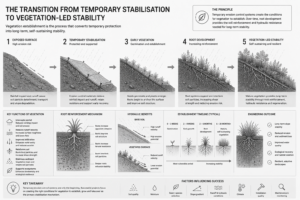
Vegetation establishment is one of the most important and often underestimated components of successful erosion control and long term landscape stabilisation.
While erosion control systems such as:
In many environments, vegetation is not simply:
It functions as living stabilisation infrastructure.
Understanding how vegetation establishes and why it sometimes fails is therefore essential for:
Modern erosion control increasingly recognises that sustainable stabilisation depends on working with natural systems, not simply resisting them mechanically.
Why Vegetation Matters in Erosion Control
Exposed soil surfaces are highly vulnerable to:
Without stabilisation:
Vegetation helps address these issues by:
Once established, vegetation becomes one of the most effective natural erosion control systems available.
Unlike temporary erosion control materials, vegetation continuously:
This is why successful erosion control projects often focus not only on:
Vegetation as Long Term Stabilisation
Temporary erosion control systems are designed to:
However, most biodegradable erosion control systems are transitional solutions.
Their purpose is to:
Over time:
This transition from temporary engineered support to permanent vegetation led stabilisation is one of the most important principles in:
The Difference Between Temporary & Permanent Stabilisation
One of the most common misunderstandings within erosion control is the confusion between:
Temporary Stabilisation
Temporary systems typically include:
These systems help:
However, their role is generally temporary.
Most biodegradable systems are designed to:
Permanent Stabilisation
Permanent stabilisation is achieved when vegetation and root systems become self-sustaining.
Long term stability develops through:
In many cases, the ultimate objective of erosion control is not:
Why Vegetation Failure Causes Erosion Failure
One of the most important concepts in sustainable erosion control is vegetation failure often becomes erosion failure.
Even correctly installed erosion control systems may underperform if:
Without vegetation:
Vegetation failure may occur because of:
This is why successful erosion control requires both engineering understanding and ecological understanding.
The erosion control material alone rarely provides:
Instead, it creates conditions that allow vegetation to succeed.
Vegetation as Engineered Infrastructure
Modern infrastructure increasingly recognises vegetation as functional infrastructure not merely landscape decoration.
Vegetation performs measurable engineering functions including:
Vegetation therefore contributes directly to:
In many nature based infrastructure systems, vegetation functions as a living engineering component.
This is especially important within:
Root Systems & Soil Reinforcement
One of the most important engineering functions of vegetation is root reinforcement.
Plant roots help:
Different vegetation types provide different:
Understanding root interaction with soil is therefore critical within:
Vegetation & Hydraulic Performance
Vegetation also plays a major role in hydraulic moderation.
Vegetation cover helps:
This helps reduce:
In many environments, well established vegetation significantly outperforms:
Vegetation Establishment Is a Process Not an Instant Result
A common misconception is that vegetation establishment occurs quickly or automatically.
In reality, successful establishment depends on:
The establishment period is often the most vulnerable phase of the entire erosion control process.
This is why temporary erosion control systems are so important they help protect the landscape while:
Nature Based Infrastructure & Regenerative Stabilisation
Vegetation establishment is central to modern nature-based infrastructure strategies.
Increasingly, infrastructure projects seek to:
Vegetation-led stabilisation aligns strongly with:
Rather than simply resisting environmental forces, these systems aim to work with ecological processes.
Vegetation Is Often the Final Engineering Objective
In many sustainable erosion control projects, the real objective is not:
The real objective is successful vegetation establishment.
Because once vegetation becomes:
This philosophy represents a major shift from:
Why Understanding Vegetation Establishment Matters
Many erosion control failures occur because:
Understanding vegetation establishment helps improve:
It also helps position modern erosion control as an integrated engineering and ecological discipline.
Disclaimer: This article is provided for general information only and does not constitute engineering, environmental, design, legal, or professional advice. Project-specific advice should always be obtained from suitably qualified professionals.
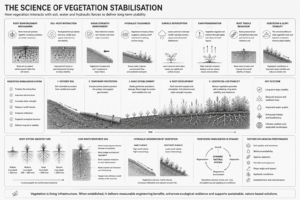
Vegetation stabilisation is not simply:
It is a measurable engineering and ecological process through which vegetation interacts with:
Modern erosion control increasingly recognises vegetation as functional green infrastructure. Root systems, surface cover,
and vegetation density directly influence:
Understanding the science behind vegetation stabilisation is essential for:
Root Reinforcement Mechanisms
One of the most important engineering functions of vegetation is root reinforcement.
Plant roots help stabilise soil by:
Roots create a reinforcing network within the soil profile that acts similarly to:
This reinforcement helps:
The effectiveness of root reinforcement depends on:
Soil Root Interaction
Vegetation stabilisation depends heavily on soil root interaction.
Roots interact mechanically and hydraulically with soil by:
This interaction helps:
Healthy vegetation requires:
Poor soil conditions may limit:
Shear Strength Improvement
Vegetation can significantly improve soil shear strength.
Shear strength refers to:
Roots increase shear strength by:
This is particularly important on:
In many environments, root reinforced soil performs substantially better than:
The degree of reinforcement depends on:
Hydraulic Roughness
Vegetation also influences hydraulic roughness.
Hydraulic roughness refers to:
Vegetation increases:
This helps:
Dense vegetation cover often reduces:
This hydraulic moderation is one of the key reasons vegetation is critical within:
Surface Interception
Vegetation helps protect soil through rainfall interception. Leaves,
stems, and plant canopies intercept rainfall before it reaches the ground surface.
This reduces:
Without vegetation, bare soil remains highly vulnerable to:
Surface interception therefore acts as a first layer of natural erosion defence.
Evapotranspiration
Vegetation also influences moisture regulation through evapotranspiration.
Evapotranspiration combines:
This process helps:
In some environments, vegetation can help reduce:
However, moisture behaviour depends heavily on:
Root Tensile Behaviour
Roots possess tensile strength,meaning they can resist pulling forces within the soil.
This tensile behaviour helps:
Different plant species exhibit different:
Deep rooted vegetation generally provides:
Understanding root tensile behaviour is particularly important within:
Vegetation & Slope Stability
Vegetation contributes directly to slope stability.
This occurs through a combination of:
Vegetation helps:
However, vegetation stabilisation is not immediate.
Root systems require time to:
This is why temporary erosion control systems are often used to protect slopes during the establishment phase.
Vegetation as a Dynamic Engineering System
Unlike:
This makes vegetation fundamentally different from:
Vegetation performance depends on:
Understanding vegetation therefore requires both engineering and ecological knowledge.
The Relationship Between Temporary Systems & Vegetation
Temporary erosion control materials such as:
These systems are not usually intended to permanently stabilise slopes alone. Instead, they support the transition towards vegetation led stability.
Vegetation Stabilisation Is a Long Term Process
One of the most misunderstood aspects of vegetation stabilisation is timescale.
Successful vegetation establishment may require:
Long term stabilisation develops progressively as:
Nature Based Engineering Principles
Vegetation stabilisation is central to nature based engineering.
Rather than relying solely on:
This philosophy is increasingly important within:
Vegetation Is Engineering Infrastructure
Modern infrastructure increasingly recognises that vegetation performs measurable engineering functions.
Vegetation contributes to:
This means vegetation should not be viewed as:
Key Scientific Mechanisms Summary
Mechanism | Engineering Function |
Root Reinforcement | Improves soil cohesion |
Soil–Root Interaction | Stabilises soil structure |
Shear Strength Improvement | Resists slope movement |
Hydraulic Roughness | Slows runoff velocity |
Surface Interception | Reduces rainfall impact |
Evapotranspiration | Influences soil moisture |
Root Tensile Behaviour | Provides tensile reinforcement |
Vegetation Cover | Protects exposed surfaces |
Why Understanding the Science Matters
Many erosion control failures occur because:
Understanding the science of vegetation stabilisation improves:
It also reinforces the idea that successful stabilisation depends on biological systems not only engineered materials.
Disclaimer: This article is provided for general information only and does not constitute engineering, environmental, design, legal, or professional advice. Project-specific advice should always be obtained from suitably qualified professionals.
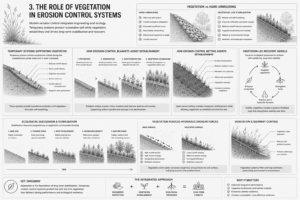
Vegetation plays a central role in modern erosion control and sustainable land stabilisation.
While many erosion control systems initially rely on:
Vegetation provides:
For this reason, modern erosion control increasingly focuses not only on:
This represents a major shift from:
Vegetation vs Hard Armouring
Traditional erosion control has often relied on:
These approaches provide:
However, hard armouring systems may also:
Vegetation based systems operate differently.
Rather than:
This does not mean vegetation replaces all hard engineering. Instead, modern erosion control increasingly combines:
Vegetation as a Living Stabilisation System
Unlike static engineering materials, vegetation is dynamic living infrastructure.
Vegetation:
As vegetation matures:
This progressive improvement is one of the major advantages of:
vegetation led stabilisation systems.
Well established vegetation may continue providing:
Temporary Systems Supporting Vegetation
Temporary erosion control systems play a critical role during the establishment phase.
Freshly disturbed soil is highly vulnerable because:
Temporary systems such as:
These systems help:
Importantly, their purpose is generally transitional not permanent.
How Erosion Control Blankets Assist Vegetation Establishment
Erosion control blankets (ECBs) help support vegetation establishment by:
The blanket creates a temporary microenvironment that helps:
As vegetation develops:
Biodegradable blankets are specifically designed to:
How Erosion Control Netting Supports Vegetation
Netting systems such as:
These systems help:
Open weave structures also allow:
The netting therefore acts as temporary ecological reinforcement.
Vegetation Led Recovery Models
Modern ecological engineering increasingly adopts vegetation-led recovery models.
These models recognise that:
Rather than relying solely on:
This approach is widely used within:
Ecological Succession & Stabilisation
One of the most important concepts within vegetation-led recovery is ecological succession.
Ecological succession refers to:
Typically, stabilisation progresses through stages including:
As succession progresses:
Temporary erosion control systems are often designed specifically to support this transition process.
Vegetation Reduces Hydraulic Erosion Forces
Vegetation significantly influences hydraulic performance.
Vegetation helps:
This hydraulic moderation reduces:
In many environments, vegetated surfaces perform substantially better than:
Vegetation & Sediment Control
One of the key benefits of vegetation is sediment stabilisation.
Vegetation helps:
This helps protect:
Vegetation as Climate Resilient Infrastructure
Vegetation led systems are increasingly important within climate adaptation strategies.
Compared with rigid hard engineering systems, vegetation often provides:
Vegetation can also help:
This makes vegetation central to:
Hybrid Engineering Approaches
Modern erosion control increasingly uses hybrid systems that combine:
Examples include:
These hybrid approaches often provide:
Vegetation Does Not Eliminate Engineering
A common misconception is that vegetation alone solves all erosion problems. In reality, successful stabilisation often requires:
Vegetation is most effective when integrated into engineered ecological systems.
Long Term Stabilisation Depends on Vegetation Success
Many erosion control failures occur because:
Long term success depends heavily on:
This is why vegetation establishment should be viewed as a primary engineering objective not merely landscaping.
Vegetation & Nature Based Infrastructure
Nature based infrastructure increasingly prioritises:
Vegetation plays a central role in:
This philosophy represents a shift from:
Comparative Stabilisation Philosophy
Hard Armouring | Vegetation-Led Stabilisation |
Rigid protection | Adaptive living system |
Immediate resistance | Progressive reinforcement |
Often permanent | Self-sustaining recovery |
Limited ecological integration | High ecological integration |
High visual impact | Natural landscape integration |
Limited regeneration | Regenerative capability |
Why This Matters
Understanding the role of vegetation in erosion control systems helps improve:
It also reinforces a key modern engineering principle successful erosion control increasingly depends on ecological systems not only hard engineering materials.
Disclaimer: This article is provided for general information only and does not constitute engineering, environmental, design, legal, or professional advice. Project-specific advice should always be obtained from suitably qualified professionals.
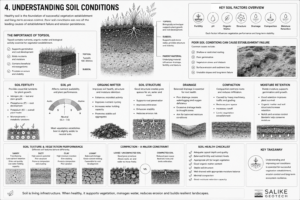
Successful vegetation establishment depends heavily on soil performance.
Even the most advanced erosion control systems may fail if:
In many erosion control projects, vegetation failure is often a soil problem not a seed problem.
Understanding soil conditions is therefore essential for:
Modern erosion control increasingly recognises that soil functions as living infrastructure.
Healthy soil supports:
Poor soil conditions, by contrast, may lead to:
Topsoil Importance
Topsoil is one of the most important components of successful vegetation establishment.
Healthy topsoil contains:
When topsoil is removed, disturbed, or degraded, vegetation establishment often becomes significantly more difficult.
Many construction and earthworks projects expose:
Without suitable topsoil conditions:
Soil Fertility
Vegetation establishment depends heavily on soil fertility.
Fertile soils provide:
Key nutrients influencing establishment include:
Nutrient deficient soils may result in:
However, over fertilisation may also create problems including:
Successful vegetation establishment therefore requires balanced soil fertility not simply high nutrient levels.
Soil pH
Soil pH strongly influences nutrient availability and plant performance.
Most vegetation establishes best within:
Highly acidic or highly alkaline soils may:
Soil pH also affects:
Understanding pH is particularly important when:
Organic Matter
Organic matter plays a major role in soil health and vegetation establishment.
Organic material improves:
Healthy soils typically contain:
Poor soils often lack:
This may significantly reduce:
Soil Structure
Soil structure refers to how soil particles are arranged and connected.
Good soil structure creates:
Healthy soil structure helps:
Poor structure may lead to:
Soil structure is often heavily affected by:
Drainage Conditions
Drainage is one of the most important factors influencing vegetation establishment success.
Poor drainage may create:
Excessively free-draining soils may cause:
Successful stabilisation depends on balanced moisture conditions.
Understanding drainage behaviour is therefore critical for:
Soil Compaction
Compaction is one of the most common causes of vegetation establishment failure.
Compacted soils often:
Compaction frequently occurs during:
Highly compacted soils may appear stable initially, but often perform poorly because:
Decompaction and soil conditioning are often essential before successful revegetation can occur.
Moisture Retention
Successful vegetation establishment depends heavily on stable soil moisture conditions.
Soils with poor moisture retention may:
Conversely, poorly drained soils may remain:
Organic matter, soil texture, and soil structure all influence:
Temporary erosion control systems such as:
Soil Texture & Vegetation Performance
Different soil textures behave differently.
Sandy Soils
Typically:
Clay Soils
Typically:
Silty Soils
Often highly:
Loamy Soils
Generally provide:
Understanding soil texture is critical for:
Poor Soil Conditions & Establishment Failure
One of the most overlooked realities in erosion control is poor soil conditions often cause vegetation failure.
Common soil related failures include:
This may occur because of:
In many projects, temporary erosion control systems fail because the soil beneath them cannot support sustainable vegetation.
Soil Conditions Influence Long Term Stability
Vegetation establishment is not simply:
It is fundamentally linked to soil performance.
Healthy soil supports:
Poor soil conditions may lead to:
This is why soil assessment should be viewed as a critical engineering and ecological process.
Soil as Living Infrastructure
Modern nature based infrastructure increasingly recognises soil as living infrastructure.
Healthy soils contribute directly to:
Soil therefore functions not simply as:
Soil Conditions & Nature-Based Stabilisation
Nature based erosion control systems depend heavily on:
This is why soil understanding is central to:
Without suitable soil conditions, long term ecological recovery becomes significantly more difficult.
Key Soil Factors Summary
Soil Factor | Influence on Vegetation |
Topsoil Quality | Supports biological activity |
Fertility | Influences plant growth |
pH | Affects nutrient uptake |
Organic Matter | Improves structure & moisture |
Soil Structure | Supports root penetration |
Drainage | Regulates moisture balance |
Compaction | Restricts roots & infiltration |
Moisture Retention | Supports germination |
Why Understanding Soil Conditions Matters
Many erosion control failures occur because:
Understanding soil conditions improves:
It also reinforces a key engineering principle successful stabilisation depends as much on soil health as on engineered protection systems.
Disclaimer: This article is provided for general information only and does not constitute engineering, environmental, design, legal, or professional advice. Project-specific advice should always be obtained from suitably qualified professionals.
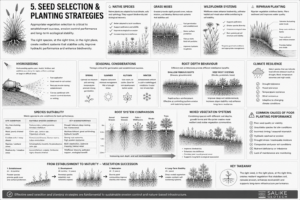
Successful vegetation establishment depends not only on:
Poor seed selection is one of the most common causes of:
Different environments require different:
Modern erosion control increasingly recognises that vegetation selection is an engineering decision not simply a landscaping choice.
The objective is not merely:
Native Species Selection
Native species are increasingly prioritised within:
Native vegetation is typically better adapted to:
This often improves:
Native species may also:
However, native planting still requires careful engineering assessment because not all native species provide:
Grass Mixes for Erosion Control
Grass systems are widely used because they provide:
Dense grass cover helps:
Different grass species provide different:
Fast establishing grasses are often used for temporary stabilisation, while deeper-rooted perennial systems may contribute to longer-term slope resilience.
Wildflower Systems
Wildflower planting is increasingly used within:
Compared with simple grass only systems, wildflower mixes may provide:
Some wildflower systems also contribute to:
However, wildflower establishment is often more sensitive to soil conditions, competition, and seasonal timing.
Successful implementation requires:
Riparian Planting
Riparian vegetation refers to planting associated with rivers, watercourses, wetlands, and drainage corridors.
These environments are exposed to:
Riparian planting strategies often focus on:
Typical riparian vegetation may include:
Root systems within riparian zones play an important role in:
Hydroseeding Systems
Hydroseeding is widely used within:
Hydroseeding typically involves spraying:
This approach helps:
Hydroseeding is often combined with:
This creates integrated establishment systems.
Seasonal Considerations
Vegetation establishment is highly influenced by seasonal timing. Temperature, rainfall, soil moisture, sunlight, and climatic conditions all affect:
Poor timing may result in:
In many climates, establishment windows are relatively narrow.
This is why erosion control planning often needs to consider:
Root Depth Behaviour
Different vegetation species develop different root architectures.
Root behaviour strongly influences:
Shallow Fibrous Root Systems
Typically:
Often associated with:
Deep Root Systems
Typically:
Often associated with:
Successful stabilisation often benefits from mixed vegetation structures with:
Climate Resilience
Vegetation selection increasingly needs to consider climate resilience. Changing rainfall patterns, temperature extremes, drought cycles, and storm intensity may all influence:
Climate resilient planting strategies often prioritise:
This is becoming increasingly important within:
Species Suitability
Not all vegetation species are suitable for:
Species suitability depends on:
Incorrect species selection may lead to:
Successful systems therefore require site-specific vegetation strategies.
Vegetation Diversity & Stability
Diverse planting systems often provide:
Mixed systems may combine:
This diversity can help improve:
Temporary vs Long Term Vegetation Strategies
Some planting systems focus on rapid temporary stabilisation. Others aim for long-term ecological succession and permanent stability.
Early stage systems may prioritise:
Long term systems may focus more on:
Successful erosion control often requires both short-term and long term vegetation thinking.
Vegetation Selection as Engineering Design
Modern ecological engineering increasingly treats vegetation selection as infrastructure design not simply planting specification.
Vegetation influences:
This means seed selection should be integrated into:
Common Causes of Poor Planting Performance
Vegetation establishment may fail because of:
These failures often lead to:
Vegetation Strategy & Nature Based Infrastructure
Nature based infrastructure increasingly relies on:
This is especially important within:
Vegetation therefore becomes a core engineering and ecological design element.
Key Vegetation Strategy Principles
Strategy Element | Engineering Objective |
Native Species | Ecological resilience |
Grass Systems | Rapid surface protection |
Wildflowers | Biodiversity & recovery |
Riparian Planting | Hydraulic stabilisation |
Hydroseeding | Rapid large-scale establishment |
Deep Root Systems | Long-term reinforcement |
Climate-Resilient Species | Adaptive performance |
Mixed Vegetation Systems | Ecological stability |
Why Seed Selection Matters
Many erosion control failures occur because:
Understanding seed selection and planting strategies improves:
It also reinforces a key principle of modern ecological engineering that vegetation is not decorative, but functional stabilisation infrastructure.
Disclaimer: This article is provided for general information only and does not constitute engineering, environmental, design, legal, or professional advice. Project-specific advice should always be obtained from suitably qualified professionals.
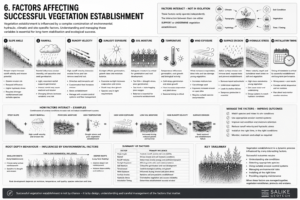
Successful vegetation establishment depends on far more than:
Vegetation establishment is influenced by a complex interaction of environmental, hydraulic, climatic and engineering conditions.
Even correctly specified erosion control systems may underperform if:
Understanding these variables is critical for:
Modern erosion control increasingly recognises that vegetation establishment is a systems-based engineering process not simply planting.
Slope Angle
Slope angle is one of the most important factors influencing erosion risk and vegetation establishment success.
Steeper slopes are generally more vulnerable to:
As slope gradients increase:
Steep slopes may also:
Because of these conditions, steeper slopes often require:
Rainfall
Rainfall directly influences erosion intensity, germination, and vegetation survival.
Rainfall affects:
Light, consistent rainfall may support:
However, intense rainfall events may cause:
Changing climate conditions are also increasing:
This makes rainfall assessment increasingly important within:
Runoff Velocity
Runoff velocity strongly influences erosion severity.
High runoff velocities may:
Vegetation establishment becomes significantly more difficult where:
Temporary systems such as:
Sunlight Exposure
Sunlight exposure affects:
Excessive sunlight exposure may:
Conversely, shaded environments may:
Different species respond differently to:
Successful vegetation strategies therefore require site-specific exposure understanding.
Soil Moisture
Soil moisture is one of the most critical factors influencing vegetation establishment success.
Insufficient moisture may lead to:
Excessive moisture may create:
Successful stabilisation depends on balanced moisture conditions.
This is why moisture retention systems such as:
Temperature
Temperature influences:
Extreme temperatures may:
Cold conditions may:
High temperatures may:
Temperature therefore plays a major role in:
Wind Exposure
Wind can significantly affect vegetation establishment performance.
High wind exposure may:
Wind also increases:
Vegetation systems in high-wind areas often require:
Surface Erosion
Active surface erosion creates one of the greatest threats to successful vegetation establishment.
Surface erosion may:
Even small scale erosion may progressively:
This is why temporary erosion control systems are essential during vulnerable establishment periods.
Hydraulic Stress
Hydraulic stress refers to:
High hydraulic stress environments may:
Hydraulic exposure must therefore be carefully assessed when selecting:
In severe environments, additional reinforcement may be required including:
Installation Timing
Installation timing is one of the most overlooked factors in vegetation establishment success.
Even correctly designed systems may fail if installed during:
Successful installation timing depends on:
Poor timing often leads to:
Interactions Between Establishment Factors
These environmental factors rarely operate independently.
For example:
Similarly:
Successful vegetation establishment therefore depends on understanding the interaction between multiple site variables.
Vegetation Establishment Is Site Specific
One of the most important principles in ecological engineering is no two sites behave identically.
Vegetation strategies must respond to:
This is why standardised “one size fits all” approaches often fail within erosion control projects.
Temporary Systems Help Manage Environmental Risk
Temporary erosion control systems are designed to:
These systems help vegetation survive during the most critical early stages of development.
Climate Change & Increasing Establishment Challenges
Climate change is increasing:
As a result, vegetation establishment strategies increasingly require:
This is becoming increasingly important within:
Vegetation Establishment as a Risk Management Process
Successful vegetation establishment is fundamentally a risk management process.
The objective is to:
This requires:
Key Environmental Factors Summary
Factor | Influence on Establishment |
Slope Angle | Influences runoff & erosion risk |
Rainfall | Affects erosion & germination |
Runoff Velocity | Controls hydraulic stress |
Sunlight Exposure | Influences growth & moisture |
Soil Moisture | Critical for root development |
Temperature | Affects biological activity |
Wind Exposure | Influences drying & erosion |
Surface Erosion | Threatens vegetation stability |
Hydraulic Stress | Influences system performance |
Installation Timing | Determines establishment success |
Why Understanding These Factors Matters
Many erosion control failures occur because:
Understanding these factors improves:
It also reinforces the principle that vegetation establishment is both an engineering and ecological discipline.
Disclaimer: This article is provided for general information only and does not constitute engineering, environmental, design, legal, or professional advice. Project-specific advice should always be obtained from suitably qualified professionals.
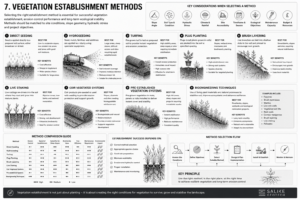
to create:
Understanding the strengths and limitations of different vegetation establishment methods is essential for:
Direct Seeding
Direct seeding is one of the most widely used vegetation establishment methods. It involves applying seed directly onto prepared soil surfaces.
Seed may be:
Direct seeding is commonly used for:
Advantages of Direct Seeding
Direct seeding may provide:
It is often suitable for:
Limitations of Direct Seeding
Direct seeding can be vulnerable to:
For this reason, direct seeding is often combined with:
Hydroseeding
Hydroseeding is a vegetation establishment technique involving the spraying of a seed slurry onto:
The slurry typically contains:
Hydroseeding is widely used within:
Advantages of Hydroseeding
Hydroseeding provides:
It is particularly useful for:
Limitations of Hydroseeding
Hydroseeding performance depends heavily on:
Without adequate protection, hydroseeded surfaces may still remain vulnerable to:
Hydroseeding is therefore frequently combined with:
Turfing
Turfing involves installing pre grown vegetation mats or rolls onto prepared surfaces.
This method provides:
Turfing is commonly used within:
Advantages of Turfing
Turfing provides:
Because vegetation is already established, the stabilisation process begins immediately.
Limitations of Turfing
Turfing may involve:
Poor soil contact or inadequate moisture may also result in:
Plug Planting
Plug planting involves installing small pre grown plants directly into:
Plug systems are often used where:
Advantages of Plug Planting
Plug planting allows:
It is particularly useful within:
Limitations of Plug Planting
Plug planting may require:
Young plugs may remain vulnerable to:
Brush Layering
Brush layering is a bioengineering technique that uses:
The branches:
Brush layering is commonly used within:
Advantages of Brush Layering
Brush layering provides:
It also supports:
Limitations of Brush Layering
Successful brush layering depends heavily on:
Poor environmental conditions may limit:
Live Staking
Live staking involves driving live plant cuttings directly into soil.
The cuttings establish roots over time and develop into:
Live staking is commonly used within:
Live staking provides:
Suitable species may rapidly develop:
Limitations of Live Staking
Performance depends on:
Live stakes may fail if:
Coir Vegetated Systems
Coir vegetated systems combine biodegradable coir-based reinforcement with:
These systems may include:
The coir provides:
Advantages of Coir Vegetated Systems
Coir systems offer:
Their extended durability compared with lighter biodegradable systems often improves:
Limitations of Coir Vegetated Systems
Coir systems still require:
Improper specification may lead to:
Pre Established Vegetation Systems
Pre established systems involve vegetation that is already mature or partially established before installation.
These systems may include:
They are commonly used where:
Advantages of Pre Established Systems
Pre established systems provide:
They are often highly effective within:
Limitations of Pre Established Systems
These systems may involve:
Long term success still depends on:
Bioengineering Techniques
Bioengineering combines living vegetation systems with engineering principles to stabilise:
Bioengineering techniques often integrate:
Examples include:
Advantages of Bioengineering
Bioengineering provides:
These systems often improve:
Limitations of Bioengineering
Bioengineering systems require:
Performance may vary depending on:
Choosing the Correct Establishment Method
Selecting the correct establishment method depends on:
In many cases,
successful stabilisation requires:
combining multiple methods together.
For example:
Vegetation Establishment as Infrastructure Design
Modern ecological engineering increasingly treats vegetation establishment as infrastructure design not merely planting.
The chosen establishment method directly influences:
This makes vegetation methodology an important part of:
Key Vegetation Establishment Methods Summary
Method | Primary Function |
Direct Seeding | Broad vegetation establishment |
Hydroseeding | Rapid large-scale application |
Turfing | Immediate surface cover |
Plug Planting | Targeted ecological establishment |
Brush Layering | Woody slope reinforcement |
Live Staking | Living root reinforcement |
Coir Vegetated Systems | Biodegradable stabilisation |
Pre-Established Systems | Immediate mature coverage |
Bioengineering | Integrated ecological engineering |
Why Understanding Establishment Methods Matters
Many erosion control failures occur because:
Understanding vegetation establishment methods improves:
It also reinforces a key principle of modern nature based engineering that successful stabilisation depends on combining:
Disclaimer: This article is provided for general information only and does not constitute engineering, environmental, design, legal, or professional advice. Project-specific advice should always be obtained from suitably qualified professionals.
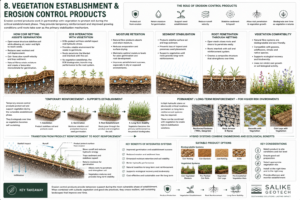
Successful erosion control depends not only on:
Modern erosion control increasingly combines:
Products such as:
Instead, their primary role is often to:
Understanding this relationship is essential because long-term stabilisation ultimately depends on vegetation not the temporary product itself.
Vegetation & Temporary Reinforcement Systems
Freshly disturbed soil surfaces are highly vulnerable to:
During early establishment phases:
Temporary erosion control systems help bridge this vulnerable period by providing transitional reinforcement.
These systems create:
How Coir Netting Assists Germination
Coir netting plays an important role in supporting early vegetation establishment.
The open woven structure helps:
Coir netting also:
This creates a more favourable germination environment.
Because coir fibres naturally retain moisture, the system may also help:
Unlike impermeable systems, coir netting allows:
ECB Interaction With Vegetation
Erosion Control Blankets (ECBs) are specifically designed to interact with vegetation establishment processes.
ECBs provide:
As vegetation develops:
The blanket therefore functions as temporary ecological support infrastructure.
Biodegradable ECBs gradually decompose as:
This transition is one of the key principles behind nature-based erosion control engineering.
Moisture Retention & Establishment Success
One of the most important functions of many biodegradable erosion control products is moisture retention.
Maintaining stable moisture conditions is critical for:
Exposed soil surfaces often dry rapidly because of:
Products such as:
This significantly improves:
Sediment Stabilisation
Vegetation establishment systems must often function within erosive hydraulic environments. Without reinforcement, seed and topsoil may be:
Erosion control products help stabilise:
This temporary stabilisation is critical because early erosion frequently causes vegetation failure. By reducing sediment movement, these systems help:
Root Penetration Through Netting
Successful vegetation establishment depends heavily on root penetration.
Biodegradable netting and ECB systems are generally designed to:
Open weave structures help:
As root systems mature:
This transition from product reinforcement to root reinforcement is fundamental to:
Vegetation Compatibility
Not all erosion control systems are equally compatible with vegetation development.
Successful systems must support:
Vegetation-compatible systems generally:
Biodegradable natural fibre systems such as:
Temporary vs Permanent Reinforcement
One of the most important concepts within erosion control engineering is the distinction between temporary and permanent reinforcement.
Temporary Reinforcement Systems
Temporary systems are designed to:
Examples include:
These systems generally:
Permanent Reinforcement Systems
Permanent systems are typically used where:
Examples may include:
In some cases, vegetation is combined with permanent reinforcement to create hybrid stabilisation systems.
Vegetation as the Long-Term Objective
One of the most important principles in sustainable erosion control is the product is not usually the final objective.
The long-term goal is often:
Temporary products exist primarily to help vegetation succeed.
Once vegetation becomes established:
Product Performance Depends on Vegetation Success
Many erosion control products may underperform if:
Without vegetation:
This is why product specification must always consider:
Coir Systems & Long-Term Ecological Recovery
Coir-based erosion control systems are particularly valuable because they combine:
Their biodegradability allows:
This makes them highly suitable within:
Hybrid Stabilisation Systems
Modern erosion control increasingly uses hybrid systems that combine:
Examples include:
These integrated systems often provide:
Erosion Control Products Are Transitional Infrastructure
A key principle of sustainable erosion control is transitional infrastructure.
Temporary erosion control products help:
Eventually:
This philosophy is central to:
Key Product & Vegetation Interactions Summary
Product Function | Vegetation Benefit |
Surface Protection | Reduces erosion during germination |
Moisture Retention | Supports root establishment |
Sediment Stabilisation | Preserves seed & soil |
Hydraulic Moderation | Reduces runoff stress |
Open Weave Structure | Allows root penetration |
Biodegradable Reinforcement | Supports ecological transition |
Temporary Stabilisation | Protects until vegetation matures |
Why Understanding Product Interaction Matters
Many erosion control failures occur because:
Understanding how vegetation interacts with erosion control products improves:
It also reinforces the principle that successful erosion control depends on integrating:
Disclaimer: This article is provided for general information only and does not constitute engineering, environmental, design, legal, or professional advice. Project-specific advice should always be obtained from suitably qualified professionals.
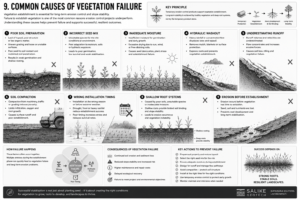
Successful vegetation establishment is one of the most important factors in long term erosion control and slope stabilisation. However, many erosion control failures occur not because:
This distinction is critical. Temporary systems such as:
When vegetation fails:
Understanding the most common causes of vegetation failure is therefore essential for:
Modern erosion control increasingly recognises that vegetation failure is often a systems failure not simply a planting issue.
Poor Soil Preparation
One of the most common causes of vegetation failure is inadequate soil preparation.
Even high quality seed mixes and erosion control systems may underperform if:
Common soil preparation problems include:
Without suitable preparation:
Poor soil preparation often results in:
Incorrect Seed Mix
Vegetation failure frequently occurs because unsuitable species are selected.
Different environments require different:
Incorrect seed mixes may result in:
For example:
Successful vegetation establishment requires site specific species selection.
Inadequate Moisture
Moisture availability is one of the most critical factors influencing germination and root development.
Insufficient moisture may lead to:
This is especially common on:
Young vegetation is particularly vulnerable because:
Temporary systems such as:
Hydraulic Washout
Hydraulic washout is one of the most severe causes of:
vegetation establishment failure.
Heavy rainfall, runoff concentration, and surface flow may:
This is particularly problematic on:
Hydraulic washout often occurs because:
Once washout begins, erosion may progressively accelerate.
Underestimating Runoff
One of the most common engineering mistakes within erosion control is underestimating runoff behaviour.
Even moderate rainfall may generate significant hydraulic stress where:
Underestimated runoff may lead to:
Successful vegetation establishment therefore requires hydrological understanding not simply planting.
This is especially important within:
Soil Compaction
Compacted soil is one of the greatest barriers to successful root development.
Compaction reduces:
Compacted soils often:
This may create:
Compaction commonly occurs during:
Without decompaction or soil conditioning, vegetation establishment may remain severely limited.
Wrong Installation Timing
Even correctly designed systems may fail if installed during unsuitable environmental conditions.
Poor timing may expose vegetation to:
For example:
Successful establishment timing depends on:
Installation timing is therefore both an ecological and engineering consideration.
Shallow Root Systems
Weak or shallow rooting is a major cause of long-term stabilisation failure. Vegetation may initially appear successful at the surface, while:
Shallow roots provide limited:
This may result in:
Root depth behaviour depends on:
Long term stabilisation requires mature, well developed root systems not simply surface vegetation coverage.
Erosion Before Establishment
The establishment phase is often the most vulnerable period within the entire erosion control process.
Before vegetation matures:
If erosion occurs before vegetation establishes:
This is why temporary erosion control systems are so important.
Products such as:
Multiple Failure Factors Often Interact
Vegetation failure rarely results from:
a single isolated problem.
More commonly, multiple factors combine together.
For example:
Similarly:
Successful vegetation establishment therefore requires systems based thinking.
Temporary Products Cannot Compensate for Poor Establishment Conditions
A major misconception within erosion control is that erosion control products alone solve stabilisation problems.
In reality, temporary systems are designed to:
However, they cannot permanently compensate for:
Long term success still depends on healthy vegetation establishment.
Vegetation Failure Is Often Delayed
Another important issue is that vegetation failure may not appear immediately.
Initial germination may appear successful, but:
This is why:
Climate Change & Increasing Establishment Risk
Climate change is increasing:
As a result, vegetation establishment failures may become more common where:
Future erosion control increasingly requires climate-resilient vegetation strategies.
Successful Establishment Requires Integrated Design
Modern ecological engineering increasingly recognises that successful vegetation establishment requires integration between:
This is especially important within:
Common Causes of Vegetation Failure Summary
Failure Cause | Typical Consequence |
Poor Soil Preparation | Weak root development |
Incorrect Seed Mix | Poor establishment performance |
Inadequate Moisture | Germination failure |
Hydraulic Washout | Seed & soil displacement |
Underestimated Runoff | Erosion escalation |
Soil Compaction | Restricted root growth |
Wrong Timing | Environmental stress |
Shallow Roots | Weak long-term stability |
Erosion Before Establishment | Failed recovery |
Why Understanding Failure Matters
Many erosion control failures occur because:
Understanding the causes of vegetation failure improves:
It also reinforces a key principle of sustainable erosion control that successful stabilisation depends on:
Disclaimer: This article is provided for general information only and does not constitute engineering, environmental, design, legal, or professional advice. Project-specific advice should always be obtained from suitably qualified professionals.
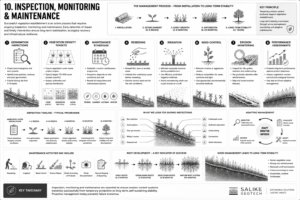
Successful vegetation establishment does not end once:
Long-term stabilisation depends on ongoing inspection, monitoring, maintenance, and adaptive management.
Many erosion control projects initially appear successful, only to experience:
Modern ecological engineering increasingly recognises that vegetation establishment is an active process not a one-time installation event.
Inspection and maintenance are therefore essential for:
Why Inspection & Monitoring Matter
Vegetation establishment occurs within:
Even well designed systems may be affected by:
Without monitoring, small issues may progressively develop into:
Inspection helps ensure that temporary stabilisation systems successfully transition into permanent vegetation-led stability.
Germination Inspections
One of the earliest stages of monitoring involves germination inspections.
These inspections help assess:
Typical inspection considerations include:
Early inspections are particularly important because the establishment phase is often the most vulnerable stage of erosion control.
Identifying problems early allows:
Vegetation Density Targets
Successful stabilisation depends not only on:
Sparse vegetation may provide limited:
Vegetation density targets help assess:
Monitoring may consider:
Density expectations vary depending on:
Maintenance Schedules
Vegetation establishment often requires structured maintenance programmes.
Maintenance schedules help ensure:
Maintenance frequency depends on:
Typical maintenance activities may include:
Long term maintenance planning is particularly important within:
Reseeding
Reseeding is commonly required where:
Reseeding helps:
However, successful reseeding also requires understanding why initial establishment failed.
Without addressing:
Irrigation
Irrigation may be essential during critical establishment periods.
Young vegetation is often highly vulnerable to:
Irrigation helps:
However, irrigation strategies must also consider:
Excessive irrigation may:
Successful irrigation therefore requires balanced moisture management.
Weed Control
Weed management is often essential for healthy vegetation establishment.
Aggressive or invasive species may:
Weed control strategies may include:
However, weed management should also consider:
Overly aggressive control methods may:
Erosion Monitoring
Monitoring erosion performance is critical because early erosion often indicates broader system instability.
Inspections may identify:
Even minor erosion features may progressively:
Erosion monitoring therefore helps support:
Performance Assessments
Long term vegetation establishment should be evaluated through performance assessment not simply visual appearance.
Performance assessments may consider:
Successful performance is generally linked to:
Performance monitoring is increasingly important within:
Inspection Frequency
Inspection frequency depends on:
Inspections are commonly required:
High risk environments may require:
Temporary Systems Require Monitoring
Temporary erosion control systems such as:
These systems may be affected by:
Monitoring ensures that:
Monitoring Supports Long Term Stabilisation
Successful vegetation establishment is not measured only by:
Monitoring helps assess whether:
This long term perspective is critical within:
Adaptive Management
Modern ecological engineering increasingly uses adaptive management approaches.
This means:
Adaptive management recognises that:
This approach improves:
Climate Change & Monitoring Requirements
Climate change is increasing:
As a result, inspection and maintenance are becoming increasingly important for:
Future stabilisation strategies will likely require more adaptive monitoring and maintenance frameworks.
Inspection & Maintenance as Engineering Practice
Inspection and maintenance should not be viewed simply as:
They are engineering management processes that directly influence:
This is especially important within:
Key Monitoring & Maintenance Activities Summary
Activity | Primary Objective |
Germination Inspections | Verify establishment success |
Vegetation Density Monitoring | Assess stabilisation coverage |
Maintenance Scheduling | Support long-term recovery |
Reseeding | Restore failed areas |
Irrigation | Maintain moisture balance |
Weed Control | Protect vegetation performance |
Erosion Monitoring | Identify instability risks |
Performance Assessments | Evaluate long-term resilience |
Why Inspection & Maintenance Matter
Many erosion control failures occur because:
Inspection and maintenance improve:
They also reinforce a key principle of sustainable erosion control that successful stabilisation requires:
Disclaimer: This article is provided for general information only and does not constitute engineering, environmental, design, legal, or professional advice. Project-specific advice should always be obtained from suitably qualified professionals.
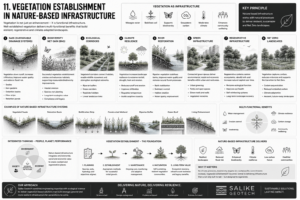
Vegetation establishment is increasingly recognised as a core component of modern infrastructure design.
Historically, infrastructure projects often prioritised:
However, modern environmental pressures including:
Within these systems, vegetation is no longer viewed simply as:
Instead, vegetation functions as engineered ecological infrastructure.
It contributes directly to:
This transition is fundamentally reshaping how:
Sustainable Drainage Systems (SuDS)
Vegetation plays a central role within Sustainable Drainage Systems (SuDS).
SuDS are designed to:
Vegetation within SuDS helps:
Vegetated SuDS features commonly include:
Healthy vegetation is essential because poorly established SuDS vegetation may reduce hydraulic performance and increase erosion vulnerability.
As climate change increases rainfall intensity, vegetation-based drainage systems are becoming increasingly important within:
Biodiversity Net Gain (BNG)
Vegetation establishment is also becoming increasingly important within Biodiversity Net Gain (BNG) strategies. BNG aims to ensure that development projects leave biodiversity in a measurably improved state.
This requires:
Successful vegetation establishment is fundamental to:
Poor vegetation establishment may compromise:
As a result, vegetation establishment is increasingly linked not only to:
Ecological Corridors
Vegetation systems help create ecological corridors that allow:
Infrastructure corridors, urban development, and fragmented landscapes often disrupt:
Vegetation-based infrastructure can help reconnect:
Examples include:
These systems contribute not only to:
Climate Resilience
Climate change is increasing:
Vegetation establishment therefore plays a growing role within climate-resilient infrastructure.
Healthy vegetation systems help:
Compared with rigid hard-engineering systems, vegetation often provides:
Climate-resilient landscapes increasingly depend on integrated ecological and engineering systems.
River Restoration
Vegetation establishment is fundamental within river restoration and riparian stabilisation projects.
Healthy riparian vegetation contributes to:
Root systems help:
Vegetation also helps:
River restoration increasingly prioritises working with natural fluvial processes rather than:
This represents a major shift towards regenerative river infrastructure.
Green Infrastructure
Green infrastructure refers to interconnected natural and vegetated systems that deliver:
Vegetation is one of the primary components of functioning green infrastructure networks.
Examples include:
Green infrastructure contributes to:
Importantly, green infrastructure increasingly functions as essential infrastructure not simply environmental enhancement.
Regenerative Infrastructure
One of the most important emerging concepts within ecological engineering is regenerative infrastructure.
Traditional infrastructure often focuses on:
Regenerative infrastructure aims to:
Vegetation establishment is central to this philosophy because:
Regenerative landscapes therefore become more stable and ecologically functional over time.
This represents a major evolution in:
Nature-Based Solutions (NbS)
Nature-Based Solutions (NbS) use natural ecological processes to address:
Vegetation-led systems are one of the most important forms of nature-based infrastructure.
Examples include:
NbS approaches often deliver:
Importantly, nature-based solutions do not eliminate engineering. Instead,
they integrate ecological systems with engineering principles.
Net Zero Landscapes
Vegetation establishment increasingly contributes to net zero and low-carbon infrastructure strategies.
Healthy vegetation systems help:
Compared with some hard-engineering approaches, vegetation-led systems may also:
Net Zero landscapes increasingly prioritise:
This is especially important within:
Vegetation as Functional Infrastructure
One of the most important shifts in modern infrastructure thinking is recognising that vegetation performs engineering functions.
Vegetation contributes directly to:
This means vegetation should no longer be viewed as:
This principle is becoming increasingly important within:
Engineering & Ecology Are Increasingly Integrated
Modern infrastructure increasingly combines engineering systems with ecological systems.
Successful projects now often require understanding:
Vegetation establishment therefore sits at the intersection of infrastructure engineering and ecological recovery.
Nature-Based Infrastructure Requires Long-Term Thinking
Unlike some traditional engineering systems, nature-based infrastructure evolves over time.
Vegetation systems:
This means successful implementation requires:
Nature-based systems are therefore living infrastructure systems not static installations.
Vegetation Establishment Supports Multi-Functional Infrastructure
One of the greatest advantages of vegetation-based systems is multifunctionality.
Vegetation can simultaneously contribute to:
This multifunctional performance is one of the key reasons nature-based infrastructure is rapidly expanding globally.
Key Nature-Based Infrastructure Themes Summary
Theme | Vegetation Function |
SuDS | Runoff management & infiltration |
BNG | Habitat creation & biodiversity |
Ecological Corridors | Landscape connectivity |
Climate Resilience | Adaptive stabilisation |
River Restoration | Bank reinforcement & ecology |
Green Infrastructure | Integrated environmental systems |
Regenerative Infrastructure | Long-term ecological recovery |
Nature-Based Solutions | Ecological engineering integration |
Net Zero Landscapes | Carbon & resilience support |
Why This Matters
Infrastructure is increasingly being evaluated not only on:
Vegetation establishment therefore becomes a critical infrastructure strategy not merely planting.
This represents a major shift within:
Vegetation Establishment as Infrastructure Stewardship
Modern ecological engineering increasingly recognises that successful infrastructure must work with natural systems not against them.
Vegetation establishment therefore becomes part of:
This is where erosion control evolves into broader environmental infrastructure thinking.
Disclaimer: This article is provided for general information only and does not constitute engineering, environmental, design, legal, or professional advice. Project-specific advice should always be obtained from suitably qualified professionals.
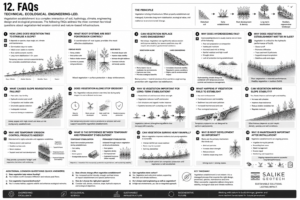
Vegetation establishment is one of the most important and often misunderstood components of erosion control, slope stabilisation, ecological restoration, and nature-based infrastructure.
Because vegetation systems interact with:
This section addresses some of the most common technical and engineering-led questions relating to:
How Long Does Vegetation Take to Stabilise a Slope?
Vegetation stabilisation is a progressive process not an immediate result.
The time required depends on:
Initial germination may occur within:
Temporary erosion control systems are often required during the vulnerable establishment phase before:
What Root Systems Are Best for Erosion Control?
Different root systems provide different:
Fibrous Root Systems
Typically:
Commonly associated with:
Deep Root Systems
Typically:
Commonly associated with:
Successful stabilisation often benefits from mixed vegetation systems that combine:
Can Vegetation Replace Hard Engineering?
Not always.
Vegetation can significantly improve:
However, severe environments may still require:
Modern erosion control increasingly uses hybrid stabilisation systems that combine:
The objective is often integration not replacement.
Why Does Hydroseeding Fail?
Hydroseeding may fail because of:
Hydroseeding is particularly vulnerable during early establishment phases.
Without sufficient protection, rainfall and runoff may:
This is why hydroseeding is frequently combined with:
Why Does Vegetation Establishment Matter in SuDS?
Vegetation is fundamental to Sustainable Drainage Systems (SuDS).
Vegetation within SuDS helps:
Poor vegetation establishment may reduce:
Well established vegetation is therefore a functional hydraulic component of SuDS infrastructure.
What Causes Slope Revegetation Failure?
Slope revegetation may fail because of:
Steep slopes are particularly vulnerable because:
Many revegetation failures occur because temporary systems are expected to perform permanently without:
Long term slope stability depends heavily on:
Does Vegetation Alone Stop Erosion?
No.
Vegetation significantly reduces:
During early establishment phases, temporary erosion control systems are often essential to:
Successful stabilisation usually depends on vegetation and engineering systems working together.
Why Is Vegetation Important for Long Term Stabilisation?
Temporary erosion control products generally provide short term protection.
Long term stabilisation develops through:
Healthy vegetation systems help:
This is why vegetation is often the ultimate stabilisation objective.
What Happens if Vegetation Fails to Establish?
If vegetation fails:
This may lead to:
Temporary systems such as:
Can Vegetation Improve Slope Stability?
Yes.
Vegetation improves slope stability through:
Roots help:
However, vegetation performance depends heavily on:
Why Are Temporary Erosion Control Products Needed?
Freshly disturbed soil is highly vulnerable because:
Temporary products help:
These systems function as transitional reinforcement until:
What Is the Difference Between Temporary & Permanent Stabilisation?
Temporary stabilisation systems provide:
Examples include:
Permanent stabilisation develops through:
The long term objective of many ecological systems is vegetation-led permanent recovery.
Can Vegetation Survive Heavy Rainfall?
Vegetation can improve resilience to rainfall, but newly established vegetation remains vulnerable.
Intense rainfall may still cause:
This is why:
Why Is Root Development So Important?
Roots are one of the primary mechanisms through which vegetation provides engineering reinforcement.
Roots help:
Surface vegetation alone is often insufficient without strong root systems.
Long-term stabilisation depends heavily on:
Does Vegetation Help Reduce Flooding?
Vegetation can help reduce:
Vegetation also improves:
This is why vegetation plays an important role within:
Can Vegetation Improve Biodiversity?
Yes. Vegetation establishment supports:
Diverse vegetation systems often improve:
This is especially important within:
Why Is Maintenance Important After Installation?
Vegetation establishment is an ongoing process.
Even after installation, vegetation systems may still require:
Without maintenance:
Monitoring and maintenance help ensure successful long-term ecological recovery.
Does Climate Change Affect Vegetation Establishment?
Yes.
Climate change is increasing:
These changes affect:
Future vegetation systems increasingly require climate adaptive and resilient design strategies.
Key FAQ Themes Summary
Topic | Key Question |
Stabilisation Time | How long does vegetation take to stabilise slopes? |
Root Systems | What vegetation provides the best reinforcement? |
Hard vs Natural Engineering | Can vegetation replace structural systems? |
Hydroseeding | Why does hydroseeding fail? |
SuDS | Why does vegetation matter in drainage systems? |
Failure Mechanisms | Why does revegetation fail? |
Temporary Systems | Why are erosion control products needed? |
Climate Resilience | How does climate affect vegetation? |
Why Technical FAQs Matter
Technical FAQs help:
They also reinforce the idea that vegetation establishment is both:
This distinction is essential within:
Disclaimer: This article is provided for general information only and does not constitute engineering, environmental, design, legal, or professional advice. Project-specific advice should always be obtained from suitably qualified professionals.
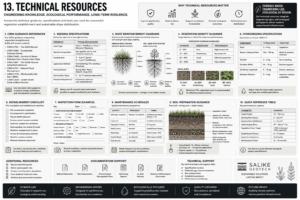
Effective vegetation establishment depends not only on:
One of the major challenges within erosion control and ecological stabilisation is that:
Modern infrastructure projects increasingly require evidence based vegetation establishment strategies supported by:
Technical resources help:
This section provides an overview of the key technical resources and engineering guidance principles commonly associated with:
CIRIA Guidance References
CIRIA guidance has become one of the most important technical reference frameworks within:
CIRIA guidance documents frequently address:
These guidance frameworks help:
Key themes commonly addressed within CIRIA guidance include:
For many infrastructure professionals, CIRIA documentation functions as a bridge between engineering practice and ecological delivery.
Seeding Specifications
Successful vegetation establishment requires clearly defined seeding specifications.
Seeding specifications typically address:
Effective specifications should consider:
Poorly defined specifications often result in:
Modern specifications increasingly prioritise:
Root Reinforcement Diagrams
Root reinforcement diagrams help visualise how vegetation stabilises soil mechanically.
These diagrams are important because:
Root reinforcement illustrations commonly demonstrate:
These technical diagrams help explain:
Root diagrams are particularly valuable within:
Vegetation Density Guidance
Vegetation density is one of the most important indicators of stabilisation performance.
Technical guidance often includes:
Dense vegetation generally improves:
Sparse or inconsistent vegetation may indicate:
Vegetation density guidance helps support:
Hydroseeding Specifications
Hydroseeding systems require detailed technical specification to ensure:
Hydroseeding specifications commonly address:
Specifications may also consider:
Poor hydroseeding specification is one of the most common causes of:
Establishment Checklists
Vegetation establishment checklists are essential because successful stabilisation depends on multiple interconnected variables.
Checklists help verify:
Typical establishment checklists may include:
These checklists help reduce:
Inspection Forms
Inspection forms provide structured documentation and monitoring frameworks.
Inspection records help assess:
Inspection forms commonly include:
This documentation supports:
Maintenance Schedules
Vegetation systems require ongoing management and maintenance.
Maintenance schedules help ensure:
Typical maintenance activities may include:
Maintenance frequency depends on:
Structured maintenance planning is especially important within:
Soil Preparation Guidance
Soil preparation is one of the most critical and most underestimated components of successful vegetation establishment.
Technical soil guidance often addresses:
Poor soil preparation frequently leads to:
Guidance frameworks therefore increasingly recognise soil as living infrastructure not simply construction material.
Successful vegetation establishment depends heavily on:
Technical Resources Support Better Decision Making
One of the key roles of technical resources is reducing uncertainty.
Vegetation establishment involves:
Technical frameworks help:
This is especially important where:
Technical Guidance & Nature Based Infrastructure
Nature based infrastructure increasingly depends on robust technical frameworks.
As vegetation systems become more integrated into:
This is helping move vegetation establishment from:
Vegetation Establishment Requires Interdisciplinary Knowledge
Technical resources increasingly demonstrate that successful vegetation establishment requires understanding:
This interdisciplinary approach is central to:
Documentation Improves Long Term Resilience
Projects with:
Documentation also supports:
Technical Resources as Part of Engineering Governance
Increasingly, vegetation establishment documentation forms part of infrastructure governance and compliance processes.
This includes:
Technical resources therefore contribute not only to:
Key Technical Resource Themes Summary
Resource Type | Primary Function |
CIRIA Guidance | Best-practice infrastructure guidance |
Seeding Specifications | Define vegetation requirements |
Root Reinforcement Diagrams | Explain stabilisation mechanisms |
Vegetation Density Guidance | Assess establishment success |
Hydroseeding Specifications | Support application quality |
Establishment Checklists | Reduce installation risk |
Inspection Forms | Monitor performance |
Maintenance Schedules | Support long-term resilience |
Soil Preparation Guidance | Improve root development |
Why Technical Resources Matter
Technical resources improve:
They also help position vegetation establishment as a measurable engineering discipline not simply planting or landscaping.
This distinction is increasingly important within:
Disclaimer: This article is provided for general information only and does not constitute engineering, environmental, design, legal, or professional advice. Project-specific advice should always be obtained from suitably qualified professionals.
Vegetation establishment is one of the most important and often underestimated components of successful erosion control and long term landscape stabilisation.
While erosion control systems such as:
In many environments, vegetation is not simply:
It functions as living stabilisation infrastructure.
Understanding how vegetation establishes and why it sometimes fails is therefore essential for:
Modern erosion control increasingly recognises that sustainable stabilisation depends on working with natural systems, not simply resisting them mechanically.
Why Vegetation Matters in Erosion Control
Exposed soil surfaces are highly vulnerable to:
Without stabilisation:
Vegetation helps address these issues by:
Once established, vegetation becomes one of the most effective natural erosion control systems available.
Unlike temporary erosion control materials, vegetation continuously:
This is why successful erosion control projects often focus not only on:
Vegetation as Long Term Stabilisation
Temporary erosion control systems are designed to:
However, most biodegradable erosion control systems are transitional solutions.
Their purpose is to:
Over time:
This transition from temporary engineered support to permanent vegetation led stabilisation is one of the most important principles in:
The Difference Between Temporary & Permanent Stabilisation
One of the most common misunderstandings within erosion control is the confusion between:
Temporary Stabilisation
Temporary systems typically include:
These systems help:
However, their role is generally temporary.
Most biodegradable systems are designed to:
Permanent Stabilisation
Permanent stabilisation is achieved when vegetation and root systems become self-sustaining.
Long term stability develops through:
In many cases, the ultimate objective of erosion control is not:
Why Vegetation Failure Causes Erosion Failure
One of the most important concepts in sustainable erosion control is vegetation failure often becomes erosion failure.
Even correctly installed erosion control systems may underperform if:
Without vegetation:
Vegetation failure may occur because of:
This is why successful erosion control requires both engineering understanding and ecological understanding.
The erosion control material alone rarely provides:
Instead, it creates conditions that allow vegetation to succeed.
Vegetation as Engineered Infrastructure
Modern infrastructure increasingly recognises vegetation as functional infrastructure not merely landscape decoration.
Vegetation performs measurable engineering functions including:
Vegetation therefore contributes directly to:
In many nature based infrastructure systems, vegetation functions as a living engineering component.
This is especially important within:
Root Systems & Soil Reinforcement
One of the most important engineering functions of vegetation is root reinforcement.
Plant roots help:
Different vegetation types provide different:
Understanding root interaction with soil is therefore critical within:
Vegetation & Hydraulic Performance
Vegetation also plays a major role in hydraulic moderation.
Vegetation cover helps:
This helps reduce:
In many environments, well established vegetation significantly outperforms:
Vegetation Establishment Is a Process Not an Instant Result
A common misconception is that vegetation establishment occurs quickly or automatically.
In reality, successful establishment depends on:
The establishment period is often the most vulnerable phase of the entire erosion control process.
This is why temporary erosion control systems are so important they help protect the landscape while:
Nature Based Infrastructure & Regenerative Stabilisation
Vegetation establishment is central to modern nature-based infrastructure strategies.
Increasingly, infrastructure projects seek to:
Vegetation-led stabilisation aligns strongly with:
Rather than simply resisting environmental forces, these systems aim to work with ecological processes.
Vegetation Is Often the Final Engineering Objective
In many sustainable erosion control projects, the real objective is not:
The real objective is successful vegetation establishment.
Because once vegetation becomes:
This philosophy represents a major shift from:
Why Understanding Vegetation Establishment Matters
Many erosion control failures occur because:
Understanding vegetation establishment helps improve:
It also helps position modern erosion control as an integrated engineering and ecological discipline.
Disclaimer: This article is provided for general information only and does not constitute engineering, environmental, design, legal, or professional advice. Project-specific advice should always be obtained from suitably qualified professionals.
Vegetation stabilisation is not simply:
It is a measurable engineering and ecological process through which vegetation interacts with:
Modern erosion control increasingly recognises vegetation as functional green infrastructure. Root systems, surface cover,
and vegetation density directly influence:
Understanding the science behind vegetation stabilisation is essential for:
Root Reinforcement Mechanisms
One of the most important engineering functions of vegetation is root reinforcement.
Plant roots help stabilise soil by:
Roots create a reinforcing network within the soil profile that acts similarly to:
This reinforcement helps:
The effectiveness of root reinforcement depends on:
Soil Root Interaction
Vegetation stabilisation depends heavily on soil root interaction.
Roots interact mechanically and hydraulically with soil by:
This interaction helps:
Healthy vegetation requires:
Poor soil conditions may limit:
Shear Strength Improvement
Vegetation can significantly improve soil shear strength.
Shear strength refers to:
Roots increase shear strength by:
This is particularly important on:
In many environments, root reinforced soil performs substantially better than:
The degree of reinforcement depends on:
Hydraulic Roughness
Vegetation also influences hydraulic roughness.
Hydraulic roughness refers to:
Vegetation increases:
This helps:
Dense vegetation cover often reduces:
This hydraulic moderation is one of the key reasons vegetation is critical within:
Surface Interception
Vegetation helps protect soil through rainfall interception. Leaves,
stems, and plant canopies intercept rainfall before it reaches the ground surface.
This reduces:
Without vegetation, bare soil remains highly vulnerable to:
Surface interception therefore acts as a first layer of natural erosion defence.
Evapotranspiration
Vegetation also influences moisture regulation through evapotranspiration.
Evapotranspiration combines:
This process helps:
In some environments, vegetation can help reduce:
However, moisture behaviour depends heavily on:
Root Tensile Behaviour
Roots possess tensile strength,meaning they can resist pulling forces within the soil.
This tensile behaviour helps:
Different plant species exhibit different:
Deep rooted vegetation generally provides:
Understanding root tensile behaviour is particularly important within:
Vegetation & Slope Stability
Vegetation contributes directly to slope stability.
This occurs through a combination of:
Vegetation helps:
However, vegetation stabilisation is not immediate.
Root systems require time to:
This is why temporary erosion control systems are often used to protect slopes during the establishment phase.
Vegetation as a Dynamic Engineering System
Unlike:
This makes vegetation fundamentally different from:
Vegetation performance depends on:
Understanding vegetation therefore requires both engineering and ecological knowledge.
The Relationship Between Temporary Systems & Vegetation
Temporary erosion control materials such as:
These systems are not usually intended to permanently stabilise slopes alone. Instead, they support the transition towards vegetation led stability.
Vegetation Stabilisation Is a Long Term Process
One of the most misunderstood aspects of vegetation stabilisation is timescale.
Successful vegetation establishment may require:
Long term stabilisation develops progressively as:
Nature Based Engineering Principles
Vegetation stabilisation is central to nature based engineering.
Rather than relying solely on:
This philosophy is increasingly important within:
Vegetation Is Engineering Infrastructure
Modern infrastructure increasingly recognises that vegetation performs measurable engineering functions.
Vegetation contributes to:
This means vegetation should not be viewed as:
Key Scientific Mechanisms Summary
Mechanism | Engineering Function |
Root Reinforcement | Improves soil cohesion |
Soil–Root Interaction | Stabilises soil structure |
Shear Strength Improvement | Resists slope movement |
Hydraulic Roughness | Slows runoff velocity |
Surface Interception | Reduces rainfall impact |
Evapotranspiration | Influences soil moisture |
Root Tensile Behaviour | Provides tensile reinforcement |
Vegetation Cover | Protects exposed surfaces |
Why Understanding the Science Matters
Many erosion control failures occur because:
Understanding the science of vegetation stabilisation improves:
It also reinforces the idea that successful stabilisation depends on biological systems not only engineered materials.
Disclaimer: This article is provided for general information only and does not constitute engineering, environmental, design, legal, or professional advice. Project-specific advice should always be obtained from suitably qualified professionals.
Vegetation plays a central role in modern erosion control and sustainable land stabilisation.
While many erosion control systems initially rely on:
Vegetation provides:
For this reason, modern erosion control increasingly focuses not only on:
This represents a major shift from:
Vegetation vs Hard Armouring
Traditional erosion control has often relied on:
These approaches provide:
However, hard armouring systems may also:
Vegetation based systems operate differently.
Rather than:
This does not mean vegetation replaces all hard engineering. Instead, modern erosion control increasingly combines:
Vegetation as a Living Stabilisation System
Unlike static engineering materials, vegetation is dynamic living infrastructure.
Vegetation:
As vegetation matures:
This progressive improvement is one of the major advantages of:
vegetation led stabilisation systems.
Well established vegetation may continue providing:
Temporary Systems Supporting Vegetation
Temporary erosion control systems play a critical role during the establishment phase.
Freshly disturbed soil is highly vulnerable because:
Temporary systems such as:
These systems help:
Importantly, their purpose is generally transitional not permanent.
How Erosion Control Blankets Assist Vegetation Establishment
Erosion control blankets (ECBs) help support vegetation establishment by:
The blanket creates a temporary microenvironment that helps:
As vegetation develops:
Biodegradable blankets are specifically designed to:
How Erosion Control Netting Supports Vegetation
Netting systems such as:
These systems help:
Open weave structures also allow:
The netting therefore acts as temporary ecological reinforcement.
Vegetation Led Recovery Models
Modern ecological engineering increasingly adopts vegetation-led recovery models.
These models recognise that:
Rather than relying solely on:
This approach is widely used within:
Ecological Succession & Stabilisation
One of the most important concepts within vegetation-led recovery is ecological succession.
Ecological succession refers to:
Typically, stabilisation progresses through stages including:
As succession progresses:
Temporary erosion control systems are often designed specifically to support this transition process.
Vegetation Reduces Hydraulic Erosion Forces
Vegetation significantly influences hydraulic performance.
Vegetation helps:
This hydraulic moderation reduces:
In many environments, vegetated surfaces perform substantially better than:
Vegetation & Sediment Control
One of the key benefits of vegetation is sediment stabilisation.
Vegetation helps:
This helps protect:
Vegetation as Climate Resilient Infrastructure
Vegetation led systems are increasingly important within climate adaptation strategies.
Compared with rigid hard engineering systems, vegetation often provides:
Vegetation can also help:
This makes vegetation central to:
Hybrid Engineering Approaches
Modern erosion control increasingly uses hybrid systems that combine:
Examples include:
These hybrid approaches often provide:
Vegetation Does Not Eliminate Engineering
A common misconception is that vegetation alone solves all erosion problems. In reality, successful stabilisation often requires:
Vegetation is most effective when integrated into engineered ecological systems.
Long Term Stabilisation Depends on Vegetation Success
Many erosion control failures occur because:
Long term success depends heavily on:
This is why vegetation establishment should be viewed as a primary engineering objective not merely landscaping.
Vegetation & Nature Based Infrastructure
Nature based infrastructure increasingly prioritises:
Vegetation plays a central role in:
This philosophy represents a shift from:
Comparative Stabilisation Philosophy
| Hard Armouring | Vegetation-Led Stabilisation |
| Rigid protection | Adaptive living system |
| Immediate resistance | Progressive reinforcement |
| Often permanent | Self-sustaining recovery |
| Limited ecological integration | High ecological integration |
| High visual impact | Natural landscape integration |
| Limited regeneration | Regenerative capability |
Why This Matters
Understanding the role of vegetation in erosion control systems helps improve:
It also reinforces a key modern engineering principle successful erosion control increasingly depends on ecological systems not only hard engineering materials.
Disclaimer: This article is provided for general information only and does not constitute engineering, environmental, design, legal, or professional advice. Project-specific advice should always be obtained from suitably qualified professionals.
Successful vegetation establishment depends heavily on soil performance.
Even the most advanced erosion control systems may fail if:
In many erosion control projects, vegetation failure is often a soil problem not a seed problem.
Understanding soil conditions is therefore essential for:
Modern erosion control increasingly recognises that soil functions as living infrastructure.
Healthy soil supports:
Poor soil conditions, by contrast, may lead to:
Topsoil Importance
Topsoil is one of the most important components of successful vegetation establishment.
Healthy topsoil contains:
When topsoil is removed, disturbed, or degraded, vegetation establishment often becomes significantly more difficult.
Many construction and earthworks projects expose:
Without suitable topsoil conditions:
Soil Fertility
Vegetation establishment depends heavily on soil fertility.
Fertile soils provide:
Key nutrients influencing establishment include:
Nutrient deficient soils may result in:
However, over fertilisation may also create problems including:
Successful vegetation establishment therefore requires balanced soil fertility not simply high nutrient levels.
Soil pH
Soil pH strongly influences nutrient availability and plant performance.
Most vegetation establishes best within:
Highly acidic or highly alkaline soils may:
Soil pH also affects:
Understanding pH is particularly important when:
Organic Matter
Organic matter plays a major role in soil health and vegetation establishment.
Organic material improves:
Healthy soils typically contain:
Poor soils often lack:
This may significantly reduce:
Soil Structure
Soil structure refers to how soil particles are arranged and connected.
Good soil structure creates:
Healthy soil structure helps:
Poor structure may lead to:
Soil structure is often heavily affected by:
Drainage Conditions
Drainage is one of the most important factors influencing vegetation establishment success.
Poor drainage may create:
Excessively free-draining soils may cause:
Successful stabilisation depends on balanced moisture conditions.
Understanding drainage behaviour is therefore critical for:
Soil Compaction
Compaction is one of the most common causes of vegetation establishment failure.
Compacted soils often:
Compaction frequently occurs during:
Highly compacted soils may appear stable initially, but often perform poorly because:
Decompaction and soil conditioning are often essential before successful revegetation can occur.
Moisture Retention
Successful vegetation establishment depends heavily on stable soil moisture conditions.
Soils with poor moisture retention may:
Conversely, poorly drained soils may remain:
Organic matter, soil texture, and soil structure all influence:
Temporary erosion control systems such as:
Soil Texture & Vegetation Performance
Different soil textures behave differently.
Sandy Soils
Typically:
Clay Soils
Typically:
Silty Soils
Often highly:
Loamy Soils
Generally provide:
Understanding soil texture is critical for:
Poor Soil Conditions & Establishment Failure
One of the most overlooked realities in erosion control is poor soil conditions often cause vegetation failure.
Common soil related failures include:
This may occur because of:
In many projects, temporary erosion control systems fail because the soil beneath them cannot support sustainable vegetation.
Soil Conditions Influence Long Term Stability
Vegetation establishment is not simply:
It is fundamentally linked to soil performance.
Healthy soil supports:
Poor soil conditions may lead to:
This is why soil assessment should be viewed as a critical engineering and ecological process.
Soil as Living Infrastructure
Modern nature based infrastructure increasingly recognises soil as living infrastructure.
Healthy soils contribute directly to:
Soil therefore functions not simply as:
Soil Conditions & Nature-Based Stabilisation
Nature based erosion control systems depend heavily on:
This is why soil understanding is central to:
Without suitable soil conditions, long term ecological recovery becomes significantly more difficult.
Key Soil Factors Summary
Soil Factor | Influence on Vegetation |
Topsoil Quality | Supports biological activity |
Fertility | Influences plant growth |
pH | Affects nutrient uptake |
Organic Matter | Improves structure & moisture |
Soil Structure | Supports root penetration |
Drainage | Regulates moisture balance |
Compaction | Restricts roots & infiltration |
Moisture Retention | Supports germination |
Why Understanding Soil Conditions Matters
Many erosion control failures occur because:
Understanding soil conditions improves:
It also reinforces a key engineering principle successful stabilisation depends as much on soil health as on engineered protection systems.
Disclaimer: This article is provided for general information only and does not constitute engineering, environmental, design, legal, or professional advice. Project-specific advice should always be obtained from suitably qualified professionals.
Successful vegetation establishment depends not only on:
Poor seed selection is one of the most common causes of:
Different environments require different:
Modern erosion control increasingly recognises that vegetation selection is an engineering decision not simply a landscaping choice.
The objective is not merely:
Native Species Selection
Native species are increasingly prioritised within:
Native vegetation is typically better adapted to:
This often improves:
Native species may also:
However, native planting still requires careful engineering assessment because not all native species provide:
Grass Mixes for Erosion Control
Grass systems are widely used because they provide:
Dense grass cover helps:
Different grass species provide different:
Fast establishing grasses are often used for temporary stabilisation, while deeper-rooted perennial systems may contribute to longer-term slope resilience.
Wildflower Systems
Wildflower planting is increasingly used within:
Compared with simple grass only systems, wildflower mixes may provide:
Some wildflower systems also contribute to:
However, wildflower establishment is often more sensitive to soil conditions, competition, and seasonal timing.
Successful implementation requires:
Riparian Planting
Riparian vegetation refers to planting associated with rivers, watercourses, wetlands, and drainage corridors.
These environments are exposed to:
Riparian planting strategies often focus on:
Typical riparian vegetation may include:
Root systems within riparian zones play an important role in:
Hydroseeding Systems
Hydroseeding is widely used within:
Hydroseeding typically involves spraying:
This approach helps:
Hydroseeding is often combined with:
This creates integrated establishment systems.
Seasonal Considerations
Vegetation establishment is highly influenced by seasonal timing. Temperature, rainfall, soil moisture, sunlight, and climatic conditions all affect:
Poor timing may result in:
In many climates, establishment windows are relatively narrow.
This is why erosion control planning often needs to consider:
Root Depth Behaviour
Different vegetation species develop different root architectures.
Root behaviour strongly influences:
Shallow Fibrous Root Systems
Typically:
Often associated with:
Deep Root Systems
Typically:
Often associated with:
Successful stabilisation often benefits from mixed vegetation structures with:
Climate Resilience
Vegetation selection increasingly needs to consider climate resilience. Changing rainfall patterns, temperature extremes, drought cycles, and storm intensity may all influence:
Climate resilient planting strategies often prioritise:
This is becoming increasingly important within:
Species Suitability
Not all vegetation species are suitable for:
Species suitability depends on:
Incorrect species selection may lead to:
Successful systems therefore require site-specific vegetation strategies.
Vegetation Diversity & Stability
Diverse planting systems often provide:
Mixed systems may combine:
This diversity can help improve:
Temporary vs Long Term Vegetation Strategies
Some planting systems focus on rapid temporary stabilisation. Others aim for long-term ecological succession and permanent stability.
Early stage systems may prioritise:
Long term systems may focus more on:
Successful erosion control often requires both short-term and long term vegetation thinking.
Vegetation Selection as Engineering Design
Modern ecological engineering increasingly treats vegetation selection as infrastructure design not simply planting specification.
Vegetation influences:
This means seed selection should be integrated into:
Common Causes of Poor Planting Performance
Vegetation establishment may fail because of:
These failures often lead to:
Vegetation Strategy & Nature Based Infrastructure
Nature based infrastructure increasingly relies on:
This is especially important within:
Vegetation therefore becomes a core engineering and ecological design element.
Key Vegetation Strategy Principles
Strategy Element | Engineering Objective |
Native Species | Ecological resilience |
Grass Systems | Rapid surface protection |
Wildflowers | Biodiversity & recovery |
Riparian Planting | Hydraulic stabilisation |
Hydroseeding | Rapid large-scale establishment |
Deep Root Systems | Long-term reinforcement |
Climate-Resilient Species | Adaptive performance |
Mixed Vegetation Systems | Ecological stability |
Why Seed Selection Matters
Many erosion control failures occur because:
Understanding seed selection and planting strategies improves:
It also reinforces a key principle of modern ecological engineering that vegetation is not decorative, but functional stabilisation infrastructure.
Disclaimer: This article is provided for general information only and does not constitute engineering, environmental, design, legal, or professional advice. Project-specific advice should always be obtained from suitably qualified professionals.
Successful vegetation establishment depends on far more than:
Vegetation establishment is influenced by a complex interaction of environmental, hydraulic, climatic and engineering conditions.
Even correctly specified erosion control systems may underperform if:
Understanding these variables is critical for:
Modern erosion control increasingly recognises that vegetation establishment is a systems-based engineering process not simply planting.
Slope Angle
Slope angle is one of the most important factors influencing erosion risk and vegetation establishment success.
Steeper slopes are generally more vulnerable to:
As slope gradients increase:
Steep slopes may also:
Because of these conditions, steeper slopes often require:
Rainfall
Rainfall directly influences erosion intensity, germination, and vegetation survival.
Rainfall affects:
Light, consistent rainfall may support:
However, intense rainfall events may cause:
Changing climate conditions are also increasing:
This makes rainfall assessment increasingly important within:
Runoff Velocity
Runoff velocity strongly influences erosion severity.
High runoff velocities may:
Vegetation establishment becomes significantly more difficult where:
Temporary systems such as:
Sunlight Exposure
Sunlight exposure affects:
Excessive sunlight exposure may:
Conversely, shaded environments may:
Different species respond differently to:
Successful vegetation strategies therefore require site-specific exposure understanding.
Soil Moisture
Soil moisture is one of the most critical factors influencing vegetation establishment success.
Insufficient moisture may lead to:
Excessive moisture may create:
Successful stabilisation depends on balanced moisture conditions.
This is why moisture retention systems such as:
Temperature
Temperature influences:
Extreme temperatures may:
Cold conditions may:
High temperatures may:
Temperature therefore plays a major role in:
Wind Exposure
Wind can significantly affect vegetation establishment performance.
High wind exposure may:
Wind also increases:
Vegetation systems in high-wind areas often require:
Surface Erosion
Active surface erosion creates one of the greatest threats to successful vegetation establishment.
Surface erosion may:
Even small scale erosion may progressively:
This is why temporary erosion control systems are essential during vulnerable establishment periods.
Hydraulic Stress
Hydraulic stress refers to:
High hydraulic stress environments may:
Hydraulic exposure must therefore be carefully assessed when selecting:
In severe environments, additional reinforcement may be required including:
Installation Timing
Installation timing is one of the most overlooked factors in vegetation establishment success.
Even correctly designed systems may fail if installed during:
Successful installation timing depends on:
Poor timing often leads to:
Interactions Between Establishment Factors
These environmental factors rarely operate independently.
For example:
Similarly:
Successful vegetation establishment therefore depends on understanding the interaction between multiple site variables.
Vegetation Establishment Is Site Specific
One of the most important principles in ecological engineering is no two sites behave identically.
Vegetation strategies must respond to:
This is why standardised “one size fits all” approaches often fail within erosion control projects.
Temporary Systems Help Manage Environmental Risk
Temporary erosion control systems are designed to:
These systems help vegetation survive during the most critical early stages of development.
Climate Change & Increasing Establishment Challenges
Climate change is increasing:
As a result, vegetation establishment strategies increasingly require:
This is becoming increasingly important within:
Vegetation Establishment as a Risk Management Process
Successful vegetation establishment is fundamentally a risk management process.
The objective is to:
This requires:
Key Environmental Factors Summary
Factor | Influence on Establishment |
Slope Angle | Influences runoff & erosion risk |
Rainfall | Affects erosion & germination |
Runoff Velocity | Controls hydraulic stress |
Sunlight Exposure | Influences growth & moisture |
Soil Moisture | Critical for root development |
Temperature | Affects biological activity |
Wind Exposure | Influences drying & erosion |
Surface Erosion | Threatens vegetation stability |
Hydraulic Stress | Influences system performance |
Installation Timing | Determines establishment success |
Why Understanding These Factors Matters
Many erosion control failures occur because:
Understanding these factors improves:
It also reinforces the principle that vegetation establishment is both an engineering and ecological discipline.
Disclaimer: This article is provided for general information only and does not constitute engineering, environmental, design, legal, or professional advice. Project-specific advice should always be obtained from suitably qualified professionals.
to create:
Understanding the strengths and limitations of different vegetation establishment methods is essential for:
Direct Seeding
Direct seeding is one of the most widely used vegetation establishment methods. It involves applying seed directly onto prepared soil surfaces.
Seed may be:
Direct seeding is commonly used for:
Advantages of Direct Seeding
Direct seeding may provide:
It is often suitable for:
Limitations of Direct Seeding
Direct seeding can be vulnerable to:
For this reason, direct seeding is often combined with:
Hydroseeding
Hydroseeding is a vegetation establishment technique involving the spraying of a seed slurry onto:
The slurry typically contains:
Hydroseeding is widely used within:
Advantages of Hydroseeding
Hydroseeding provides:
It is particularly useful for:
Limitations of Hydroseeding
Hydroseeding performance depends heavily on:
Without adequate protection, hydroseeded surfaces may still remain vulnerable to:
Hydroseeding is therefore frequently combined with:
Turfing
Turfing involves installing pre grown vegetation mats or rolls onto prepared surfaces.
This method provides:
Turfing is commonly used within:
Advantages of Turfing
Turfing provides:
Because vegetation is already established, the stabilisation process begins immediately.
Limitations of Turfing
Turfing may involve:
Poor soil contact or inadequate moisture may also result in:
Plug Planting
Plug planting involves installing small pre grown plants directly into:
Plug systems are often used where:
Advantages of Plug Planting
Plug planting allows:
It is particularly useful within:
Limitations of Plug Planting
Plug planting may require:
Young plugs may remain vulnerable to:
Brush Layering
Brush layering is a bioengineering technique that uses:
The branches:
Brush layering is commonly used within:
Advantages of Brush Layering
Brush layering provides:
It also supports:
Limitations of Brush Layering
Successful brush layering depends heavily on:
Poor environmental conditions may limit:
Live Staking
Live staking involves driving live plant cuttings directly into soil.
The cuttings establish roots over time and develop into:
Live staking is commonly used within:
Live staking provides:
Suitable species may rapidly develop:
Limitations of Live Staking
Performance depends on:
Live stakes may fail if:
Coir Vegetated Systems
Coir vegetated systems combine biodegradable coir-based reinforcement with:
These systems may include:
The coir provides:
Advantages of Coir Vegetated Systems
Coir systems offer:
Their extended durability compared with lighter biodegradable systems often improves:
Limitations of Coir Vegetated Systems
Coir systems still require:
Improper specification may lead to:
Pre Established Vegetation Systems
Pre established systems involve vegetation that is already mature or partially established before installation.
These systems may include:
They are commonly used where:
Advantages of Pre Established Systems
Pre established systems provide:
They are often highly effective within:
Limitations of Pre Established Systems
These systems may involve:
Long term success still depends on:
Bioengineering Techniques
Bioengineering combines living vegetation systems with engineering principles to stabilise:
Bioengineering techniques often integrate:
Examples include:
Advantages of Bioengineering
Bioengineering provides:
These systems often improve:
Limitations of Bioengineering
Bioengineering systems require:
Performance may vary depending on:
Choosing the Correct Establishment Method
Selecting the correct establishment method depends on:
In many cases,
successful stabilisation requires:
combining multiple methods together.
For example:
Vegetation Establishment as Infrastructure Design
Modern ecological engineering increasingly treats vegetation establishment as infrastructure design not merely planting.
The chosen establishment method directly influences:
This makes vegetation methodology an important part of:
Key Vegetation Establishment Methods Summary
Method | Primary Function |
Direct Seeding | Broad vegetation establishment |
Hydroseeding | Rapid large-scale application |
Turfing | Immediate surface cover |
Plug Planting | Targeted ecological establishment |
Brush Layering | Woody slope reinforcement |
Live Staking | Living root reinforcement |
Coir Vegetated Systems | Biodegradable stabilisation |
Pre-Established Systems | Immediate mature coverage |
Bioengineering | Integrated ecological engineering |
Why Understanding Establishment Methods Matters
Many erosion control failures occur because:
Understanding vegetation establishment methods improves:
It also reinforces a key principle of modern nature based engineering that successful stabilisation depends on combining:
Disclaimer: This article is provided for general information only and does not constitute engineering, environmental, design, legal, or professional advice. Project-specific advice should always be obtained from suitably qualified professionals.
Successful erosion control depends not only on:
Modern erosion control increasingly combines:
Products such as:
Instead, their primary role is often to:
Understanding this relationship is essential because long-term stabilisation ultimately depends on vegetation not the temporary product itself.
Vegetation & Temporary Reinforcement Systems
Freshly disturbed soil surfaces are highly vulnerable to:
During early establishment phases:
Temporary erosion control systems help bridge this vulnerable period by providing transitional reinforcement.
These systems create:
How Coir Netting Assists Germination
Coir netting plays an important role in supporting early vegetation establishment.
The open woven structure helps:
Coir netting also:
This creates a more favourable germination environment.
Because coir fibres naturally retain moisture, the system may also help:
Unlike impermeable systems, coir netting allows:
ECB Interaction With Vegetation
Erosion Control Blankets (ECBs) are specifically designed to interact with vegetation establishment processes.
ECBs provide:
As vegetation develops:
The blanket therefore functions as temporary ecological support infrastructure.
Biodegradable ECBs gradually decompose as:
This transition is one of the key principles behind nature-based erosion control engineering.
Moisture Retention & Establishment Success
One of the most important functions of many biodegradable erosion control products is moisture retention.
Maintaining stable moisture conditions is critical for:
Exposed soil surfaces often dry rapidly because of:
Products such as:
This significantly improves:
Sediment Stabilisation
Vegetation establishment systems must often function within erosive hydraulic environments. Without reinforcement, seed and topsoil may be:
Erosion control products help stabilise:
This temporary stabilisation is critical because early erosion frequently causes vegetation failure. By reducing sediment movement, these systems help:
Root Penetration Through Netting
Successful vegetation establishment depends heavily on root penetration.
Biodegradable netting and ECB systems are generally designed to:
Open weave structures help:
As root systems mature:
This transition from product reinforcement to root reinforcement is fundamental to:
Vegetation Compatibility
Not all erosion control systems are equally compatible with vegetation development.
Successful systems must support:
Vegetation-compatible systems generally:
Biodegradable natural fibre systems such as:
Temporary vs Permanent Reinforcement
One of the most important concepts within erosion control engineering is the distinction between temporary and permanent reinforcement.
Temporary Reinforcement Systems
Temporary systems are designed to:
Examples include:
These systems generally:
Permanent Reinforcement Systems
Permanent systems are typically used where:
Examples may include:
In some cases, vegetation is combined with permanent reinforcement to create hybrid stabilisation systems.
Vegetation as the Long-Term Objective
One of the most important principles in sustainable erosion control is the product is not usually the final objective.
The long-term goal is often:
Temporary products exist primarily to help vegetation succeed.
Once vegetation becomes established:
Product Performance Depends on Vegetation Success
Many erosion control products may underperform if:
Without vegetation:
This is why product specification must always consider:
Coir Systems & Long-Term Ecological Recovery
Coir-based erosion control systems are particularly valuable because they combine:
Their biodegradability allows:
This makes them highly suitable within:
Hybrid Stabilisation Systems
Modern erosion control increasingly uses hybrid systems that combine:
Examples include:
These integrated systems often provide:
Erosion Control Products Are Transitional Infrastructure
A key principle of sustainable erosion control is transitional infrastructure.
Temporary erosion control products help:
Eventually:
This philosophy is central to:
Key Product & Vegetation Interactions Summary
Product Function | Vegetation Benefit |
Surface Protection | Reduces erosion during germination |
Moisture Retention | Supports root establishment |
Sediment Stabilisation | Preserves seed & soil |
Hydraulic Moderation | Reduces runoff stress |
Open Weave Structure | Allows root penetration |
Biodegradable Reinforcement | Supports ecological transition |
Temporary Stabilisation | Protects until vegetation matures |
Why Understanding Product Interaction Matters
Many erosion control failures occur because:
Understanding how vegetation interacts with erosion control products improves:
It also reinforces the principle that successful erosion control depends on integrating:
Disclaimer: This article is provided for general information only and does not constitute engineering, environmental, design, legal, or professional advice. Project-specific advice should always be obtained from suitably qualified professionals.
Successful vegetation establishment is one of the most important factors in long term erosion control and slope stabilisation. However, many erosion control failures occur not because:
This distinction is critical. Temporary systems such as:
When vegetation fails:
Understanding the most common causes of vegetation failure is therefore essential for:
Modern erosion control increasingly recognises that vegetation failure is often a systems failure not simply a planting issue.
Poor Soil Preparation
One of the most common causes of vegetation failure is inadequate soil preparation.
Even high quality seed mixes and erosion control systems may underperform if:
Common soil preparation problems include:
Without suitable preparation:
Poor soil preparation often results in:
Incorrect Seed Mix
Vegetation failure frequently occurs because unsuitable species are selected.
Different environments require different:
Incorrect seed mixes may result in:
For example:
Successful vegetation establishment requires site specific species selection.
Inadequate Moisture
Moisture availability is one of the most critical factors influencing germination and root development.
Insufficient moisture may lead to:
This is especially common on:
Young vegetation is particularly vulnerable because:
Temporary systems such as:
Hydraulic Washout
Hydraulic washout is one of the most severe causes of:
vegetation establishment failure.
Heavy rainfall, runoff concentration, and surface flow may:
This is particularly problematic on:
Hydraulic washout often occurs because:
Once washout begins, erosion may progressively accelerate.
Underestimating Runoff
One of the most common engineering mistakes within erosion control is underestimating runoff behaviour.
Even moderate rainfall may generate significant hydraulic stress where:
Underestimated runoff may lead to:
Successful vegetation establishment therefore requires hydrological understanding not simply planting.
This is especially important within:
Soil Compaction
Compacted soil is one of the greatest barriers to successful root development.
Compaction reduces:
Compacted soils often:
This may create:
Compaction commonly occurs during:
Without decompaction or soil conditioning, vegetation establishment may remain severely limited.
Wrong Installation Timing
Even correctly designed systems may fail if installed during unsuitable environmental conditions.
Poor timing may expose vegetation to:
For example:
Successful establishment timing depends on:
Installation timing is therefore both an ecological and engineering consideration.
Shallow Root Systems
Weak or shallow rooting is a major cause of long-term stabilisation failure. Vegetation may initially appear successful at the surface, while:
Shallow roots provide limited:
This may result in:
Root depth behaviour depends on:
Long term stabilisation requires mature, well developed root systems not simply surface vegetation coverage.
Erosion Before Establishment
The establishment phase is often the most vulnerable period within the entire erosion control process.
Before vegetation matures:
If erosion occurs before vegetation establishes:
This is why temporary erosion control systems are so important.
Products such as:
Multiple Failure Factors Often Interact
Vegetation failure rarely results from:
a single isolated problem.
More commonly, multiple factors combine together.
For example:
Similarly:
Successful vegetation establishment therefore requires systems based thinking.
Temporary Products Cannot Compensate for Poor Establishment Conditions
A major misconception within erosion control is that erosion control products alone solve stabilisation problems.
In reality, temporary systems are designed to:
However, they cannot permanently compensate for:
Long term success still depends on healthy vegetation establishment.
Vegetation Failure Is Often Delayed
Another important issue is that vegetation failure may not appear immediately.
Initial germination may appear successful, but:
This is why:
Climate Change & Increasing Establishment Risk
Climate change is increasing:
As a result, vegetation establishment failures may become more common where:
Future erosion control increasingly requires climate-resilient vegetation strategies.
Successful Establishment Requires Integrated Design
Modern ecological engineering increasingly recognises that successful vegetation establishment requires integration between:
This is especially important within:
Common Causes of Vegetation Failure Summary
Failure Cause | Typical Consequence |
Poor Soil Preparation | Weak root development |
Incorrect Seed Mix | Poor establishment performance |
Inadequate Moisture | Germination failure |
Hydraulic Washout | Seed & soil displacement |
Underestimated Runoff | Erosion escalation |
Soil Compaction | Restricted root growth |
Wrong Timing | Environmental stress |
Shallow Roots | Weak long-term stability |
Erosion Before Establishment | Failed recovery |
Why Understanding Failure Matters
Many erosion control failures occur because:
Understanding the causes of vegetation failure improves:
It also reinforces a key principle of sustainable erosion control that successful stabilisation depends on:
Disclaimer: This article is provided for general information only and does not constitute engineering, environmental, design, legal, or professional advice. Project-specific advice should always be obtained from suitably qualified professionals.
Successful vegetation establishment does not end once:
Long-term stabilisation depends on ongoing inspection, monitoring, maintenance, and adaptive management.
Many erosion control projects initially appear successful, only to experience:
Modern ecological engineering increasingly recognises that vegetation establishment is an active process not a one-time installation event.
Inspection and maintenance are therefore essential for:
Why Inspection & Monitoring Matter
Vegetation establishment occurs within:
Even well designed systems may be affected by:
Without monitoring, small issues may progressively develop into:
Inspection helps ensure that temporary stabilisation systems successfully transition into permanent vegetation-led stability.
Germination Inspections
One of the earliest stages of monitoring involves germination inspections.
These inspections help assess:
Typical inspection considerations include:
Early inspections are particularly important because the establishment phase is often the most vulnerable stage of erosion control.
Identifying problems early allows:
Vegetation Density Targets
Successful stabilisation depends not only on:
Sparse vegetation may provide limited:
Vegetation density targets help assess:
Monitoring may consider:
Density expectations vary depending on:
Maintenance Schedules
Vegetation establishment often requires structured maintenance programmes.
Maintenance schedules help ensure:
Maintenance frequency depends on:
Typical maintenance activities may include:
Long term maintenance planning is particularly important within:
Reseeding
Reseeding is commonly required where:
Reseeding helps:
However, successful reseeding also requires understanding why initial establishment failed.
Without addressing:
Irrigation
Irrigation may be essential during critical establishment periods.
Young vegetation is often highly vulnerable to:
Irrigation helps:
However, irrigation strategies must also consider:
Excessive irrigation may:
Successful irrigation therefore requires balanced moisture management.
Weed Control
Weed management is often essential for healthy vegetation establishment.
Aggressive or invasive species may:
Weed control strategies may include:
However, weed management should also consider:
Overly aggressive control methods may:
Erosion Monitoring
Monitoring erosion performance is critical because early erosion often indicates broader system instability.
Inspections may identify:
Even minor erosion features may progressively:
Erosion monitoring therefore helps support:
Performance Assessments
Long term vegetation establishment should be evaluated through performance assessment not simply visual appearance.
Performance assessments may consider:
Successful performance is generally linked to:
Performance monitoring is increasingly important within:
Inspection Frequency
Inspection frequency depends on:
Inspections are commonly required:
High risk environments may require:
Temporary Systems Require Monitoring
Temporary erosion control systems such as:
These systems may be affected by:
Monitoring ensures that:
Monitoring Supports Long Term Stabilisation
Successful vegetation establishment is not measured only by:
Monitoring helps assess whether:
This long term perspective is critical within:
Adaptive Management
Modern ecological engineering increasingly uses adaptive management approaches.
This means:
Adaptive management recognises that:
This approach improves:
Climate Change & Monitoring Requirements
Climate change is increasing:
As a result, inspection and maintenance are becoming increasingly important for:
Future stabilisation strategies will likely require more adaptive monitoring and maintenance frameworks.
Inspection & Maintenance as Engineering Practice
Inspection and maintenance should not be viewed simply as:
They are engineering management processes that directly influence:
This is especially important within:
Key Monitoring & Maintenance Activities Summary
Activity | Primary Objective |
Germination Inspections | Verify establishment success |
Vegetation Density Monitoring | Assess stabilisation coverage |
Maintenance Scheduling | Support long-term recovery |
Reseeding | Restore failed areas |
Irrigation | Maintain moisture balance |
Weed Control | Protect vegetation performance |
Erosion Monitoring | Identify instability risks |
Performance Assessments | Evaluate long-term resilience |
Why Inspection & Maintenance Matter
Many erosion control failures occur because:
Inspection and maintenance improve:
They also reinforce a key principle of sustainable erosion control that successful stabilisation requires:
Disclaimer: This article is provided for general information only and does not constitute engineering, environmental, design, legal, or professional advice. Project-specific advice should always be obtained from suitably qualified professionals.
Vegetation establishment is increasingly recognised as a core component of modern infrastructure design.
Historically, infrastructure projects often prioritised:
However, modern environmental pressures including:
Within these systems, vegetation is no longer viewed simply as:
Instead, vegetation functions as engineered ecological infrastructure.
It contributes directly to:
This transition is fundamentally reshaping how:
Sustainable Drainage Systems (SuDS)
Vegetation plays a central role within Sustainable Drainage Systems (SuDS).
SuDS are designed to:
Vegetation within SuDS helps:
Vegetated SuDS features commonly include:
Healthy vegetation is essential because poorly established SuDS vegetation may reduce hydraulic performance and increase erosion vulnerability.
As climate change increases rainfall intensity, vegetation-based drainage systems are becoming increasingly important within:
Biodiversity Net Gain (BNG)
Vegetation establishment is also becoming increasingly important within Biodiversity Net Gain (BNG) strategies. BNG aims to ensure that development projects leave biodiversity in a measurably improved state.
This requires:
Successful vegetation establishment is fundamental to:
Poor vegetation establishment may compromise:
As a result, vegetation establishment is increasingly linked not only to:
Ecological Corridors
Vegetation systems help create ecological corridors that allow:
Infrastructure corridors, urban development, and fragmented landscapes often disrupt:
Vegetation-based infrastructure can help reconnect:
Examples include:
These systems contribute not only to:
Climate Resilience
Climate change is increasing:
Vegetation establishment therefore plays a growing role within climate-resilient infrastructure.
Healthy vegetation systems help:
Compared with rigid hard-engineering systems, vegetation often provides:
Climate-resilient landscapes increasingly depend on integrated ecological and engineering systems.
River Restoration
Vegetation establishment is fundamental within river restoration and riparian stabilisation projects.
Healthy riparian vegetation contributes to:
Root systems help:
Vegetation also helps:
River restoration increasingly prioritises working with natural fluvial processes rather than:
This represents a major shift towards regenerative river infrastructure.
Green Infrastructure
Green infrastructure refers to interconnected natural and vegetated systems that deliver:
Vegetation is one of the primary components of functioning green infrastructure networks.
Examples include:
Green infrastructure contributes to:
Importantly, green infrastructure increasingly functions as essential infrastructure not simply environmental enhancement.
Regenerative Infrastructure
One of the most important emerging concepts within ecological engineering is regenerative infrastructure.
Traditional infrastructure often focuses on:
Regenerative infrastructure aims to:
Vegetation establishment is central to this philosophy because:
Regenerative landscapes therefore become more stable and ecologically functional over time.
This represents a major evolution in:
Nature-Based Solutions (NbS)
Nature-Based Solutions (NbS) use natural ecological processes to address:
Vegetation-led systems are one of the most important forms of nature-based infrastructure.
Examples include:
NbS approaches often deliver:
Importantly, nature-based solutions do not eliminate engineering. Instead,
they integrate ecological systems with engineering principles.
Net Zero Landscapes
Vegetation establishment increasingly contributes to net zero and low-carbon infrastructure strategies.
Healthy vegetation systems help:
Compared with some hard-engineering approaches, vegetation-led systems may also:
Net Zero landscapes increasingly prioritise:
This is especially important within:
Vegetation as Functional Infrastructure
One of the most important shifts in modern infrastructure thinking is recognising that vegetation performs engineering functions.
Vegetation contributes directly to:
This means vegetation should no longer be viewed as:
This principle is becoming increasingly important within:
Engineering & Ecology Are Increasingly Integrated
Modern infrastructure increasingly combines engineering systems with ecological systems.
Successful projects now often require understanding:
Vegetation establishment therefore sits at the intersection of infrastructure engineering and ecological recovery.
Nature-Based Infrastructure Requires Long-Term Thinking
Unlike some traditional engineering systems, nature-based infrastructure evolves over time.
Vegetation systems:
This means successful implementation requires:
Nature-based systems are therefore living infrastructure systems not static installations.
Vegetation Establishment Supports Multi-Functional Infrastructure
One of the greatest advantages of vegetation-based systems is multifunctionality.
Vegetation can simultaneously contribute to:
This multifunctional performance is one of the key reasons nature-based infrastructure is rapidly expanding globally.
Key Nature-Based Infrastructure Themes Summary
Theme | Vegetation Function |
SuDS | Runoff management & infiltration |
BNG | Habitat creation & biodiversity |
Ecological Corridors | Landscape connectivity |
Climate Resilience | Adaptive stabilisation |
River Restoration | Bank reinforcement & ecology |
Green Infrastructure | Integrated environmental systems |
Regenerative Infrastructure | Long-term ecological recovery |
Nature-Based Solutions | Ecological engineering integration |
Net Zero Landscapes | Carbon & resilience support |
Why This Matters
Infrastructure is increasingly being evaluated not only on:
Vegetation establishment therefore becomes a critical infrastructure strategy not merely planting.
This represents a major shift within:
Vegetation Establishment as Infrastructure Stewardship
Modern ecological engineering increasingly recognises that successful infrastructure must work with natural systems not against them.
Vegetation establishment therefore becomes part of:
This is where erosion control evolves into broader environmental infrastructure thinking.
Disclaimer: This article is provided for general information only and does not constitute engineering, environmental, design, legal, or professional advice. Project-specific advice should always be obtained from suitably qualified professionals.
Vegetation establishment is one of the most important and often misunderstood components of erosion control, slope stabilisation, ecological restoration, and nature-based infrastructure.
Because vegetation systems interact with:
This section addresses some of the most common technical and engineering-led questions relating to:
How Long Does Vegetation Take to Stabilise a Slope?
Vegetation stabilisation is a progressive process not an immediate result.
The time required depends on:
Initial germination may occur within:
Temporary erosion control systems are often required during the vulnerable establishment phase before:
What Root Systems Are Best for Erosion Control?
Different root systems provide different:
Fibrous Root Systems
Typically:
Commonly associated with:
Deep Root Systems
Typically:
Commonly associated with:
Successful stabilisation often benefits from mixed vegetation systems that combine:
Can Vegetation Replace Hard Engineering?
Not always.
Vegetation can significantly improve:
However, severe environments may still require:
Modern erosion control increasingly uses hybrid stabilisation systems that combine:
The objective is often integration not replacement.
Why Does Hydroseeding Fail?
Hydroseeding may fail because of:
Hydroseeding is particularly vulnerable during early establishment phases.
Without sufficient protection, rainfall and runoff may:
This is why hydroseeding is frequently combined with:
Why Does Vegetation Establishment Matter in SuDS?
Vegetation is fundamental to Sustainable Drainage Systems (SuDS).
Vegetation within SuDS helps:
Poor vegetation establishment may reduce:
Well established vegetation is therefore a functional hydraulic component of SuDS infrastructure.
What Causes Slope Revegetation Failure?
Slope revegetation may fail because of:
Steep slopes are particularly vulnerable because:
Many revegetation failures occur because temporary systems are expected to perform permanently without:
Long term slope stability depends heavily on:
Does Vegetation Alone Stop Erosion?
No.
Vegetation significantly reduces:
During early establishment phases, temporary erosion control systems are often essential to:
Successful stabilisation usually depends on vegetation and engineering systems working together.
Why Is Vegetation Important for Long Term Stabilisation?
Temporary erosion control products generally provide short term protection.
Long term stabilisation develops through:
Healthy vegetation systems help:
This is why vegetation is often the ultimate stabilisation objective.
What Happens if Vegetation Fails to Establish?
If vegetation fails:
This may lead to:
Temporary systems such as:
Can Vegetation Improve Slope Stability?
Yes.
Vegetation improves slope stability through:
Roots help:
However, vegetation performance depends heavily on:
Why Are Temporary Erosion Control Products Needed?
Freshly disturbed soil is highly vulnerable because:
Temporary products help:
These systems function as transitional reinforcement until:
What Is the Difference Between Temporary & Permanent Stabilisation?
Temporary stabilisation systems provide:
Examples include:
Permanent stabilisation develops through:
The long term objective of many ecological systems is vegetation-led permanent recovery.
Can Vegetation Survive Heavy Rainfall?
Vegetation can improve resilience to rainfall, but newly established vegetation remains vulnerable.
Intense rainfall may still cause:
This is why:
Why Is Root Development So Important?
Roots are one of the primary mechanisms through which vegetation provides engineering reinforcement.
Roots help:
Surface vegetation alone is often insufficient without strong root systems.
Long-term stabilisation depends heavily on:
Does Vegetation Help Reduce Flooding?
Vegetation can help reduce:
Vegetation also improves:
This is why vegetation plays an important role within:
Can Vegetation Improve Biodiversity?
Yes. Vegetation establishment supports:
Diverse vegetation systems often improve:
This is especially important within:
Why Is Maintenance Important After Installation?
Vegetation establishment is an ongoing process.
Even after installation, vegetation systems may still require:
Without maintenance:
Monitoring and maintenance help ensure successful long-term ecological recovery.
Does Climate Change Affect Vegetation Establishment?
Yes.
Climate change is increasing:
These changes affect:
Future vegetation systems increasingly require climate adaptive and resilient design strategies.
Key FAQ Themes Summary
Topic | Key Question |
Stabilisation Time | How long does vegetation take to stabilise slopes? |
Root Systems | What vegetation provides the best reinforcement? |
Hard vs Natural Engineering | Can vegetation replace structural systems? |
Hydroseeding | Why does hydroseeding fail? |
SuDS | Why does vegetation matter in drainage systems? |
Failure Mechanisms | Why does revegetation fail? |
Temporary Systems | Why are erosion control products needed? |
Climate Resilience | How does climate affect vegetation? |
Why Technical FAQs Matter
Technical FAQs help:
They also reinforce the idea that vegetation establishment is both:
This distinction is essential within:
Disclaimer: This article is provided for general information only and does not constitute engineering, environmental, design, legal, or professional advice. Project-specific advice should always be obtained from suitably qualified professionals.
Effective vegetation establishment depends not only on:
One of the major challenges within erosion control and ecological stabilisation is that:
Modern infrastructure projects increasingly require evidence based vegetation establishment strategies supported by:
Technical resources help:
This section provides an overview of the key technical resources and engineering guidance principles commonly associated with:
CIRIA Guidance References
CIRIA guidance has become one of the most important technical reference frameworks within:
CIRIA guidance documents frequently address:
These guidance frameworks help:
Key themes commonly addressed within CIRIA guidance include:
For many infrastructure professionals, CIRIA documentation functions as a bridge between engineering practice and ecological delivery.
Seeding Specifications
Successful vegetation establishment requires clearly defined seeding specifications.
Seeding specifications typically address:
Effective specifications should consider:
Poorly defined specifications often result in:
Modern specifications increasingly prioritise:
Root Reinforcement Diagrams
Root reinforcement diagrams help visualise how vegetation stabilises soil mechanically.
These diagrams are important because:
Root reinforcement illustrations commonly demonstrate:
These technical diagrams help explain:
Root diagrams are particularly valuable within:
Vegetation Density Guidance
Vegetation density is one of the most important indicators of stabilisation performance.
Technical guidance often includes:
Dense vegetation generally improves:
Sparse or inconsistent vegetation may indicate:
Vegetation density guidance helps support:
Hydroseeding Specifications
Hydroseeding systems require detailed technical specification to ensure:
Hydroseeding specifications commonly address:
Specifications may also consider:
Poor hydroseeding specification is one of the most common causes of:
Establishment Checklists
Vegetation establishment checklists are essential because successful stabilisation depends on multiple interconnected variables.
Checklists help verify:
Typical establishment checklists may include:
These checklists help reduce:
Inspection Forms
Inspection forms provide structured documentation and monitoring frameworks.
Inspection records help assess:
Inspection forms commonly include:
This documentation supports:
Maintenance Schedules
Vegetation systems require ongoing management and maintenance.
Maintenance schedules help ensure:
Typical maintenance activities may include:
Maintenance frequency depends on:
Structured maintenance planning is especially important within:
Soil Preparation Guidance
Soil preparation is one of the most critical and most underestimated components of successful vegetation establishment.
Technical soil guidance often addresses:
Poor soil preparation frequently leads to:
Guidance frameworks therefore increasingly recognise soil as living infrastructure not simply construction material.
Successful vegetation establishment depends heavily on:
Technical Resources Support Better Decision Making
One of the key roles of technical resources is reducing uncertainty.
Vegetation establishment involves:
Technical frameworks help:
This is especially important where:
Technical Guidance & Nature Based Infrastructure
Nature based infrastructure increasingly depends on robust technical frameworks.
As vegetation systems become more integrated into:
This is helping move vegetation establishment from:
Vegetation Establishment Requires Interdisciplinary Knowledge
Technical resources increasingly demonstrate that successful vegetation establishment requires understanding:
This interdisciplinary approach is central to:
Documentation Improves Long Term Resilience
Projects with:
Documentation also supports:
Technical Resources as Part of Engineering Governance
Increasingly, vegetation establishment documentation forms part of infrastructure governance and compliance processes.
This includes:
Technical resources therefore contribute not only to:
Key Technical Resource Themes Summary
Resource Type | Primary Function |
CIRIA Guidance | Best-practice infrastructure guidance |
Seeding Specifications | Define vegetation requirements |
Root Reinforcement Diagrams | Explain stabilisation mechanisms |
Vegetation Density Guidance | Assess establishment success |
Hydroseeding Specifications | Support application quality |
Establishment Checklists | Reduce installation risk |
Inspection Forms | Monitor performance |
Maintenance Schedules | Support long-term resilience |
Soil Preparation Guidance | Improve root development |
Why Technical Resources Matter
Technical resources improve:
They also help position vegetation establishment as a measurable engineering discipline not simply planting or landscaping.
This distinction is increasingly important within:
Disclaimer: This article is provided for general information only and does not constitute engineering, environmental, design, legal, or professional advice. Project-specific advice should always be obtained from suitably qualified professionals.