

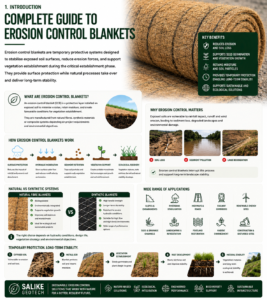
Erosion is one of the most persistent challenges affecting:
When soil surfaces become exposed to:
Erosion control blankets are designed to help stabilise these vulnerable surfaces during the critical establishment phase before vegetation becomes fully developed.
They provide temporary surface protection that:
Used across a wide range of:
Understanding Erosion Control Blankets
An erosion control blanket (ECB) is a protective layer installed directly onto exposed soil surfaces to help:
These systems may be manufactured from:
Erosion control blankets are commonly used on:
Their purpose is not simply to cover the ground, but to create temporary engineered protection while natural stabilisation develops.
Why Erosion Control Matters
Without protection, exposed soils can deteriorate rapidly.
Rainfall impact alone can:
As runoff velocity increases:
This can lead to:
Erosion control blankets help interrupt this process by:
Temporary Protection, Long Term Stability
One of the most important principles behind erosion control blankets is that they are designed as transitional stabilisation systems.
Their role is to:
As vegetation matures:
This approach reflects a major shift in modern environmental engineering towards nature-based stabilisation strategies.
Natural vs Synthetic Systems
Modern erosion control blankets may include:
Natural fibre blankets commonly use materials such as:
These systems are often selected where:
Synthetic systems may provide:
Selecting the appropriate blanket system depends on:
More Than Surface Protection
Erosion control blankets do more than simply cover exposed soil.
Depending on the system type and specification, they may also:
This interaction between:
Supporting Sustainable Infrastructure
As infrastructure and environmental sectors increasingly prioritise:
Their ability to combine:
Nature Based Stabilisation Systems
Many erosion control blankets are specifically designed to work with ecological recovery processes.
Rather than permanently replacing natural systems with rigid infrastructure, they:
This philosophy is increasingly associated with:
A Broad Range of Applications
Erosion control blankets are used across many sectors including:
Applications range from:
Understanding the Wider System
Successful erosion control depends on understanding how:
Erosion control blankets are therefore best understood not simply as products, but as part of integrated environmental stabilisation systems.
Purpose of This Guide
This guide explores:
The objective is to provide a structured technical understanding of erosion control blankets and their application within:
Disclaimer: This article is provided for general information only and does not constitute engineering, environmental, design, legal, or professional advice. Project-specific advice should always be obtained from suitably qualified professionals.
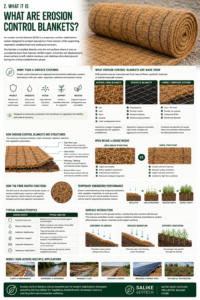
An erosion control blanket (ECB) is a temporary surface stabilisation system designed to protect exposed soil from erosion while supporting vegetation establishment and ecological recovery.
The blanket is installed directly onto the soil surface where it acts as a protective layer that helps:
Erosion control blankets are widely used within:
Their primary function is to provide temporary engineered protection until vegetation and natural stabilisation systems become established.
More Than a Surface Covering
Although erosion control blankets may appear visually simple, they function as engineered environmental stabilisation systems.
They are specifically designed to interact with:
Rather than permanently replacing natural systems with rigid armouring, ECBs are intended to:
This transition from temporary protection to vegetation-led stability is one of the defining principles behind erosion control blanket systems.
What Erosion Control Blankets Are Made From
Erosion control blankets may be manufactured from:
The material selection influences:
Natural Fibre Erosion Control Blankets
Natural blankets are commonly manufactured using materials such as:
These systems are typically selected where:
Natural fibre blankets generally support:
Coir Based Blankets
Coir erosion control blankets are manufactured using:
natural coir fibre,
derived from the outer husk of coconuts.
Coir fibre is valued because of its:
Coir blankets are commonly used for:
Synthetic Erosion Control Blankets
Synthetic systems may be manufactured using:
These systems may provide:
Some synthetic systems are designed as permanent reinforcement solutions, particularly where vegetation alone may not provide sufficient long term stabilisation.
Hybrid & Composite Blanket Systems
Some erosion control blankets combine:
hybrid stabilisation systems.
These systems attempt to balance:
Examples may include:
How Erosion Control Blankets Are Structured
Most erosion control blankets consist of:
The structure influences:
Open weave systems may provide:
Denser systems may provide:
The Role of the Fibre Matrix
The fibre matrix within the blanket is extremely important because it helps:
The matrix also creates a protective microenvironment that encourages:
Temporary Engineered Performance
Erosion control blankets are generally designed as temporary stabilisation systems.
Their role is to:
As vegetation matures:
This ecological transition is fundamental to nature based erosion control philosophy.
Surface Interaction
Unlike rigid hard-armouring systems, erosion control blankets interact closely with:
This close surface interaction helps:
Correct surface conformity is one of the key reasons why ECBs can be highly effective in:
Understanding the “Blanket” Concept
The term “erosion control blanket” does not refer simply to a sheet placed over the ground. It refers to a functional stabilisation layer that moderates the interaction between:
The blanket acts as:
Engineering & Ecological Integration
Modern erosion control blankets increasingly combine:
This is why ECBs are now commonly associated with:
Their role extends beyond simple erosion reduction into long term landscape recovery and resilience.
Typical Characteristics of Erosion Control Blankets
Characteristic | Typical Function |
Surface Protection | Reduces soil erosion |
Moisture Retention | Supports germination |
Sediment Stabilisation | Reduces soil displacement |
Vegetation Support | Encourages root development |
Hydraulic Moderation | Slows runoff velocity |
Temporary Stabilisation | Supports transition to natural recovery |
Why Understanding What ECBs Are Matters
Many erosion problems occur because:
Understanding what erosion control blankets actually are
and how they function is essential for:
Disclaimer: This article is provided for general information only and does not constitute engineering, environmental, design, legal, or professional advice. Project-specific advice should always be obtained from suitably qualified professionals.
Erosion control blankets are used to protect vulnerable soil surfaces during periods when the ground is exposed and susceptible to erosion.
Disturbed landscapes particularly those affected by:
Erosion control blankets help provide temporary engineered surface protection while vegetation and natural stabilisation processes develop. Their purpose is not only to reduce erosion, but also to:
Protecting Exposed Soil
Bare soil is highly vulnerable to:
Without protection:
This may lead to:
Erosion control blankets help shield the soil surface from direct erosive forces.
Reducing Rainfall Impact
One of the primary causes of erosion is rainfall impact.
When raindrops strike exposed soil:
Erosion control blankets absorb and diffuse rainfall energy before it reaches the soil surface.
This helps:
Slowing Surface Runoff
As water flows across exposed slopes:
Erosion control blankets help:
This hydraulic moderation helps minimise:
Retaining Soil Particles
Once soil particles become detached, they are easily transported downslope or into waterways.
The structure of an erosion control blanket helps:
This is especially important on:
Sediment retention also supports vegetation establishment and long-term recovery.
Supporting Vegetation Establishment
One of the most important reasons erosion control blankets are used is to support vegetation development.
Vegetation is one of the most effective forms of long-term erosion control because:
However, newly seeded or planted areas are often extremely vulnerable during the early establishment phase.
Erosion control blankets create a protective microenvironment that helps:
Improving Moisture Retention
Dry exposed soils may struggle to support:
Many erosion control blankets help retain:
This improved moisture environment can significantly assist:
Stabilising Slopes
Slopes are particularly vulnerable because gravity and runoff combine to increase:
Erosion control blankets help stabilise slopes by:
They are widely used on:
Supporting Temporary Stabilisation
Erosion control blankets are commonly used where temporary protection is required until:
This transitional stabilisation approach is central to:
The blanket provides:
Reducing Sediment Pollution
Erosion often results in sediment entering:
Excess sediment may contribute to:
By reducing soil loss and sediment transport, erosion control blankets help support improved environmental protection.
Supporting Sustainable Infrastructure
Modern infrastructure increasingly prioritises:
Erosion control blankets support these objectives by:
They are increasingly used within:
Nature Based Erosion Control
Unlike rigid hard-armouring systems that permanently dominate the landscape, many erosion control blankets are designed to work with nature rather than against it.
They help:
This makes them highly relevant within:
Common Environments Where ECBs Are Used
Erosion control blankets are commonly used in:
Each environment may require different:
Why Temporary Protection Matters
Perhaps the most important reason erosion control blankets are used is because landscapes are most vulnerable before vegetation becomes established.
The establishment phase is often the:
Erosion control blankets help bridge this critical transition between exposed disturbed soil and stable vegetated landscape.
Typical Reasons Erosion Control Blankets Are Used
Purpose | Benefit |
Rainfall Protection | Reduces soil detachment |
Runoff Moderation | Slows water velocity |
Sediment Retention | Stabilises displaced soil |
Moisture Retention | Supports germination |
Vegetation Support | Encourages root establishment |
Temporary Stabilisation | Protects vulnerable surfaces |
Ecological Recovery | Supports long-term resilience |
Understanding Their Role in Modern Stabilisation
Erosion control blankets are increasingly recognised not simply as protective products, but as components of integrated ecological stabilisation systems.
Their effectiveness comes from how they interact with:
Understanding why they are used is essential for:
Disclaimer: This article is provided for general information only and does not constitute engineering, environmental, design, legal, or professional advice. Project-specific advice should always be obtained from suitably qualified professionals.
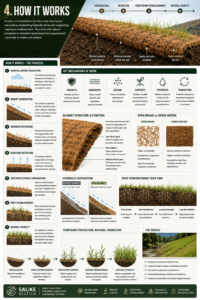
Erosion control blankets work by creating a temporary protective layer between:
Their function is based on a combination of:
Rather than permanently replacing natural stabilisation systems, erosion control blankets are designed to assist the transition from exposed vulnerable soil to stable vegetated landscape.
This interaction between:
Surface Protection
The first role of an erosion control blanket is shielding exposed soil surfaces.
When rainfall strikes bare ground:
The blanket acts as a protective buffer that:
This helps minimise:
Hydraulic Moderation
Water flowing across exposed slopes can quickly generate:
Erosion control blankets help moderate this hydraulic interaction by:
The fibre matrix and surface structure interrupt the movement of water across the slope.
This hydraulic moderation helps:
Sediment Retention
As runoff slows:
The blanket effectively creates a temporary stabilising matrix that helps:
Sediment retention is especially important during:
Moisture Retention
Vegetation establishment often fails because:
Many erosion control blankets help retain:
The blanket reduces:
This improved moisture environment supports:
Supporting Seed Germination
Erosion control blankets help create a stable germination environment.
The blanket structure:
This is particularly important on:
Improved seed stability increases the likelihood of:
Root Reinforcement
As vegetation begins to establish:
Root systems:
Over time vegetation becomes the primary stabilisation mechanism.
The erosion control blanket acts as:
Erosion control blankets are flexible systems that conform closely to:
This close surface contact is important because it helps:
Poor surface conformity may create:
Correct installation therefore plays a major role in blanket performance effectiveness.
Different erosion control blanket structures influence:
Typically provide:
They are often used where:
Typically provide:
These systems may be more suitable where:
Erosion control blankets are generally designed to provide temporary engineered performance.
Their role is to:
As vegetation matures:
This transition from engineered support to natural stability is one of the defining principles behind ECB systems.
Many natural fibre blankets are specifically designed to biodegrade gradually over time.
As vegetation establishes and stabilisation improves:
Importantly biodegradation is not system failure. Instead, it reflects the intended ecological transition process.
One of the key ways erosion control blankets work is by dissipating hydraulic energy.
Instead of allowing water to flow freely across exposed soil:
This energy reduction significantly improves:
The blanket also creates a surface microclimate that supports:
This microenvironment improves:
Unlike rigid hard-engineering systems, erosion control blankets are designed to support ecological recovery rather than replace it.
They function by assisting:
This is why erosion control blankets are increasingly associated with:
Stage | What Happens |
Installation | Blanket protects exposed soil |
Rainfall Interaction | Impact forces are reduced |
Runoff Moderation | Water flow slows |
Sediment Retention | Soil particles stabilise |
Moisture Retention | Germination conditions improve |
Vegetation Establishment | Roots develop |
Natural Stability | Vegetation reinforces landscape |
Many erosion control failures occur because:
Understanding how erosion control blankets actually function is essential for:
Disclaimer: This article is provided for general information only and does not constitute engineering, environmental, design, legal, or professional advice. Project-specific advice should always be obtained from suitably qualified professionals.
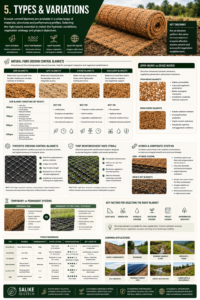
Erosion control blankets are available in a wide range of:
Different blanket types are designed to address different:
Selecting the correct erosion control blanket is critical because not all blankets perform the same way.
Some systems prioritise:
while others are designed for:
Understanding the different blanket categories helps ensure:
Natural Fibre Erosion Control Blankets
Natural fibre blankets are manufactured using biodegradable organic materials.
These systems are typically selected where:
Natural blankets gradually biodegrade as vegetation establishes and natural stability develops.
Coir Erosion Control Blankets
Coir blankets are manufactured from natural coconut husk fibre.
Coir fibre is widely used because of its:
Compared with many other natural fibres, coir generally provides:
Coir blankets are commonly used on:
Typical Coir Blanket Variations
400gsm Coir Blanket
Typically used for:
Characteristics:
700gsm Coir Blanket
One of the most widely used specifications.
Suitable for:
Provides:
900gsm Coir Blanket
Typically used where:
Provides:
1200gsm Coir Blanket
Used within:
Characteristics include:
Jute Erosion Control Blankets
Jute blankets are manufactured from natural jute fibre.
Jute systems generally provide:
They are commonly used where:
Typical applications include:
Straw Erosion Control Blankets
Straw blankets are typically manufactured using:
They are commonly used for:
Straw blankets often provide:
Excelsior Blankets
Excelsior blankets are manufactured using wood fibre matrices.
These systems can provide:
Excelsior blankets are often used for:
Synthetic Erosion Control Blankets
Synthetic blankets are manufactured using:
Unlike biodegradable natural systems, synthetic blankets may provide:
These systems are commonly used where:
Turf Reinforcement Mats (TRMs)
TRMs are a more advanced category of permanent synthetic erosion control systems.
These systems are designed to:
TRMs are often specified for:
Unlike temporary ECBs, TRMs are generally intended as permanent reinforcement systems.
Hybrid & Composite Blanket Systems
Some erosion control blankets combine:
These systems aim to balance:
Coir & PP Mesh Systems
These combine:
Benefits may include:
Double Net Blankets
Double net systems provide:
These are often used where:
Open-Weave vs Dense Matrix Systems
Blankets may also vary according to weave density and fibre structure.
Open-Weave Blankets
Characteristics:
Typically used where:
Dense Matrix Blankets
Characteristics:
Often used where:
Temporary vs Permanent Systems
Another important distinction is between temporary ECBs and permanent reinforcement systems.
Temporary ECBs
Designed to:
Permanent Systems
Designed to:
Correct selection depends on:
Choosing the Right Blanket Type
No single erosion control blanket is suitable for every application.
Selection should consider:
Incorrect blanket selection may lead to:
Typical Blanket Type Comparison
Blanket Type | Typical Lifespan | Best For |
Straw Blanket | Short-term | Light erosion & temporary revegetation |
Jute Blanket | Short to moderate | Landscaping & ecological recovery |
Coir Blanket | Moderate to long | Slopes, riverbanks & infrastructure |
Hybrid Blanket | Moderate to long | Increased reinforcement needs |
Synthetic ECB | Long-term | High hydraulic exposure |
TRM | Permanent | Severe erosion & reinforced systems |
Understanding Blanket Variations Matters
Different blanket systems are designed for:
Understanding these variations is essential for:
Disclaimer: This article is provided for general information only and does not constitute engineering, environmental, design, legal, or professional advice. Project-specific advice should always be obtained from suitably qualified professionals.
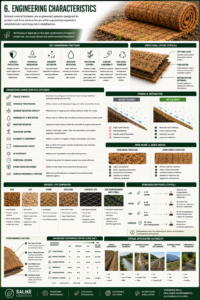
The performance of an erosion control blanket is heavily influenced by its:
Although erosion control blankets are often associated with:
Understanding the engineering characteristics of erosion control blankets is essential for:
Different blanket systems provide different levels of:
Selecting the correct system therefore requires performance-led specification rather than simply choosing a blanket based on appearance or material type.
Surface Protection Performance
One of the primary engineering functions of an erosion control blanket is protecting the soil surface from erosion forces.
The blanket acts as a protective interface between:
Performance is influenced by:
Higher-performing systems generally provide:
Tensile Strength
Tensile strength refers to the blanket’s ability to resist pulling and mechanical stress.
This characteristic is important because erosion control blankets may experience:
Higher tensile strength systems generally provide:
Synthetic systems and reinforced composite blankets often provide:
Hydraulic Performance
Hydraulic performance relates to how the blanket interacts with:
A well-performing blanket should:
Hydraulic resistance requirements vary depending on:
Higher hydraulic environments may require:
Sediment Retention Capacity
Sediment retention is one of the most important characteristics of an erosion control blanket.
The blanket structure helps:
Retention capacity depends on:
Denser blanket systems often provide:
Permeability & Water Infiltration
Good erosion control blankets allow controlled water infiltration.
Permeability is important because it helps:
Blankets with poor permeability may:
Open-weave systems generally provide:
Moisture Retention Characteristics
Many natural fibre blankets provide moisture retention capability.
This is particularly important for:
Moisture retention performance depends on:
Coir fibre systems are often valued because they can:
Vegetation Support Performance
Erosion control blankets are specifically engineered to support vegetation establishment.
Performance characteristics influencing vegetation include:
Successful vegetation integration is critical because:
Flexibility & Surface Conformity
Blankets must conform closely to:
Good conformity helps:
Flexible systems generally provide:
Rigid or poorly conforming systems may create:
Biodegradation Profile
Biodegradable systems are designed to gradually decompose over time.
The biodegradation profile influences:
Different materials biodegrade at different rates.
Jute Systems
Typically provide:
Often suited for:
Coir Systems
Typically provide:
Commonly selected where:
Synthetic Systems
Typically provide:
UV Resistance
Ultraviolet exposure may affect:
Natural fibre systems generally degrade progressively under:
Synthetic systems may provide:
Longevity & Functional Lifespan
Functional lifespan refers to how long the blanket remains structurally effective.
Lifespan depends on:
Typical blanket categories may range from:
Shear Stress Resistance
Shear stress resistance relates to the blanket’s ability to resist erosive flow forces.
Higher hydraulic environments require systems capable of withstanding:
TRMs and reinforced synthetic systems generally provide:
Surface Roughness & Friction
The texture and structure of a blanket influence:
Rougher surfaces increase:
This helps:
Temporary vs Permanent Engineering Roles
Engineering characteristics vary significantly between temporary ECBs
and permanent reinforcement systems.
Temporary Systems
Designed for:
Permanent Systems
Designed for:
Correct selection depends on:
Engineering Performance Depends on Installation
Even high-quality blankets may underperform if:
Engineering performance depends on both product specification and installation quality.
Typical Engineering Characteristics Comparison
Characteristic | Importance |
Tensile Strength | Structural stability |
Hydraulic Resistance | Erosion protection |
Sediment Retention | Surface stabilisation |
Permeability | Water infiltration |
Moisture Retention | Vegetation support |
Flexibility | Surface conformity |
Biodegradation | Ecological transition |
UV Resistance | Durability |
Shear Resistance | Hydraulic performance |
Engineering Characteristics Influence Long-Term Success
Understanding engineering characteristics is essential because erosion control blankets are performance-based stabilisation systems.
Their effectiveness depends on how:
Correct engineering assessment helps ensure:
Disclaimer: This article is provided for general information only and does not constitute engineering, environmental, design, legal, or professional advice. Project-specific advice should always be obtained from suitably qualified professionals.
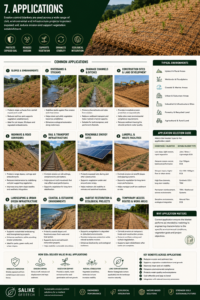
Erosion control blankets are used across a broad range of:
Their ability to provide:
Different erosion control blanket systems are selected depending on:
Understanding where and how ECBs are applied is essential for correct specification and long-term stabilisation success.
Slopes & Embankments
One of the most common applications for erosion control blankets is slope stabilisation.
Exposed slopes are particularly vulnerable because:
Erosion control blankets help:
They are widely used on:
Highways & Road Infrastructure
Highway construction often creates:
Erosion control blankets are commonly used to:
Typical applications include:
Rail Infrastructure
Railway environments often contain:
Erosion control blankets help:
Vegetated stabilisation systems may also help reduce:
Riverbanks & Waterways
Riverbanks are exposed to:
Erosion control blankets help:
Coir and natural fibre blankets are particularly common within:
Drainage Channels & Ditches
Drainage systems often experience:
Erosion control blankets help:
Depending on hydraulic exposure, applications may include:
Sustainable Drainage Systems (SuDS)
Modern SuDS schemes increasingly integrate:
Erosion control blankets support:
Natural fibre systems are commonly selected where ecological integration is prioritised.
Renewable Energy Sites
Large-scale renewable energy developments often involve:
Erosion control blankets are frequently used within:
Applications may include:
Construction & Land Development
Construction activity frequently exposes:
Without protection, these surfaces may experience:
Erosion control blankets help provide temporary stabilisation during active construction phases.
Typical uses include:
Landscaping & Urban Green Infrastructure
Erosion control blankets are widely used within:
Applications may include:
Their ability to support:
Peatland Restoration
Peatland environments are highly sensitive to:
Erosion control blankets may be used to:
Natural fibre systems are often preferred because of their:
Habitat Restoration & Ecological Rehabilitation
Many ecological restoration projects require:
Erosion control blankets are commonly used within:
They help create conditions favourable for:
Coastal & Shoreline Environments
Some erosion control blankets are used within:
Applications may involve:
Hydraulic exposure and tidal interaction are critical considerations within these environments.
Higher-energy coastal conditions may require:
Landfill & Environmental Containment Projects
Landfill caps and restored containment sites often require:
Erosion control blankets help:
These systems are frequently used during:
Temporary Access Routes & Work Areas
Temporary work zones and access routes may expose soils to:
Certain ECB systems may help:
Applications Depend on Blanket Type
Not all erosion control blankets are suitable for every application.
Correct blanket selection depends on:
For example:
Typical Application Comparison
Application | Typical Blanket Type |
Landscaping | Jute / Straw ECB |
Slopes & Embankments | Coir ECB |
Riverbanks | Coir / Hybrid ECB |
Drainage Channels | Reinforced ECB / TRM |
Highways | Coir / Synthetic ECB |
Renewable Energy Sites | Coir ECB |
Habitat Restoration | Natural Fibre ECB |
Severe Hydraulic Conditions | TRM / Reinforced Systems |
Supporting Nature-Based Stabilisation
One of the most important aspects of erosion control blanket applications is their ability to support vegetation-led stabilisation systems.
Rather than relying solely on rigid hard-engineering approaches, ECBs help landscapes:
This is why erosion control blankets are increasingly associated with:
Understanding Applications Improves Specification
Many erosion control failures occur because:
Understanding the full range of ECB applications helps ensure:
Disclaimer: This article is provided for general information only and does not constitute engineering, environmental, design, legal, or professional advice. Project-specific advice should always be obtained from suitably qualified professionals.
Correct installation is one of the most important factors influencing the long-term performance of erosion control blankets.
Even high-quality blanket systems may underperform if they are:
Successful installation should ensure that the erosion control blanket:
Because erosion control blankets are designed as transitional stabilisation systems, installation should always be approached as part of a wider:
Understanding the Purpose of Installation
The purpose of installation is not simply to place a blanket over exposed ground.
Correct installation helps:
Poor installation may significantly reduce:
Typical Installation Environments
Erosion control blankets are commonly installed within:
Each environment presents different:
Installation methodology should therefore always be site-specific.
Stage 1 – Site Assessment & Preparation
Before installation begins, the site should be assessed for:
Proper site preparation may include:
Good preparation helps ensure:
Stage 2 – Seeding & Soil Preparation
Where vegetation establishment is required, seeding is often completed before blanket installation.
This may include:
Proper soil preparation and seed distribution are critical because vegetation provides the long-term stabilisation mechanism. Without successful vegetation establishment:
Stage 3 – Blanket Positioning
The erosion control blanket should be rolled out:
Correct positioning helps:
The blanket should:
Good surface conformity is essential for effective erosion control performance.
Stage 4 – Trenching & Anchor Slots
At the top of slopes, erosion control blankets are commonly secured within anchor trenches or anchor slots.
This helps prevent:
Typical anchor trenches are:
This is one of the most important installation details because:
Stage 5 – Overlapping Adjacent Rolls
Where multiple blanket rolls are installed:
Proper overlaps help:
Overlap dimensions vary depending on:
Steeper slopes and higher-flow environments generally require:
Stage 6 – Anchoring & Pinning
Anchoring is one of the most critical stages of installation.
Erosion control blankets are commonly secured using:
Correct anchoring spacing depends on:
Higher-risk environments generally require:
Insufficient anchoring may lead to:
Stage 7 – Surface Conformity
The blanket should remain tightly integrated with the soil surface.
Voids or suspended sections may allow:
Good surface conformity improves:
This is especially important on:
Stage 8 – Channel & Drainage Installation
Within:
Higher hydraulic environments may require:
Correct flow alignment is essential to:
Stage 9 – Vegetation Establishment
Following installation:
The blanket helps:
As vegetation matures:
The transition from engineered blanket protection to vegetation-led stability is fundamental to ECB performance.
Stage 10 – Inspection & Maintenance
Following installation, inspection is important to identify:
Inspection is particularly important after:
Maintenance may include:
Early intervention can help prevent:
Installation in High-Risk Environments
Steep slopes,
high-flow channels,
and severe erosion environments may require:
Installation complexity generally increases with:
Correct engineering assessment is therefore critical within aggressive erosion environments.
Temporary vs Permanent Installation Systems
Installation requirements vary depending on whether the blanket is designed for temporary stabilisation or permanent reinforcement.
Temporary Systems
Typically focus on:
Permanent Systems
Typically require:
Common Installation Mistakes
Common installation problems may include:
These issues may significantly reduce:
Typical Installation Sequence
Stage | Primary Objective |
Site Preparation | Create stable installation surface |
Seeding | Support vegetation establishment |
Blanket Placement | Ensure hydraulic protection |
Crest Anchoring | Prevent uplift & underflow |
Overlapping | Maintain continuity |
Pinning | Secure blanket stability |
Vegetation Development | Achieve long-term stability |
Monitoring | Maintain system performance |
Installation as Part of a Wider Stabilisation Strategy
Erosion control blankets should not be viewed as isolated products.
Their success depends on integration with:
The best outcomes occur when installation forms part of a holistic nature-based stabilisation approach.
Disclaimer: This article is provided for general information only and does not constitute engineering, environmental, design, legal, or professional advice. Project-specific advice should always be obtained from suitably qualified professionals.
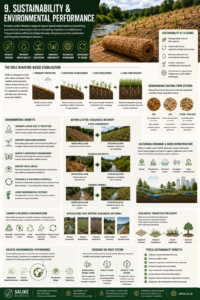
Erosion control blankets play an increasingly important role within:
As industries move away from:
Erosion control blankets, particularly natural fibre systems, are often selected because they help combine engineering performance with ecological integration.
Their sustainability value extends beyond:
It also includes:
Supporting Nature-Based Stabilisation
Many erosion control blankets are specifically designed to work with ecological recovery processes.
Rather than permanently replacing natural systems with rigid hard engineering, ECBs help:
This approach aligns closely with:
Reducing Long-Term Landscape Disturbance
Traditional hard-armouring systems may:
Erosion control blankets instead support:
As vegetation establishes:
This helps create more self-sustaining landscapes.
Biodegradable Natural Fibre Systems
Natural fibre blankets such as:
As vegetation establishes:
Importantly biodegradation is part of the intended engineering process, not system failure.
The objective is to:
Coir Fibre Sustainability
Coir erosion control blankets are manufactured using coconut husk fibre, a natural by-product of the coconut industry.
Using coir fibre helps:
Coir is often valued because it provides:
Supporting Vegetation Recovery
One of the greatest environmental benefits of erosion control blankets is their ability to support vegetation establishment.
Vegetation contributes significantly to:
By helping vegetation establish successfully, ECBs support:
Sediment & Water Quality Protection
Erosion can significantly affect:
Sediment transport may contribute to:
Erosion control blankets help reduce:
This may help support improved water quality and environmental protection.
Habitat & Ecological Integration
Many erosion control blankets are used within:
Natural fibre systems often integrate more effectively with:
This makes them particularly suitable for:
Supporting Biodiversity Objectives
As infrastructure sectors increasingly prioritise:
This is particularly relevant within:
Reduced Visual Impact
Compared with:
As vegetation establishes:
This can improve:
Temporary vs Permanent Environmental Footprint
Natural fibre systems are generally designed for temporary environmental integration.
Once vegetation stabilises the landscape:
Synthetic systems may provide:
Selecting between:
Sustainable Drainage & Green Infrastructure
Erosion control blankets are increasingly used within:
They support:
This reflects a broader shift towards environmentally integrated infrastructure systems.
Carbon & Resource Considerations
Natural fibre blankets may also contribute to:
However, environmental performance should always be considered holistically.
Factors influencing sustainability may include:
Ecological Transition Philosophy
One of the most important sustainability concepts behind erosion control blankets is ecological transition.
The blanket is not intended to dominate the landscape permanently.
Instead, it helps:
This philosophy is central to:
Sustainability Depends on Correct Specification
Not all erosion control blankets deliver the same environmental performance.
Sustainability outcomes depend on:
Poor specification may result in:
Typical Sustainability Benefits
Sustainability Aspect | Contribution |
Vegetation Support | Long-term natural stability |
Biodegradability | Reduced permanent material presence |
Sediment Reduction | Improved water protection |
Ecological Integration | Habitat compatibility |
Renewable Materials | Reduced reliance on synthetic resources |
Nature-Based Recovery | Supports regenerative stabilisation |
Erosion Control Blankets as Part of Regenerative Infrastructure
Modern erosion control systems are increasingly evaluated not only by:
Erosion control blankets, particularly natural fibre systems, are increasingly recognised as components of regenerative infrastructure.
They help support:
Disclaimer: This article is provided for general information only and does not constitute engineering, environmental, design, legal, or professional advice. Project-specific advice should always be obtained from suitably qualified professionals.
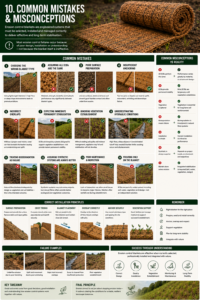
Although erosion control blankets are widely used across:
Many erosion control failures occur not because the blanket itself is ineffective,
but because:
Understanding the most common mistakes and misconceptions is essential for achieving successful long-term stabilisation outcomes.
Erosion control blankets should not be viewed as:
They are engineered stabilisation systems that interact directly with:
Mistake 1 – Choosing the Wrong Blanket Type
One of the most common problems is incorrect blanket selection.
Not all erosion control blankets are designed for the same:
For example:
Similarly:
Correct selection should always consider:
Mistake 2 – Assuming All ECBs Are the Same
Many people incorrectly assume all erosion control blankets perform equally.
In reality, ECB performance varies significantly depending on:
A coir blanket,
for example,
behaves very differently from:
Understanding these differences is essential for:
Mistake 3 – Poor Surface Preparation
Blankets installed over:
Surface preparation is critical because ECBs perform best when tightly integrated with the soil surface.
Good preparation typically includes:
Mistake 4 – Insufficient Anchoring
Poor anchoring is one of the most common installation failures.
If blankets are:
Hydraulic conditions, slope angle, and blanket type all influence required anchor density.
Higher-risk environments generally require:
Mistake 5 – Incorrect Overlaps
Improper overlaps between blanket rolls may create:
Overlaps should always:
Steeper slopes and higher hydraulic conditions generally require:
Mistake 6 – Poor Crest Trenching
The crest trench is one of the most important installation details.
Without proper crest anchoring:
This mistake is extremely common on:
Proper trenching helps ensure hydraulic continuity and blanket stability.
Mistake 7 – Expecting Immediate Permanent Stabilisation
A major misconception is believing erosion control blankets alone provide permanent stabilisation. Most ECBs are designed as temporary transition systems.
Their role is to:
Without successful vegetation establishment:
The blanket is not the final stabilisation mechanism vegetation is.
Mistake 8 – Ignoring Vegetation Establishment
Some projects focus heavily on:
This often leads to:
Vegetation is critical because:
ECB performance should therefore always be considered alongside vegetation strategy.
Mistake 9 – Underestimating Hydraulic Conditions
Hydraulic exposure is frequently underestimated.
Concentrated flow, steep slopes, or severe runoff conditions may exceed the performance limits of:
This can result in:
Higher hydraulic environments may require:
Mistake 10 – Using ECBs in Unsuitable Environments
Erosion control blankets are highly effective in many applications,
but they are not suitable for every environment. Extreme hydraulic conditions, wave attack, or severe concentrated flow may require:
Correct specification should always be site-specific.
Mistake 11 – Treating Biodegradation as Failure
Another common misconception is believing that biodegradation means the blanket has failed. For natural fibre systems,
biodegradation is an intended design characteristic.
The blanket is designed to:
The objective is ecological transition, not permanent artificial surface cover.
Mistake 12 – Assuming Synthetic Systems Are Always Better
Some specifiers assume:
While synthetic systems may provide:
The correct system depends on:
Mistake 13 – Poor Maintenance & Inspection
Many ECB systems require:
Ignoring early issues such as:
Early intervention significantly improves long-term stabilisation success.
Mistake 14 – Focusing Only on the Blanket
Erosion control blankets should not be viewed as isolated products.
Their performance depends on interaction between:
Successful erosion control requires integrated stabilisation thinking.
Common Misconceptions Summary
Misconception | Reality |
All ECBs perform the same | Performance varies significantly |
ECBs provide permanent stability | Most are temporary systems |
Vegetation is optional | Vegetation is critical |
Biodegradation means failure | It is often intentional |
Installation is simple | Correct installation is essential |
Synthetic is always superior | Depends on project requirements |
Blanket alone solves erosion | Integrated stabilisation is required |
Why Understanding Mistakes Matters
Many erosion control failures occur because:
Understanding common mistakes helps improve:
This is particularly important as erosion control increasingly becomes part of:
Erosion Control Is a System, Not a Product
Perhaps the most important principle to understand is that erosion control blankets are part of a wider stabilisation system.
Their success depends on:
The best outcomes occur when ECBs are integrated within holistic stabilisation strategies.
Disclaimer: This article is provided for general information only and does not constitute engineering, environmental, design, legal, or professional advice. Project-specific advice should always be obtained from suitably qualified professionals.
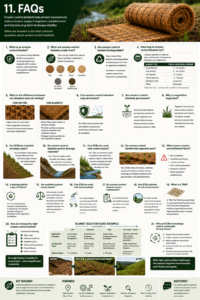
Erosion control blankets are widely used across:
However, because ECB systems vary significantly in:
This section addresses some of the most common questions relating to erosion control blankets and their practical application.
What is an erosion control blanket?
An erosion control blanket (ECB) is a temporary or permanent stabilisation system installed over exposed soil surfaces to help:
The blanket acts as a protective interface between:
What are erosion control blankets made from?
Erosion control blankets may be manufactured using:
Common materials include:
Material selection depends on:
Are erosion control blankets biodegradable?
Some erosion control blankets are fully biodegradable, while others are:
Natural fibre systems such as:
Synthetic systems may remain:
How long do erosion control blankets last?
The functional lifespan of an ECB depends on:
Typical lifespan ranges may include:
Blanket Type | Typical Functional Lifespan |
Straw Blanket | 3–12 months |
Jute Blanket | 6–24 months |
Coir Blanket | 2–5 years |
Hybrid Systems | 3–10 years |
Synthetic ECBs | Long-term |
TRMs | Permanent |
These values are indicative only and vary depending on site conditions and project exposure.
What is the difference between coir blankets and coir netting?
Although they may appear similar, they perform different functions.
Coir Netting
Typically consists of:
Often used for:
Coir Blankets
Typically contain:
Designed to provide:
Can erosion control blankets stop all erosion?
No.
Erosion control blankets help:
Performance depends on:
Severe hydraulic environments may require:
Are erosion control blankets permanent?
Most natural fibre erosion control blankets are designed as temporary stabilisation systems.
Their role is to:
Permanent systems typically include:
Why is vegetation important?
Vegetation is one of the most important components of long-term erosion control.
Root systems help:
The blanket provides:
Can ECBs be installed on steep slopes?
Yes, but steeper slopes generally require:
High-gradient environments may require:
Correct system selection is critical for steep slope applications.
Do erosion control blankets work in drainage channels?
Yes.
Many ECB systems are used within:
However:
High-flow environments may require:
Can erosion control blankets be used near watercourses?
Yes, particularly within:
Natural fibre systems are commonly selected because they:
Environmental regulations and hydraulic conditions should always be considered.
Do erosion control blankets help vegetation grow?
Yes.
Many ECBs support vegetation establishment by:
Vegetation performance depends on:
What causes erosion control blanket failure?
Common causes include:
Many failures occur because the wrong blanket type is selected for site conditions.
Is biodegradation a sign of failure?
No.
For biodegradable systems decomposition is intentional.
Natural fibre blankets are designed to:
The goal is ecological transition, not permanent surface covering.
Are synthetic systems always better?
Not necessarily.
Synthetic systems may provide:
However,
natural fibre systems may provide:
The correct system depends on:
Can ECBs be used with hydroseeding?
Yes.
Hydroseeding is commonly used alongside erosion control blankets.
The blanket helps:
Many infrastructure and environmental projects combine:
Do erosion control blankets require maintenance?
Yes, particularly during the early establishment phase.
Inspection is important after:
Maintenance may include:
Are ECBs suitable for all environments?
No.
While ECBs are highly versatile,
some severe environments may require:
Correct specification should always be site-specific.
What is a TRM?
A TRM (Turf Reinforcement Mat) is a permanent reinforced erosion control system.
Unlike temporary biodegradable blankets,
TRMs are designed to:
TRMs are often used within:
How do I choose the right erosion control blanket?
Selection should consider:
No single blanket type is suitable for every project.
Correct specification should balance:
Why are erosion control blankets increasingly used in sustainable infrastructure?
Modern infrastructure increasingly prioritises:
Erosion control blankets support these objectives by:
This makes them highly relevant within:
Frequently Asked Questions Help Improve Understanding
Many erosion control challenges occur because:
Understanding the most common questions helps improve:
Disclaimer: This article is provided for general information only and does not constitute engineering, environmental, design, legal, or professional advice. Project-specific advice should always be obtained from suitably qualified professionals.
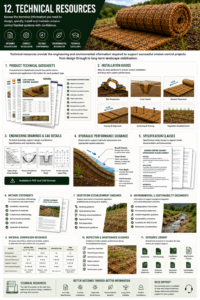
| Installation Topic | Purpose |
| Site Preparation | Improve soil contact |
| Crest Trenching | Prevent underflow erosion |
| Overlap Layout | Maintain hydraulic continuity |
| Pinning & Anchoring | Stabilise blanket position |
| Flow Alignment | Improve runoff control |
| Vegetation Establishment | Support long-term stability |
| Inspection & Maintenance | Maintain performance |
| Resource Type | Purpose |
| Datasheets | Product & material information |
| Installation Guides | Practical implementation |
| CAD Drawings | Engineering coordination |
| Method Statements | Construction procedures |
| Hydraulic Guidance | Flow & erosion understanding |
| Specification Clauses | Tender & procurement support |
| Vegetation Guidance | Long-term ecological recovery |
| Sustainability Documents | Environmental integration |
Disclaimer: This article is provided for general information only and does not constitute engineering, environmental, design, legal, or professional advice. Project-specific advice should always be obtained from suitably qualified professionals.
Erosion is one of the most persistent challenges affecting:
When soil surfaces become exposed to:
Erosion control blankets are designed to help stabilise these vulnerable surfaces during the critical establishment phase before vegetation becomes fully developed.
They provide temporary surface protection that:
Used across a wide range of:
Understanding Erosion Control Blankets
An erosion control blanket (ECB) is a protective layer installed directly onto exposed soil surfaces to help:
These systems may be manufactured from:
Erosion control blankets are commonly used on:
Their purpose is not simply to cover the ground, but to create temporary engineered protection while natural stabilisation develops.
Why Erosion Control Matters
Without protection, exposed soils can deteriorate rapidly.
Rainfall impact alone can:
As runoff velocity increases:
This can lead to:
Erosion control blankets help interrupt this process by:
Temporary Protection, Long Term Stability
One of the most important principles behind erosion control blankets is that they are designed as transitional stabilisation systems.
Their role is to:
As vegetation matures:
This approach reflects a major shift in modern environmental engineering towards nature-based stabilisation strategies.
Natural vs Synthetic Systems
Modern erosion control blankets may include:
Natural fibre blankets commonly use materials such as:
These systems are often selected where:
Synthetic systems may provide:
Selecting the appropriate blanket system depends on:
More Than Surface Protection
Erosion control blankets do more than simply cover exposed soil.
Depending on the system type and specification, they may also:
This interaction between:
Supporting Sustainable Infrastructure
As infrastructure and environmental sectors increasingly prioritise:
Their ability to combine:
Nature Based Stabilisation Systems
Many erosion control blankets are specifically designed to work with ecological recovery processes.
Rather than permanently replacing natural systems with rigid infrastructure, they:
This philosophy is increasingly associated with:
A Broad Range of Applications
Erosion control blankets are used across many sectors including:
Applications range from:
Understanding the Wider System
Successful erosion control depends on understanding how:
Erosion control blankets are therefore best understood not simply as products, but as part of integrated environmental stabilisation systems.
Purpose of This Guide
This guide explores:
The objective is to provide a structured technical understanding of erosion control blankets and their application within:
Disclaimer: This article is provided for general information only and does not constitute engineering, environmental, design, legal, or professional advice. Project-specific advice should always be obtained from suitably qualified professionals.
An erosion control blanket (ECB) is a temporary surface stabilisation system designed to protect exposed soil from erosion while supporting vegetation establishment and ecological recovery.
The blanket is installed directly onto the soil surface where it acts as a protective layer that helps:
Erosion control blankets are widely used within:
Their primary function is to provide temporary engineered protection until vegetation and natural stabilisation systems become established.
More Than a Surface Covering
Although erosion control blankets may appear visually simple, they function as engineered environmental stabilisation systems.
They are specifically designed to interact with:
Rather than permanently replacing natural systems with rigid armouring, ECBs are intended to:
This transition from temporary protection to vegetation-led stability is one of the defining principles behind erosion control blanket systems.
What Erosion Control Blankets Are Made From
Erosion control blankets may be manufactured from:
The material selection influences:
Natural Fibre Erosion Control Blankets
Natural blankets are commonly manufactured using materials such as:
These systems are typically selected where:
Natural fibre blankets generally support:
Coir Based Blankets
Coir erosion control blankets are manufactured using:
natural coir fibre,
derived from the outer husk of coconuts.
Coir fibre is valued because of its:
Coir blankets are commonly used for:
Synthetic Erosion Control Blankets
Synthetic systems may be manufactured using:
These systems may provide:
Some synthetic systems are designed as permanent reinforcement solutions, particularly where vegetation alone may not provide sufficient long term stabilisation.
Hybrid & Composite Blanket Systems
Some erosion control blankets combine:
hybrid stabilisation systems.
These systems attempt to balance:
Examples may include:
How Erosion Control Blankets Are Structured
Most erosion control blankets consist of:
The structure influences:
Open weave systems may provide:
Denser systems may provide:
The Role of the Fibre Matrix
The fibre matrix within the blanket is extremely important because it helps:
The matrix also creates a protective microenvironment that encourages:
Temporary Engineered Performance
Erosion control blankets are generally designed as temporary stabilisation systems.
Their role is to:
As vegetation matures:
This ecological transition is fundamental to nature based erosion control philosophy.
Surface Interaction
Unlike rigid hard-armouring systems, erosion control blankets interact closely with:
This close surface interaction helps:
Correct surface conformity is one of the key reasons why ECBs can be highly effective in:
Understanding the “Blanket” Concept
The term “erosion control blanket” does not refer simply to a sheet placed over the ground. It refers to a functional stabilisation layer that moderates the interaction between:
The blanket acts as:
Engineering & Ecological Integration
Modern erosion control blankets increasingly combine:
This is why ECBs are now commonly associated with:
Their role extends beyond simple erosion reduction into long term landscape recovery and resilience.
Typical Characteristics of Erosion Control Blankets
Characteristic | Typical Function |
Surface Protection | Reduces soil erosion |
Moisture Retention | Supports germination |
Sediment Stabilisation | Reduces soil displacement |
Vegetation Support | Encourages root development |
Hydraulic Moderation | Slows runoff velocity |
Temporary Stabilisation | Supports transition to natural recovery |
Why Understanding What ECBs Are Matters
Many erosion problems occur because:
Understanding what erosion control blankets actually are
and how they function is essential for:
Disclaimer: This article is provided for general information only and does not constitute engineering, environmental, design, legal, or professional advice. Project-specific advice should always be obtained from suitably qualified professionals.
Erosion control blankets work by creating a temporary protective layer between:
Their function is based on a combination of:
Rather than permanently replacing natural stabilisation systems, erosion control blankets are designed to assist the transition from exposed vulnerable soil to stable vegetated landscape.
This interaction between:
Surface Protection
The first role of an erosion control blanket is shielding exposed soil surfaces.
When rainfall strikes bare ground:
The blanket acts as a protective buffer that:
This helps minimise:
Hydraulic Moderation
Water flowing across exposed slopes can quickly generate:
Erosion control blankets help moderate this hydraulic interaction by:
The fibre matrix and surface structure interrupt the movement of water across the slope.
This hydraulic moderation helps:
Sediment Retention
As runoff slows:
The blanket effectively creates a temporary stabilising matrix that helps:
Sediment retention is especially important during:
Moisture Retention
Vegetation establishment often fails because:
Many erosion control blankets help retain:
The blanket reduces:
This improved moisture environment supports:
Supporting Seed Germination
Erosion control blankets help create a stable germination environment.
The blanket structure:
This is particularly important on:
Improved seed stability increases the likelihood of:
Root Reinforcement
As vegetation begins to establish:
Root systems:
Over time vegetation becomes the primary stabilisation mechanism.
The erosion control blanket acts as:
Erosion control blankets are flexible systems that conform closely to:
This close surface contact is important because it helps:
Poor surface conformity may create:
Correct installation therefore plays a major role in blanket performance effectiveness.
Different erosion control blanket structures influence:
Typically provide:
They are often used where:
Typically provide:
These systems may be more suitable where:
Erosion control blankets are generally designed to provide temporary engineered performance.
Their role is to:
As vegetation matures:
This transition from engineered support to natural stability is one of the defining principles behind ECB systems.
Many natural fibre blankets are specifically designed to biodegrade gradually over time.
As vegetation establishes and stabilisation improves:
Importantly biodegradation is not system failure. Instead, it reflects the intended ecological transition process.
One of the key ways erosion control blankets work is by dissipating hydraulic energy.
Instead of allowing water to flow freely across exposed soil:
This energy reduction significantly improves:
The blanket also creates a surface microclimate that supports:
This microenvironment improves:
Unlike rigid hard-engineering systems, erosion control blankets are designed to support ecological recovery rather than replace it.
They function by assisting:
This is why erosion control blankets are increasingly associated with:
Stage | What Happens |
Installation | Blanket protects exposed soil |
Rainfall Interaction | Impact forces are reduced |
Runoff Moderation | Water flow slows |
Sediment Retention | Soil particles stabilise |
Moisture Retention | Germination conditions improve |
Vegetation Establishment | Roots develop |
Natural Stability | Vegetation reinforces landscape |
Many erosion control failures occur because:
Understanding how erosion control blankets actually function is essential for:
Disclaimer: This article is provided for general information only and does not constitute engineering, environmental, design, legal, or professional advice. Project-specific advice should always be obtained from suitably qualified professionals.
Erosion control blankets are available in a wide range of:
Different blanket types are designed to address different:
Selecting the correct erosion control blanket is critical because not all blankets perform the same way.
Some systems prioritise:
while others are designed for:
Understanding the different blanket categories helps ensure:
Natural Fibre Erosion Control Blankets
Natural fibre blankets are manufactured using biodegradable organic materials.
These systems are typically selected where:
Natural blankets gradually biodegrade as vegetation establishes and natural stability develops.
Coir Erosion Control Blankets
Coir blankets are manufactured from natural coconut husk fibre.
Coir fibre is widely used because of its:
Compared with many other natural fibres, coir generally provides:
Coir blankets are commonly used on:
Typical Coir Blanket Variations
400gsm Coir Blanket
Typically used for:
Characteristics:
700gsm Coir Blanket
One of the most widely used specifications.
Suitable for:
Provides:
900gsm Coir Blanket
Typically used where:
Provides:
1200gsm Coir Blanket
Used within:
Characteristics include:
Jute Erosion Control Blankets
Jute blankets are manufactured from natural jute fibre.
Jute systems generally provide:
They are commonly used where:
Typical applications include:
Straw Erosion Control Blankets
Straw blankets are typically manufactured using:
They are commonly used for:
Straw blankets often provide:
Excelsior Blankets
Excelsior blankets are manufactured using wood fibre matrices.
These systems can provide:
Excelsior blankets are often used for:
Synthetic Erosion Control Blankets
Synthetic blankets are manufactured using:
Unlike biodegradable natural systems, synthetic blankets may provide:
These systems are commonly used where:
Turf Reinforcement Mats (TRMs)
TRMs are a more advanced category of permanent synthetic erosion control systems.
These systems are designed to:
TRMs are often specified for:
Unlike temporary ECBs, TRMs are generally intended as permanent reinforcement systems.
Hybrid & Composite Blanket Systems
Some erosion control blankets combine:
These systems aim to balance:
Coir & PP Mesh Systems
These combine:
Benefits may include:
Double Net Blankets
Double net systems provide:
These are often used where:
Open-Weave vs Dense Matrix Systems
Blankets may also vary according to weave density and fibre structure.
Open-Weave Blankets
Characteristics:
Typically used where:
Dense Matrix Blankets
Characteristics:
Often used where:
Temporary vs Permanent Systems
Another important distinction is between temporary ECBs and permanent reinforcement systems.
Temporary ECBs
Designed to:
Permanent Systems
Designed to:
Correct selection depends on:
Choosing the Right Blanket Type
No single erosion control blanket is suitable for every application.
Selection should consider:
Incorrect blanket selection may lead to:
Typical Blanket Type Comparison
Blanket Type | Typical Lifespan | Best For |
Straw Blanket | Short-term | Light erosion & temporary revegetation |
Jute Blanket | Short to moderate | Landscaping & ecological recovery |
Coir Blanket | Moderate to long | Slopes, riverbanks & infrastructure |
Hybrid Blanket | Moderate to long | Increased reinforcement needs |
Synthetic ECB | Long-term | High hydraulic exposure |
TRM | Permanent | Severe erosion & reinforced systems |
Understanding Blanket Variations Matters
Different blanket systems are designed for:
Understanding these variations is essential for:
Disclaimer: This article is provided for general information only and does not constitute engineering, environmental, design, legal, or professional advice. Project-specific advice should always be obtained from suitably qualified professionals.
The performance of an erosion control blanket is heavily influenced by its:
Although erosion control blankets are often associated with:
Understanding the engineering characteristics of erosion control blankets is essential for:
Different blanket systems provide different levels of:
Selecting the correct system therefore requires performance-led specification rather than simply choosing a blanket based on appearance or material type.
Surface Protection Performance
One of the primary engineering functions of an erosion control blanket is protecting the soil surface from erosion forces.
The blanket acts as a protective interface between:
Performance is influenced by:
Higher-performing systems generally provide:
Tensile Strength
Tensile strength refers to the blanket’s ability to resist pulling and mechanical stress.
This characteristic is important because erosion control blankets may experience:
Higher tensile strength systems generally provide:
Synthetic systems and reinforced composite blankets often provide:
Hydraulic Performance
Hydraulic performance relates to how the blanket interacts with:
A well-performing blanket should:
Hydraulic resistance requirements vary depending on:
Higher hydraulic environments may require:
Sediment Retention Capacity
Sediment retention is one of the most important characteristics of an erosion control blanket.
The blanket structure helps:
Retention capacity depends on:
Denser blanket systems often provide:
Permeability & Water Infiltration
Good erosion control blankets allow controlled water infiltration.
Permeability is important because it helps:
Blankets with poor permeability may:
Open-weave systems generally provide:
Moisture Retention Characteristics
Many natural fibre blankets provide moisture retention capability.
This is particularly important for:
Moisture retention performance depends on:
Coir fibre systems are often valued because they can:
Vegetation Support Performance
Erosion control blankets are specifically engineered to support vegetation establishment.
Performance characteristics influencing vegetation include:
Successful vegetation integration is critical because:
Flexibility & Surface Conformity
Blankets must conform closely to:
Good conformity helps:
Flexible systems generally provide:
Rigid or poorly conforming systems may create:
Biodegradation Profile
Biodegradable systems are designed to gradually decompose over time.
The biodegradation profile influences:
Different materials biodegrade at different rates.
Jute Systems
Typically provide:
Often suited for:
Coir Systems
Typically provide:
Commonly selected where:
Synthetic Systems
Typically provide:
UV Resistance
Ultraviolet exposure may affect:
Natural fibre systems generally degrade progressively under:
Synthetic systems may provide:
Longevity & Functional Lifespan
Functional lifespan refers to how long the blanket remains structurally effective.
Lifespan depends on:
Typical blanket categories may range from:
Shear Stress Resistance
Shear stress resistance relates to the blanket’s ability to resist erosive flow forces.
Higher hydraulic environments require systems capable of withstanding:
TRMs and reinforced synthetic systems generally provide:
Surface Roughness & Friction
The texture and structure of a blanket influence:
Rougher surfaces increase:
This helps:
Temporary vs Permanent Engineering Roles
Engineering characteristics vary significantly between temporary ECBs
and permanent reinforcement systems.
Temporary Systems
Designed for:
Permanent Systems
Designed for:
Correct selection depends on:
Engineering Performance Depends on Installation
Even high-quality blankets may underperform if:
Engineering performance depends on both product specification and installation quality.
Typical Engineering Characteristics Comparison
Characteristic | Importance |
Tensile Strength | Structural stability |
Hydraulic Resistance | Erosion protection |
Sediment Retention | Surface stabilisation |
Permeability | Water infiltration |
Moisture Retention | Vegetation support |
Flexibility | Surface conformity |
Biodegradation | Ecological transition |
UV Resistance | Durability |
Shear Resistance | Hydraulic performance |
Engineering Characteristics Influence Long-Term Success
Understanding engineering characteristics is essential because erosion control blankets are performance-based stabilisation systems.
Their effectiveness depends on how:
Correct engineering assessment helps ensure:
Disclaimer: This article is provided for general information only and does not constitute engineering, environmental, design, legal, or professional advice. Project-specific advice should always be obtained from suitably qualified professionals.
Erosion control blankets are used across a broad range of:
Their ability to provide:
Different erosion control blanket systems are selected depending on:
Understanding where and how ECBs are applied is essential for correct specification and long-term stabilisation success.
Slopes & Embankments
One of the most common applications for erosion control blankets is slope stabilisation.
Exposed slopes are particularly vulnerable because:
Erosion control blankets help:
They are widely used on:
Highways & Road Infrastructure
Highway construction often creates:
Erosion control blankets are commonly used to:
Typical applications include:
Rail Infrastructure
Railway environments often contain:
Erosion control blankets help:
Vegetated stabilisation systems may also help reduce:
Riverbanks & Waterways
Riverbanks are exposed to:
Erosion control blankets help:
Coir and natural fibre blankets are particularly common within:
Drainage Channels & Ditches
Drainage systems often experience:
Erosion control blankets help:
Depending on hydraulic exposure, applications may include:
Sustainable Drainage Systems (SuDS)
Modern SuDS schemes increasingly integrate:
Erosion control blankets support:
Natural fibre systems are commonly selected where ecological integration is prioritised.
Renewable Energy Sites
Large-scale renewable energy developments often involve:
Erosion control blankets are frequently used within:
Applications may include:
Construction & Land Development
Construction activity frequently exposes:
Without protection, these surfaces may experience:
Erosion control blankets help provide temporary stabilisation during active construction phases.
Typical uses include:
Landscaping & Urban Green Infrastructure
Erosion control blankets are widely used within:
Applications may include:
Their ability to support:
Peatland Restoration
Peatland environments are highly sensitive to:
Erosion control blankets may be used to:
Natural fibre systems are often preferred because of their:
Habitat Restoration & Ecological Rehabilitation
Many ecological restoration projects require:
Erosion control blankets are commonly used within:
They help create conditions favourable for:
Coastal & Shoreline Environments
Some erosion control blankets are used within:
Applications may involve:
Hydraulic exposure and tidal interaction are critical considerations within these environments.
Higher-energy coastal conditions may require:
Landfill & Environmental Containment Projects
Landfill caps and restored containment sites often require:
Erosion control blankets help:
These systems are frequently used during:
Temporary Access Routes & Work Areas
Temporary work zones and access routes may expose soils to:
Certain ECB systems may help:
Applications Depend on Blanket Type
Not all erosion control blankets are suitable for every application.
Correct blanket selection depends on:
For example:
Typical Application Comparison
Application | Typical Blanket Type |
Landscaping | Jute / Straw ECB |
Slopes & Embankments | Coir ECB |
Riverbanks | Coir / Hybrid ECB |
Drainage Channels | Reinforced ECB / TRM |
Highways | Coir / Synthetic ECB |
Renewable Energy Sites | Coir ECB |
Habitat Restoration | Natural Fibre ECB |
Severe Hydraulic Conditions | TRM / Reinforced Systems |
Supporting Nature-Based Stabilisation
One of the most important aspects of erosion control blanket applications is their ability to support vegetation-led stabilisation systems.
Rather than relying solely on rigid hard-engineering approaches, ECBs help landscapes:
This is why erosion control blankets are increasingly associated with:
Understanding Applications Improves Specification
Many erosion control failures occur because:
Understanding the full range of ECB applications helps ensure:
Disclaimer: This article is provided for general information only and does not constitute engineering, environmental, design, legal, or professional advice. Project-specific advice should always be obtained from suitably qualified professionals.
Erosion control blankets play an increasingly important role within:
As industries move away from:
Erosion control blankets, particularly natural fibre systems, are often selected because they help combine engineering performance with ecological integration.
Their sustainability value extends beyond:
It also includes:
Supporting Nature-Based Stabilisation
Many erosion control blankets are specifically designed to work with ecological recovery processes.
Rather than permanently replacing natural systems with rigid hard engineering, ECBs help:
This approach aligns closely with:
Reducing Long-Term Landscape Disturbance
Traditional hard-armouring systems may:
Erosion control blankets instead support:
As vegetation establishes:
This helps create more self-sustaining landscapes.
Biodegradable Natural Fibre Systems
Natural fibre blankets such as:
As vegetation establishes:
Importantly biodegradation is part of the intended engineering process, not system failure.
The objective is to:
Coir Fibre Sustainability
Coir erosion control blankets are manufactured using coconut husk fibre, a natural by-product of the coconut industry.
Using coir fibre helps:
Coir is often valued because it provides:
Supporting Vegetation Recovery
One of the greatest environmental benefits of erosion control blankets is their ability to support vegetation establishment.
Vegetation contributes significantly to:
By helping vegetation establish successfully, ECBs support:
Sediment & Water Quality Protection
Erosion can significantly affect:
Sediment transport may contribute to:
Erosion control blankets help reduce:
This may help support improved water quality and environmental protection.
Habitat & Ecological Integration
Many erosion control blankets are used within:
Natural fibre systems often integrate more effectively with:
This makes them particularly suitable for:
Supporting Biodiversity Objectives
As infrastructure sectors increasingly prioritise:
This is particularly relevant within:
Reduced Visual Impact
Compared with:
As vegetation establishes:
This can improve:
Temporary vs Permanent Environmental Footprint
Natural fibre systems are generally designed for temporary environmental integration.
Once vegetation stabilises the landscape:
Synthetic systems may provide:
Selecting between:
Sustainable Drainage & Green Infrastructure
Erosion control blankets are increasingly used within:
They support:
This reflects a broader shift towards environmentally integrated infrastructure systems.
Carbon & Resource Considerations
Natural fibre blankets may also contribute to:
However, environmental performance should always be considered holistically.
Factors influencing sustainability may include:
Ecological Transition Philosophy
One of the most important sustainability concepts behind erosion control blankets is ecological transition.
The blanket is not intended to dominate the landscape permanently.
Instead, it helps:
This philosophy is central to:
Sustainability Depends on Correct Specification
Not all erosion control blankets deliver the same environmental performance.
Sustainability outcomes depend on:
Poor specification may result in:
Typical Sustainability Benefits
Sustainability Aspect | Contribution |
Vegetation Support | Long-term natural stability |
Biodegradability | Reduced permanent material presence |
Sediment Reduction | Improved water protection |
Ecological Integration | Habitat compatibility |
Renewable Materials | Reduced reliance on synthetic resources |
Nature-Based Recovery | Supports regenerative stabilisation |
Erosion Control Blankets as Part of Regenerative Infrastructure
Modern erosion control systems are increasingly evaluated not only by:
Erosion control blankets, particularly natural fibre systems, are increasingly recognised as components of regenerative infrastructure.
They help support:
Disclaimer: This article is provided for general information only and does not constitute engineering, environmental, design, legal, or professional advice. Project-specific advice should always be obtained from suitably qualified professionals.
Although erosion control blankets are widely used across:
Many erosion control failures occur not because the blanket itself is ineffective,
but because:
Understanding the most common mistakes and misconceptions is essential for achieving successful long-term stabilisation outcomes.
Erosion control blankets should not be viewed as:
They are engineered stabilisation systems that interact directly with:
Mistake 1 – Choosing the Wrong Blanket Type
One of the most common problems is incorrect blanket selection.
Not all erosion control blankets are designed for the same:
For example:
Similarly:
Correct selection should always consider:
Mistake 2 – Assuming All ECBs Are the Same
Many people incorrectly assume all erosion control blankets perform equally.
In reality, ECB performance varies significantly depending on:
A coir blanket,
for example,
behaves very differently from:
Understanding these differences is essential for:
Mistake 3 – Poor Surface Preparation
Blankets installed over:
Surface preparation is critical because ECBs perform best when tightly integrated with the soil surface.
Good preparation typically includes:
Mistake 4 – Insufficient Anchoring
Poor anchoring is one of the most common installation failures.
If blankets are:
Hydraulic conditions, slope angle, and blanket type all influence required anchor density.
Higher-risk environments generally require:
Mistake 5 – Incorrect Overlaps
Improper overlaps between blanket rolls may create:
Overlaps should always:
Steeper slopes and higher hydraulic conditions generally require:
Mistake 6 – Poor Crest Trenching
The crest trench is one of the most important installation details.
Without proper crest anchoring:
This mistake is extremely common on:
Proper trenching helps ensure hydraulic continuity and blanket stability.
Mistake 7 – Expecting Immediate Permanent Stabilisation
A major misconception is believing erosion control blankets alone provide permanent stabilisation. Most ECBs are designed as temporary transition systems.
Their role is to:
Without successful vegetation establishment:
The blanket is not the final stabilisation mechanism vegetation is.
Mistake 8 – Ignoring Vegetation Establishment
Some projects focus heavily on:
This often leads to:
Vegetation is critical because:
ECB performance should therefore always be considered alongside vegetation strategy.
Mistake 9 – Underestimating Hydraulic Conditions
Hydraulic exposure is frequently underestimated.
Concentrated flow, steep slopes, or severe runoff conditions may exceed the performance limits of:
This can result in:
Higher hydraulic environments may require:
Mistake 10 – Using ECBs in Unsuitable Environments
Erosion control blankets are highly effective in many applications,
but they are not suitable for every environment. Extreme hydraulic conditions, wave attack, or severe concentrated flow may require:
Correct specification should always be site-specific.
Mistake 11 – Treating Biodegradation as Failure
Another common misconception is believing that biodegradation means the blanket has failed. For natural fibre systems,
biodegradation is an intended design characteristic.
The blanket is designed to:
The objective is ecological transition, not permanent artificial surface cover.
Mistake 12 – Assuming Synthetic Systems Are Always Better
Some specifiers assume:
While synthetic systems may provide:
The correct system depends on:
Mistake 13 – Poor Maintenance & Inspection
Many ECB systems require:
Ignoring early issues such as:
Early intervention significantly improves long-term stabilisation success.
Mistake 14 – Focusing Only on the Blanket
Erosion control blankets should not be viewed as isolated products.
Their performance depends on interaction between:
Successful erosion control requires integrated stabilisation thinking.
Common Misconceptions Summary
Misconception | Reality |
All ECBs perform the same | Performance varies significantly |
ECBs provide permanent stability | Most are temporary systems |
Vegetation is optional | Vegetation is critical |
Biodegradation means failure | It is often intentional |
Installation is simple | Correct installation is essential |
Synthetic is always superior | Depends on project requirements |
Blanket alone solves erosion | Integrated stabilisation is required |
Why Understanding Mistakes Matters
Many erosion control failures occur because:
Understanding common mistakes helps improve:
This is particularly important as erosion control increasingly becomes part of:
Erosion Control Is a System, Not a Product
Perhaps the most important principle to understand is that erosion control blankets are part of a wider stabilisation system.
Their success depends on:
The best outcomes occur when ECBs are integrated within holistic stabilisation strategies.
Disclaimer: This article is provided for general information only and does not constitute engineering, environmental, design, legal, or professional advice. Project-specific advice should always be obtained from suitably qualified professionals.
Erosion control blankets are widely used across:
However, because ECB systems vary significantly in:
This section addresses some of the most common questions relating to erosion control blankets and their practical application.
What is an erosion control blanket?
An erosion control blanket (ECB) is a temporary or permanent stabilisation system installed over exposed soil surfaces to help:
The blanket acts as a protective interface between:
What are erosion control blankets made from?
Erosion control blankets may be manufactured using:
Common materials include:
Material selection depends on:
Are erosion control blankets biodegradable?
Some erosion control blankets are fully biodegradable, while others are:
Natural fibre systems such as:
Synthetic systems may remain:
How long do erosion control blankets last?
The functional lifespan of an ECB depends on:
Typical lifespan ranges may include:
Blanket Type | Typical Functional Lifespan |
Straw Blanket | 3–12 months |
Jute Blanket | 6–24 months |
Coir Blanket | 2–5 years |
Hybrid Systems | 3–10 years |
Synthetic ECBs | Long-term |
TRMs | Permanent |
These values are indicative only and vary depending on site conditions and project exposure.
What is the difference between coir blankets and coir netting?
Although they may appear similar, they perform different functions.
Coir Netting
Typically consists of:
Often used for:
Coir Blankets
Typically contain:
Designed to provide:
Can erosion control blankets stop all erosion?
No.
Erosion control blankets help:
Performance depends on:
Severe hydraulic environments may require:
Are erosion control blankets permanent?
Most natural fibre erosion control blankets are designed as temporary stabilisation systems.
Their role is to:
Permanent systems typically include:
Why is vegetation important?
Vegetation is one of the most important components of long-term erosion control.
Root systems help:
The blanket provides:
Can ECBs be installed on steep slopes?
Yes, but steeper slopes generally require:
High-gradient environments may require:
Correct system selection is critical for steep slope applications.
Do erosion control blankets work in drainage channels?
Yes.
Many ECB systems are used within:
However:
High-flow environments may require:
Can erosion control blankets be used near watercourses?
Yes, particularly within:
Natural fibre systems are commonly selected because they:
Environmental regulations and hydraulic conditions should always be considered.
Do erosion control blankets help vegetation grow?
Yes.
Many ECBs support vegetation establishment by:
Vegetation performance depends on:
What causes erosion control blanket failure?
Common causes include:
Many failures occur because the wrong blanket type is selected for site conditions.
Is biodegradation a sign of failure?
No.
For biodegradable systems decomposition is intentional.
Natural fibre blankets are designed to:
The goal is ecological transition, not permanent surface covering.
Are synthetic systems always better?
Not necessarily.
Synthetic systems may provide:
However,
natural fibre systems may provide:
The correct system depends on:
Can ECBs be used with hydroseeding?
Yes.
Hydroseeding is commonly used alongside erosion control blankets.
The blanket helps:
Many infrastructure and environmental projects combine:
Do erosion control blankets require maintenance?
Yes, particularly during the early establishment phase.
Inspection is important after:
Maintenance may include:
Are ECBs suitable for all environments?
No.
While ECBs are highly versatile,
some severe environments may require:
Correct specification should always be site-specific.
What is a TRM?
A TRM (Turf Reinforcement Mat) is a permanent reinforced erosion control system.
Unlike temporary biodegradable blankets,
TRMs are designed to:
TRMs are often used within:
How do I choose the right erosion control blanket?
Selection should consider:
No single blanket type is suitable for every project.
Correct specification should balance:
Why are erosion control blankets increasingly used in sustainable infrastructure?
Modern infrastructure increasingly prioritises:
Erosion control blankets support these objectives by:
This makes them highly relevant within:
Frequently Asked Questions Help Improve Understanding
Many erosion control challenges occur because:
Understanding the most common questions helps improve:
Disclaimer: This article is provided for general information only and does not constitute engineering, environmental, design, legal, or professional advice. Project-specific advice should always be obtained from suitably qualified professionals.
Technical resources are an essential part of successful:
While erosion control blankets may appear visually simple,
their performance depends on:
For this reason, infrastructure and environmental projects often require structured technical documentation to support:
Technical resources help bridge the gap between product knowledge and real-world engineering application.
Why Technical Resources Matter
Erosion control blankets should not be viewed as:
They are engineered stabilisation systems that interact directly with:
Access to clear technical information helps improve:
Product Technical Datasheets
Technical datasheets provide structured information relating to:
Datasheets may also include:
Typical Datasheet Categories
Coir Erosion Control Blankets
Typically include:
Jute Erosion Control Blankets
Typically include:
Straw Blankets
Typically include:
Reinforced ECBs & TRMs
Typically include:
Installation Guides
Installation documentation is one of the most important technical resources because installation quality directly affects performance.
Installation guides may include:
Clear installation guidance helps reduce:
Typical Installation Resource Topics
| Installation Topic | Purpose |
| Site Preparation | Improve soil contact |
| Crest Trenching | Prevent underflow erosion |
| Overlap Layout | Maintain hydraulic continuity |
| Pinning & Anchoring | Stabilise blanket position |
| Flow Alignment | Improve runoff control |
| Vegetation Establishment | Support long-term stability |
| Inspection & Maintenance | Maintain performance |
Engineering Drawings & CAD Details
Engineering drawings help support:
Typical drawings may include:
Depending on project requirements, resources may be available in:
Hydraulic Performance Guidance
Hydraulic conditions are one of the most important factors influencing ECB performance.
Technical guidance may therefore include:
This helps ensure correct blanket selection for hydraulic conditions.
Specification Clauses
Specification-ready documentation may help consultants and contractors during:
Typical specification resources may include:
Well-structured specification clauses improve:
Method Statements
Method statements provide structured construction guidance.
These documents may include:
Method statements are particularly useful within:
Vegetation Establishment Guidance
Long-term erosion control success depends heavily on vegetation development.
Technical vegetation resources may therefore include:
These resources help support:
Environmental & Sustainability Documentation
As projects increasingly prioritise:
These resources may support:
Material Comparison Resources
Technical comparison guides help explain the differences between:
These resources may compare:
Comparison guidance helps support more informed specification decisions.
Inspection & Maintenance Guidance
Some ECB systems require:
Technical resources may therefore include:
This helps improve:
Technical Resources Improve Specification Quality
Many erosion control failures occur because:
Structured technical resources help improve:
Supporting Engineering & Environmental Integration
Modern erosion control systems increasingly combine:
Technical resources help connect these disciplines by supporting:
Typical Technical Resource Categories
| Resource Type | Purpose |
| Datasheets | Product & material information |
| Installation Guides | Practical implementation |
| CAD Drawings | Engineering coordination |
| Method Statements | Construction procedures |
| Hydraulic Guidance | Flow & erosion understanding |
| Specification Clauses | Tender & procurement support |
| Vegetation Guidance | Long-term ecological recovery |
| Sustainability Documents | Environmental integration |
Disclaimer: This article is provided for general information only and does not constitute engineering, environmental, design, legal, or professional advice. Project-specific advice should always be obtained from suitably qualified professionals.