Beyond Advocacy: the need for engineering clarity
Nature based solutions have become central to modern infrastructure discourse. Within geotechnical engineering and erosion control, natural fibre systems, including coir based products, are increasingly specified as part of a broader shift towards sustainable, low impact design.
However, as adoption grows, so too does the risk of oversimplification.
Natural fibre systems are not universal solutions. Their effectiveness is highly dependent on site conditions, application context and engineering judgement. For designers and specifiers, understanding both where they perform and where they do not is essential.
Where natural fibre systems perform effectively
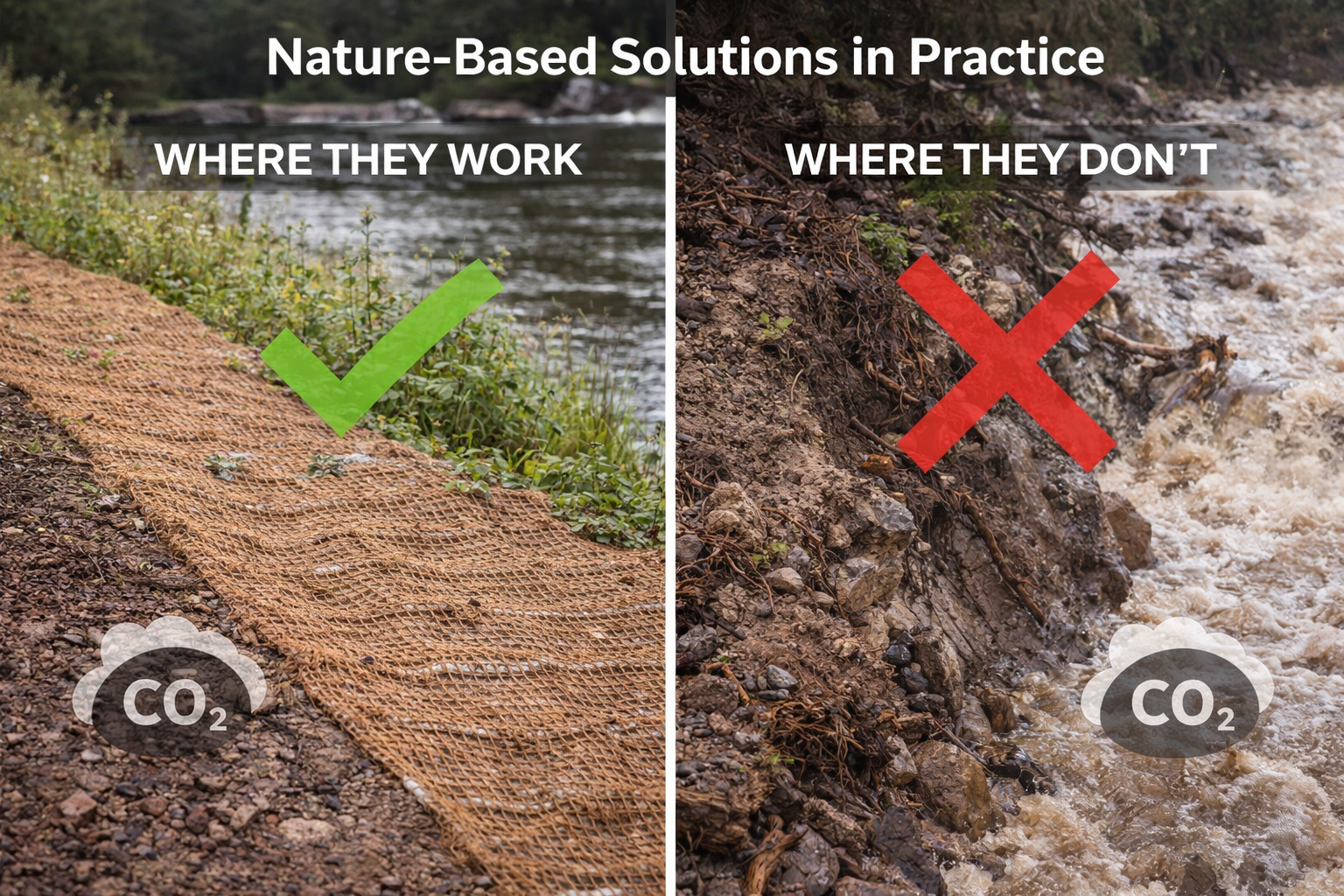
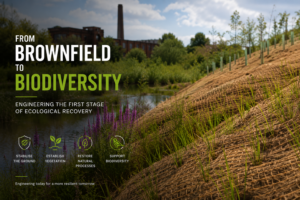
In appropriate conditions, coir based systems provide highly effective erosion control and environmental integration.
They are particularly well suited to:
- Surface erosion control on stable slopes
- Low to moderate flow environments, such as small watercourses and drainage channels
- Projects requiring vegetation establishment, including restoration and landscaping schemes
- Temporary stabilisation, where long term performance is expected to transition to natural systems
Their ability to:
- retain moisture
- reduce surface runoff velocity
- trap sediment
- support root development
makes them highly effective as transitional engineering systems.
In these contexts, natural fibre solutions align closely with both engineering requirements and environmental objectives.
The Importance of Soil Conditions
One of the most critical and often underestimated factors in the performance of coir systems is soil dependency.
Natural fibre solutions rely on interaction with the underlying soil and vegetation processes. Their effectiveness is influenced by:
- soil cohesion and structure
- compaction levels
- organic content
- ability to support vegetation growth
In loose, highly erodible or poorly graded soils, additional preparation or stabilisation measures may be required. Without this, even well installed systems may struggle to perform as intended.
Coir systems do not replace soil stability they rely on it.
Hydraulic Constraints and Performance Limits
Hydraulic conditions represent another key limitation.
While coir systems perform well in low to moderate flow environments, they are not designed to withstand:
- high velocity water flows
- significant hydraulic shear stress
- aggressive scour conditions
In such environments, the risk of displacement or premature degradation increases.
For riverbanks, channels and coastal applications, this necessitates careful assessment of:
- flow velocity
- water level fluctuation
- erosion risk during storm events
In higher energy conditions, natural fibre systems may need to be:
- combined with structural elements
- supplemented with additional protection
- or replaced with alternative engineering solutions
Where natural fibre systems are not appropriate
There are clear scenarios where coir based solutions are not suitable as standalone systems:
- Structurally unstable slopes, where deep seated failure is present
- High energy hydraulic environments, including fast flowing rivers or exposed coastal zones
- Sites with poor soil conditions, where vegetation establishment is unlikely
- Applications requiring long term structural reinforcement
In such cases, traditional geotechnical interventions including reinforcement, drainage or hard engineering remain necessary.
Engineering integrity over advocacy
As the industry moves towards more sustainable practices, there is a growing tendency to promote nature based solutions as universally applicable. This approach, while well intentioned, risks undermining both performance and credibility.
True engineering leadership requires balance.
The value of natural fibre systems lies not in their universal application, but in their correct application.
At Salike®, we advocate for a pragmatic approach one that integrates natural solutions where appropriate, while recognising their limitations.
Conclusion: precision builds trust
Nature-based solutions represent a significant advancement in how erosion control and geotechnical design can align with environmental objectives. However, their success depends on precision, not promotion.
By understanding:
- where coir systems perform
- where they require support
- and where alternative solutions are necessary
engineers can deliver outcomes that are both effective and responsible.
In this context, trust is built not through claims, but through clarity ensuring that every solution is aligned with the realities of the ground conditions it is designed to serve.