Introduction: The most overlooked phase in slope engineering
In engineered slope stabilisation, the focus often centres on installation specifications, tensile strengths, anchorage systems and compliance. Yet the most decisive period in determining whether a slope succeeds or fails frequently occurs after installation — during the first 24 months.
This early establishment phase is not simply a “grow-in” period. It is a structural transition window.
It is the point at which responsibility transfers from engineered surface protection to biologically reinforced soil structure.
When vegetation establishes successfully within this window, slopes stabilise, strengthen and mature.
When it does not, deterioration begins quietly — and often irreversibly.
The Engineering Reality: Slopes are temporarily stable at installation
Immediately following installation of erosion control systems — whether coir netting, blankets, logs or vegetated pallets — slopes are in a temporary equilibrium state.
Surface protection is present.
Shear resistance is supplemented.
Runoff velocity is reduced.
However:
- Root networks are immature
- Soil cohesion remains largely mechanical
- Hydrological resilience is limited
- Biological reinforcement is minimal
At this stage, the slope is not yet self-sustaining.It is protected — but not stabilised.
Why the first 24 months matter
Vegetation establishment follows a predictable progression:
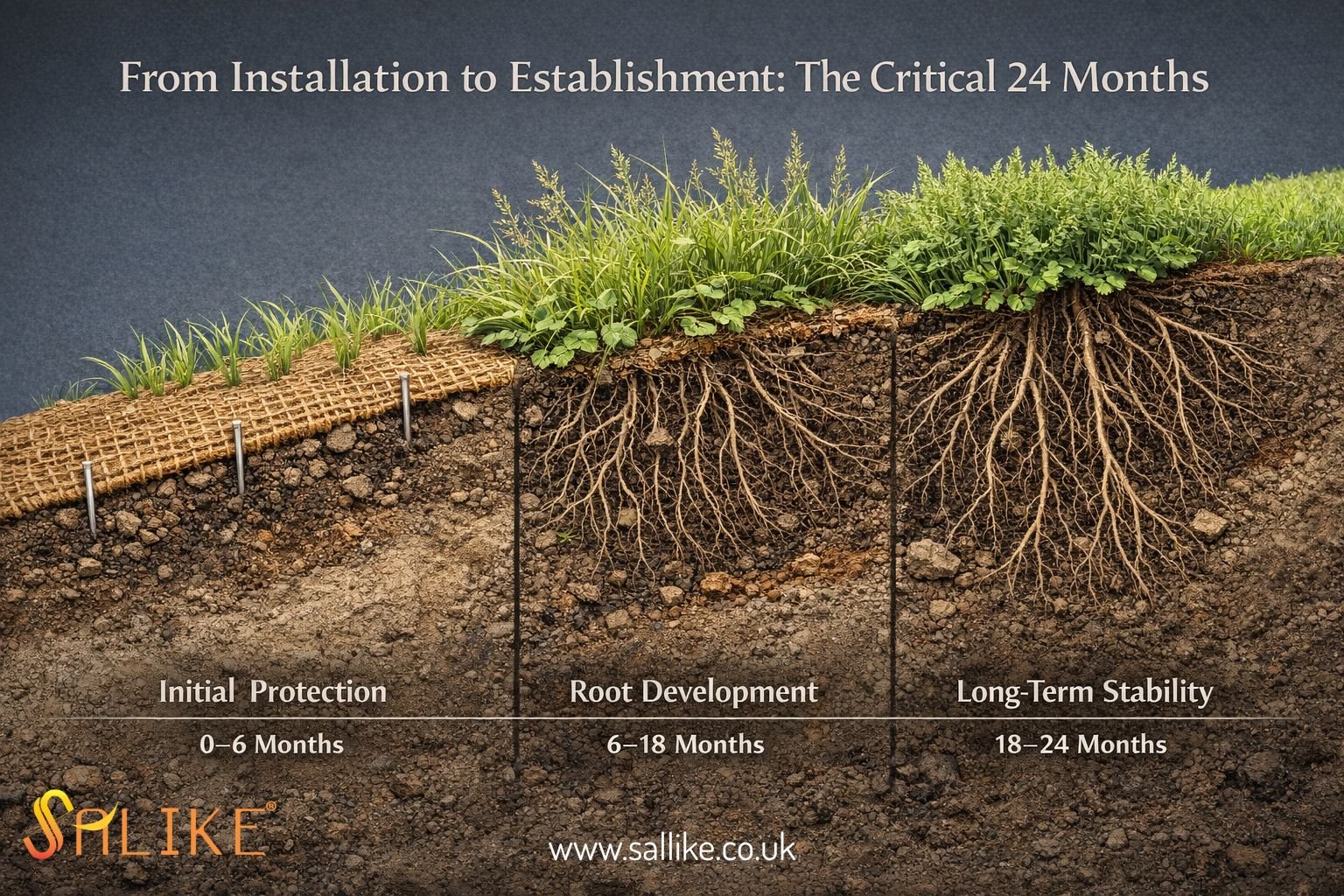
Phase 1: Germination & Root Initiation (0–6 Months)
- Fine root hairs begin binding surface particles
- Surface erosion reduces
- Microbial activity increases
- Organic matter begins integrating into upper soil layers
Failure risk at this stage:
- Surface washout
- Seed displacement
- Desiccation or waterlogging stress
This is where high-performance coir netting plays a critical role — maintaining seed contact and moderating moisture levels.
Phase 2: Root Network Development (6–18 Months)
- Root depth increases significantly
- Lateral root spread begins reinforcing soil mass
- Shear strength increases measurably
- Soil structure becomes more aggregated
This phase determines long-term stability.
If vegetation density is insufficient or patchy, preferential water channels develop — accelerating erosion beneath the surface.
Phase 3: Structural Reinforcement (18–24 Months)
- Root matrices interlock soil layers
- Hydrological buffering improves
- Slope becomes increasingly self-regulating
- Surface protection systems begin naturally degrading (if biodegradable)
This is the transition from engineered intervention to ecological resilience.
If establishment has succeeded, the slope now strengthens over time rather than weakens.
What happens when an establishment fails?
The consequences rarely appear immediately.
Instead, gradual degradation occurs:
- Reduced vegetative cover
- Increased surface runoff velocity
- Soil particle migration
- Micro-rilling
- Progressive weakening
By year three, intervention costs are exponentially higher.
Most “failed erosion control systems” are not product failures.
They are establishment failures.
The role of biodegradable coir in the 24-month window
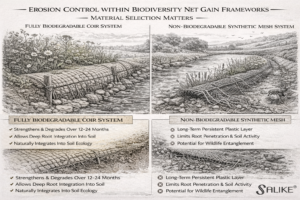
High-grade coir technologies— when engineered correctly — are uniquely suited to support this critical period.
Unlike synthetic geotextiles, coir:
- Retains moisture while remaining free-draining
- Provides mechanical surface stabilisation
- Degrades gradually as vegetation strengthens
- Improves soil organic content as fibres break down
- Supports microbial activity essential to root health
The degradation timeline of premium coir netting (such as 700gsm formats) aligns closely with the vegetation establishment curve.
This is not coincidence.
It is engineered synchronisation.
Engineering considerations for successful establishment
For long-term slope stability, early vegetation success must be designed — not assumed.
Key considerations include:
- Soil profile compatibility
- Seed mix selection appropriate to hydrology
- Proper ground preparation
- Anchorage spacing and tensioning
- Moisture management strategy
- Post-installation inspection regime
Early neglect compounds exponentially.
Early attention compounds beneficially.
Policy and asset implications
Across UK infrastructure — highways, rail corridors, utilities and flood defence assets — long-term resilience increasingly underpins procurement decisions.
Establishment success within the first 24 months determines:
- Maintenance budgets
- Asset lifespan
- Carbon lifecycle performance
- Biodiversity performance outcomes
- Regulatory compliance
Nature-based systems are only as strong as their establishment phase.
A strategic perspective
Slope stabilisation should not be measured at practical completion.
It should be evaluated at year two.
That is when the true engineering success becomes visible.
At Salike, our approach centres on this transitional period — designing coir-based solutions that support vegetation establishment with precision, reliability and performance integrity.
Because slopes are not stabilised by installation.
They are stabilised by establishment.