Peatlands occupy a singular and irreplaceable position within the United Kingdom’s natural capital. According to the UK Government and its statutory advisory bodies, peat soils store more carbon than all the forests of the UK combined, representing one of the nation’s most significant terrestrial carbon reservoirs (Department for Environment, Food & Rural Affairs, England Peat Action Plan; Committee on Climate Change reports). When intact and functioning, peatlands operate as long-term carbon sinks, regulate water flows, and support rare and sensitive habitats. When degraded, however, they can become a substantial source of greenhouse gas emissions.
The restoration of peatland is therefore not a matter of environmental preference, but of national importance.
The engineering challenge of degraded peat
Across upland and lowland landscapes alike, historic drainage, overgrazing, burning and infrastructure development have left extensive areas of peat in a fragile condition. Government agencies have documented common degradation patterns including erosion gullies, surface cracking, loss of vegetation cover, and instability of peat masses (Natural England technical guidance; NatureScot peatland restoration resources).
Erosion gullies in particular accelerate water movement through the peat profile, lowering water tables and exposing bare peat to oxidation. The resulting cycle — drainage, drying, erosion and carbon release — compounds both ecological and climate impacts.
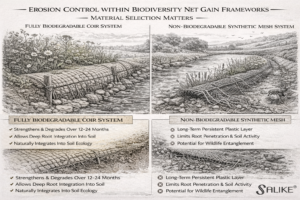
Restoration demands technical intervention that is both structurally reliable and environmentally appropriate. Heavy, permanent synthetic systems may offer immediate mechanical restraint, yet they risk introducing materials that do not align with the long-term regenerative objective of peatland recovery. In this context, material selection is not incidental; it is central.
Coir logs for gully blocking and re-wetting
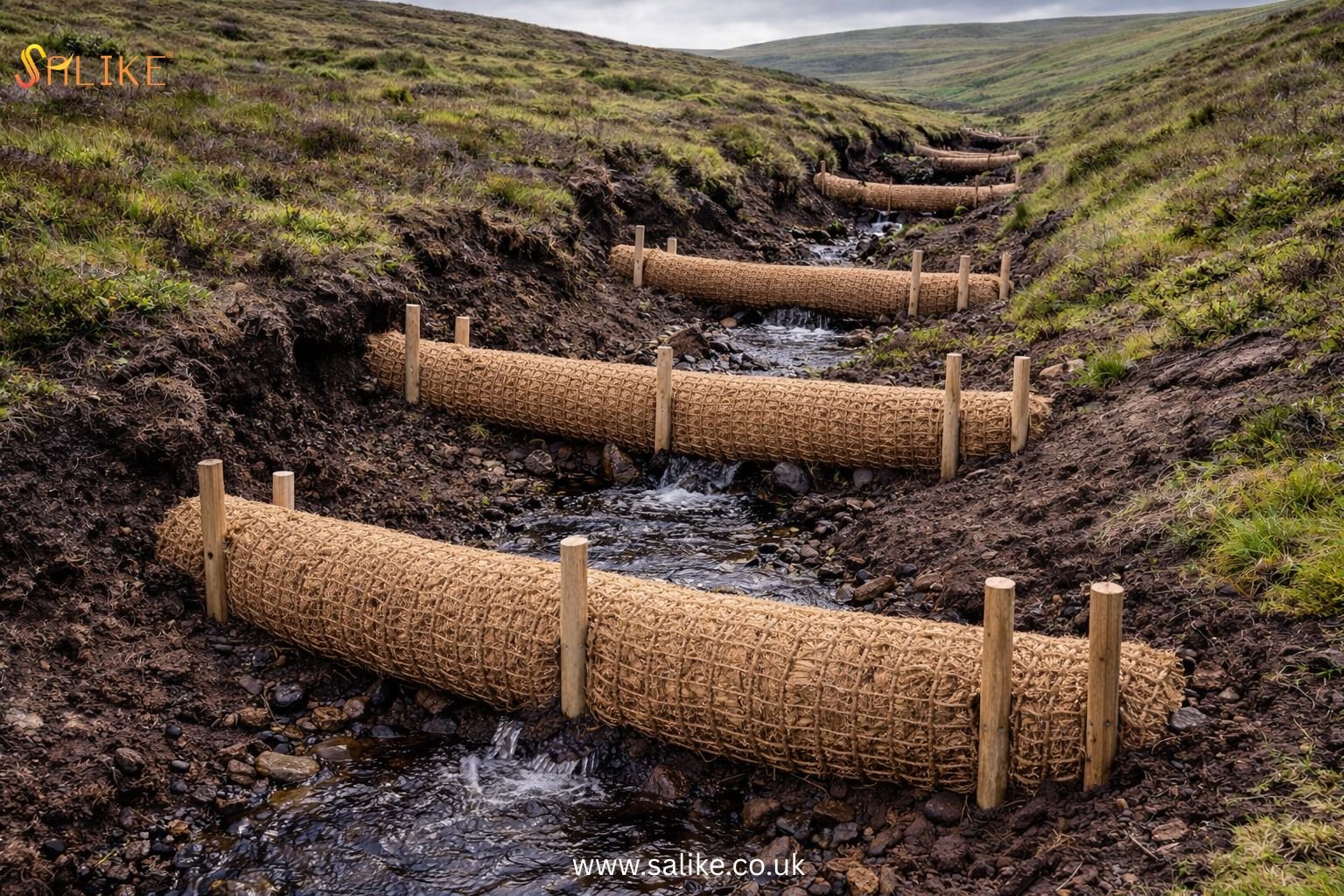
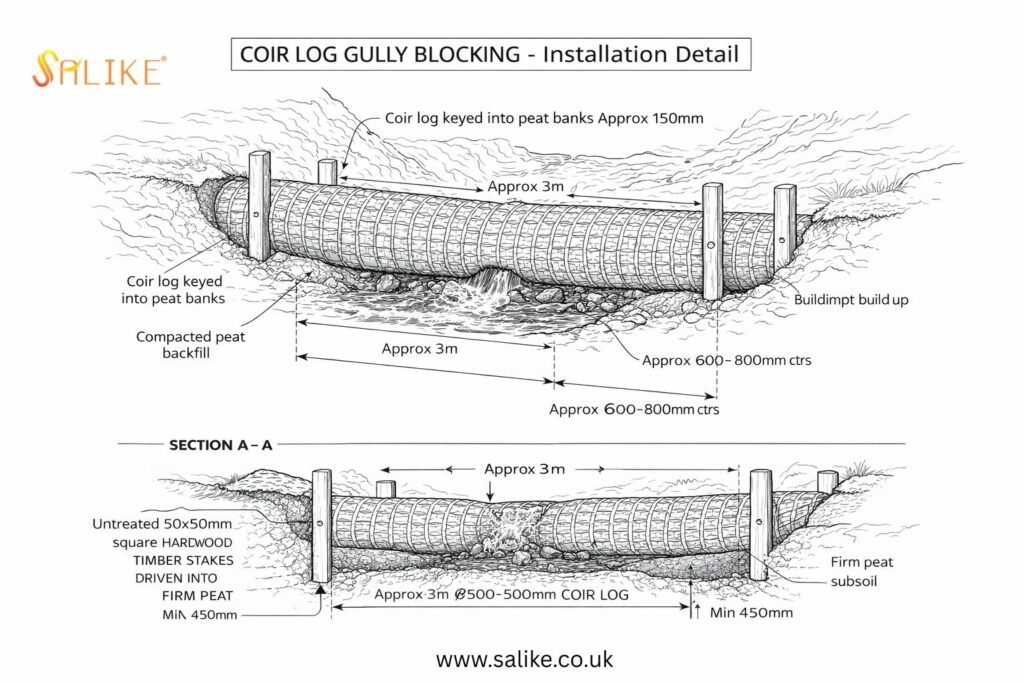
Engineered coir logs offer a measured and effective solution for peatland gully blocking. Installed transversely across erosion channels, they slow water velocity, encourage sediment deposition and assist in re-wetting the peat body upstream of the intervention.
The inherent tensile strength and mass of densely packed coir fibres provide immediate stabilisation, while their permeability allows controlled water passage. As sediment accumulates and vegetation re-establishes, the system transitions from fibre-led restraint to root-reinforced stability. Over time, the coir biodegrades naturally, leaving no synthetic residue within the peat matrix.
For large-scale restoration programmes — increasingly supported by government-backed peat strategies — consistent manufacture and predictable field performance are essential. Engineered coir innovations deliver that reliability while staying fully aligned with the ecological goals of restoration.
Surface stabilisation through coir netting
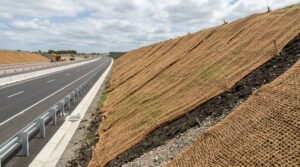
Where peat surfaces have been stripped of vegetative cover, wind and rainfall erosion can rapidly remove fine material, further destabilising the system. Coir netting provides an effective method of surface stabilisation during the critical establishment phase.
Properly specified and anchored, coir netting secures loose peat, reduces surface runoff velocity and creates microclimatic conditions favourable to revegetation. Its open-weave structure allows light penetration and plant emergence, while its biodegradable nature ensures that once vegetation is established, the material relinquishes its structural role without environmental burden.
Such systems reflect a fundamental principle of peatland restoration: intervention should support ecological processes, not replace them.
Carbon logic and material responsibility
The Climate Change Committee and DEFRA have both emphasised the importance of protecting and restoring peatlands as part of the UK’s pathway to net zero. In projects designed explicitly to reduce carbon emissions and enhance sequestration, it is reasonable to consider the embodied and end-of-life implications of the materials specified.
Biodegradable natural fibre systems sit comfortably within a carbon-conscious design philosophy. They perform a temporary engineering function and then reintegrate into the environment they were introduced to protect. Synthetic polymer systems, by contrast, persist long after their structural role has ceased, introducing long-term material legacies into sensitive landscapes.
The question, therefore, is not solely one of immediate tensile performance, but of whole-life appropriateness.
A considered approach to peatland restoration
At Salike®, peatland applications are approached with the same discipline that defines our wider geotechnical portfolio: careful material selection, engineering consistency and respect for environmental integrity. Our role is not to impose artificial permanence upon living landscapes, but to provide measured, reliable support during recovery.
Peatland restoration demands both humility and technical precision. Engineered coir innovations, when properly specified and installed, offer a means of delivering structural stability while remaining faithful to the regenerative objectives set out by national policy and environmental science.
In landscapes where carbon, biodiversity and hydrology converge, material choice is more than a technical decision — it is a statement of intent.