Coastal resilience in the United Kingdom is entering a more technically nuanced phase. The question is no longer whether a shoreline should be defended, but how it should be stabilised in a manner consistent with sediment dynamics, habitat objectives and whole-life carbon accountability.
In estuarine and transitional coastal environments, rigid revetments and vertical structures often interrupt the very geomorphological processes they seek to control. While hard engineering retains its place in high-energy open-coast applications, it is not universally appropriate.
At Salike®, we consider natural fibre shoreline systems not as alternatives born of environmental preference, but as engineered interventions suited to defined hydraulic conditions. High-density coir logs and structured coir netting, when correctly specified, operate as temporary reinforcement structures designed to facilitate sediment accretion and vegetative succession.
This paper examines their application in:
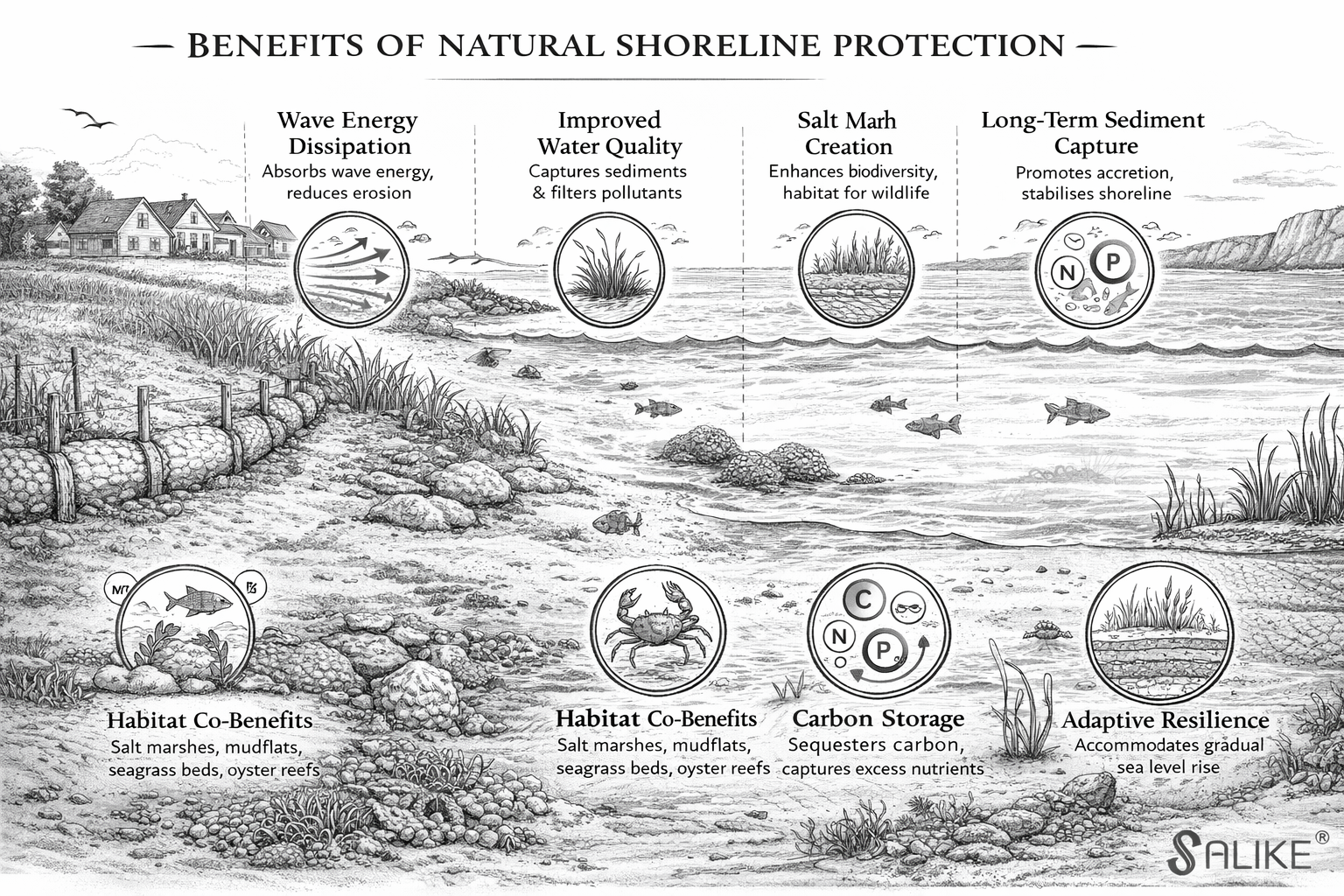
- Wave energy dissipation
- Salt marsh formation
- Long-term sediment capture
- Comparative suitability against hard engineering systems
Coastal & Estuarine Instability: An Engineering Context
Erosion in estuarine settings is rarely singular in cause. It typically arises from a combination of:
- Toe scour during tidal cycles
- Wind-driven wave fetch
- Tidal drawdown instability
- Loss of vegetative root reinforcement
- Progressive sediment deficit
Rigid structures address erosion by resisting movement. However, resistance frequently results in wave reflection, localised scour acceleration and downdrift impact. In contrast, permeable natural fibre systems are designed to attenuate energy rather than oppose it outright.
The distinction is fundamental: energy reduction versus force redirection.
Wave Energy Dissipation Through High-Density Coir Logs
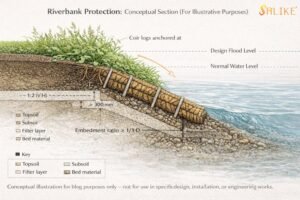
High-density coir logs (often termed coir wattles, coir rolls, waterlogs) perform as compressible, permeable toe protection elements in low to moderate energy environments.
When positioned at the erosion interface, they:
- Absorb and dissipate incident wave energy
- Reduce near-bed flow velocity
- Create a hydraulic shadow zone
- Promote fine sediment deposition landward of the log
Unlike impermeable concrete units, coir logs do not reflect wave energy. The fibre matrix allows water to pass through while reducing kinetic intensity, thereby limiting base scour.
Their application is particularly suited to:
- Tidal creek margins
- Managed realignment schemes
- Salt marsh restoration fronts
- Transitional estuarine banks
They are not substitutes for rock armour in exposed coastal wave climates. Proper hydraulic assessment remains non-negotiable.
Sediment Capture & Progressive Stabilisation
The long-term performance of shoreline systems is governed by sediment behaviour.
Coir systems are deliberately transitional. Their purpose is to:
- Reduce hydraulic velocity
- Encourage suspended sediment settlement
- Enable colonisation by salt-tolerant vegetation
- Transfer stabilising function to root structures over time
As accretion occurs, fine silts consolidate and pioneer species establish. Root matrices increase shear resistance within the upper soil horizon, progressively reducing reliance on the fibre structure.
Degradation of coir, within its designed lifespan, represents planned lifecycle behaviour rather than structural deficiency.
Salt Marsh Creation & Biodiversity Net Gain Alignment
Within the framework of the UK’s Biodiversity Net Gain requirements and broader environmental policy, shoreline protection must increasingly demonstrate ecological compatibility.
Coir shoreline systems facilitate:
- Natural marsh edge formation
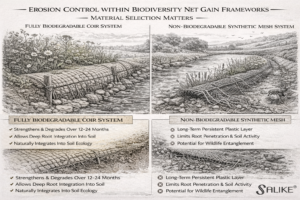
- Root penetration through biodegradable fibre
- Micro-habitat complexity
- Invertebrate colonisation
- Carbon capture within accreted sediment layers
By contrast, persistent synthetic materials may:
- Outlast functional need
- Impede root integration
- Require eventual removal
- Introduce entanglement risk
Material selection is therefore both an engineering and ecological decision.
Application of Salike(R) 700gsm Coir Netting in Coastal Contexts
Structured 700gsm coir netting can be employed effectively above the primary tidal scour line.
Its role is:
- Surface erosion control
- Soil particle retention
- Vegetation anchorage during establishment
In shoreline schemes, it complements rather than replaces toe protection elements. A typical hierarchy may involve:
Toe coir logs → Upper bank netting → Live planting → Natural succession.
It should not be relied upon as sole defence in permanently submerged conditions.
Suitability Compared with Hard Engineering
Hard engineering retains necessity in:
- High wave exposure zones
- Port and quay infrastructure
- Critical flood defence alignments
- Deep-water scour environments
However, in many estuarine settings, rigid systems may:
- Interrupt sediment transport pathways
- Exacerbate adjacent erosion
- Increase embodied carbon
- Provide negligible ecological value
Nature-based fibre systems offer an alternative in appropriate contexts — particularly where resilience, adaptability and environmental integration are design objectives.
The decision is technical, not ideological.
Salike® Position
At Salike®, we do not advocate coir indiscriminately. We advocate correct specification.
Our high-density coir logs and engineered coir netting systems are intended for defined hydraulic envelopes within:
- Estuarine banks
- Managed realignment schemes
- Salt marsh fringe stabilisation
- Low to moderate energy shoreline restoration
Every site requires assessment of:
- Wave climate and fetch
- Tidal range
- Sediment grading
- Shear stress thresholds
- Anchoring methodology
- Vegetation establishment strategy
Shoreline stabilisation is rarely achieved through product selection alone. It is achieved through design integration.
Closing Reflection
Natural shoreline protection is not the absence of engineering; it is the disciplined application of engineering principles to living systems.
When correctly designed and appropriately installed, coir systems:
- Dissipate wave energy
- Capture sediment
- Encourage marsh formation
- Transition structural function to vegetation
- Reduce long-term environmental footprint
In suitable hydraulic conditions, they represent a technically sound and policy-aligned solution for coastal resilience.