Introduction: Biodiversity Net Gain Is Now Statutory — Not Aspirational
Since February 2024, Biodiversity Net Gain (BNG) has become a statutory requirement under the Environment Act 2021 for most developments in England. Developers must now demonstrate a minimum 10% measurable uplift in biodiversity value.
This shift has fundamentally altered how infrastructure, river restoration, highways embankments and land development schemes are designed and specified.
Biodiversity is no longer an enhancement.
It is a compliance obligation.
Within this framework, erosion control systems play a critical enabling role. However, material selection directly influences whether a project genuinely delivers ecological uplift — or inadvertently compromises it.
The Engineering Role of Erosion Control in Habitat Creation
In BNG-aligned schemes, erosion control systems often support:
- Wildflower meadow establishment on embankments
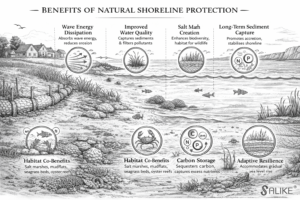
- Riverbank restoration
- Wetland creation
- SuDS basin stabilisation
- Regraded brownfield slopes
These interventions are typically scored using the statutory biodiversity metric. Early vegetation establishment is essential to achieve habitat classification uplift.
Erosion control materials must therefore:
- Stabilise soil during establishment
- Support seed retention and root development
- Degrade in line with vegetation maturity
- Avoid long-term ecological interference
This is not simply about holding soil in place.
It is about enabling habitat formation.
Why Material Choice Directly Affects Biodiversity Outcomes
The biodiversity metric rewards:
- Habitat distinctiveness
- Condition
- Connectivity
- Long-term sustainability
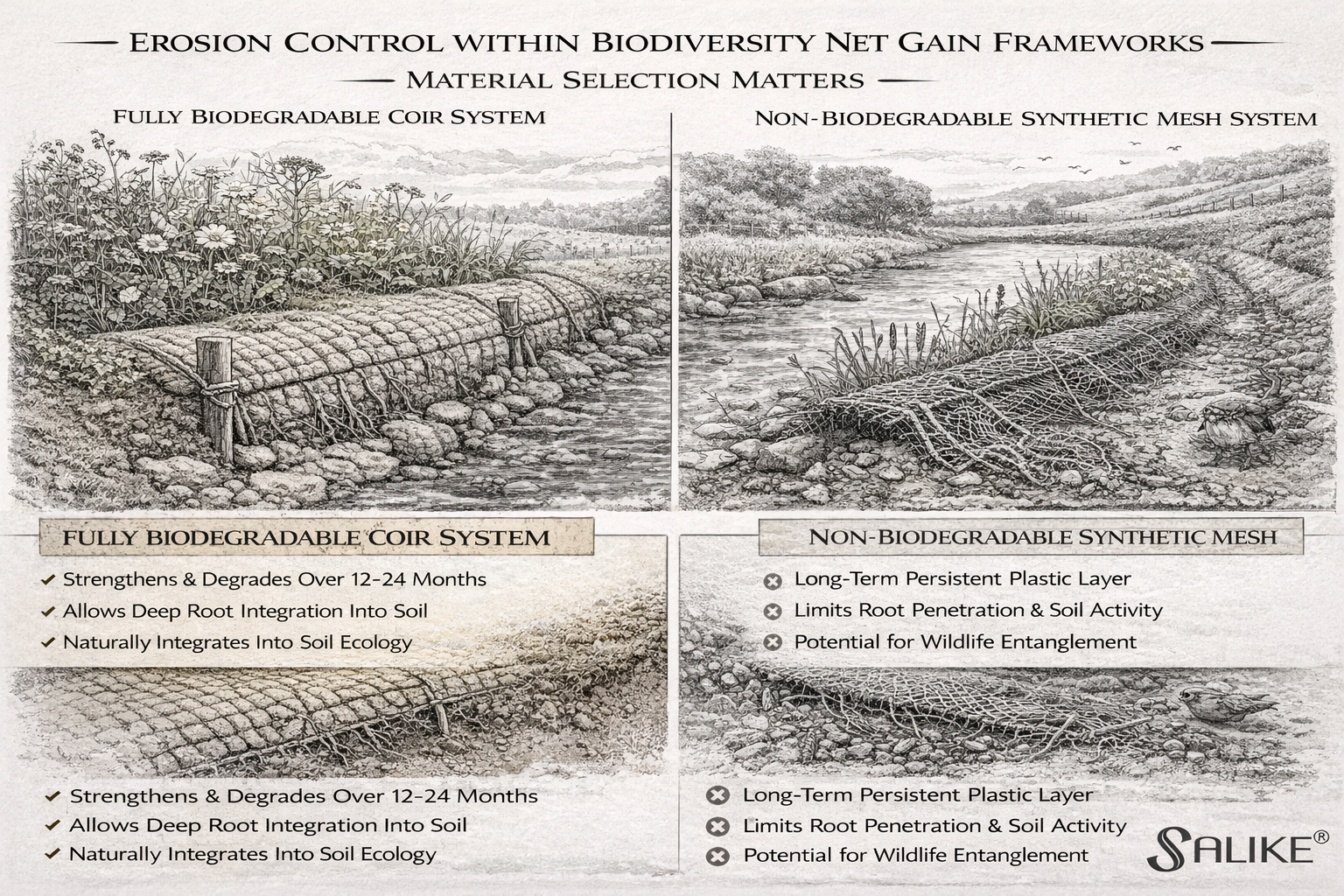
If erosion control materials remain in situ beyond their useful lifespan, they may:
- Inhibit root penetration
- Restrict soil fauna movement
- Alter microhabitat conditions
- Introduce persistent synthetic fibres
In some cases, non-biodegradable systems have required removal prior to habitat maturity — undermining the very uplift they were intended to support.
Within BNG frameworks, materials must align with ecological timeframes.
Engineering performance must transition seamlessly into ecological function.
Synthetic Entanglement Risks and Microplastic Legacy
Synthetic erosion control products, including certain polypropylene and plastic-based geotextiles, can present long-term risks:
- Wildlife entanglement
- Microplastic shedding
- Residual subsurface material persistence
- Interference with soil biota
While synthetic systems can provide high tensile performance, their lifecycle must be considered within biodiversity-led projects.
BNG does not solely measure vegetative cover.
It evaluates ecosystem function and long-term habitat viability.
Material persistence beyond design intent may conflict with ecological objectives.
Fully Biodegradable Erosion Control Systems: Engineering with an Exit Strategy
Fully biodegradable coir-based systems provide a different lifecycle profile.
Properly specified, natural fibre systems:
- Deliver immediate surface stabilisation
- Moderate moisture retention
- Allow root penetration through open weave structures
- Gradually degrade as vegetation establishes
- Integrate into soil organic matter
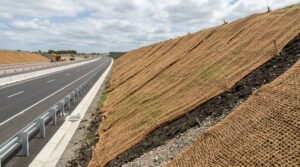
High-performance coir netting, blankets and vegetated logs are engineered to provide structural support during the critical establishment window — typically 12–24 months — before transitioning out of the system.
This aligns with habitat maturation timelines and supports BNG condition targets.
Biodegradability is not a marketing feature.
It is a performance characteristic.
Compliance, Procurement and Specification Considerations
For consultants and contractors operating within BNG frameworks, specification should consider:
- Degradation timeline relative to establishment period
- Interaction with target habitat type
- Compatibility with seed mixes and planting plans
- Absence of persistent synthetic residues
- Long-term soil health implications
Material selection may influence:
- Biodiversity metric scoring
- Planning compliance
- Long-term management obligations
- Public and stakeholder scrutiny
BNG introduces accountability beyond installation.
Materials are now part of ecological legacy.
Salike’s Approach to Biodiversity-Aligned Erosion Control
At Salike, our erosion control systems are engineered with long-term ecological integration in mind.
Our biodegradable product range includes:
- Coir Netting – Open-weave, high-strength natural fibre stabilisation
- Coir Blankets – Surface erosion protection for steep or exposed slopes
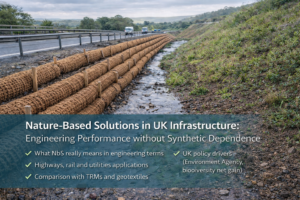
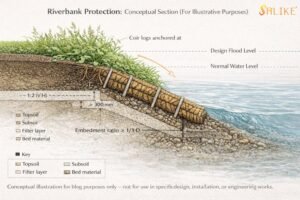
- Coir Logs – Toe protection and bank stabilisation compatible with habitat creation
Each solution is designed to:
- Support early vegetation establishment
- Transition from structural reinforcement to soil integration
- Avoid persistent synthetic residue
- Align with biodiversity-led design principles
(Internal linking can be added here to product category pages for SEO performance.)
Strategic Perspective: Biodiversity and Engineering Are No Longer Separate Disciplines
Under Biodiversity Net Gain legislation, engineering decisions carry ecological consequences.
Material selection within erosion control systems is no longer a purely technical decision. It is a biodiversity decision.
The most successful schemes will be those where structural performance and ecological integration are aligned from the outset.
Because within BNG frameworks, stability alone is not sufficient.
It must be sustainable.