The language of Nature-Based Solutions (NbS) has rapidly entered the vocabulary of UK infrastructure delivery. Yet for engineers, consultants and asset owners, terminology alone is insufficient. What matters is not whether a solution is described as “natural”, but whether it performs — structurally, hydraulically and over its intended design life — while aligning with regulatory and environmental obligations.
Nature-Based Solutions, in engineering terms, are interventions that work with ecological processes to achieve measurable technical outcomes: slope stabilisation, erosion control, hydraulic moderation, sediment retention and habitat enhancement. They are not aesthetic gestures. They are functional systems designed to meet quantifiable performance criteria while supporting long-term environmental recovery.
In the UK context, this alignment has become increasingly relevant. The Environment Act 2021 introduced mandatory Biodiversity Net Gain for qualifying developments, requiring measurable ecological uplift. The Environment Agency’s guidance on working with natural processes in flood and coastal risk management encourages approaches that restore natural function where practicable. Infrastructure delivery must therefore reconcile structural reliability with environmental stewardship.
The question is no longer whether NbS are desirable; it is how they are engineered.
Coir within engineered Nature-Based Systems
Natural fibre systems, when properly specified and installed, provide a practical route to delivering NbS without compromising engineering integrity. Coir — derived from coconut husk fibre — offers tensile strength, durability and moisture retention characteristics suited to temporary reinforcement during critical establishment phases.
Coir netting is widely used for surface erosion control on slopes, embankments and infrastructure corridors. Its open weave stabilises topsoil, reduces runoff velocity and supports vegetation establishment. As root networks develop, the structural role transitions from fibre reinforcement to biological reinforcement. The material degrades naturally once vegetation has assumed load-bearing responsibility.
Coir erosion control blankets provide more robust surface protection where higher exposure or steeper gradients demand enhanced performance. Properly anchored, they protect seedbeds, mitigate surface wash and retain moisture during early growth stages — particularly relevant along highways and rail embankments where slope failure can have operational consequences.
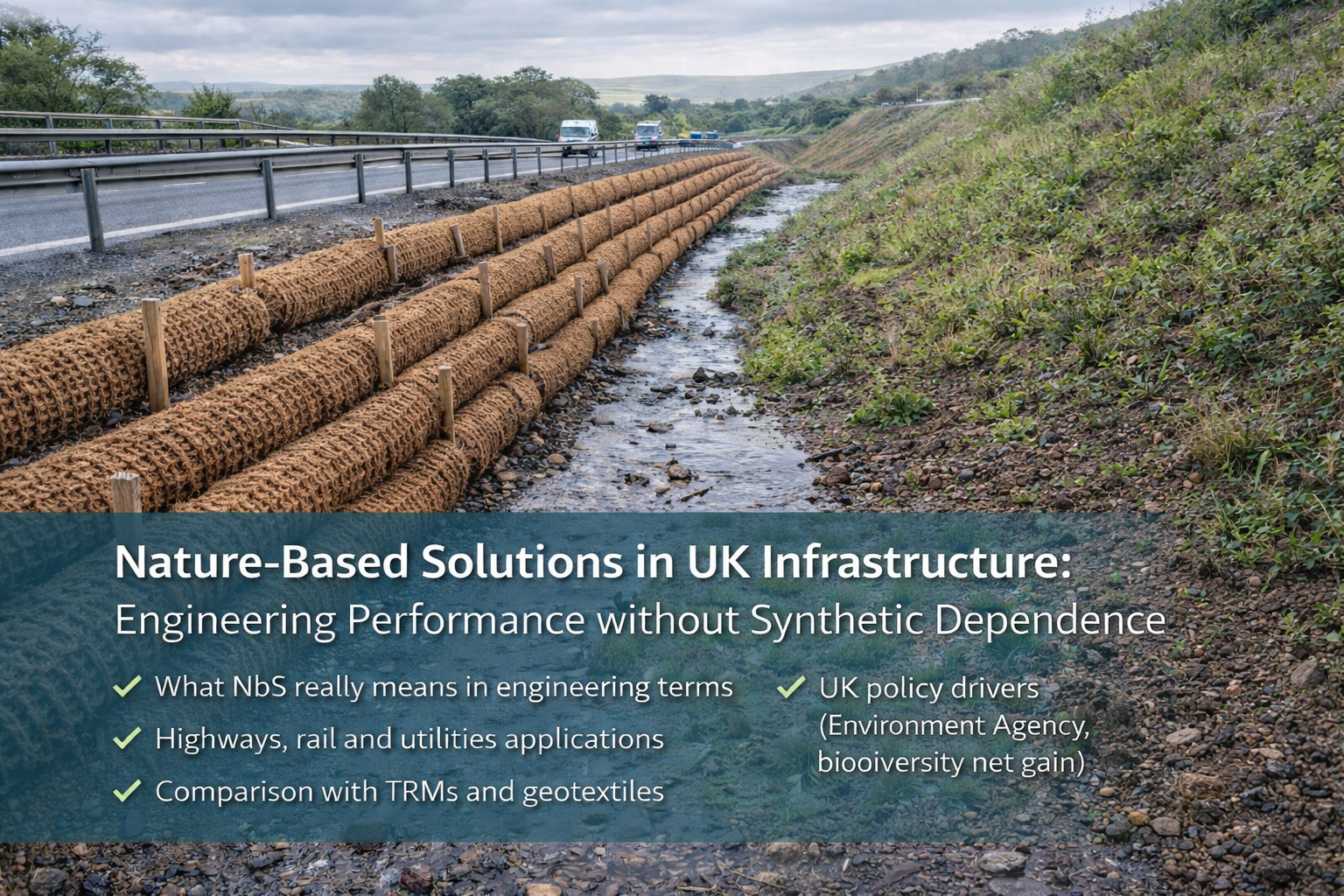
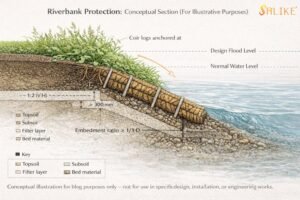
Coir logs serve as linear stabilisation elements in drainage channels, swales, riverbanks and infrastructure outfalls. Installed perpendicular to flow and securely keyed into banks, they slow water velocity, trap sediment and create conditions for vegetation colonisation. In rail and utilities corridors, they provide discreet and biodegradable alternatives to permanent polymer systems.
Coir pallets offer structural support in soft ground and riparian applications. Used to create stable planting platforms or reinforce marginal zones, they distribute load while remaining compatible with ecological restoration objectives.
In each case, the engineering logic remains central: temporary structural assistance during establishment, followed by biological consolidation.
Comparison with synthetic TRMs and geotextiles
Turf Reinforcement Mats (TRMs) and polymer geotextiles are widely deployed across UK infrastructure. They provide consistent tensile properties and long service lives. However, they are typically fossil-derived and designed for permanence.
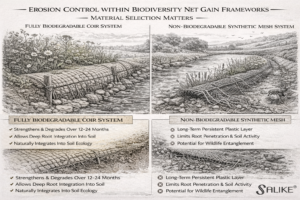
Where long-term synthetic reinforcement is structurally required — for example in high-velocity channels or permanent revetment systems — such materials may remain appropriate. Yet in many surface erosion and vegetation establishment applications, the structural demand is temporary. Once vegetation establishes, the synthetic matrix often becomes redundant, remaining buried within the soil profile.
The distinction is therefore not one of strength alone, but of suitability to the performance duration required. In regenerative or biodiversity-led schemes, biodegradable systems align more closely with ecological intent.
Policy drivers and infrastructure delivery
UK infrastructure operates within an evolving regulatory landscape. The Environment Agency promotes sustainable flood risk management and working with natural processes. Biodiversity Net Gain requirements oblige developers to deliver measurable habitat improvement. Net zero commitments under the Climate Change Act 2008 continue to influence procurement and material selection.
Nature-Based Solutions provide a mechanism through which infrastructure projects can contribute to these policy objectives while maintaining operational resilience. Material choice, therefore, carries both engineering and governance implications.
Engineering without synthetic dependence
At Salike®, we do not advocate the abandonment of engineering rigour in favour of environmental narrative. On the contrary, NbS must be engineered with the same discipline applied to conventional geotechnics: correct specification, adequate fixing, hydraulic consideration and whole-life awareness.
Coir systems, when appropriately deployed, demonstrate that natural materials can satisfy practical infrastructure demands while supporting long-term ecological integration. They are not a symbolic alternative to synthetic systems; they are a technically viable solution where temporary reinforcement and biological transition are appropriate.
As UK infrastructure evolves under climate, biodiversity and carbon accountability frameworks, the role of engineered natural fibre systems will continue to expand. The objective is not to reject synthetic materials outright, but to apply them judiciously — and to recognise where nature, properly engineered, provides a credible and responsible alternative.
In the discipline of modern geotechnics, performance and environmental integrity need not be competing priorities. When carefully specified, they can — and increasingly must — operate together.