Introduction: Moving beyond surface protection
Riverbank stabilisation is often misunderstood as an erosion-control exercise.
In reality, it is a hydraulic engineering challenge governed by force, velocity, scour dynamics and soil mechanics.
Bioengineered solutions — when properly designed — do not merely prevent surface erosion. They integrate structural toe defence, hydraulic energy dissipation and vegetative reinforcement into a single stabilisation system.
The difference between cosmetic greening and engineered resilience lies entirely in design principles.
1. Toe Protection: The foundation of bank stability
The most common cause of riverbank failure is not surface erosion.
It is toe undermining.
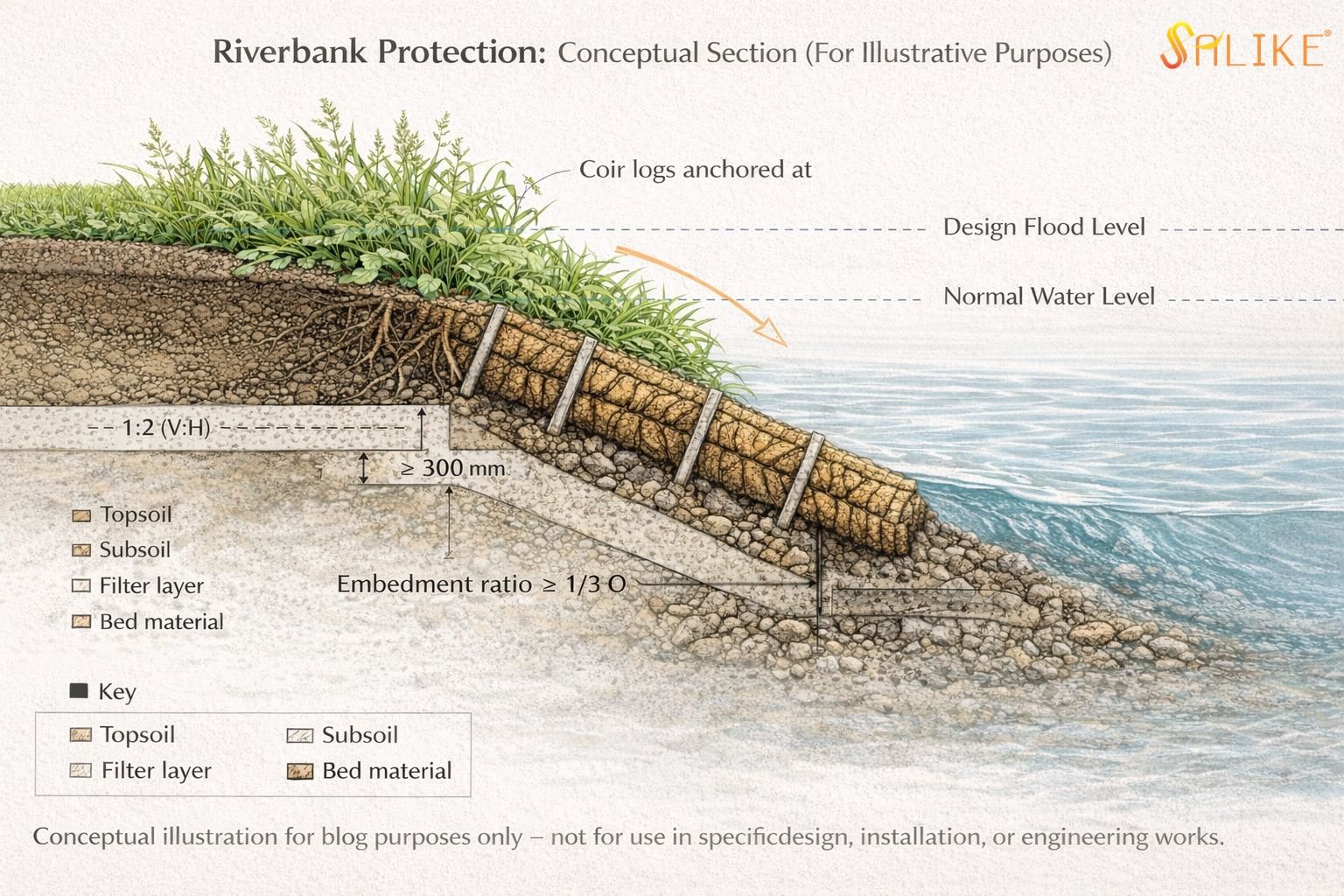
Hydraulic scour at the bank toe progressively removes support from the lower profile. Once the toe is compromised, rotational failure becomes likely — regardless of surface treatment quality.
Effective bioengineered systems prioritise:
- Scour-resistant toe structures
- Proper embedment depth
- Alignment with expected low-flow and high-flow regimes
- Protection against undercutting during peak discharge
Coir logs, vegetated rolls or reinforced toe bundles must not sit on the bank surface; they must be partially embedded and properly keyed into the substrate.
Toe integrity dictates overall bank integrity.
2. Understanding Hydraulic Forces
Riverbanks are subjected to a complex combination of forces:
- Shear stress from flowing water
- Hydrostatic pressure variations
- Turbulence at bends and constrictions
- Uplift during rapid drawdown
- Impact loading from debris
Bioengineered solutions must be designed in response to these forces — not simply applied to the surface.
Critical design considerations include:
- Bank angle
- Channel curvature
- Flood recurrence intervals
- Soil cohesion classification
- Expected seasonal flow variability
Without a hydraulic understanding, vegetation alone cannot provide protection.
3. Flow Velocities and Shear Stress Thresholds
Vegetative systems perform effectively within defined hydraulic limits.
Beyond certain velocity thresholds, unreinforced vegetation will fail.
Typical considerations:
- Low velocity (<1 m/s): Vegetative reinforcement may suffice
- Moderate velocity (1–2 m/s): Integrated toe protection and surface netting required
- Higher velocities (>2 m/s): Enhanced structural reinforcement necessary
Design should be informed by:
- Calculated shear stress
- Channel geometry
- Historic flow data
This ensures that biodegradable components degrade only once vegetation has reached structural maturity.
Engineering alignment between fibre longevity and vegetation establishment is critical.
4. Anchoring Methods: Securing the System
Improper anchorage remains one of the most overlooked failure points.
Even well-designed bioengineered systems fail when anchoring does not account for:
- Uplift forces
- Bank saturation
- Soil type
- Flood velocity acceleration
Anchoring strategies may include:
- Hardwood stakes
- Driven steel pins
- Trench burial at crest and toe
- Overlapping netting systems
- Deadman anchoring in weak soils
Anchor spacing must respond to hydraulic exposure — not generic installation guides.
The system is only as strong as its weakest fixing point.
5. Planting Integration: Structural Reinforcement Through Root Networks
Vegetation is not aesthetic cover.
It is structural reinforcement.
Root matrices increase:
- Soil cohesion
- Resistance to shallow mass movement
- Hydraulic energy dissipation
- Sediment retention
Species selection must align with:
- Bank moisture profile
- Flow tolerance
- Root architecture depth
- Native ecological compatibility
Early establishment — particularly within the first two growing seasons — determines whether the bank transitions from engineered protection to ecological stability.
This is not planting for appearance.
It is planting for load-bearing performance.
Long-Term Stability: Systems Thinking
Bioengineered riverbank protection is not a product selection exercise.
It is an integrated design framework combining:
- Toe structural defence
- Hydraulic analysis
- Flow velocity modelling
- Secure anchorage
- Vegetative reinforcement
When properly designed, the system strengthens over time as vegetation matures and biodegradable components integrate into the soil matrix.
When poorly designed, early scour, uplift or vegetation failure leads to progressive instability.
The distinction lies in engineering foresight.
Strategic Perspective
As UK infrastructure increasingly prioritises nature-based solutions, bioengineered riverbank systems must demonstrate performance equivalence — or superiority — to traditional hard-armour approaches.
That performance is achieved not through greening alone, but through disciplined design principles.
At Salike, our approach to coir-based riverbank systems centres on long-term structural integrity — ensuring hydraulic resilience, controlled degradation timelines and vegetation-led reinforcement that endures.
Because riverbanks are not stabilised by installation.
They are stabilised by engineered integration.