
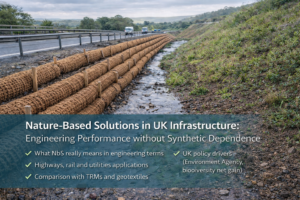
Engineering Performance without Synthetic Dependence
The language of Nature-Based Solutions (NbS) has rapidly entered the vocabulary of UK infrastructure delivery. Yet for engineers, consultants and asset owners, terminology alone is
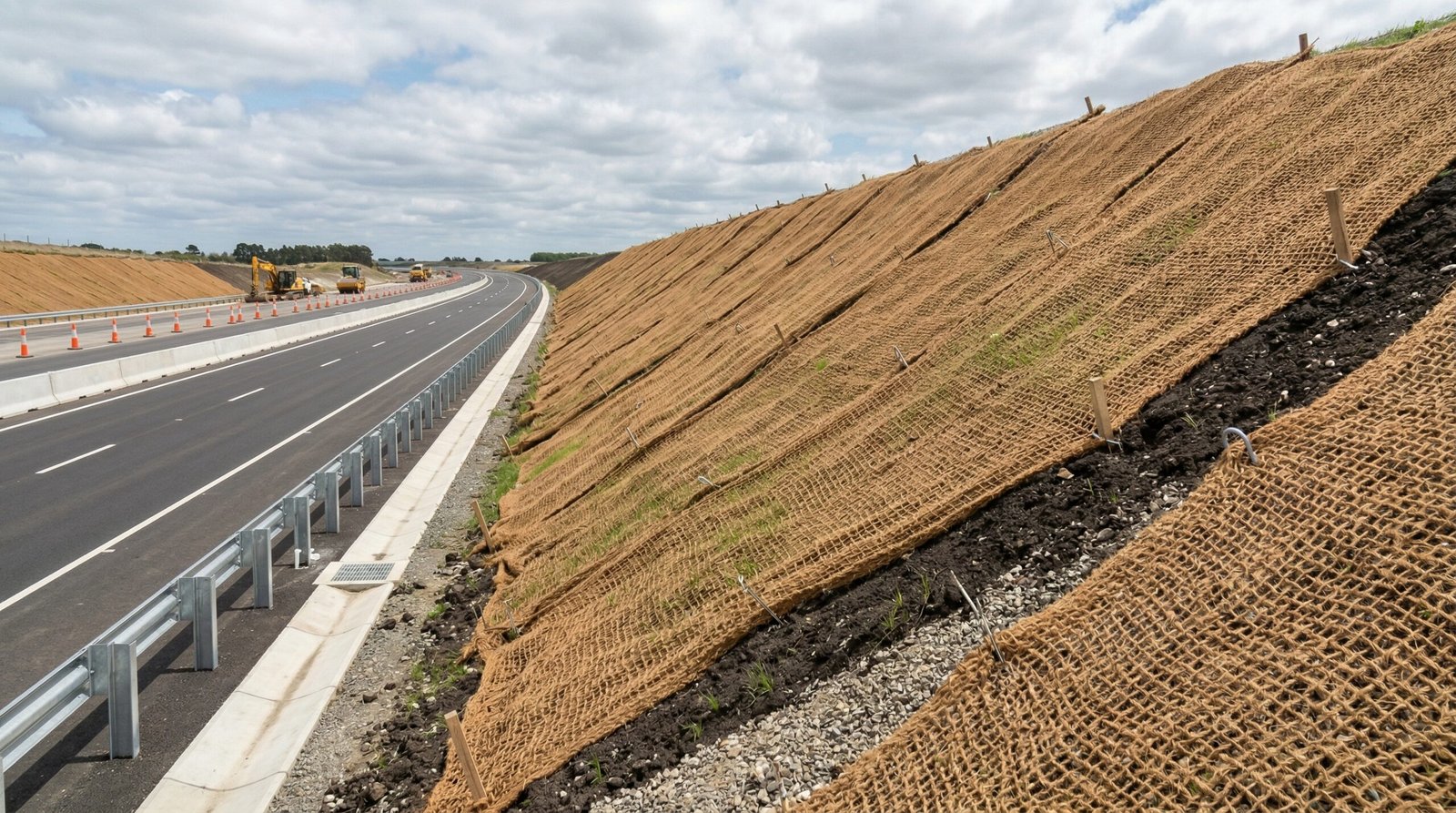
Carbon accountability is no longer confined to operational energy. Within infrastructure and ground engineering, embodied carbon has become a primary determinant of design strategy, procurement evaluation and long-term asset stewardship.
For geotechnical engineers, this shift has tangible implications. Material selection in earthworks — including erosion control systems, slope stabilisation products and temporary reinforcement measures — now contributes directly to reported carbon performance.
At Salike®, we view natural fibre systems not as aesthetic or environmental embellishments, but as proportionate engineering responses within a carbon-constrained delivery environment.
Embodied carbon refers to the greenhouse gas emissions associated with material extraction, processing, manufacture, transport, installation and end-of-life treatment.
“The UK’s commitment to achieving net zero greenhouse gas emissions by 2050 is enshrined in law under the Climate Change Act 2008 (as amended).¹ Public authorities are increasingly required to consider whole-life carbon impacts within procurement and delivery frameworks.
In parallel, the Infrastructure and Projects Authority’s guidance on Transforming Infrastructure Performance has emphasised whole-life value and carbon measurement in major projects.
Geotechnical works — though often perceived as temporary or preparatory — contribute materially to embodied carbon totals through:
Reducing carbon in earthworks is not achieved solely through structural redesign. It is influenced by specification at the material level.
Corporate carbon reporting is increasingly structured around three emission categories:
For infrastructure clients and contractors, Scope 3 emissions frequently represent the largest proportion of total reported carbon. These include emissions embodied within purchased materials and subcontracted works.
As reporting frameworks mature — including alignment with the Greenhouse Gas Protocol and Task Force on Climate-related Financial Disclosures (TCFD) — supply chain emissions are under greater scrutiny.
Erosion control materials and slope stabilisation systems, while individually modest, accumulate across large projects. The specification of polymer-based materials with long manufacturing chains and energy-intensive processing contributes to Scope 3 exposure.
Natural fibre systems offer a materially different lifecycle profile.
Public sector procurement increasingly incorporates carbon weighting within tender evaluation. National Highways, Network Rail and local authorities have embedded sustainability criteria into contractor selection processes.
Carbon reporting trends now include:
The Construction Leadership Council’s Net Zero Carbon Industry Roadmap highlights the necessity of reducing embodied emissions within construction materials.³
In this context, erosion control systems are no longer neutral components. They form part of the carbon ledger.
Specification decisions must consider:
Durability beyond functional need does not equate to sustainability.
Fully biodegradable natural fibre systems — such as coir netting, blankets and logs — differ fundamentally from synthetic geotextiles in lifecycle behaviour.
Properly specified, natural fibre systems:
From a carbon perspective, several advantages arise:
Biodegradation within defined design windows — typically 12 to 24 months for erosion control applications — ensures that the system exits once vegetation assumes structural function.
This represents engineering with a defined exit strategy.
Across the UK infrastructure sector, carbon measurement is moving from high-level aspiration to audited performance data.
Emerging trends include:
As clients seek to reduce Scope 3 exposure, supply chain material selection becomes increasingly consequential.
Materials that persist unnecessarily within the asset lifecycle may be viewed unfavourably where biodegradable alternatives exist and are technically appropriate.
Proportionate engineering is increasingly synonymous with carbon-conscious engineering.
It would be technically unsound to suggest that natural fibre systems replace all synthetic or structural geotechnical products. High-load reinforcement, permanent retaining systems and deep stabilisation works demand engineered materials suited to those loads.
However, many erosion control and surface stabilisation applications are transitional by design.
Where the engineering objective is to:
— specifying materials that persist for decades may exceed functional requirement.
In such circumstances, natural fibre systems provide sufficient performance without long-term material burden.
At Salike®, our approach to erosion control and slope stabilisation reflects three principles:
Our biodegradable range — including coir netting, coir blankets and coir logs — is engineered to provide:
We do not advocate natural fibre indiscriminately. We advocate specification aligned with engineering need and lifecycle accountability.
Within carbon-reporting environments, materials are no longer invisible.
They are recorded.
Reducing embodied carbon in geotechnical projects does not depend solely upon structural innovation. It depends upon disciplined material selection.
Scope 3 emissions now dominate infrastructure carbon reporting. Procurement frameworks increasingly weight carbon performance. End-of-life persistence carries both environmental and reputational implications.
Natural fibre systems, correctly specified within their design limits, offer a proportionate means of reducing long-term embodied impact in transitional geotechnical applications.
In a carbon-accountable construction sector, sustainability is not achieved through rhetoric. It is achieved through specification.
The language of Nature-Based Solutions (NbS) has rapidly entered the vocabulary of UK infrastructure delivery. Yet for engineers, consultants and asset owners, terminology alone is
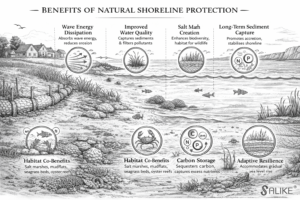
Coastal resilience in the United Kingdom is entering a more technically nuanced phase. The question is no longer whether a shoreline should be defended, but
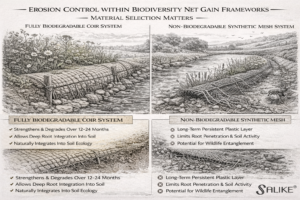
Introduction: Biodiversity Net Gain Is Now Statutory — Not Aspirational Since February 2024, Biodiversity Net Gain (BNG) has become a statutory requirement under the Environment
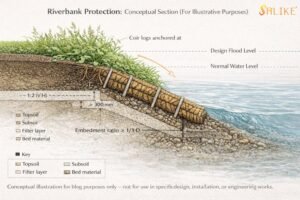
Introduction: Moving beyond surface protection Riverbank stabilisation is often misunderstood as an erosion-control exercise. In reality, it is a hydraulic engineering challenge governed by force,